

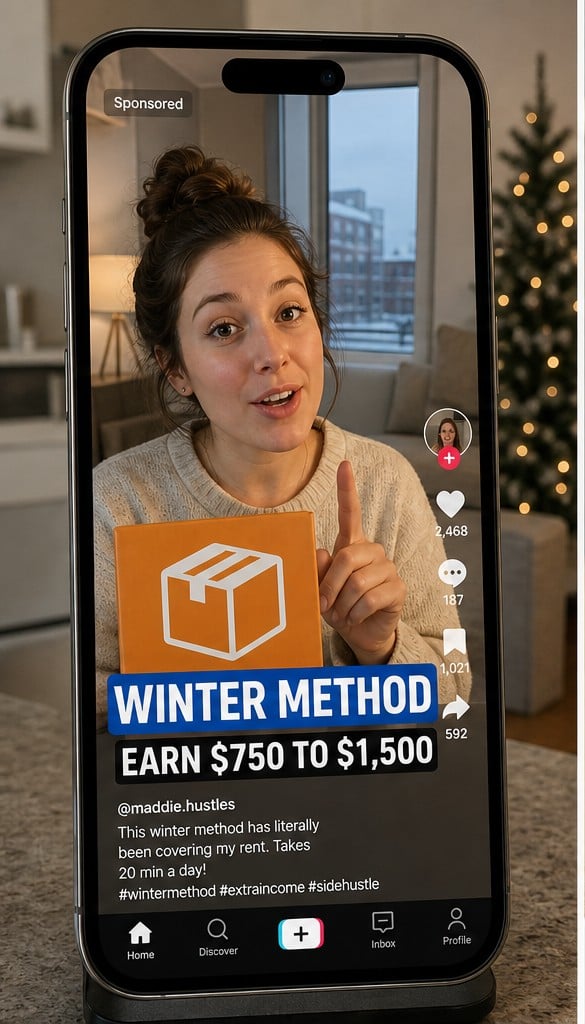
A cheerful TikTok video appears just as winter expenses begin to pile up. The creator says a little-known Amazon program can provide $750, sometimes even $1,500, for completing a few simple steps.
The promise sounds specific enough to be real and ordinary enough to share with a friend. Yet the button does not open a hidden Amazon benefit. It opens a commercial reward funnel whose real conditions emerge only after the visitor has clicked, registered, and started handing over valuable information.
Overview
The seasonal story borrows Amazon's credibility
The Amazon Winter Method scam is promoted as a seasonal assistance program, shopping loophole, or side-income technique. Videos may say it can cover rent, holiday debt, or household bills, giving the offer an emotional purpose beyond an ordinary prize.
Amazon's name is the trust anchor, but the campaign pages reported with this story have used unrelated reward domains and rotating labels. A retailer logo, package, or familiar orange color does not establish ownership. The address bar and legal terms identify the operator.
A short eligibility check hides a deal-based reward program
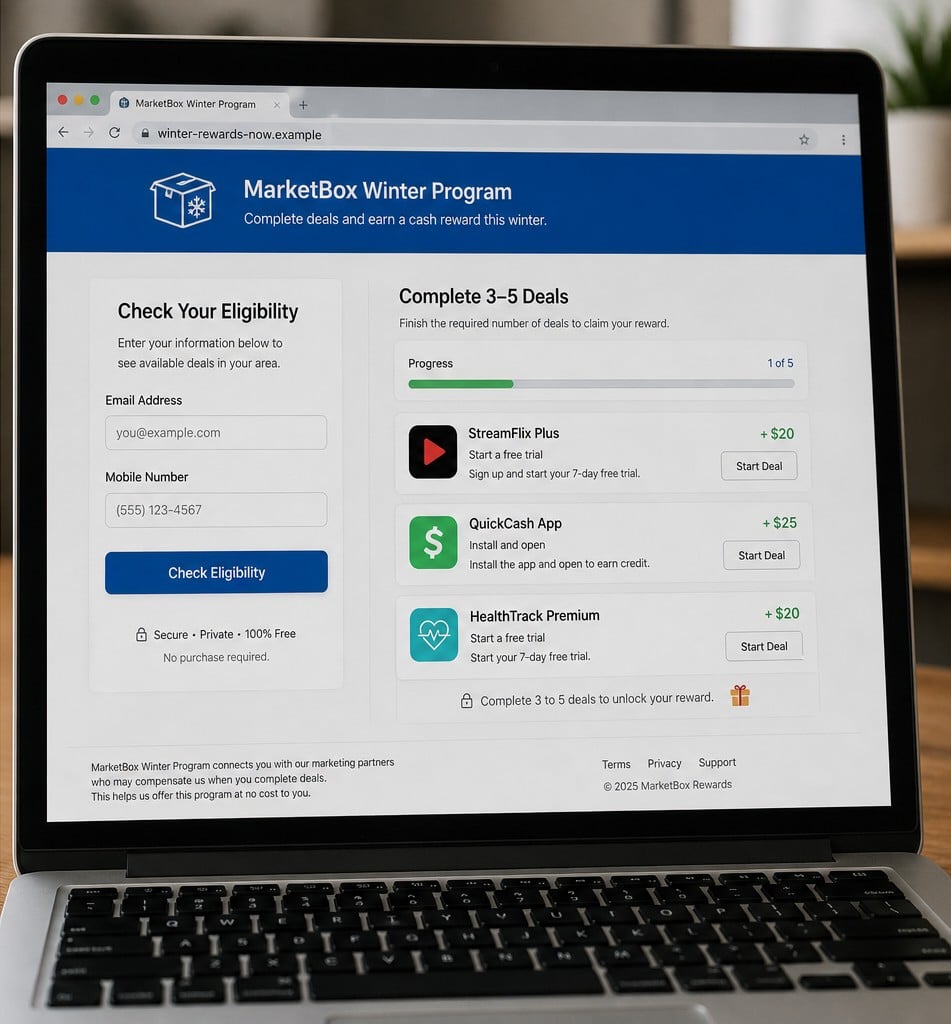
The first page may ask whether the visitor is over 18, lives in the United States, or shops online. Nearly everyone is moved forward. The apparent approval creates momentum before the page explains that several third-party offers must be completed.
Those offers can include app downloads, paid services, purchases, or free trials that renew. The visitor did not discover a cash benefit inside Amazon. The visitor entered an affiliate system in which registrations and completed deals can generate revenue for other parties.
The funnel can profit without delivering the headline amount
A lead has value as soon as contact details and consent are collected. The affiliate may also receive credit when the visitor starts an offer. Meanwhile, the participant carries the cost of subscriptions, tracking failures, deadlines, identity checks, and possible disqualification.
That distinction explains why some pages include formal reward terms while the social claim remains misleading. A difficult promotional reward is not the easy Amazon payment shown in the video, and the existence of rules does not turn an unrelated campaign into an official retailer program.
- TikTok videos promise $750 to $1,500 through a secret winter program.
- The link leaves Amazon and passes through affiliate tracking domains.
- Easy questions make the visitor feel selected or pre-approved.
- Registration collects contact data and broad marketing consent.
- Multiple third-party deals replace the promised quick payout.
- Trials can renew and each merchant may require separate cancellation.
- The same reward system can return under another season or retailer name.
What a Real Amazon Reward Looks Like
Amazon does operate genuine reward programs, but their structure helps expose this story. The Amazon Shopper Panel, for example, is invitation-only and uses an official Amazon service. Its published description says eligible participants can share receipts or answer surveys, with amounts shown inside the program.
That is very different from a public TikTok claim promising four figures to almost anyone. A real offer should be visible through an Amazon-owned domain, an official app, or an authenticated account. It should clearly state the reward, eligibility, privacy rules, and action required before collecting payment details.
Scammers benefit from mixing a trace of truth with an invented opportunity. Viewers may remember that Amazon has surveys, shopper programs, gift cards, and seasonal promotions. The video combines those real concepts into a new program that Amazon has not announced.
The safest verification method is independent navigation. Close the social link, open Amazon directly, and search the account, help center, or verified channels for the exact phrase Winter Method. If the only evidence comes from affiliates repeating one another, the promised connection has not been established.
Do not let a padlock icon settle the question. HTTPS protects data while it travels to a website. It does not prove that Amazon owns the site, approves the offer, or will issue the reward. A secure connection can deliver personal information safely to the wrong business.
Domains, Deal Walls, and the Missing Amazon Connection
Versions of the campaign have been associated with names such as WinterOffer2025, Up Level Rewards, and Reward4Spot. The changing addresses matter because none is an Amazon retail domain. The route points away from the company invoked in the social post and toward a lead-generation ecosystem.
The page can claim that a participant needs only three to five deals, while the complete terms may divide rewards into levels or impose additional requirements. A deal that appears free can still require a card, a subscription, an app account, or continued service beyond a short trial period.
Tracking creates another layer of uncertainty. A participant may complete an offer but fail to receive credit because cookies were blocked, the device changed, an account was considered ineligible, or the merchant did not report completion in time. The burden of proving each step remains with the participant.
The FTC's broader prize guidance offers a useful rule: a real prize is free, and a demand to pay to receive a prize is a scam warning. Deal-based reward programs may describe purchases as qualifications rather than fees, but a social ad that promises effortless cash while hiding mandatory spending deserves the same skepticism.
No single missing logo proves criminal conduct, and not every affiliate reward platform is identical. The evidence supports a narrower conclusion: the Winter Method promotion misrepresents an unrelated, conditional marketing funnel as a simple Amazon benefit. That is enough reason not to register or pay.
How the Amazon Winter Method Scam Works
Step 1: A seasonal TikTok video promises financial breathing room
The campaign begins with a vertical video that looks like ordinary personal advice. A creator points to an Amazon package, winter graphic, or earnings caption and says the method covered rent or produced $750 to $1,500 with only a few minutes of work.
The seasonal label creates urgency without using a traditional countdown. Viewers assume the opportunity will disappear when winter ends, so they are less likely to stop and verify whether Amazon has ever named such a program.
Step 2: The profile link passes through tracking pages
The viewer taps a bio link, shortened address, or Learn More button. Several redirects may record the campaign, device, location, and referring creator before a reward page loads. That transition is easy to miss inside an in-app browser.
Follow the ownership, not the visual theme. If the final domain is not controlled by Amazon, the visitor has left Amazon before answering the first question, no matter how many packages and shopping icons remain on screen.
Step 3: Easy questions create a false sense of qualification
The landing page asks simple questions that rarely disqualify anyone. It may congratulate the visitor, display a progress bar, or say a reward has been reserved. These messages make a general advertising lead feel like a personally approved claim.
The questions do not establish employment, Amazon membership benefits, or a cash entitlement. Their practical purpose is to keep the visitor moving toward registration and to collect details that can help advertisers categorize the lead.
Step 4: Registration turns the visitor into a marketable lead
The next screen requests a name, email, mobile number, address, birth date, or demographic information. Small consent language may authorize marketing messages from the operator and numerous partners.
This can be the first successful conversion for the campaign. The advertiser has obtained data and permission even if the participant never finishes the reward. Calls, texts, and emails can continue after the Winter Method page disappears.
Step 5: The simple method becomes a wall of third-party deals
The promised payment is now conditional on completing offers. Early deals may involve free apps, while later ones can require purchases, subscriptions, deposits, or services that have nothing to do with Amazon. Some levels may remain hidden until earlier selections are completed.
This structure makes the full cost difficult to calculate at the beginning. Sunk-cost pressure grows with every completed deal, encouraging the participant to spend again rather than abandon the time and money already invested.
Step 6: Trial subscriptions create charges outside the reward site
A low introductory price may renew after several days or weeks. Every merchant has its own billing descriptor, support department, cancellation method, and refund policy. Cancelling the reward account does not necessarily cancel those contracts.
The participant may therefore receive several unfamiliar charges instead of one obvious Winter Method bill. By the time the pattern is recognized, the social account or landing domain may have changed.
Step 7: Verification and tracking make the reward hard to claim
After completing deals, users may face identity verification, proof-of-completion requests, household limits, deadlines, and tracking delays. One uncredited offer can stop progress, while support may send standardized instructions back to the same merchants.
Whether a small number of users eventually qualify does not validate the TikTok story. The ad promised an Amazon method, but the actual journey was an affiliate contract with costs and conditions that Amazon did not present.
Company, Address, and Fulfillment Checks
The Amazon name is advertising bait, not proof of sponsorship
The social creative may feature boxes, an app screen, or the word Amazon, while the terms name a reward operator or marketing company. The creator, affiliate network, reward administrator, and deal merchants can all be different entities.
Read the legal name beside the registration button and compare it with the privacy policy, terms, receipt, and card statement. If Amazon is absent from that chain, the campaign cannot borrow Amazon's accountability merely by displaying its brand.
A domain privacy address is not a company headquarters
Reward domains may hide public registration details through privacy services, use a virtual mailbox, or provide only a generic contact form. Those arrangements are not automatically unlawful, but they make accountability weaker when the page is collecting sensitive information.
A legitimate operator should still disclose a legal entity and a usable dispute route in its own policies. A registrar address or fulfillment mailbox cannot explain who bought the lead, validated the deals, or authorized the advertised Amazon claim.
Support often fragments when money starts leaving
The reward desk may handle tracking but not subscriptions. Each merchant may handle only its own trial. The social creator may disappear, and Amazon support cannot cancel purchases made with unrelated companies.
Call or message support before paying and ask for the complete deal count, total possible cost, renewal schedule, tracking rules, and exact reward issuer. If those answers cannot be provided clearly before registration, the system is not transparent enough to trust.
Digital fulfillment can be as opaque as a fake warehouse
There is no physical supplement here, but there is a supply chain: an affiliate supplies traffic, a platform captures the lead, partners supply deals, merchants collect payments, and an administrator decides whether a reward qualifies.
Map each role before proceeding. When the ad, contract, data collector, biller, and reward issuer use different names, a consumer can be passed between companies while deadlines and renewal dates continue to run.
Warning Signs to Watch For
- A secret Amazon program appears only in social media videos.
- The claimed reward is unusually large for a few minutes of effort.
- The link opens an unrelated domain instead of Amazon.
- Almost every answer leads to a congratulations screen.
- Contact details are collected before all conditions are displayed.
- Third-party trials and purchases replace the simple payout.
- The operator, reward issuer, and billing merchants use different names.
- Support cannot show a clear total cost or cancellation map.
The decisive warning is the handoff from a familiar Amazon story to an unrelated deal wall. Stop at that transition. No number of boxes, shopping icons, or excited comments can turn a third-party domain into an Amazon benefit.
What to Do if You Have Fallen Victim to This Scam
- Stop the deal sequence and list every offer you opened. Do not complete another trial because a progress bar says the reward is close. Search your email and browser history for every app, subscription, survey, purchase, and financial offer opened through the Winter Method page. Record the merchant, date, price, and renewal deadline for each one.
- Cancel each trial with the company that actually bills it. The reward operator usually cannot cancel subscriptions created with separate merchants. Use the cancellation route in each receipt or official merchant account, state that you reject future billing, and save the confirmation page. If support does not respond, keep copies of every attempt.
- Call the card issuer from a trusted number. Use the number printed on the card or shown in the bank's official app. Explain which charges you knowingly authorized to pursue the reward and which renewals were unexpected. Ask about disputes, merchant blocks, recurring payment tokens, and whether replacing the card is appropriate.
- Secure the email and shopping accounts involved. Change any password entered on the reward site, especially if it was reused for Amazon or email. Review account sessions, delivery addresses, payment methods, and forwarding rules, then enable multi-factor authentication wherever it is available.
- Preserve the complete path before it changes. Save the TikTok video, profile, Winter Method wording, redirect addresses, registration form, consent text, deal wall, receipts, cancellation requests, and card descriptors. A screenshot of the first promise is useful, but the hidden conditions and billing trail are what explain the loss.
- Remove downloads and scan the device. Uninstall apps or browser extensions installed only to satisfy a deal, revoke suspicious notification permissions, and delete unknown configuration profiles. Run a full Malwarebytes scan if a redirect, download, or extension may have introduced malicious or potentially unwanted software.
- Reduce repeat exposure to the advertising network. AdGuard can block many malicious ad domains, pop-ups, and tracking redirects used to circulate reward funnels. It cannot confirm that a promotion is genuine, so continue verifying Amazon offers inside the official app or on Amazon-owned domains.
- Monitor personal data and financial activity. Watch statements, email, texts, and credit reports for unfamiliar activity. If the form collected a Social Security number, government ID, or enough data for identity theft, follow the personalized recovery plan at IdentityTheft.gov and consider a fraud alert or credit freeze.
- Report the campaign and reject recovery offers. Report the sponsored post to the platform, notify Amazon about the impersonation, and submit the redirect chain and billing details at ReportFraud.ftc.gov. Ignore anyone who later promises to unlock the reward or recover charges for another fee.
Frequently Asked Questions
Is the Amazon Winter Method a real Amazon program?
No official Amazon program matching the viral $750 to $1,500 Winter Method claim has been established. Genuine programs should be verifiable through Amazon-owned services, not only through a creator's external link.
Does Amazon ever pay people to answer surveys?
Amazon has legitimate programs such as the invitation-only Amazon Shopper Panel, where available rewards and eligibility appear through official channels. That does not authenticate a public TikTok funnel using Amazon's name.
Can someone receive a reward after completing the deals?
A conditional reward platform may pay some users who satisfy every rule. That possibility does not make the social sponsorship claim true or remove the costs, tracking risks, subscriptions, and data-sharing conditions.
Why does the page ask for a phone number?
The number can be used to verify a lead and, depending on the consent language, authorize marketing calls or texts. Read the disclosure before submitting it and do not assume Amazon will receive the information.
Will cancelling the reward site stop every charge?
Usually not. Apps, memberships, and trials can create separate agreements with separate merchants. Cancel each one directly and keep written confirmation.
What if I used my Amazon password on the page?
Change it immediately through Amazon's official app or website, review orders and account sessions, secure the linked email, enable multi-factor authentication, and contact Amazon if you see unfamiliar activity.
The Bottom Line
The Amazon Winter Method scam turns a seasonal promise into a long commercial funnel. What begins as $750 to $1,500 for a few easy steps can become data collection, paid deals, renewable trials, tracking disputes, and identity checks.
Verify Amazon offers from inside Amazon, not from the branding on an outside page. If the reward becomes more complicated only after registration, close the funnel before your contact details and card become the real payout.

Join the discussion
0 commentsShare your experience or ask a question about this article.
Discussion
Start the conversation
Have a question or something useful to share? Add the first comment.