

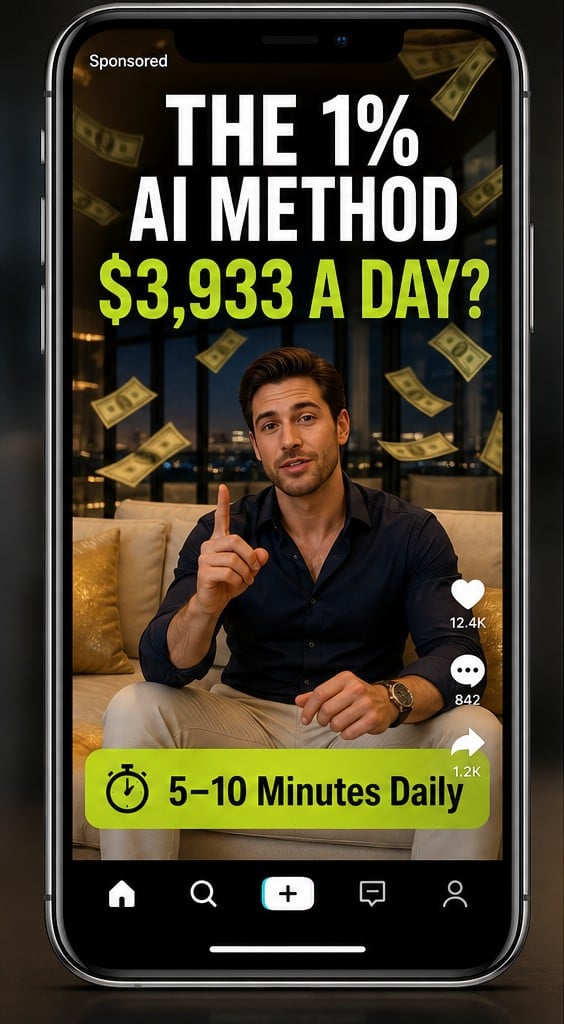
The video makes artificial intelligence look like a switch. Turn on a private app, spend 5 to 10 minutes a day, and an automated system supposedly produces $3,933 before the viewer has finished breakfast.
The claim is enormous, but the requested first payment is deliberately modest. That contrast is the engine of the pitch. A small activation fee feels rational only while the dashboard and falling-cash video are mistaken for evidence.
Overview
The campaign sells certainty through the language of AI
The 1% AI App scam, sometimes written as 1PercentAI or even 1 Persent AI, claims that a hidden automated engine finds buyers, generates commissions, or exploits a small advantage unavailable to the other 99%.
AI is useful to the story because it sounds complex enough to explain impossible performance. Viewers are encouraged to believe they do not need to understand the business model because the software performs the difficult work.
A polished dashboard replaces verifiable income records
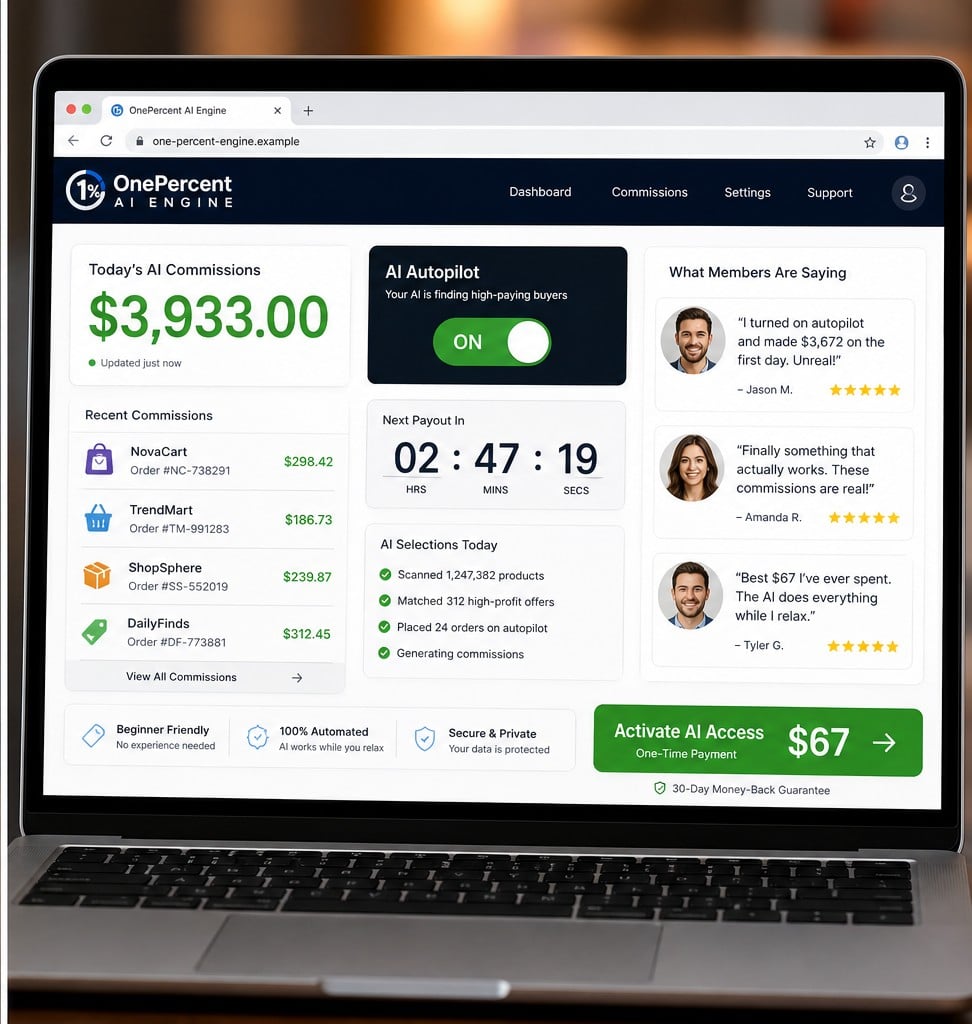
The sales page may show commissions, orders, countdowns, member testimonials, and an autopilot control. None of those interface elements prove that a customer bought something, that a merchant paid a commission, or that the viewer can withdraw the displayed amount.
The operator controls the page and can populate identical results for every visitor. Independent proof would require named platforms, transaction records, real expenses, refund rates, and typical-user results, not a simulated account shown before purchase.
The real transaction is access, followed by possible upsells
A price such as $67 is presented as the final step before activation. The buyer may then encounter order bumps, premium tools, coaching, traffic packages, or memberships. Each new offer is justified as the missing component needed to reach the original claim.
The seller receives real money immediately. The purchaser receives information or software whose ability to produce the advertised daily income has not been independently demonstrated. A money-back guarantee is useful only if the seller is identifiable and honors it.
- Social videos promise up to $3,933 a day from an AI method.
- The claimed workload is only 5 to 10 minutes daily.
- A dramatic dashboard shows commissions before the user buys access.
- Testimonials and lifestyle images substitute for audited results.
- A small activation price makes the enormous promise feel attainable.
- Upsells can turn the first purchase into a much larger expense.
- Disclaimers may describe fictional scenarios or non-typical outcomes.
AI Does Not Remove the Economics of Earning Money
A genuine online business must create value for a customer. It needs a product or service, a source of traffic, conversion costs, refunds, taxes, competition, and continuing work. Artificial intelligence can automate tasks, but it cannot make those business fundamentals disappear.
A claim of $3,933 every day would exceed $1.4 million a year. If an app produced that result reliably for a one-time $67 payment, the seller would have little economic reason to distribute it broadly through social ads. The mismatch between price and promised output is itself a warning.
The SEC and other regulators warn that promoters use AI buzzwords to market unrealistic systems and that guarantees of amazing returns with little or no risk are classic fraud signs. Not every income app is an investment, but the same logic applies to unsupported automated-profit claims.
Real performance evidence includes the number of customers, typical net results, costs, failure rate, timeframe, and method used to verify claims. A handful of screenshots and testimonials cannot show what the average buyer earns after advertising, subscriptions, chargebacks, and taxes.
The safest question is simple: where does each $1 of commission come from? If the answer remains vague, changes between affiliate sales and AI trading, or depends on recruiting more buyers into the same system, do not let the interface distract from the missing business.
What the Ad and Disclaimer Say When Read Together
Campaign versions have used claims such as $250,000, $3,933 a day, and $40,000 to $80,000 a month on autopilot. They also emphasize that a user needs only a phone or computer and a few minutes, removing the normal relationship between time, skill, capital, and output.
The landing page can feature a presenter on a couch while cash falls around him, followed by an animated dashboard. This is a staged sales narrative. A visual demonstration is not an audited live account, and the viewer cannot inspect the underlying transactions.
Small-print disclosures are crucial. Some sales pages say actors are used, scenarios are fictional, or income examples are not representative. Those qualifications directly weaken the certainty created by the main video and should be read before any card information is entered.
The purchase may be processed through an established marketplace. That can provide order records and a refund channel, but it does not test the algorithm, verify commissions, or endorse the marketing. The legal seller remains responsible for substantiating its claims.
Even if the member area contains lessons or tools, the central question remains whether the advertising accurately described typical results. Delivering generic affiliate instructions does not prove that an AI app produced thousands a day for beginners.
How the 1% AI App Scam Works
Step 1: A social video makes AI look like a private money switch
The advertisement shows cash, a comfortable home, luxury items, or a presenter claiming that ordinary people are finally allowed into the profitable 1%. Captions promise $3,933 a day with 5 to 10 minutes of work.
The figure is precise enough to sound measured, even though no calculation is shown. Specific numbers often feel more credible than round promises, but precision in a caption is not evidence of performance.
Step 2: A long presentation explains away normal skepticism
The sales video says previous methods failed because they lacked advanced AI, special data, or a newly opened loophole. It may claim that banks, employers, or established marketers want the system hidden.
That story converts missing transparency into proof of exclusivity. Instead of naming the revenue source and showing audited records, the presenter asks the viewer to trust that secrecy protects an advantage.
Step 3: A simulated dashboard displays instant commissions
The page shows recent orders, buyer names, countdowns, and a balance such as $3,933. A toggle marked AI Autopilot suggests the software has already performed profitable work for the visitor.
No independent account has been connected. The numbers can be hard-coded demonstrations. Until funds are traceable to real transactions and withdrawable under a contract, the dashboard is an advertisement.
Step 4: Testimonials turn examples into expected outcomes
Cards show smiling members saying they made thousands on the first day or finally found a system that works. The ad may not explain whether they are customers, paid actors, affiliates, fictional profiles, or unusual cases.
Look for substantiation, dates, net results, and typical-user data. A five-star quote selected by the seller cannot establish what new buyers usually earn or how many receive refunds.
Step 5: A small activation fee captures the first payment
The checkout frames $67 as negligible beside the daily claim and may use a countdown or limited-license warning. The guarantee reduces fear, while payment logos provide visual legitimacy.
The processor may be real, but the income claim remains the seller's responsibility. Read the legal entity, renewal terms, refund window, and support route before authorizing any transaction.
Step 6: Upsells redefine what complete access means
After the initial order, the buyer can be offered premium traffic, advanced automation, personal coaching, higher commissions, or a members-only tier. Declining may trigger warnings that the basic system will be slower or incomplete.
This is how a $67 decision can grow into hundreds or thousands. Each purchase is presented as protecting the previous one, even though none independently proves the original daily-income claim.
Step 7: Refund friction and rotating names extend the campaign
Support may encourage the buyer to finish more lessons or wait for results before honoring a refund. Separate order bumps can have separate policies, and card statements may use a name absent from the advertisement.
When complaints accumulate, the seller or affiliates can change the app name, earnings number, presenter, and domain. Remember the story pattern: AI secrecy, impossible passive income, simulated dashboard, low entry price, and escalating upgrades.
Company, Address, and Fulfillment Checks
The brand name may hide the legal seller
A name such as 1% AI sounds like a technology company, but the checkout and terms may identify a marketer, course publisher, or marketplace vendor. Search the legal entity and compare it with the receipt and card descriptor.
An accountable seller should explain who owns the software, where the company is registered, and what product produces the commissions. A catchy app name cannot replace those details.
A virtual address cannot prove a working AI business
Online sellers may use registered agents, virtual offices, domain privacy services, or fulfillment mailboxes. Those tools are common, but they do not demonstrate a development team, operating history, financial license, or support organization.
Search the listed address and phone number. If they belong to a mailbox, unrelated company, or generic answering service, do not treat them as proof that a high-performing AI platform exists behind the sales page.
Silent support makes a guarantee nearly worthless
A refund promise depends on a reachable seller that follows a clear policy. Before purchasing, contact support and ask for the legal entity, recurring price, refund method, software documentation, typical results, and source of commissions.
No reply, copied answers, or pressure to buy first is a strong warning. After payment, keep every ticket and timestamp because the bank may need proof that the seller failed to honor the advertised terms.
Digital fulfillment must match the income claim
A login, PDF, or collection of videos can satisfy a narrow delivery record while leaving the central promise unsupported. Generic affiliate training is not the same as an AI engine proven to create $3,933 daily commissions.
Trace the advertiser, legal seller, software owner, data provider, checkout processor, and payment source. If the chain ends with new buyers paying for access, rather than outside customers purchasing real value, the claimed automation has not been explained.
Warning Signs to Watch For
- The app promises up to $3,933 a day with almost no work.
- AI is used as an explanation instead of a documented business model.
- A dashboard shows commissions before any real account is connected.
- Testimonials lack verifiable identities and typical-user results.
- A $67 price is compared with life-changing daily income.
- Order bumps and upgrades appear after the first payment.
- Small print describes fictional scenarios or results that vary.
- Support cannot explain where commissions originate.
The most important red flag is the unexplained money. An AI label can automate a task, but it cannot create buyers, commissions, or profits from nowhere. If the seller cannot trace the revenue, the dashboard is decoration.
What to Do if You Have Fallen Victim to This Scam
- Turn off the supposed AI system and stop sending money. Do not deposit more, buy an upgrade, or pay a release fee because an earnings panel shows a pending payout. A dashboard controlled by the seller can display any number. Save it as evidence and end the session.
- Cancel the purchase and every continuity agreement. Use the support information on the exact receipt and state that you reject future billing, upgrades, coaching, and data access. Request a refund under the stated guarantee and save confirmation. If a marketplace processed the order, open a case through its official portal.
- Contact the bank with the advertising details. Tell the issuer that the purchase followed claims of thousands in daily automated income from a few minutes of work. Identify the initial charge, order bumps, upsells, and unexpected renewals. Ask about disputes, merchant-token blocks, and card replacement.
- Secure financial, email, and shopping accounts. Change passwords entered on the site, especially if they were reused. Revoke unknown app connections and API access, review email forwarding rules, and enable multi-factor authentication. If bank or brokerage credentials were shared, contact those institutions immediately.
- Preserve the ad, disclaimers, dashboard, and checkout. Save the video, account name, daily-income promise, destination domain, sales presentation, small-print disclaimer, testimonials, dashboard, checkout, guarantee, receipt, and support exchanges. Capture the contrast between the large claim and the qualifying language.
- Remove software and run a security check. Uninstall unknown AI tools, browser extensions, trading programs, remote-access apps, or mobile profiles introduced by the funnel. Use Malwarebytes for a complete scan if anything was downloaded or the device began behaving abnormally.
- Block repeat ads and malicious redirects. AdGuard can reduce exposure to scam advertisements, pop-ups, and tracking infrastructure used to retarget previous visitors. It does not evaluate investment performance or business claims, so treat it as a security layer rather than a due-diligence service.
- Monitor identity and money movement. Review cards, bank accounts, payment apps, credit reports, and email for follow-up charges or takeover attempts. If identity documents or a Social Security number were submitted, use IdentityTheft.gov and consider a credit freeze.
- Report the system and avoid recovery pitches. Report the social ad, notify the checkout marketplace, and submit the evidence at ReportFraud.ftc.gov. If the pitch involved investments or securities, report it to the SEC or state regulator. Ignore anyone demanding a fee to recover the purchase or withdraw fake profits.
Frequently Asked Questions
Is the 1% AI App a proven passive-income system?
No independent evidence reviewed for this campaign establishes the advertised $3,933 daily result or shows typical buyers achieving comparable net income. Treat the dashboard as marketing until verified otherwise.
Can AI generate online income automatically?
AI can help automate research, writing, support, analysis, and other tasks, but a business still needs a real product, customers, traffic, costs, and oversight. Automation does not guarantee profit.
Why is the access price only $67?
A low first price reduces hesitation and creates a customer who can later be offered upgrades. It should not be judged against the seller's claimed earnings, because those earnings have not been independently established.
Does a 30-day guarantee remove the risk?
No. Refunds depend on the seller's policy, exclusions, responsiveness, and financial stability. Read the exact terms, avoid unnecessary upsells, and keep the receipt and support correspondence.
Does a familiar checkout platform verify the AI claims?
Usually not. A marketplace or processor can handle payment and order support without auditing the product's income representations. Verify the seller and evidence separately.
What if I connected a bank or brokerage account?
Disconnect the service, revoke tokens and API keys, change credentials, contact the financial institution, review transactions, and enable multi-factor authentication. Never let unverified software retain withdrawal authority.
The Bottom Line
The 1% AI App scam uses modern technology language to sell an old promise: extraordinary money with almost no time, skill, or risk. A simulated earnings screen makes the first payment feel small, then upsells can keep the buyer spending.
Ignore the falling cash and trace the business. If the seller cannot show where commissions come from, what typical users net, and why a $67 tool would produce $3,933 every day, there is no reason to fund the experiment.

Join the discussion
0 commentsShare your experience or ask a question about this article.
Discussion
Start the conversation
Have a question or something useful to share? Add the first comment.