

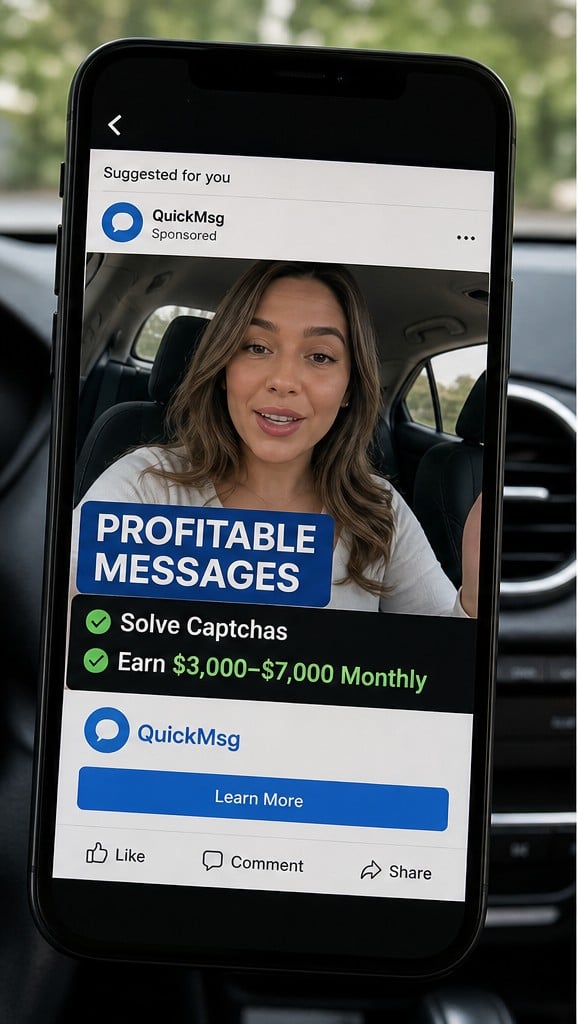
A social media ad says there is a new profession hiding inside Telegram. The work sounds almost mechanical: open messages, solve CAPTCHA tests for large technology companies, and collect between $3,000 and $7,000 each month.
The simplicity is the hook. No interview, technical background, or schedule appears necessary. Yet the route does not end with an employer assigning paid work. It ends with a sales page asking the supposed worker to become the customer.
Overview
The campaign invents a job that feels technical but easy
The Profitable Messages Telegram scam has circulated under labels including New Profession, Bot Profitable Messages, and Digital Freedom. Ads claim that companies need people to solve security tests, verify messages, or complete CAPTCHA tasks from a phone.
Mentioning Amazon, Apple, Google, or other large firms makes the tasks sound necessary and funded. The names do not establish a contract. A real vendor would identify itself, explain the client relationship, and provide employment or contractor terms before asking for money.
Telegram provides speed and a false sense of automation
A bot or channel can instantly display tasks, earnings, support replies, and success stories. Automation feels professional, but the operator controls every message and number. A balance inside a bot is not a bank deposit or payroll record.
Telegram also lets campaign names and usernames change quickly. When one ad account disappears, a new profile can route users to the same course or a similar checkout with little interruption.
The promised profession becomes a paid digital product
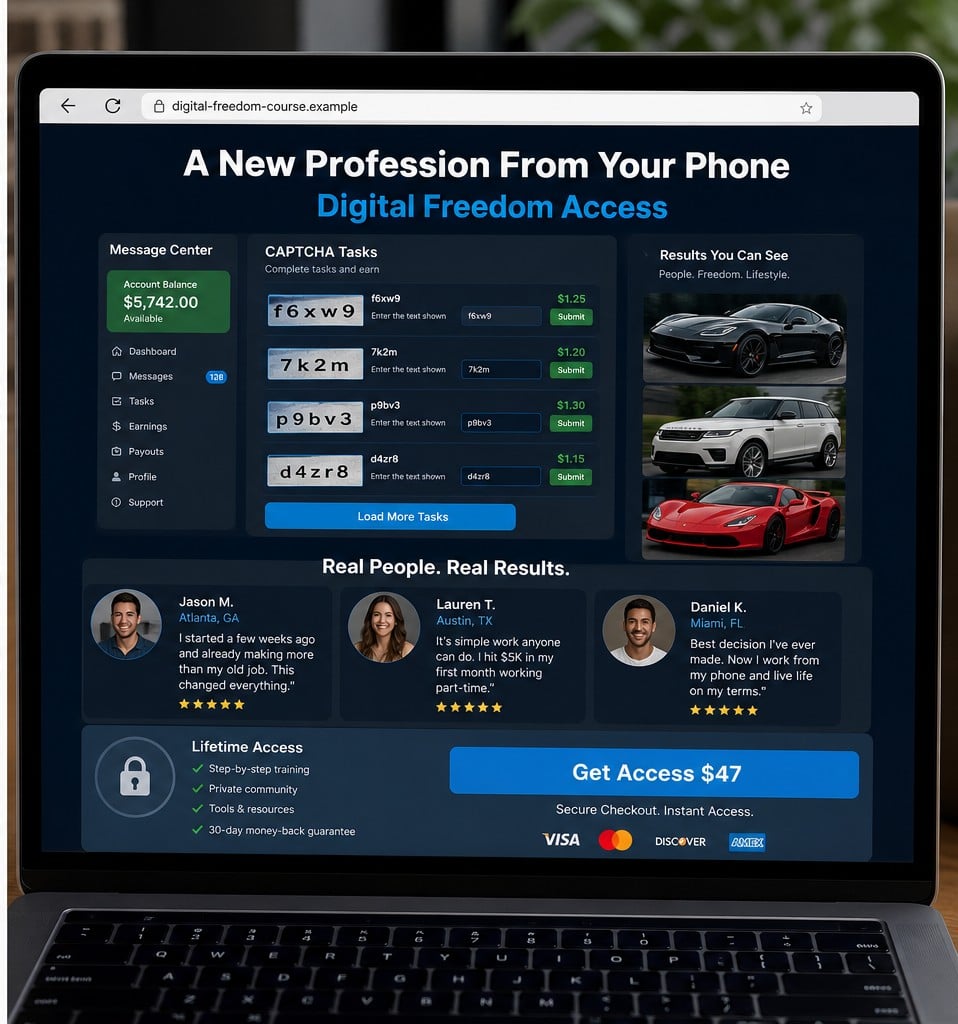
After a video presentation, the visitor may be offered Digital Freedom or a similar course through a checkout platform. The product can contain lessons or community access, but the transaction is not the job originally promised.
The worker now pays the promoter, reversing the normal employment relationship. Additional task packs, automation tools, coaching, upgrades, or deposits can create further losses while the claimed monthly income remains unsupported.
- Social ads promise $3,000 to $7,000 monthly from a phone.
- The work is described as solving CAPTCHA or message-verification tasks.
- Large technology companies are named without proof of a contract.
- A Telegram bot displays tasks and an impressive balance.
- The user is sent to a video presentation and paid digital product.
- Course delivery does not establish the advertised employment.
- New names and accounts can replace the campaign when complaints appear.
Why CAPTCHA Work Sounds More Credible Than It Is
CAPTCHA tests are real, and companies do hire security, moderation, and data-labeling workers. The campaign borrows those familiar ideas but removes the parts that make work accountable: a named employer, application, contract, rate, supervision, tax status, and reliable payment method.
The income promise does not fit the task. A claim of $3,000 to $7,000 each month for entering simple characters from a phone would attract enormous legitimate competition. A promoter should be able to document who buys the work and how the economics support the advertised rate.
The FTC warns that side-hustle scams often promise big money for minimal effort and demand payment up front. Its guidance is direct: a legitimate gig does not require the worker to buy training or access before receiving work.
Telegram itself is only a communication platform. Legitimate businesses use it, but the presence of a bot, channel, subscriber count, or verification-style icon does not authenticate an employer. Users must investigate the business outside the app.
Ask for a written contract and a sample payment record that can be independently verified. A screenshot inside a bot, a luxury-car testimonial, or a presenter saying clients are confidential does not answer who purchased the CAPTCHA work.
The Rotating Names Behind the Same Sales Story
The campaign has used several names while keeping the basic narrative intact: a new phone profession, easy messages or security tasks, high monthly earnings, and private access. Rotating labels make reputation searches less useful because warnings about yesterday's name do not automatically appear beside today's ad.
Reported landing pages have used disposable-looking domains and an AI-style narrator to explain the process. Some ads begin with a Meta car-themed creative or a lifestyle video, then transition to claims of $3,000, $5,000, or $7,000 each month without documenting a real employer.
A product called Digital Freedom has been offered through a digital checkout, with the seller identified under another label. A processor can confirm that a product transaction occurred, but it cannot confirm that Amazon, Apple, Google, or any named client hired the buyer.
The contractual mismatch is more important than whether files arrive. The ad presents paid tasks; the receipt describes education or access. If the course teaches general online marketing rather than providing the promised CAPTCHA assignment and wages, fulfillment does not resolve the deception.
Some task scams later ask users to deposit money to unlock higher-value work or release earnings. The FTC says the displayed commissions in such systems can be fake and warns never to pay anyone to get paid. Treat any Telegram deposit request as a reason to stop immediately.
How the Profitable Messages Telegram Scam Works
Step 1: A lifestyle ad introduces a new phone profession
The campaign begins with a confident narrator, a person in a car, or images of financial freedom. Captions promise thousands each month without experience and say the phone can become the only tool needed.
The phrase new profession discourages comparison with normal wages. If the work has supposedly just appeared, viewers are less likely to ask why established job boards, staffing firms, and company career pages do not list it.
Step 2: Famous company names supply imaginary demand
The presentation says large companies need humans to solve CAPTCHA tests, verify security messages, or improve online systems. Logos and familiar names make an unidentified promoter sound like part of a major outsourcing chain.
No client contract is displayed. A legitimate vendor should name its legal business, explain whether workers are employees or contractors, and show how the rate is calculated. General claims about confidential partners are not enough.
Step 3: Telegram creates the appearance of a working platform
A link opens a bot or channel that displays instructions, task buttons, message counters, and a growing balance. Instant replies and polished menus make the system feel more concrete than a simple sales page.
Every element remains under the operator's control. The bot can show the same $5,742 balance to thousands of visitors without a client funding it. Test the withdrawal before believing the display, and never pay to activate it.
Step 4: A video builds urgency and handles objections
The user is sent to a long presentation explaining why the method is secret, why traditional jobs fail, and why the current price is unusually low. Testimonials show cars, travel, and people claiming rapid results.
Those stories do not replace payroll records. Disclaimers may reveal that examples are illustrative, actors are used, or results vary. The small print often describes a different level of certainty from the narration.
Step 5: The applicant is asked to buy Digital Freedom access
Instead of completing hiring documents, the visitor reaches a checkout for a course, membership, or toolkit. A price such as $47 feels minor next to a promised $3,000 to $7,000 monthly income.
The payment creates a customer relationship with the seller. It does not create employment with Telegram or any technology company named earlier. That distinction should be obvious before the card form, not discovered inside the member area.
Step 6: Upsells and task deposits can increase the loss
After purchase, the system may promote automation, premium groups, coaching, advanced modules, or higher-paying task access. Some task schemes also demand deposits to clear a negative balance or unlock withdrawal.
Do not chase the initial payment. A small loss can become much larger when users keep spending to prove that the original decision was correct. No honest employer requires a worker to finance wages.
Step 7: The story moves to new accounts and domains
When an ad is removed or a name develops complaints, the same footage and sales logic can return as New Profession, Digital Freedom, or another bot. The presenter and price may change while the payment-first structure remains.
Search the legal seller, billing descriptor, phone number, and support email, not only the current marketing name. Those identifiers are harder to rotate and more useful when connecting complaints.
Company, Address, and Fulfillment Checks
The named technology companies are not the employer
Amazon, Apple, Google, and Telegram can be mentioned to provide prestige without participating in the offer. A logo on a slide does not prove that the course seller has a contract to supply CAPTCHA workers.
Ask for the legal employer, tax arrangement, supervisor, and client authorization. If the only document is a digital-product license, the campaign sold access rather than providing the job described in the advertisement.
Disposable domains and aliases block accountability
A campaign using several names and short-lived pages makes it difficult to identify who made a specific promise. Privacy-protected registration, generic mailboxes, and contact forms can add distance between the presenter and legal seller.
Compare the company in the terms, checkout, receipt, card statement, and support reply. An unexplained chain of aliases is a serious red flag when the business claims it can reliably pay thousands every month.
Support may confirm access but not employment
A responsive course desk can resend a password or point to lessons. That proves only that a digital product exists. Ask which client pays for the tasks, how completed work is audited, and where a worker can enforce unpaid wages.
If support redirects those questions to motivation, future opportunities, or community success, save the response. It documents that the actual service differs from the recruitment claim.
The digital supply chain should be traceable
A transparent arrangement would identify the advertiser, employer, task platform, client, payroll provider, seller, and checkout processor. In this funnel, those roles blur together while the user alone provides money and personal information.
Do not treat a known checkout platform as the employer. It may process the order for an independent seller, but it does not validate the income claim or assume responsibility for Telegram messages made outside its checkout.
Warning Signs to Watch For
- The job promises $3,000 to $7,000 monthly for trivial tasks.
- No employer application, interview, or written contract exists.
- Famous company names appear without client authorization.
- A Telegram bot controls the tasks and displayed balance.
- The worker must pay for training or access before earning.
- The receipt describes a course instead of employment.
- Upsells or deposits are required to unlock more work.
- Campaign names and domains change frequently.
The hardest fact cuts through every testimonial: an employer pays the worker. When a Telegram opportunity makes the worker pay the promoter before a client, contract, or wage exists, the profitable messages are profitable for the seller.
What to Do if You Have Fallen Victim to This Scam
- Stop the Telegram conversation and do not pay for more access. Do not purchase another module, task pack, activation, or withdrawal code. Block the recruiter after saving evidence. A supposed account balance or queue of paid CAPTCHA tasks is not proof that an employer owes you money.
- Cancel the digital product through the receipt channel. Use the official support route named on the course or checkout receipt. Ask for cancellation, a refund under the published policy, and confirmation that recurring billing or additional installments are stopped. Keep the ticket number and every reply.
- Contact the bank or payment provider promptly. Describe the promise of monthly Telegram earnings, the actual digital product received, and any later requests for deposits. Ask about dispute options, merchant blocks, and whether the payment credential should be replaced.
- Lock down Telegram, email, and other accounts. Change passwords shared with the landing page and enable Telegram's two-step verification. Review active sessions, connected devices, recovery email, bots, and downloaded files. Revoke any session or bot you do not recognize.
- Save the recruitment and sales sequence. Capture the sponsored ad, narrator claims, Telegram handle, bot messages, CAPTCHA screen, displayed earnings, domain, checkout, seller name, receipt, and support messages. Export or screenshot the chat before blocking the account because usernames can be changed quickly.
- Remove downloads and perform a security scan. Delete unknown APK files, desktop programs, extensions, or remote-support tools supplied by the recruiter. Run Malwarebytes if anything was installed or if the browser began redirecting, and never grant accessibility or administrator control to a task app.
- Reduce malicious links and ad exposure. AdGuard can block many scam domains, advertising redirects, and pop-ups used to distribute work-from-phone offers. It cannot verify an employer or make a Telegram bot safe, so investigate the company independently before sharing data.
- Protect identity and financial information. Monitor payment accounts and email for follow-up attempts. If you submitted an ID, bank account, tax number, or selfie, use IdentityTheft.gov for a recovery plan and warn the bank that the information may have been exposed.
- Report the accounts and refuse recovery services. Report the bot or user inside Telegram, report the social advertisement, notify the checkout provider, and file the loss at ReportFraud.ftc.gov and IC3.gov when appropriate. Never pay someone who claims to recover a course fee or release Telegram earnings.
Frequently Asked Questions
Is Profitable Messages a real Telegram job?
The campaign described here has not established an identifiable employer or verified client contract. It leads users toward a paid digital product rather than a normal hiring and payroll process.
Do Amazon, Apple, or Google pay random users to solve CAPTCHA tests?
These companies employ workers and vendors for many roles, but the names in an advertisement do not prove a connection. Verify any opportunity through official career pages and a documented legal employer.
Can a Telegram bot display real earnings?
It can, but the display alone proves nothing. The operator controls the interface and can generate tasks and balances without receiving client funds. Confirm the employer and withdrawable payment independently.
Is a $47 course automatically a scam?
No. A digital course can be legitimate. The problem is marketing it as access to reliable paid work or existing earnings when the seller cannot substantiate that claim.
Why does the campaign keep changing names?
Rotating names, accounts, and domains helps advertisements escape complaints and platform enforcement. Search stable identifiers such as the legal seller, checkout receipt, support email, and card descriptor.
What if the bot asks for crypto to release my balance?
Do not pay. The FTC warns that task scams display fake earnings and then demand deposits. Save the wallet address and messages, contact the payment service immediately if you sent funds, and report the account.
The Bottom Line
The Profitable Messages Telegram scam dresses a digital-product sale as a new profession. Easy CAPTCHA tasks and a growing balance create the feeling of employment, but the path leads to paid access before any accountable employer appears.
Do not pay to receive work or to withdraw numbers generated by a bot. A real side hustle can explain who buys the labor, why it has value, and how workers are paid without asking them to finance the promise.

Join the discussion
0 commentsShare your experience or ask a question about this article.
Discussion
Start the conversation
Have a question or something useful to share? Add the first comment.