

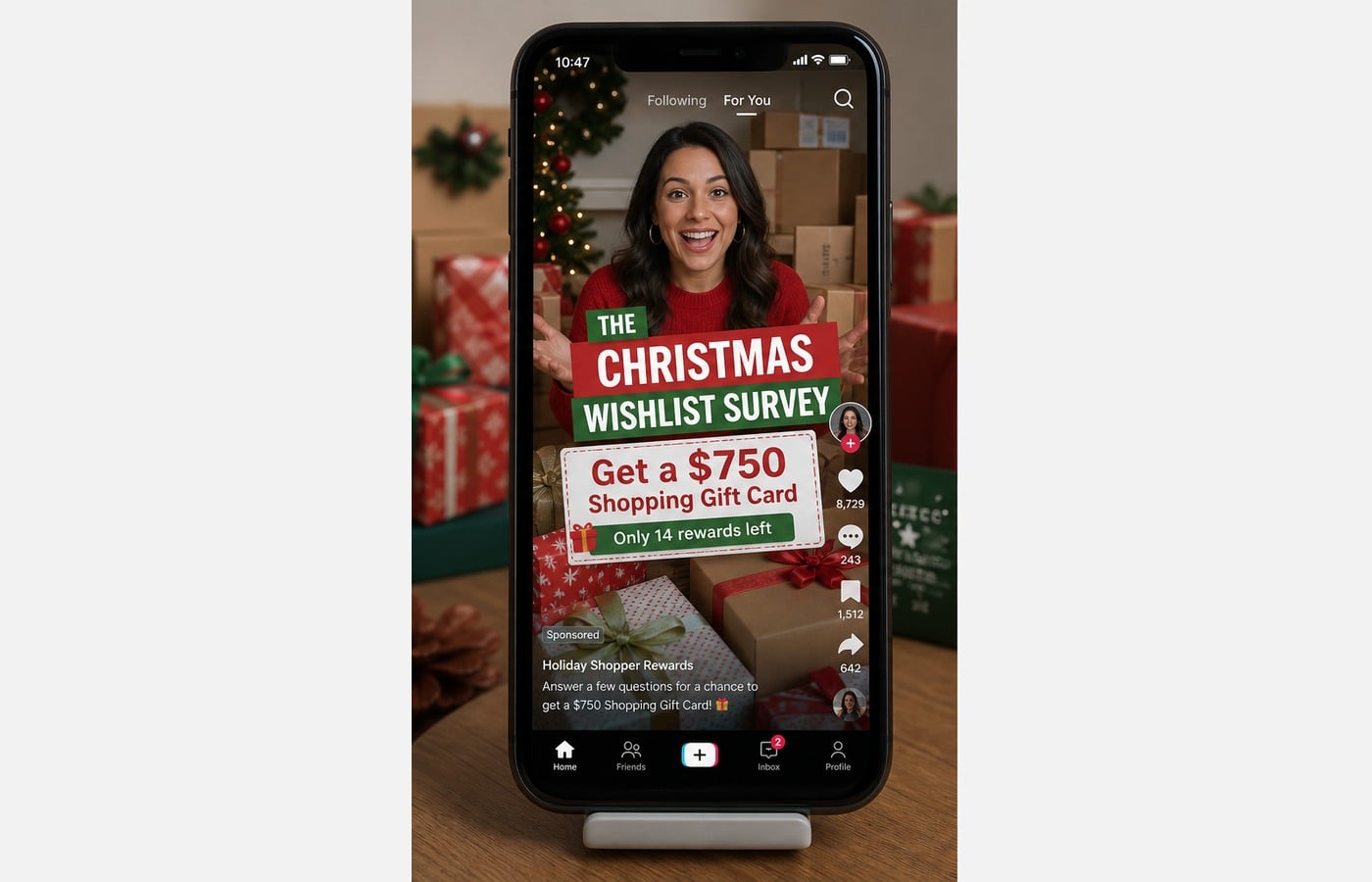
The video arrives when gift lists are longer than the household budget. A smiling shopper says a special Christmas survey can provide a $750 card, but only a handful of rewards remain.
That timing is the real magic. The Christmas wishlist survey scam uses a familiar retailer and seasonal pressure to make a commercial lead funnel look like holiday help.
Overview
The campaign turns financial pressure into urgency
The Christmas wishlist survey scam promises $500, $750, or $850 in shopping credit after a few easy questions. Videos show packages, decorated rooms, shopping carts, and families supposedly receiving everything on a wish list.
The message is most effective when people are worried about gifts, food, travel, or debt. A countdown or only 14 left badge implies that verifying the offer could cost the family its chance.
The retailer theme hides an unrelated operator
Ads can imitate Amazon or another familiar shopping brand while using misspellings such as Amzn to avoid moderation. The destination domains have included generic reward names rather than the retailer's official web address.
A logo, orange button, or package is not ownership evidence. The legal operator is the entity named in the page's terms and privacy policy, and it may be a lead generator collecting data for numerous marketing partners.
The survey is only the entrance to qualifying deals
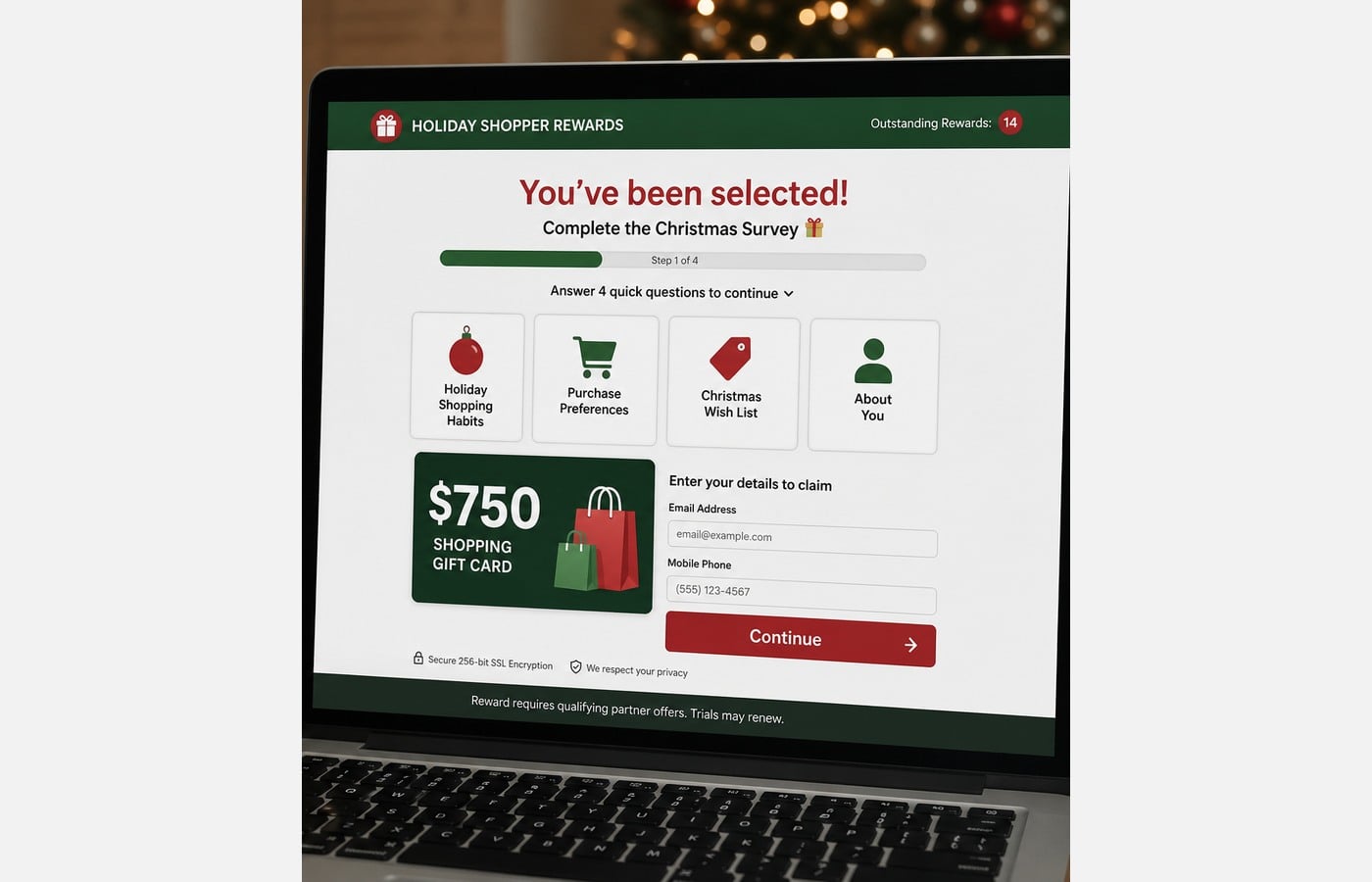
After answering shopping questions, participants may be required to register, complete several paid or free offers, pass tracking and identity checks, and submit a claim on time. Trials can renew through separate merchants.
That process bears little resemblance to the social promise of a quick Christmas survey. Even where formal reward terms exist, the advertisement can still mislead by hiding the cost, effort, data collection, and retailer's lack of involvement.
- Seasonal social ads promise a $500 to $850 shopping reward.
- A familiar retailer's colors and packages create borrowed trust.
- Only a few rewards left and countdowns pressure fast action.
- The link leaves the retailer and passes through tracking domains.
- Easy survey answers lead almost everyone to congratulations.
- Registration collects contact data and marketing consent.
- Partner deals, purchases, trials, and verification replace the simple survey.
Why a Real Holiday Survey Looks Different
Retailers do conduct customer surveys and may offer modest incentives. A real survey can usually be reached from an official receipt, authenticated account, company app, or retailer-owned domain. Its sponsor, rules, privacy terms, and reward are disclosed before sensitive data is collected.
A surprise TikTok promotion promising $750 to nearly anyone is different. The reward vastly exceeds the value of a short opinion, and the link may pass through several unrelated domains before displaying a page styled to resemble the retailer.
The retailer should be able to confirm the exact program through its official help center. Close the social browser, type the retailer's address independently, and search for the full promotion name. Do not ask support through a phone number printed on the questionable page.
A secure padlock icon cannot settle the question. HTTPS encrypts information sent to the domain. It does not prove that the brand shown in the ad owns the domain, approves the campaign, or will issue a gift card.
Typos such as Amzn Christmas Srveys can be intentional. Slight misspellings help advertisers rotate creative, avoid trademark filters, and create new keyword phrases while remaining recognizable to hurried viewers.
The fake comment section is another pressure tool. Accounts claim they received the card or bought gifts, but the promoter can create those comments, reuse stolen profiles, or display a static image that no real user posted.
The best test is not whether the page looks professional. It is whether the named retailer confirms the offer, the domain belongs to the stated sponsor, and the complete requirements make economic sense before the visitor registers.
Reward Networks, Personal Data, and Hidden Costs
Reported Christmas survey campaigns have used domains such as DealzDen, UpLevelRewards, and Reward4Spot. Those names point toward promotional reward and lead-generation activity, not an authenticated retailer account.
Reward program documents have described qualification through registration, personally identifiable information, partner deals, and ID verification. Depending on the reward level, participants may need to complete multiple offers rather than one holiday survey.
The FTC's 2023 case against Fluent, RewardZone USA, and related entities is relevant background. The complaint alleged deceptive lead-generation practices and explained that the companies collected consumer information and provided leads to third parties. A final stipulated order closed the case.
This does not establish that every Christmas ad today uses the same operator. It does demonstrate why the footer, consent text, privacy policy, and redirect chain must be saved. The retailer in the video can be entirely separate from the business receiving the lead.
Marketing partners may offer streaming services, apps, insurance quotes, education, subscriptions, and other products. A free trial can require card details and convert to paid service unless cancelled before its deadline.
The total cost may be impossible to know until later deal levels appear. Participants can also lose credit because of tracking problems or eligibility rules, prompting additional spending to replace an offer that did not register.
The campaign can therefore profit without paying the headline amount to most visitors. Contact information has marketing value, completed offers can generate commissions, and subscription merchants collect revenue while the participant carries the cost and claim burden.
How the Christmas Wishlist Survey Scam Works
Step 1: A holiday video promises relief, not just a prize
A creator stands beside packages and says a hidden survey covered the family's wish list. The $750 reward is framed as help for parents, grandparents, or anyone struggling with seasonal expenses.
That emotional framing makes the click feel responsible rather than risky. Viewers are encouraged to share the opportunity with family before verifying it.
Step 2: Scarcity says the seasonal window is closing
The post displays a small number of rewards, a December deadline, or a timer. Christmas provides a natural end date, so the false urgency feels more believable than a generic five-minute sale.
Reload the page and the same inventory may return. A legitimate promotion publishes fixed entry dates and complete rules that remain readable without a resetting countdown.
Step 3: Redirects separate the ad from the reward operator
The Learn More button can pass through tracking links that record the campaign and affiliate. The final page retains shopping colors even though the address bar no longer shows the retailer.
Expand shortened links and write down every domain. The redirects reveal who is measuring and monetizing the click.
Step 4: Easy questions create a false sense of selection
The survey asks about shopping habits, holiday budgets, or favorite products. Almost any answer advances to a congratulations message and a reserved gift card.
The questions do not demonstrate random selection or retailer membership. They keep the visitor engaged and may add demographic value to the lead.
Step 5: Registration captures contact and consent
The next page requests email, phone, address, birth date, or household information. Small text may authorize messages from the operator and a long list of partners.
Read the consent before pressing Continue. The campaign can profit from the lead even if no gift card is ever claimed.
Step 6: Partner deals replace the Christmas survey
The participant learns that several offers must be completed across different levels. Some involve apps, purchases, deposits, subscriptions, or service inquiries unrelated to holiday shopping.
Calculate the maximum total cost and renewal exposure before starting. If the page will not show every required level in advance, do not proceed.
Step 7: Tracking and verification complicate the claim
The reward may depend on cookies, merchant reporting, household eligibility, an ID check, and submission within a deadline. One missing credit can stop the process after time and money have been spent.
The original ad made a survey sound sufficient. The actual contract shifts the burden to the participant while the social creator and familiar retailer remain outside the dispute.
Company, Address, and Fulfillment Checks
The retailer logo is not the contracting company
The legal operator may be a rewards or marketing company, while the promoted retailer supplies only visual credibility. Check whether the retailer appears anywhere in the terms beyond a reward choice.
If the operator cannot show authorization from the brand used in the ad, do not treat the promotion as an official retailer benefit.
Registered offices can belong to lead generators
A real corporate address is better than none, but it does not mean the retailer owns the survey. Search the entity's business model, enforcement history, related trade names, and privacy disclosures.
A mailbox, virtual office, or headquarters can receive legal notices without explaining which affiliate created the seasonal advertisement.
Support responsibilities are deliberately divided
The reward administrator handles deal credit, each merchant handles billing, the social platform handles the ad, and the retailer may have no account to find. Consumers can lose valuable cancellation time while being redirected.
Before registering, ask who cancels every trial and who pays the gift card. If there is no single clear map, the offer is not simple enough to trust.
The lead and deal chain is the real fulfillment system
Affiliates deliver visitors, a platform collects data, partners sell offers, merchants renew services, and an administrator evaluates claims. That is the commercial product being assembled behind the holiday theme.
Follow the data and payment flow. It explains why the ad can be profitable even when a visitor never sees $750.
Warning Signs to Watch For
- A $750 reward appears only in sponsored social videos.
- The campaign uses a misspelled version of a retailer's name.
- Only a few rewards are supposedly left for every visitor.
- The destination domain is not owned by the retailer.
- Nearly every survey answer produces congratulations.
- Personal data is requested before all conditions are visible.
- Partner deals and renewing trials are required.
- Several unrelated companies control support and billing.
A holiday survey should end with a survey. When it continues into a deal wall, card entry, trial renewals, and ID verification, the $750 card is bait for a much larger commercial transaction.
What to Do if You Have Fallen Victim to This Scam
- Stop completing offers and map every account. Search email, texts, app stores, and browser history for every service, quote, purchase, trial, and subscription opened through the Christmas page. Record renewal dates and merchant names immediately.
- Cancel every trial with its own merchant. Use the official receipt or account for each service and request written confirmation. Cancelling the reward profile or clicking unsubscribe does not terminate separate partner agreements.
- Contact the card issuer from a trusted number. Explain the $750 holiday promise, prices shown before checkout, and every unexpected charge. Ask about disputes, recurring payment blocks, card replacement, and deadlines for written notice.
- Secure retailer and email accounts. If the same password was used on the funnel, change it on the official retailer site and everywhere else it was reused. Review saved cards, delivery addresses, forwarding rules, sessions, and multi-factor authentication.
- Preserve the ad and complete redirect chain. Save the creator, sponsored video, reward amount, scarcity counter, every domain, survey, consent text, deal requirements, receipts, identity request, support replies, and statement descriptors.
- Remove deal-related downloads and scan. Uninstall apps, extensions, profiles, and notification permissions added only to qualify. Run Malwarebytes if the funnel caused redirects, pop-ups, suspicious downloads, or login prompts.
- Block repeat advertising and tracking. AdGuard can reduce exposure to malicious ads, pop-ups, and redirect infrastructure used by seasonal reward campaigns. It does not authenticate a retailer promotion, so verify future offers inside official channels.
- Protect sensitive identity data. If the page collected a Social Security number, photo ID, or proof of address before you verified the operator, follow IdentityTheft.gov guidance and consider a fraud alert or credit freeze.
- Report the campaign and reject recovery fees. Report the ad to the platform, notify the impersonated retailer, and file the domains, consent language, and charges at ReportFraud.ftc.gov. Ignore anyone asking for another payment to approve the gift card or recover your losses.
Frequently Asked Questions
Is the Christmas wishlist survey an official retailer promotion?
Not merely because the ad uses packages, colors, or a familiar name. Confirm the exact program from the retailer's official site or authenticated app before providing information.
Can someone really receive a reward from a deal program?
Some formal promotional programs issue rewards to participants who satisfy extensive terms. That does not make a social ad honest when it describes the process as a quick retailer survey.
Why do the pages ask for a phone number?
Contact data can be used for verification and marketing. Read the consent list carefully because the information may be shared with multiple partners.
Are free trials actually free?
They may begin at no cost or a low price but renew unless cancelled. Record the deadline and cancellation method for every offer before entering card details.
Why might my completed deal not count?
Tracking, cookies, eligibility, duplicate household rules, device changes, merchant reporting, or deadlines can affect credit. Save proof of completion.
Does the retailer cancel partner subscriptions?
Usually not when the purchases occurred on unrelated sites. Contact each billing merchant directly and monitor the statement.
The Bottom Line
The Christmas wishlist survey scam turns holiday stress into clicks, leads, deals, and subscriptions. A familiar retailer is the wrapping paper, while unrelated operators and merchants control the actual transaction.
A real survey clearly identifies its sponsor and reward before collecting sensitive data. If a $750 promise requires multiple partner offers and renewing trials, close the page and keep the wish list away from the checkout.

Join the discussion
0 commentsShare your experience or ask a question about this article.
Discussion
Start the conversation
Have a question or something useful to share? Add the first comment.