

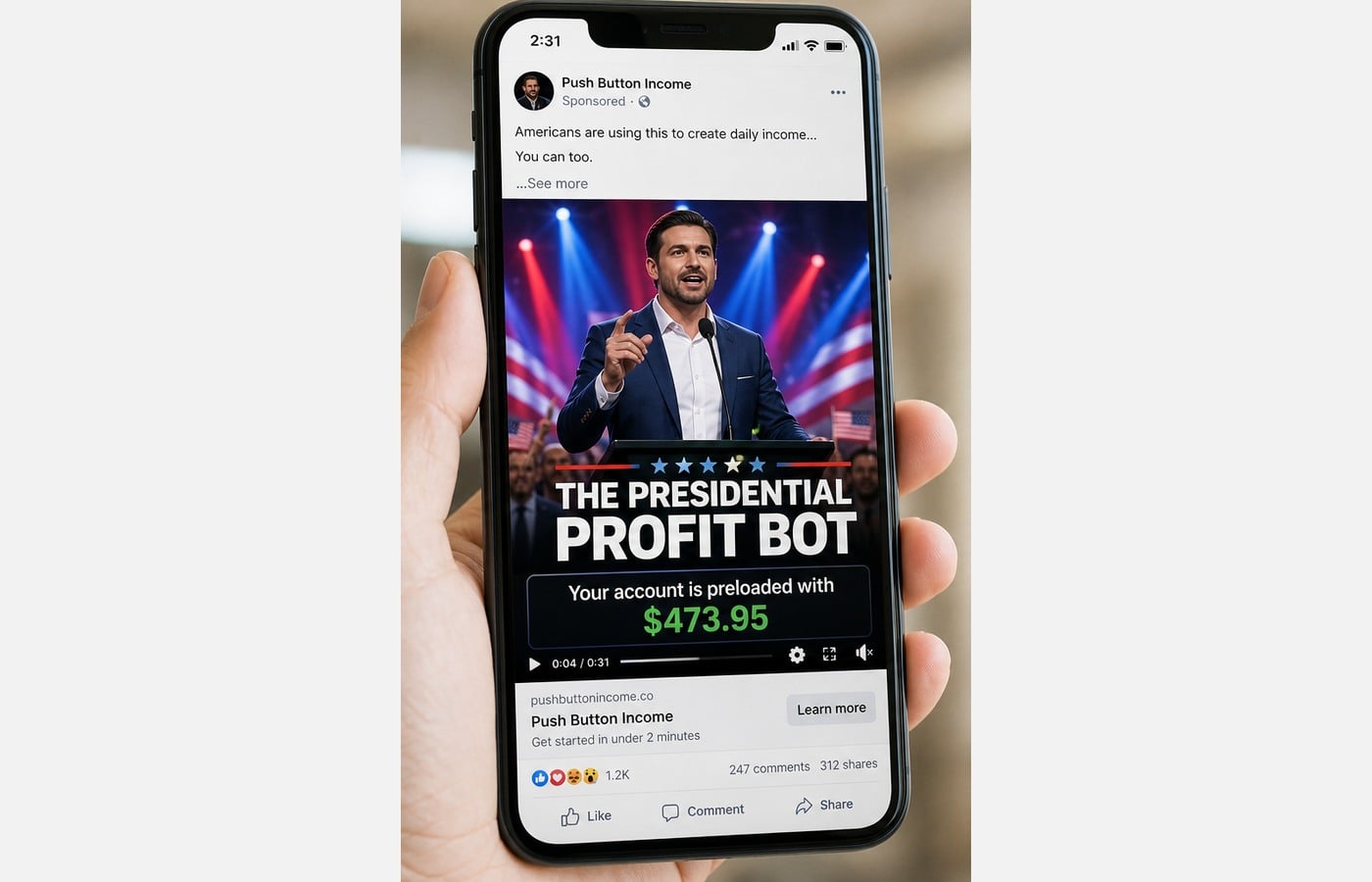
A patriotic video says a powerful new bot has been opened to ordinary Americans. Before the viewer creates an account, the screen claims $473.95 is already waiting to be withdrawn.
The number looks precise and the political story feels current. Yet the presidential AI money bot scam is not a government benefit, a campaign program, or an automatic source of daily income.
Overview
The political figure is a trust shortcut, not the operator
The presidential AI money bot scam borrows the imagery, slogans, and business reputation of a national political figure. Some versions use edited photographs, synthetic narration, or an AI presenter to imply official sponsorship.
No verified government or political organization is identified as the employer, software owner, or source of the money. A public figure's image in an ad does not create authorization, and an affiliate cannot manufacture an endorsement by repeating it.
The preloaded $473.95 is a webpage number
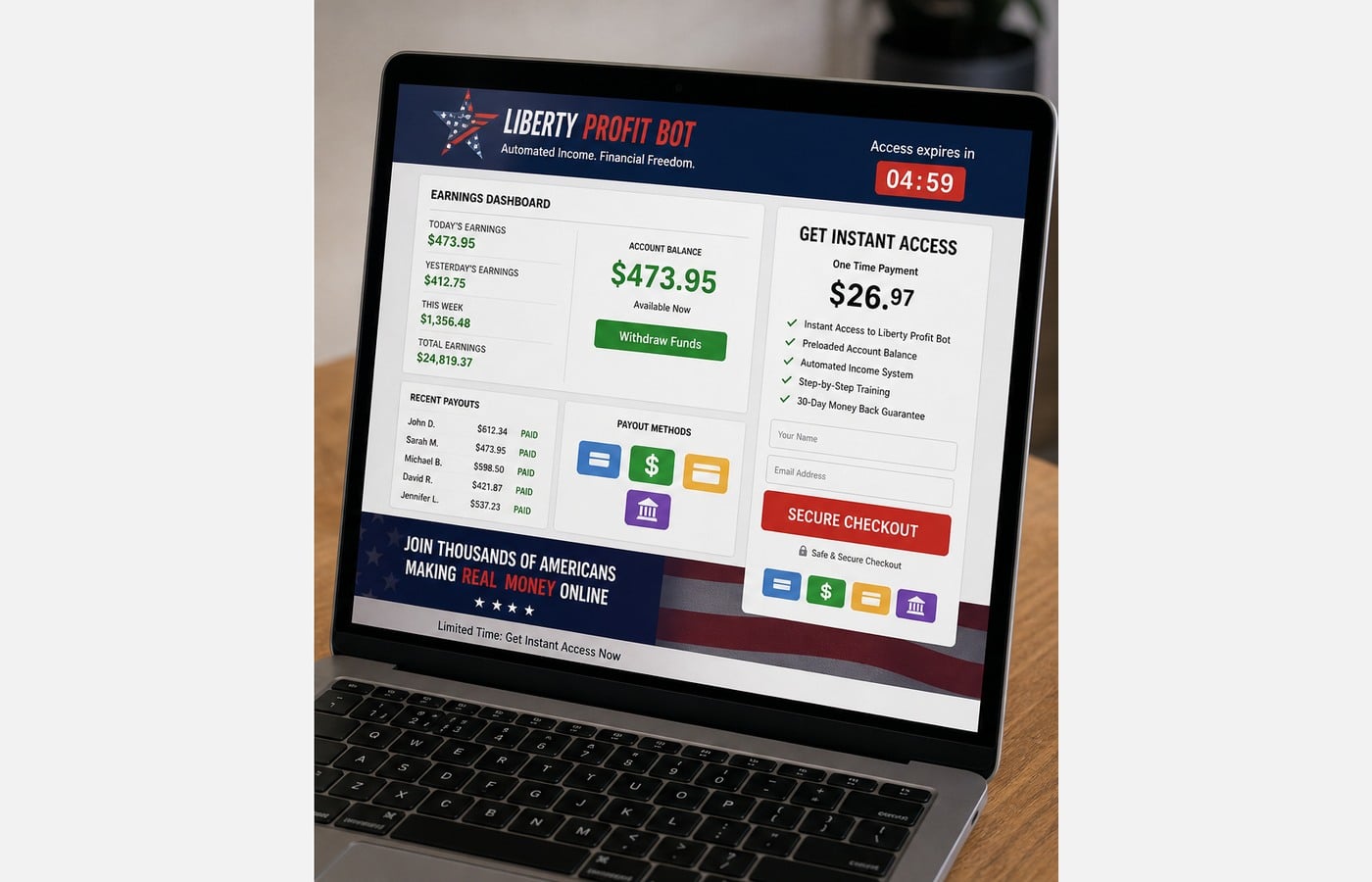
Visitors are told that an account has already earned or received $473.95, often before they submit a name. The same page may list recent payouts, payment icons, weekly totals, and a withdrawal button.
Those elements are generated by the operator. They do not show an outside customer, funded account, bank transfer, or withdrawable balance. The page can display the same amount to every visitor at almost no cost.
The actual offer is a low-priced digital product
The funnel can lead to a checkout priced around $26.97 through a third-party retailer such as Explodely. That purchase may provide a login, videos, or generic money-making information, but it does not establish the automated income promised in the ad.
Explodely's public terms identify it as merchant of record for products sold through its platform. Its role in processing and delivering an order is not proof that a political figure endorsed the product or that the seller's earnings statements are accurate.
- A political or presidential theme creates instant authority.
- AI audio, edited video, or a fictional presenter implies an endorsement.
- The visitor sees $473.95 before performing any paid work.
- Generic payment icons make the balance look withdrawable.
- A five-minute timer pressures the visitor to buy access.
- The checkout sells a digital product for about $26.97.
- Personal details can be reused for additional income pitches.
Why the $473.95 Promise Fails a Basic Reality Check
The advertised number implies annual income of more than $173,000 if it arrives every day. A promoter offering that result for $26.97 should be able to explain the customer, transaction, product, capital, risk, and net result behind each payment.
Instead, the story relies on an automated bot, secret access, and political influence. AI can process information and automate tasks, but it cannot create revenue without a real economic activity. Someone must buy a product, pay for labor, or take investment risk.
The page may claim the bot is inspired by a famous business mind rather than directly owned by that person. This wording provides deniability while allowing the visuals to make a stronger impression. Judge the complete message, not one carefully qualified sentence.
The FTC warns that large, easy earnings claims and pressure to act immediately are classic signs of a deceptive money-making opportunity. Honest sellers should be able to document typical results and should not need a resetting countdown to prevent comparison.
A preloaded balance is especially revealing. The website cannot know the visitor's identity, bank, work, or eligibility before the page loads. The amount is therefore part of the sales presentation, not a personalized financial record.
The system may also invoke television shows, financial media, or major payment services. Search those organizations' official channels. A logo or colored icon on the seller's page is not an independent statement from the organization it resembles.
The safe conclusion does not depend on knowing who coded the webpage. The extraordinary payout is unsupported, the endorsement is unverified, and the buyer is asked to send real money before any credible income source is demonstrated.
The Checkout, Merchant, and Address Trail
Versions of this story have routed customers to a digital checkout handled by Explodely LLC. Its terms list 1317 Edgewater Drive, Suite 4648, Orlando, Florida 32804 and describe Explodely as the trusted retailer and merchant of record.
Florida corporate records show Explodely LLC as an active company registered in 2021. That means the payment gateway can be a real legal business even when an independent product promoter makes misleading claims before the checkout.
This distinction matters. A real processor can deliver a digital file, calculate tax, and handle refunds. It may not have produced the advertisement, built the alleged bot, verified the earnings, or received authorization from the public figure shown in the campaign.
The address has also appeared across numerous unrelated digital-product offers. A shared commercial address is not evidence of a software development office dedicated to the presidential bot, and it cannot establish that the promoter works with a government or political organization.
Look at the receipt for the exact product name and supplier. If the advertisement promises one system while the invoice names another course, app, or gateway, capture the mismatch. It can be important in a refund or card dispute.
The low price is deliberate. Losing $26.97 may seem too small to contest, but the first order can lead to upsells, coaching, traffic packages, recurring plans, or future calls from people who know the buyer is interested in fast income.
No independent evidence reviewed for this story demonstrates that ordinary buyers receive $473.95 a day. The dashboard itself cannot serve as proof because it is controlled by the same sales funnel asking the visitor to pay.
How the Presidential AI Money Bot Scam Works
Step 1: A patriotic social ad creates official-looking urgency
Red, white, and blue graphics, rally footage, or a confident political-style presenter announces a new opportunity for Americans. The narrator says elites or traditional employers do not want the public to know about it.
The theme turns skepticism into identity. Viewers may interpret doubt as missing a movement rather than evaluating an anonymous commercial offer.
Step 2: AI makes an endorsement appear to exist
A famous face may seem to speak directly about the bot, or an edited photograph may show branded clothing and a product logo. Synthetic audio can imitate cadence even when the lip movement is imperfect.
Verify the statement on the person's official website or verified account. If the only copies come from advertisers and affiliate reviews, the endorsement has not been established.
Step 3: The page assigns a balance before an account exists
The landing page congratulates the visitor and displays $473.95 as today's earnings or available balance. Lists of recent payouts create the appearance that other members are withdrawing money now.
Refresh the page or open it in a private window and the same figures may return. That behavior shows a scripted marketing component rather than a personal financial account.
Step 4: A countdown threatens to reassign the access
The visitor is told the place, code, or funded account will be given to someone else in five or twenty minutes. The timer may restart whenever the page reloads.
False scarcity prevents research. A credible business opportunity remains explainable after the clock reaches zero and does not need to confiscate supposed earnings because a visitor read the terms.
Step 5: A small fee converts hope into a real purchase
The $26.97 charge looks insignificant beside $473.95 a day. Secure-checkout graphics and a refund guarantee reduce the fear of entering card details.
The payment buys the product named on the receipt, not the dashboard balance. Read the supplier identity, refund policy, recurring terms, and billing descriptor before authorizing it.
Step 6: Generic training replaces the promised bot
The member area may contain affiliate marketing lessons, videos, templates, or links to other products. Access to content allows the seller to argue that something was delivered even though no automatic payout mechanism appears.
Judge delivery against the ad. A course about online income is not the pre-funded political bot that supposedly generated money before the buyer arrived.
Step 7: Upsells and new campaigns pursue the same lead
After the initial payment, buyers may be offered faster automation, premium traffic, personal help, or another secret system. Emails and calls can continue under names unrelated to the original ad.
Do not spend more to rescue the first purchase. Search the legal supplier, phone, email, address, and card descriptor because campaign names and patriotic presenters can change overnight.
Company, Address, and Fulfillment Checks
The political figure is not the company
The operator should be a named legal entity with a product, staff, support process, and evidence for its earnings claim. A campaign image, slogan, or flag cannot fill any of those roles.
If support will not state who owns the bot and where revenue originates, there is no accountable business behind the political story.
The gateway address is not proof of a bot headquarters
Explodely lists 1317 Edgewater Drive, Suite 4648 in Orlando. The same address can serve a merchant-of-record function for many independent digital suppliers.
Do not describe it as the bot's engineering office without evidence. Identify the supplier named on the order, then search its own registration, address, people, and operating history.
Processor support and product support have different duties
The merchant of record may locate a transaction and process an eligible refund. Only the supplier can explain the software, earnings model, testimonials, and public-figure authorization.
Contact both when necessary and save their answers. Being passed between them is not a reason to let a refund deadline expire.
Digital fulfillment can hide a serious mismatch
A working login proves that a file or course was delivered. It does not prove that the marketed bot exists, that $473.95 was funded, or that buyers obtain typical daily payouts.
Ask for a live withdrawal from an independently verifiable account before paying. A screen controlled by the seller is not independent verification.
Warning Signs to Watch For
- A political figure appears to endorse an obscure paid system.
- The video cannot be found on the figure's verified channels.
- A $473.95 balance appears before registration or work.
- The five-minute timer resets when the page reloads.
- The product costs $26.97 but supposedly returns far more every day.
- The page never identifies the outside source of revenue.
- The receipt describes digital content rather than a funded account.
- Upsells appear after the first payment.
Follow the only money that can be verified. The visitor pays $26.97 to the checkout. The promised $473.95 exists only inside a page controlled by the seller. Until that direction reverses in a real bank account, there is no payout.
What to Do if You Have Fallen Victim to This Scam
- Stop buying upgrades and do not pay to withdraw. Save the displayed balance, then close the page. Do not buy traffic, coaching, activation codes, tax certificates, or premium access to release the $473.95. A legitimate withdrawal does not require repeated purchases.
- Request a refund through the exact receipt. Use the supplier and merchant-of-record support details on the order confirmation. Describe the political endorsement and preloaded-balance claim, request cancellation, and obtain written confirmation that no recurring plan remains.
- Call the card issuer promptly. Explain what the ad promised, what the receipt named, and what was actually delivered. Ask about dispute deadlines, unfamiliar renewals, merchant blocks, and replacement of the card if its details may be misused.
- Preserve the full funnel. Capture the social account, political imagery, AI video, $473.95 panel, timer, URL, checkout, terms, receipt, member area, upsells, support replies, and card descriptor. A complete sequence is stronger than one screenshot.
- Secure accounts and personal information. Change any reused password, enable multi-factor authentication, and watch email and phone accounts for follow-up income pitches. If an ID or tax number was submitted, use IdentityTheft.gov for a recovery plan.
- Remove untrusted software. Uninstall bot programs, extensions, APK files, remote-access tools, or configuration profiles supplied by the promoter. Run a full Malwarebytes scan if anything was downloaded or the device began redirecting.
- Block common advertising and tracking routes. AdGuard can reduce exposure to malicious ads, pop-ups, and tracking links that retarget people who visited similar funnels. It cannot verify an earnings claim, so continue checking offers independently.
- Report impersonation and deceptive earnings claims. Report the ad to the social platform and submit the seller, processor, domains, and financial loss at ReportFraud.ftc.gov. Notify the public figure's official organization only through verified contact channels.
- Ignore recovery and investment follow-ups. Victim lists can attract callers promising a refund, crypto investment, or government recovery for another fee. Do not share one-time codes, install remote software, or send more money.
Frequently Asked Questions
Did a president create a daily profit bot?
No verifiable government or political announcement supports the commercial offer described here. The endorsement imagery is part of the advertisement, not proof of authorization.
Is the $473.95 balance real?
A balance displayed before the site knows the visitor is a scripted sales element. It is not evidence of funded money or a withdrawal right.
What does the $26.97 payment buy?
It buys the digital product named on the checkout receipt. That may be information or member access, which is different from owning a pre-funded automatic-income account.
Does a real payment processor make the offer legitimate?
No. A merchant of record can handle a lawful transaction without verifying every claim made by an independent supplier or affiliate before the checkout.
Can AI bots generate guaranteed daily income?
No legitimate tool can guarantee this result without explaining the underlying business, costs, capital, customers, and risk. AI does not create money from nothing.
How do I cancel or seek a refund?
Use the support details on the receipt immediately, document the request, and contact the card issuer if the seller does not resolve it or if unauthorized charges appear.
The Bottom Line
The presidential AI money bot scam uses politics to bypass the question every income offer must answer: who pays, for what, and why? A staged dashboard and synthetic endorsement provide excitement, not an economic model.
Do not trade a real $26.97 for a fictional $473.95 balance. Verify the owner, revenue source, typical results, and endorsement independently, or leave the page.

Join the discussion
0 commentsShare your experience or ask a question about this article.
Discussion
Start the conversation
Have a question or something useful to share? Add the first comment.