

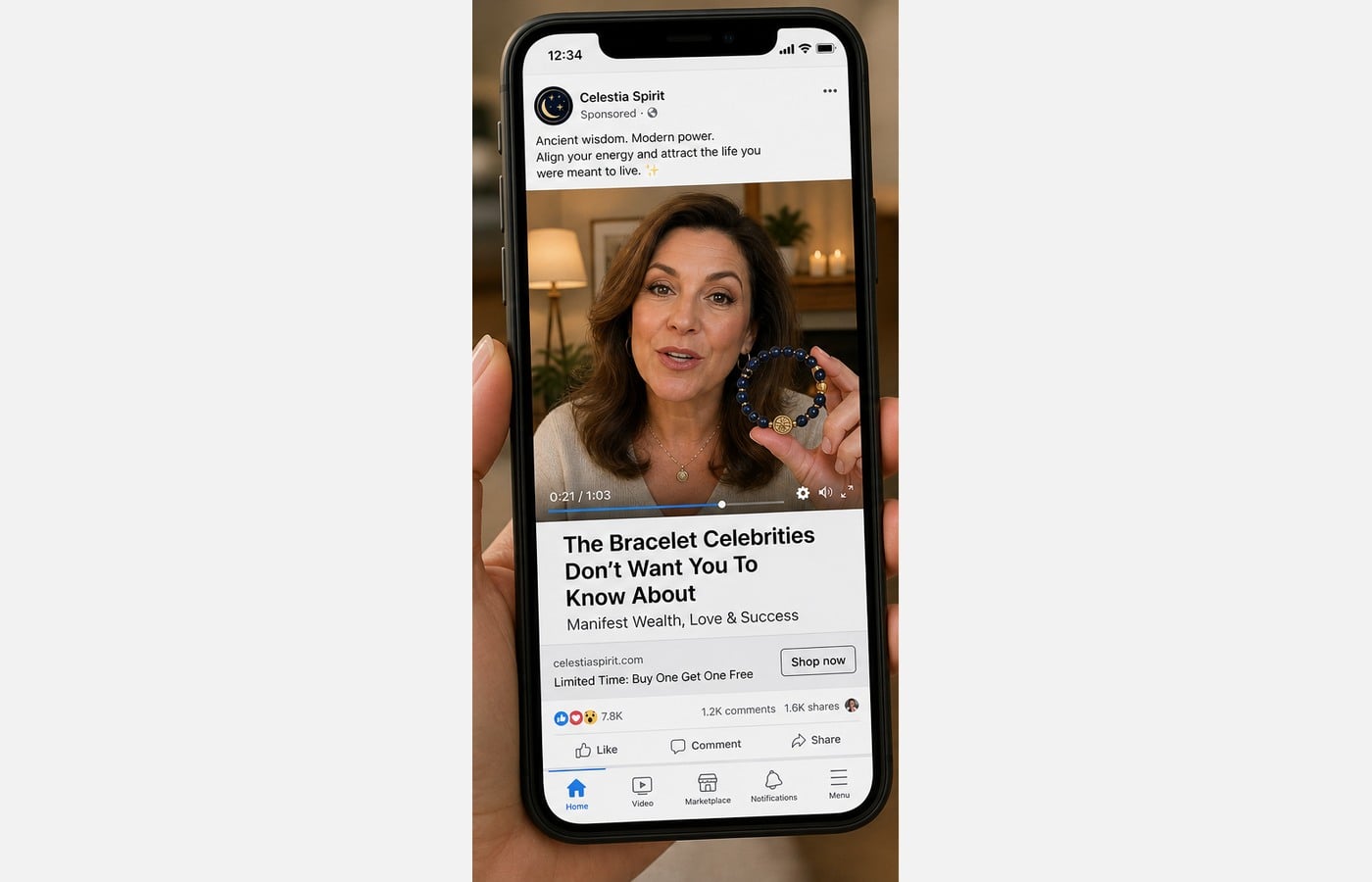
The woman in the video looks thrilled. She holds up a blue bracelet and says her luck changed almost overnight, then hints that famous people have quietly worn the same stones for years.
It feels more like a personal discovery than an advertisement. That is precisely why the celebrity manifestation bracelet scam is so persuasive, and why the most important part of the offer is found nowhere near the glowing testimonial.
Overview
The advertisement sells a life change, not a piece of jewelry
The celebrity manifestation bracelet scam begins with an emotional promise. A bracelet is said to remove negative energy, help the universe hear a person's wishes, and attract money, romance, confidence, pregnancy, or career success.
These outcomes cannot be evaluated like color, size, or delivery speed. When nothing happens, the customer can be told to wait, believe more strongly, clear another blockage, or buy another spiritual product instead of questioning the original claim.
AI faces and implied celebrity use create borrowed trust
Short videos can feature polished AI-generated people who tell intimate stories about debt, heartbreak, or years of disappointment. Other versions imply that singers, actors, or wealthy entrepreneurs wear the same bracelet without presenting a verifiable endorsement.
A familiar-looking face and a confident voice can feel like evidence, but neither identifies a real customer. The FTC's endorsement principles require testimonials to reflect honest experience, and material relationships should not be hidden from the audience.
The real risk appears in the product and subscription terms
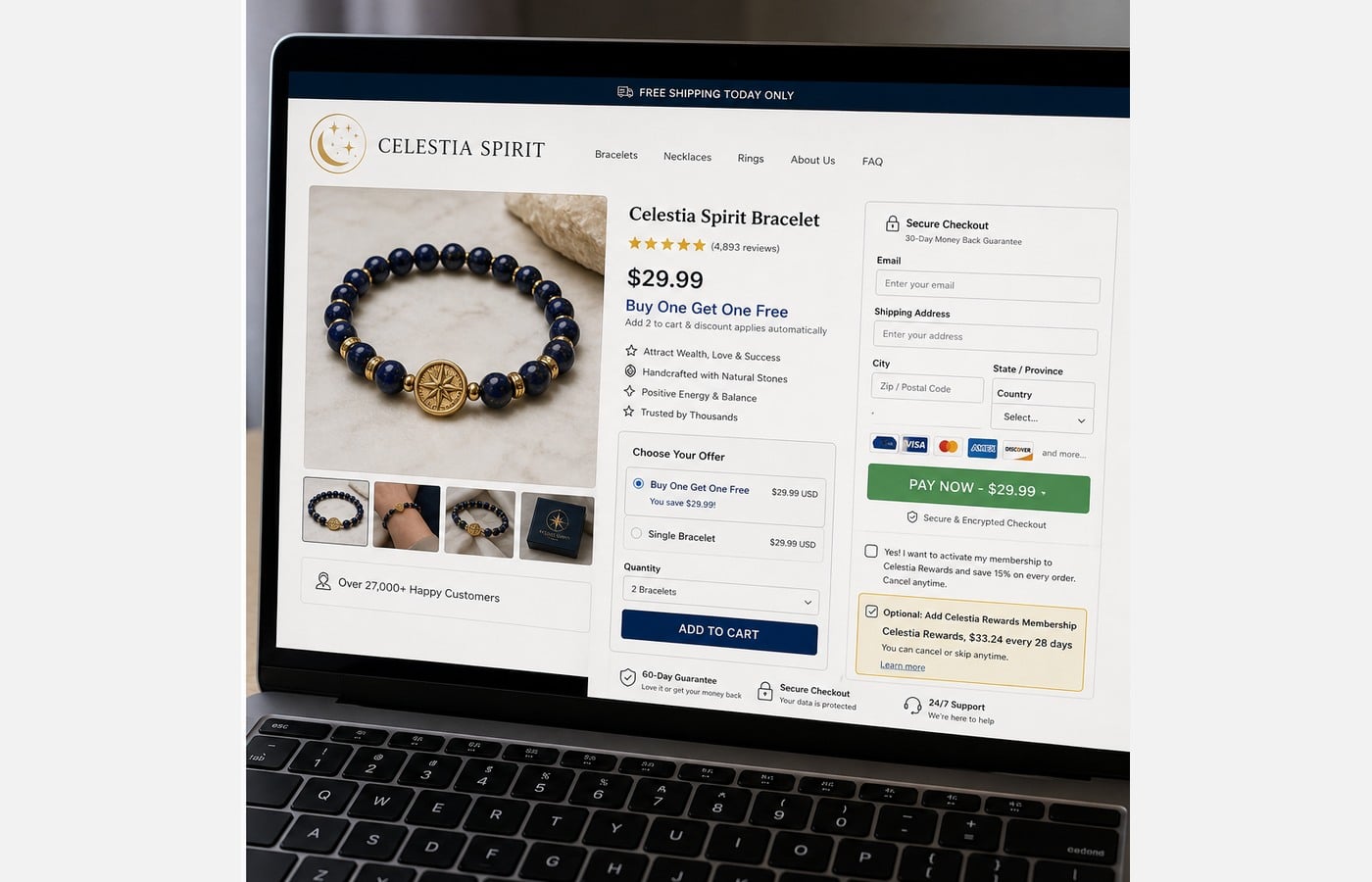
The current Spirilet terms identify 154321632 Canada Inc as the operator and describe an optional membership billed at $33.24 every 28 days. Older indexed pages described a $21 monthly rewards program, showing that the offer and price can change over time.
Numerous public reviewers allege that recurring charges surprised them or continued after the bracelet purchase. Those are customer allegations, not proof that every order is enrolled, but they are serious enough to make the checkout checkbox, confirmation email, and card statement essential reading.
- AI-generated testimonials describe sudden improvements in money, love, or health.
- Celebrity associations are suggested without a verifiable endorsement.
- An ordinary bracelet is presented as a channel for supernatural results.
- Stone type, origin, and value may be difficult to verify from the page.
- The legal terms name a $33.24 charge every 28 days for an optional membership.
- Customers have publicly alleged unexpected or difficult-to-stop billing.
- The seller, international fulfillment partner, and returns destination may be different entities.
What Spirilet's Own Pages Reveal
The sales copy uses phrases such as Manifest Abundance and Freedom, unblock manifestation, and communicate with the universe. A product page has also displayed a testimonial claiming that a romantic interest asked a customer out after she wore the bracelet. These are extraordinary narratives attached to a modest accessory.
The company's terms take a much narrower position. They state that spiritual, zodiac, astrology, and manifestation content is provided for entertainment and personal enjoyment, with no guarantee of a financial, psychological, medical, or personal outcome. That disclaimer is fundamentally different from an ad suggesting the bracelet changed a life.
The same terms say enrollment in the subscription requires a manually selected checkbox and authorizes $33.24 every 28 days. They also say an account is created, cancellation is handled through a customer portal, and a refund request does not automatically cancel the subscription.
That last distinction can cost money. A buyer may receive a refund for one charge while future billing remains active unless the membership is separately cancelled. Anyone who bought the bracelet should verify both the refund status and the subscription status in writing.
The site currently gives the contact email info@spirilet.com and phone number +1 404-400-4899. It says orders are completed by an international seller named Reach USA. Earlier indexed pages named SmartBuyers LLC, while current terms name 154321632 Canada Inc.
A changing collection of names does not by itself prove fraud. It does make the transaction harder to understand, especially when the brand, legal operator, fulfillment partner, payment processor, return location, and card descriptor may not match.
The refund information is also inconsistent across indexed pages. One policy describes 30 days, while current terms describe 120 days for physical products. Save the version displayed when you ordered because a later edit should not erase the terms that influenced the purchase.
The Bracelet, Gemstones, and Testimonial Problem
The bracelet has been promoted as a personalized spiritual object made with stones connected to a zodiac sign. Similar-looking blue bead bracelets appear across large marketplaces at a wide range of prices, so appearance alone cannot establish the composition, origin, or special value of the item delivered.
The FTC's Jewelry Guides say sellers should truthfully represent the type, quality, material, origin, price, value, manufacture, and distribution of jewelry. If a stone is simulated or imitation, that fact should be clearly disclosed rather than obscured by mystical language.
A customer cannot determine whether a bead is mined lapis lazuli, dyed stone, glass, resin, or another material from a lifestyle photo. Ask for the exact materials, treatments, origin, and supporting documentation before treating a spiritual description as a product specification.
The AI testimonial layer creates a second verification problem. A generated face can be given any backstory, and a synthesized narrator can claim a promotion, pregnancy, debt payoff, or reconciliation that never occurred. Search the speaker's name and original account, then look for a disclosure that the scene is dramatized.
Public reviews of Spirilet are mixed. Some buyers praise the bracelet's appearance or customer service, while others allege breakage, long delivery times, unrecognized charges, or subscriptions they say they did not knowingly request. That mixed record is more informative than selecting only the five-star cards shown by the seller.
The product can exist and still be sold through misleading advertising. Receiving a bracelet does not validate supernatural promises, prove that a celebrity wore it, establish the stone's claimed origin, or show that a recurring membership was clearly understood.
The practical conclusion is narrower than declaring every bead counterfeit. The emotional outcome claims are unverified, the celebrity-style promotion is not reliable evidence, and the documented renewal terms create a financial risk that must be evaluated independently of the jewelry.
How the Celebrity Manifestation Bracelet Scam Works
Step 1: An AI testimonial begins with a painful personal story
A social video introduces someone who felt unlucky, lonely, broke, or emotionally exhausted. The person says ordinary solutions failed until a mysterious bracelet appeared at exactly the right moment.
The story mirrors a viewer's private hopes and lowers skepticism before price, materials, company identity, or billing terms are discussed. It is emotional targeting disguised as a personal recommendation.
Step 2: Celebrity secrecy makes the object feel exclusive
The narrator hints that wealthy or famous people use the same stones, or that an unnamed celebrity tried to suppress the discovery. Images may resemble entertainment coverage without linking to an authentic interview.
This borrowed authority is easy to fake with AI. A genuine endorsement should be traceable to the person's verified channels and should disclose whether the person was paid or received the product.
Step 3: A mystical explanation avoids measurable proof
The page says negative energy blocks abundance and that the bracelet reopens communication with the universe. Scientific-sounding references to frequency, vibration, and natural stone are mixed with spiritual claims.
None of this demonstrates that wearing the item causes money, romance, fertility, or health improvements. The explanation is structured so that failure can always be blamed on timing or the user's mindset.
Step 4: A large markdown creates an impulse purchase
The bracelet appears reduced from a much higher reference price and may include a buy-one-get-one offer, limited stock message, or lifetime guarantee. The apparent bargain discourages comparison shopping.
Compare the exact material, clasp, bead size, and construction on independent marketplaces. A discount is meaningful only when the reference price and product specifications are real and comparable.
Step 5: A rewards checkbox can authorize recurring billing
At checkout, the buyer may be offered savings, zodiac updates, partner deals, or membership benefits. The current terms say selecting the option authorizes $33.24 every 28 days, starting 28 days after enrollment.
Do not rely on the product total alone. Read the text beside every checkbox, capture it before payment, and inspect the confirmation email for the words subscription, membership, renewal, rewards, or auto-bill.
Step 6: International fulfillment separates the ad from the package
The storefront says an international seller handles orders, while customer support provides a return address only after contact. The parcel label may therefore identify a logistics partner rather than the company named in the terms.
This separation can complicate refunds. Shipping a bracelet back to a warehouse does not necessarily cancel digital membership billing, and cancelling a membership does not automatically create a merchandise refund.
Step 7: New charges appear after the emotional purchase is forgotten
A renewal every 28 days does not fall on the same calendar date each month. A descriptor may also differ from the brand the customer remembers, making the charge harder to recognize quickly.
By the time several renewals are noticed, the advertisement may be gone. That is why the order page, checkbox, terms, confirmation, bank descriptor, and cancellation record should be saved together.
Company, Address, and Fulfillment Checks
The company name has changed across indexed pages
Current terms identify 154321632 Canada Inc. Older storefront content identified SmartBuyers LLC, and current footer language says Reach USA completes orders. Consumers should not have to assemble this chain after a billing dispute.
Ask which entity sold the bracelet, which owns the subscription, which processes refunds, and which appears on the statement. If support cannot answer all four, the accountability trail is too weak.
The contact page gives a phone, but no clear operating address
The published phone is +1 404-400-4899 and the email is info@spirilet.com. The current terms select courts in Montreal, Quebec, yet the contact page does not present a normal headquarters or return address beside those details.
A support number is useful only if it answers product-specific questions and sends written confirmation. Call before ordering and ask for the legal operator, physical return location, renewal price, and exact cancellation process.
The fulfillment partner is not proof of manufacture
A warehouse or international seller can pack and route bracelets without designing, testing, or manufacturing them. The name on a parcel cannot prove where the beads were made or whether the material matches the advertisement.
Demand a complete material description and country-of-origin information. Cheap mass-produced jewelry is not automatically dangerous, but unknown alloys, coatings, dyes, and stones deserve caution, especially for sensitive skin.
Support must cancel the charge, not merely calm the customer
Customer reviews often describe friendly replies, but a polite response is not the same as a completed cancellation. The only useful result is written confirmation that the membership is closed, future charges are stopped, and any promised refund has been issued.
Check the portal after speaking with support and monitor the next statement. If billing continues, contact the card issuer promptly with the terms, cancellation proof, and dates of every renewal.
Warning Signs to Watch For
- A bracelet is credited with money, romance, pregnancy, or medical improvements.
- The testimonial speaker cannot be verified outside the advertisement.
- Celebrity involvement is implied but never confirmed on an official channel.
- Mystical and scientific words are blended without testable evidence.
- The stone type and origin are not supported by product documentation.
- A rewards offer authorizes $33.24 every 28 days.
- Refunding one charge does not automatically cancel the subscription.
- The brand, legal operator, fulfillment partner, and statement descriptor may differ.
The sharpest warning is the contrast between the miracle story and the contract. The ad talks about abundance and destiny, while the legally meaningful text talks about a recurring card charge. Read the second one first.
What to Do if You Have Fallen Victim to This Scam
- Cancel the membership separately from the product order. Log in to the customer portal and complete the subscription cancellation. Then email info@spirilet.com requesting written confirmation that the $33.24 charge every 28 days has ended. A refund request alone may not stop future billing under the published terms.
- Contact the card issuer from the number on the card. Explain the bracelet purchase, any checkbox you remember seeing, and each charge you did not expect. Ask about disputes, blocking the recurring merchant token, and replacing the card if cancellation cannot be confirmed.
- Save the advertisement and checkout evidence. Keep the social video, celebrity implication, product claims, materials description, price, subscription language, confirmation email, receipt, parcel label, support replies, and statement descriptors. Date every screenshot.
- Document the bracelet you actually received. Photograph the packaging, labels, bead color, clasp, defects, and any irritation. Do not discard the mailing envelope because its sender and return details may identify the fulfillment chain.
- Change any reused password. If the shop password was also used for email, social media, or shopping accounts, replace it everywhere. Enable multi-factor authentication and review active sessions and saved payment methods.
- Scan the device if the ad caused downloads or redirects. Remove unknown shopping apps, browser extensions, profiles, or notification permissions introduced by the funnel. Run a full Malwarebytes scan if anything was installed or the browser began acting strangely.
- Reduce repeat exposure to malicious advertising. AdGuard can block many ad domains, pop-ups, and tracking redirects used to retarget previous buyers. It cannot authenticate gemstone claims or cancel a membership, so keep monitoring the financial account.
- Report the marketing accurately. Report the social ad to the platform and submit the billing trail at ReportFraud.ftc.gov. Distinguish the documented subscription terms from your personal experience so investigators receive a precise account.
- Speak with a clinician about a physical reaction. Stop wearing the bracelet if it causes a rash, swelling, pain, or other reaction. Seek medical advice when needed and keep the item and packaging in case material information becomes relevant.
Frequently Asked Questions
Can a manifestation bracelet attract money or love?
There is no reliable evidence that wearing a bracelet causes wealth, romance, fertility, or other promised life outcomes. It may have decorative or personal symbolic value, but that is different from a guaranteed result.
Is every Spirilet buyer automatically subscribed?
The current terms say the program is optional and requires a checkbox. However, public reviewers have alleged surprising charges, so every buyer should inspect the confirmation and statement rather than assume no membership exists.
How much does the current Spirilet subscription cost?
The published terms reviewed for this article state $33.24 every 28 days. Older indexed content referred to $21 monthly, which is why the exact terms shown at the time of purchase matter.
Who operates the Spirilet website?
Current terms name 154321632 Canada Inc. Other indexed pages have mentioned SmartBuyers LLC and Reach USA, the latter as an international order-fulfillment seller.
Does receiving the bracelet prove the advertisement was honest?
No. Delivery proves a product was shipped. It does not substantiate celebrity involvement, supernatural outcomes, gemstone origin, reference pricing, or the clarity of recurring billing.
What should I do about an unfamiliar renewal?
Cancel through the portal, notify support in writing, and contact the card issuer promptly. Save the checkout, terms, confirmations, correspondence, and statement descriptor for any dispute.
The Bottom Line
The celebrity manifestation bracelet scam turns ordinary jewelry into an emotional rescue story, then places the consequential financial terms at checkout. AI testimonials and celebrity hints cannot prove that a bracelet changes destiny.
Treat the item as jewelry, verify its materials, and inspect every billing option. If a $33.24 renewal every 28 days was not what you intended, cancel both the membership and any stored payment authority immediately.

Join the discussion
0 commentsShare your experience or ask a question about this article.
Discussion
Start the conversation
Have a question or something useful to share? Add the first comment.