

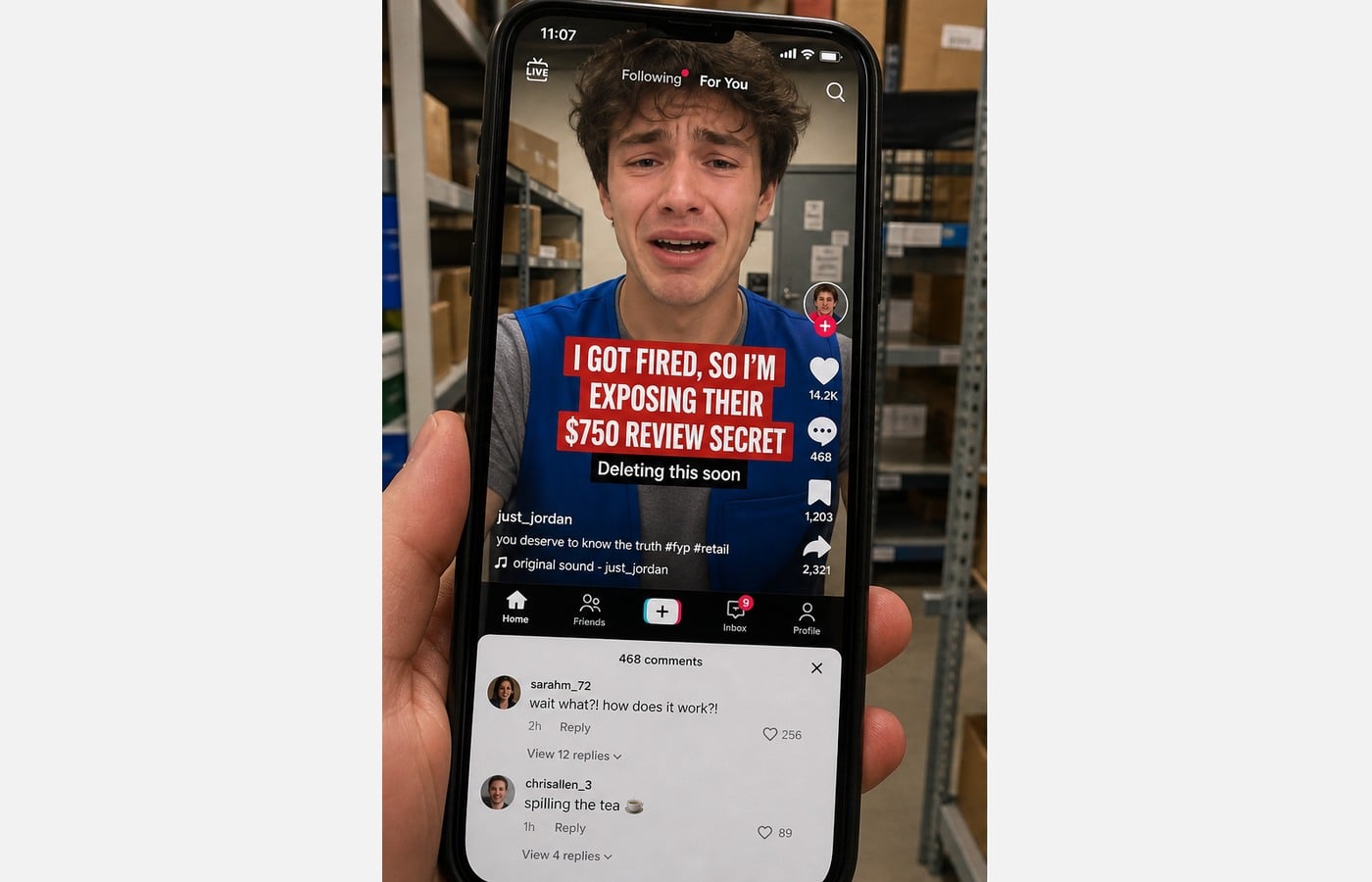
The employee looks angry, embarrassed, and ready to settle a score. After being fired for leaving work during an emergency, the person promises to reveal the company's most closely guarded secret, a product review worth $750.
It is a powerful little story because it explains why the offer is not on the retailer's website. The fired employee review secret scam turns the lack of official evidence into part of the bait.
Overview
The whistleblower story gives the link a believable reason to exist
The fired employee review secret scam usually appears as a TikTok slideshow or emotional video. A supposed worker says management treated them unfairly, so they are exposing discounts, price codes, or a hidden product-review program before the post is deleted.
The firing, emergency, uniform, and workplace photos are narrative props. They make the creator seem reluctant and credible, while the deleting soon caption pressures viewers to click before checking whether the person ever worked for the named brand.
The promised review job becomes a promotional reward funnel
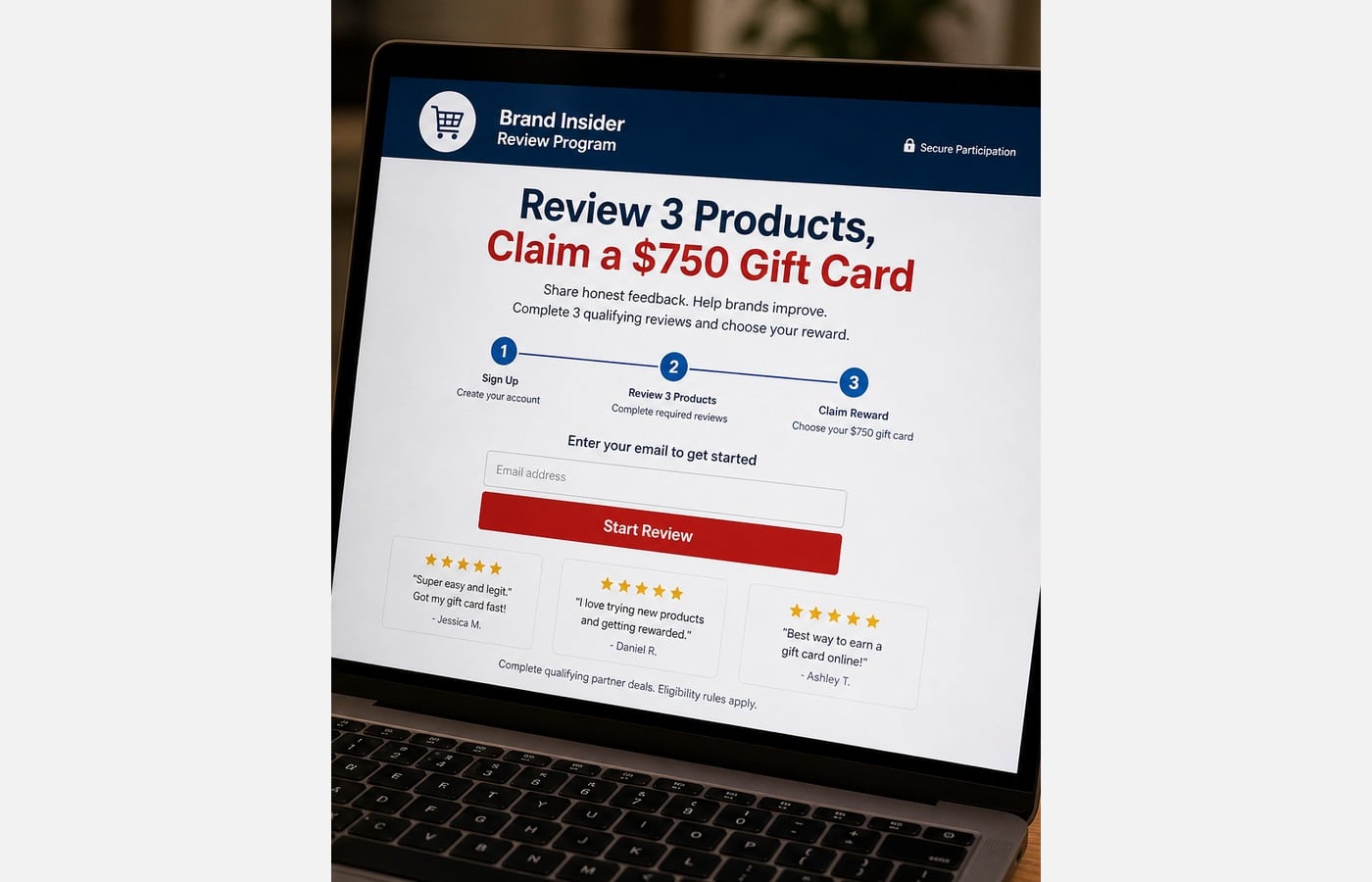
The video says a person can review one or three products and receive a $750 gift card. The linked page then requests contact details and may require multiple qualifying deals, purchases, app installations, or trials from third-party marketing partners.
That is not a normal paid-review job. The visitor becomes a sales lead and promotion participant. Any possible reward is controlled by lengthy eligibility rules, tracking, deadlines, household limits, and verification requirements absent from the whistleblower story.
The brand can change while the script remains identical
Versions have invoked Walmart, Target, Starbucks, Lululemon, Crumbl, and other popular names. Domains such as 750Review, 750Circle, Sbux100, and TokTest have helped make each version look tailored to the brand in the video.
The stable feature is not the retailer. It is the story of a disgruntled insider leading viewers to an unrelated reward or subscription page. Recognizing that pattern protects readers when the next campaign uses a new uniform and logo.
- A supposed employee is fired after a dramatic personal emergency.
- The person vows to expose company secrets and delete the post soon.
- One secret promises a $750 gift card for simple product reviews.
- The link uses a domain unrelated to the retailer's official site.
- A short questionnaire collects contact and demographic information.
- Qualifying deals, trials, or purchases appear after registration.
- The reward can depend on tracking, verification, and strict deadlines.
Why the Fired Worker Story Is So Effective
Most suspicious offers suffer from an obvious problem: if the benefit is real, why can nobody find it on the company's official website? The fired-worker narrative answers that question before the viewer asks. It claims the program is an internal secret that management never wanted publicized.
The emergency gives the character moral credibility. A person fired for taking a partner to the hospital or a pet to the veterinarian appears sympathetic, and retaliation feels understandable. Viewers may share the post to support the worker before checking the linked domain.
A slideshow can use stolen workplace photographs, AI-generated people, or unrelated creators. A name badge and colored vest are inexpensive props. Ask for a verified employment history, an original account with consistent older posts, and evidence that the retailer recognizes the program.
The phrase deleting this soon creates artificial scarcity. A legitimate employee benefit or customer promotion does not become valid because a social account threatens to erase the instructions. The deadline exists to prevent the viewer from searching the brand's official help center.
The $750 amount is large enough to relieve grocery or holiday pressure but not so large that it immediately sounds like a lottery. The task, reviewing a few products, also resembles genuine consumer research, which makes the fictional reward easier to accept.
Real market research can pay participants, but recruitment identifies the research firm, purpose, eligibility, compensation, privacy rules, and time required. It does not ordinarily ask a participant to buy unrelated services to qualify for wages.
The FTC warns against task offers that pay for ratings and reviews, especially when participants must put in their own money. Honest employers pay workers. They do not make wages conditional on trial subscriptions, deposits, or buying a package of partner deals.
What Happens Behind the $750 Review Button
Earlier reward funnels have directed participants to companies associated with RewardZone USA and Fluent. Program descriptions stated that users could qualify by registering, providing personally identifiable information, completing deals from marketing partners, and passing an identity verification process.
The FTC brought a case against Fluent, RewardZone USA, and related companies in 2023. The agency's complaint described lead-generation practices and named brands including Up Rewards, The Reward Genius, Flash Rewards, and National Consumer Center. The case ended with a stipulated order.
That enforcement history does not prove that every current $750 page is operated by the same company. It does show why the legal operator, partner network, consent language, and exact domain must be identified rather than assuming the retailer in the video runs the program.
Deal walls can include streaming plans, apps, subscriptions, insurance inquiries, online education, and other offers. Some begin with a low price or free trial and renew if the participant does not cancel with the individual merchant.
Tracking is a second hazard. A completed offer may not credit because cookies were blocked, devices changed, the merchant rejected eligibility, or reporting arrived late. The participant may then spend again to replace the missing deal and protect the time already invested.
Identity verification may require a photo ID and proof of address. Those requirements can be part of fraud prevention for a real promotional program, but they are far more sensitive than the easy social video suggests. Never upload identity documents until the legal recipient and privacy terms are verified.
A few people reporting successful rewards would not make the original whistleblower story honest. The central deception is presenting a conditional, commercial lead-generation program as a secret retailer payment for three simple reviews.
How the Fired Employee Review Secret Scam Works
Step 1: A dramatic firing story earns sympathy
The post says a worker was dismissed after leaving for a family, medical, or pet emergency. Workplace photos, tears, and a uniform make the account feel personal rather than promotional.
The viewer is invited to take the worker's side. That emotional choice happens before the promised $750 benefit appears, so skepticism can feel like doubting a victim.
Step 2: The worker reveals a forbidden $750 review program
The person lists harmless store tips, then saves the valuable secret for the final slide. A domain supposedly lets anyone review a few products for a $750 gift card.
The late reveal increases watch time and makes the link feel like a reward for hearing the full story. No official policy or retailer announcement is shown.
Step 3: A lookalike page asks easy eligibility questions
The landing page uses familiar colors and a generic gift card while asking age, location, or shopping-preference questions. Nearly every response advances to a congratulations screen.
The quiz does not test review skill or create employment. It prepares the visitor for registration and can categorize the lead for advertisers.
Step 4: Registration collects valuable contact data
The visitor enters a name, email, phone, address, and demographic details. Consent text may permit calls, texts, emails, and data sharing with a long list of marketing partners.
The operator can profit from the lead even if the participant never receives a gift card. Read every consent link and do not assume the retailer controls the data.
Step 5: Three reviews become multiple qualifying deals
After registration, the simple task changes. The participant must select deals at several levels, some involving a purchase, subscription, deposit, app, or service application.
The complete cost and time are hard to calculate at the start. A progress meter encourages continued spending because abandoning the process feels like wasting previous effort.
Step 6: Trials renew through separate merchants
Each deal can create its own contract, billing descriptor, cancellation route, and renewal date. Closing the reward page or unsubscribing from its email does not cancel those services.
The participant may later see several small charges under unfamiliar names. Missing one renewal can erase much of the supposed gift card's value before any claim is approved.
Step 7: Verification and tracking delay the reward
The final stage may require proof of completed deals, identity documents, address verification, and submission within a deadline. One uncredited transaction can block the claim.
The original social account can disappear while support focuses only on the formal terms. The user is left enforcing a complex promotion that was advertised as three easy product reviews.
Company, Address, and Fulfillment Checks
The retailer in the video is usually not the legal operator
A brand logo creates interest, but the terms may identify a lead generator, reward administrator, affiliate, and several partner merchants. None may be owned by the retailer portrayed in the firing story.
Compare the legal name in the footer with the website domain, privacy policy, consent list, receipts, and card statement. If the retailer is absent, it cannot resolve the contracts created elsewhere.
A real office does not validate a false recruitment story
Reward and marketing companies can have registered offices and still be promoted through unauthorized affiliates. An address proves where a company receives legal mail, not that the social employee is real or that the retailer approved the ad.
Search the address and entity in official registries, then ask whether the operator accepts responsibility for the exact sponsored post and $750 review wording.
Support is fragmented across the funnel
The reward desk handles tracking, each merchant handles its subscription, the platform handles the ad, and the retailer handles none of them. This fragmentation benefits promoters when a participant needs to stop charges quickly.
Create a table of every company, offer, support address, renewal date, and cancellation number. One general unsubscribe request is not enough.
Digital lead fulfillment is the real supply chain
The affiliate delivers a click, the landing page captures a lead, marketing partners receive registrations, merchants collect payments, and an administrator decides whether the reward qualifies.
That chain explains the economics far better than a retailer paying $750 for three opinions. Follow who receives data and money at each step.
Warning Signs to Watch For
- A new account claims to be a recently fired employee.
- The backstory is more detailed than the reward's legal terms.
- The post says it will be deleted soon.
- A $750 gift card is promised for only a few reviews.
- The link does not use the retailer's official domain.
- Everyone appears to qualify after easy questions.
- Purchases and trials replace the promised review task.
- Several companies control billing and support.
The story is designed to make missing official evidence feel like proof of secrecy. Reverse that logic. If the retailer does not publish the program and the link leaves its domain, the supposed employee secret is a warning, not an opportunity.
What to Do if You Have Fallen Victim to This Scam
- Stop completing deals and list every one already opened. Search email, texts, browser history, and app stores for every registration, trial, purchase, quote request, or subscription started through the $750 page. Record the merchant, price, trial end, and renewal date.
- Cancel each merchant separately. Use the official account or receipt for every deal. Request cancellation and written confirmation from each company. Closing the reward account does not automatically end third-party subscriptions.
- Contact the card issuer quickly. Explain the fired-employee story, the $750 promise, and any costs that were not clear before registration. Ask about disputes, merchant blocks, recurring payment tokens, and replacing the card when appropriate.
- Secure accounts and reused passwords. Change any password entered on the funnel if it was reused elsewhere. Review email forwarding, shopping accounts, saved cards, login sessions, and multi-factor authentication settings.
- Preserve the entire advertisement path. Save the employee video, account history, deleting-soon caption, domain, survey, consent text, deal wall, terms, receipts, cancellations, and statement descriptors. The emotional promise and later conditions belong in the same evidence package.
- Remove apps and scan the device. Delete downloads, extensions, profiles, and notification permissions installed only to complete deals. Run Malwarebytes if the device started redirecting, displaying unwanted ads, or requesting suspicious credentials.
- Reduce malicious ads and tracking. AdGuard can block many advertising domains, tracking redirects, and pop-ups used by reward funnels. It cannot tell whether a survey is official, so always navigate to the retailer independently.
- Protect identity documents and credit. If you uploaded an ID, Social Security number, or proof of address to an operator you cannot verify, follow IdentityTheft.gov guidance and consider a fraud alert or credit freeze.
- Report every layer and ignore recovery offers. Report the social post, notify the impersonated retailer, and submit the domains, operators, and charges at ReportFraud.ftc.gov. Do not pay anyone who later promises to approve the reward or recover costs.
Frequently Asked Questions
Do retailers really pay $750 for three product reviews?
Legitimate research and review programs exist, but the offer described here is not verified through a retailer's official channel and adds conditions far beyond three simple reviews.
Why does the ad say the employee was fired?
The story explains why the offer appears outside official channels and creates sympathy, urgency, and a reason to share. It is a persuasion device, not employment verification.
Can a reward program require partner deals?
Some promotional programs do, but those conditions must be evaluated separately from the social claim. Buying several deals is not the same as being paid by a retailer for reviews.
Why might a completed deal not receive credit?
Tracking can fail because of cookies, device changes, eligibility rules, merchant reporting, duplicate households, or deadlines. Save confirmations for every offer.
Should I upload an ID to claim the gift card?
Only after confirming the legal operator, privacy policy, exact claim process, and domain independently. An ID is far more valuable than the easy survey makes it appear.
Does cancelling the reward page stop subscriptions?
No. Every partner merchant may hold a separate billing agreement. Cancel each service directly and monitor the statement.
The Bottom Line
The fired employee review secret scam is a story-first version of a reward funnel. The worker, emergency, and retaliation make the link memorable, but they do not establish a retailer program or a right to $750.
Close the social post and verify the offer from the brand's official site. If three reviews become data collection, partner deals, and renewing trials, the secret benefits the marketers, not the supposed reviewer.

Join the discussion
0 commentsShare your experience or ask a question about this article.
Discussion
Start the conversation
Have a question or something useful to share? Add the first comment.