

A premium electric dirt bike appears in a sponsored post with an almost unbelievable explanation. A warehouse contract ended, the retailer needs space, and a bike normally priced above $1,000 is supposedly available for $49 today.
The Amazon $49 e-bike clearance scam is built around that single moment of disbelief. The page gives the shopper just enough retailer-style design and urgency to turn suspicion into a rushed checkout.
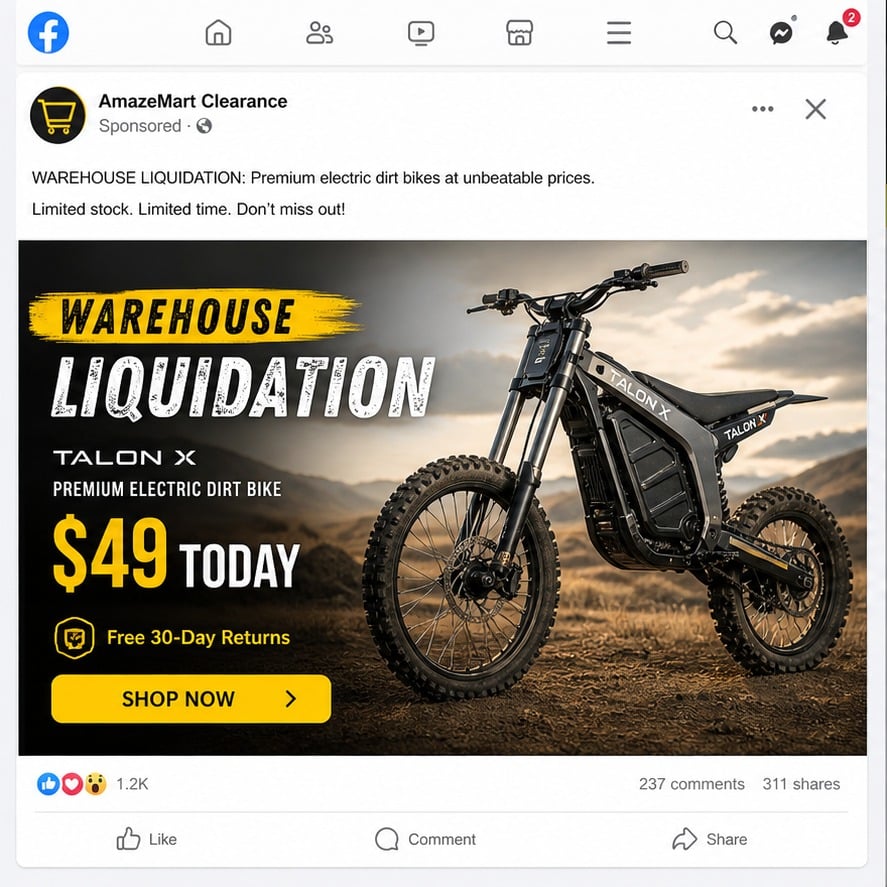
The ad may mention Amazon, a famous e-bike maker, free returns, and limited stock. The clickable domain, however, belongs to an unrelated store with no verified connection to either company.
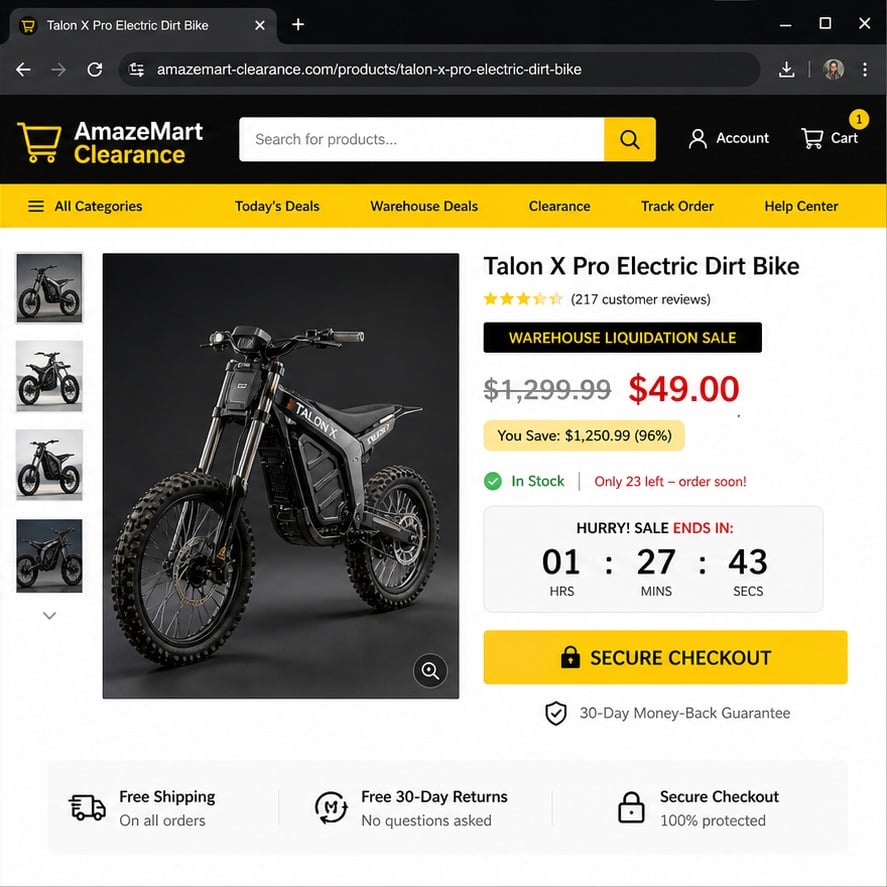
On a phone, the clone page can feel familiar because it uses a black header, yellow buttons, a search bar, review stars, and product categories. Those visual cues are easy to copy and do not authenticate the seller.
If the buyer pays, the likely outcomes range from no meaningful shipment to a cheap substitute, a small unrelated item, or weeks of generic support messages. The $49 hook is reusable, so the domain can change while the story stays the same.
Overview
The sale story does not explain the economics
An electric dirt bike includes a battery pack, motor, controller, frame, suspension, brakes, charger, packaging, and costly shipping. A claimed $49 retail price does not realistically cover that combination for a premium model.
Scam pages avoid the math by inventing a dramatic reason for the discount. Common explanations include warehouse liquidation, abandoned inventory, canceled distributor contracts, damaged boxes, retailer anniversaries, or a one-day staff-only event.
A real liquidation still identifies the seller, product condition, warranty status, quantity, pickup or shipping terms, and return policy. It does not require shoppers to trust a newly encountered domain simply because the page resembles Amazon.
The clone store borrows Amazon's trust without Amazon's protections
The destination can use marketplace-style colors and navigation while removing the details that matter: a verifiable seller profile, authentic order history, platform messaging, buyer protection, and an order visible inside the real Amazon account.
Typing Amazon.com independently should lead to the same product and promotion if Amazon is genuinely running the sale. If the offer exists only behind a social ad on another domain, it is not an Amazon checkout.
A padlock and HTTPS do not change that. Encryption protects the connection to the clone site, even when the site is collecting information under false pretenses.
The story can rotate from e-bikes to mobility scooters
The same historic campaign also advertised inexpensive electric mobility scooters. That rotation shows the store was not built around one carefully sourced product line.
High-value, heavy items work well as bait because shoppers already expect major discounts during clearance events. The low price also encourages multiple purchases for family members before anyone verifies the seller.
When a store suddenly offers e-bikes, scooters, generators, tools, tents, toys, and holiday products through separate advertisements, the inventory may be a collection of copied pages rather than stock the operator possesses.
- A social ad claims Amazon or a known manufacturer is clearing premium inventory.
- The click leaves the real retailer and opens an unrelated domain.
- Marketplace colors and navigation imitate trust without platform protection.
- A $49 price ignores the cost of the battery, motor, frame, and shipping.
- The store hides or blurs the legal company, phone number, and return location.
- The same template can promote scooters, generators, tents, or other expensive items.
The $49 E-Bike Campaign Behind the Warning
A documented campaign used Facebook and Instagram advertisements to promote a premium electric dirt bike and mobility scooters for $49. The pages claimed the items came from an Amazon or manufacturer clearance.
The clickable store used the domain Forgrich.com rather than Amazon.com. Its visual presentation and advertising references created an association with Amazon that the store itself did not substantiate.
One advertisement named a Segway Dirt eBike X260, a product category that normally carried a far higher price. The promotion claimed free returns and used limited-time language to reduce comparison shopping.
The store did not provide a clear phone number or mailing address that allowed a shopper to verify the legal operator before payment. Historical domain information pointed to nameservers associated with a provider in China, while page-management data involved several countries.
Those technical details do not identify who personally operated every advertisement. They do show why the shopper could not simply assume Amazon, Segway, the Facebook page, and the checkout merchant were the same entity.
A seller can also hide the advertised products from its ordinary homepage. Someone arriving directly may see generic merchandise, while the $49 e-bike page appears only to visitors carrying a specific ad link.
Why a Familiar Storefront Is Not Enough
A real marketplace purchase creates an order inside the shopper's account on that marketplace. The seller name, shipping status, messages, return options, and payment record remain available through the official platform.
A clone site may display an Account link that does little or creates a new account only on the clone. It cannot add the purchase to an Amazon order history because Amazon never processed it.
Copied product photos are another clue. Reverse-image searches may show the same e-bike on the manufacturer's site with a different price, specifications, and authorized dealer list.
Reviews embedded on the page are controlled by the seller. Five stars and a number such as 4,827 verified buyers are not independent evidence unless the reviewer identities and platform verification can be checked.
The final merchant descriptor may not resemble the store or advertised brand. Screenshot the checkout and compare the receipt with the pending card transaction before it settles.
If the site requests payment through cryptocurrency, wire transfer, gift card, or a person-to-person app, recovery becomes harder. Credit cards generally provide stronger dispute options for merchandise that never arrives or is not delivered as agreed.
How the Amazon $49 E-Bike Clearance Scam Works
Step 1: The ad invents a credible reason for an impossible price
The campaign does not simply say cheap bike. It supplies a story: Amazon has excess stock, a distributor contract ended, boxes are damaged, or a warehouse must clear inventory before a deadline.
That narrative helps the shopper explain away the price gap. Instead of asking how a premium e-bike can cost $49, the viewer imagines a rare logistical accident.
The post may use a page name containing Amazon, clearance, warehouse, outlet, or electric vehicle. Page names can be chosen freely and do not prove a commercial relationship.
Step 2: The promotion borrows a recognizable product
Photos and video show a premium dirt bike, often with the styling of a known model. The ad lists speed, range, fast charging, and suspension features that make the offer feel specific.
The store may not provide a genuine serializable model number or manufacturer warranty. Its job is to preserve the visual impression long enough to reach checkout.
Some campaigns switch to a mobility scooter or another high-value electric vehicle using the same page structure. The seller identity remains vague while the product bait changes.
Step 3: A clone storefront imitates the trusted retailer
The landing page recreates familiar colors, menus, rating stars, shipping icons, and secure-checkout badges. The browser address is the detail the scammer hopes the shopper will overlook.
Clicking the logo may lead to a generic store instead of the retailer's official homepage. Help links can be incomplete, copied, or routed to a simple email form.
A real Amazon promotion should be reachable through Amazon.com and visible in the user's Amazon account. An unrelated checkout does not inherit Amazon buyer protection.
Step 4: Scarcity pushes the shopper through payment
A countdown, stock meter, and messages about other buyers create the impression that careful research will cause the deal to vanish. Reloading the page may reset these elements.
The form collects the buyer's name, email, phone number, address, and card details. Even if the order is never fulfilled, that data can support later spam and targeted fraud.
The checkout may add shipping insurance, accessories, or multiple units. Review the total rather than relying on the $49 number repeated in the advertisement.
Step 5: Confirmation keeps the buyer waiting
An automated receipt can make the store feel legitimate. It may promise dispatch within several business days and provide a link that never moves beyond order received.
Support replies often blame warehouse volume, customs, weather, or a courier. The explanations change, but the practical result is the same: the buyer delays contacting the card issuer.
A merchant may also send a low-value parcel so tracking shows delivery. Save the package weight and label because they can demonstrate that an e-bike could not have been inside.
Step 6: Refund requests meet an untraceable seller
The email may stop responding, offer a small credit, or require an expensive overseas return. A generic support name cannot explain which company will actually issue the refund.
If the parcel contains a cheap item, photograph it before use and keep all packaging. The difference between what was advertised and what arrived should be described precisely.
Do not let repeated promises push the dispute beyond the issuer's deadline. Ask the bank about timing while continuing to communicate with the seller in writing.
Step 7: The campaign moves to another domain and product
The page template, product images, and clearance story can be copied to a new domain in minutes. The next ad may feature a tent, generator, scooter, tool set, or outdoor building.
Because the product name changes, searching only the current store may return little information. Search the exact price, advertised retailer, product photo, and clearance story as well.
Recognizing the funnel protects against the next version. A famous retailer does not conduct a secret liquidation through an unrelated domain discovered only in a social advertisement.
Company, Address, and Fulfillment Checks
The retailer name in the ad is not the checkout company
Amazon may be mentioned in the creative while an unrelated entity accepts the payment. Compare the domain, terms, receipt, card descriptor, parcel label, and refund email.
If the seller claims to be an authorized dealer, verify that claim through the manufacturer or retailer reached independently. A copied logo is not authorization.
The buyer needs the legal merchant's name, not a temporary store label. Without it, complaints and warranty claims have no clear target.
The address may lead nowhere useful
A clone store may omit its address, provide only a return depot after purchase, or copy a location belonging to another business. Search the exact address and suite before ordering.
A warehouse can forward parcels without operating the website. It is not automatically the headquarters, bike manufacturer, or company that charged the card.
An overseas return is not inherently improper, but hiding it until after payment can turn a promised free return into an uneconomical process.
Support may be a delay mechanism
Send one pre-sale question asking for the exact model, manufacturer, battery certification, warranty provider, and return destination. A legitimate seller should answer directly.
Generic responses about a logistics team or current high demand do not verify inventory. A support inbox that serves unrelated stores is another warning.
After payment, keep communications factual and written. Do not accept endless reshipment promises when the original product cannot be shown to exist in the seller's warehouse.
An e-bike supply chain must be traceable
Electric bikes require a named manufacturer, frame identification, battery specifications, charger certification, motor rating, manual, warranty, and replacement-part path. These are safety and ownership details, not optional marketing extras.
Bikes and batteries can be mass-produced in China or many other countries. Country alone does not determine quality, but an unnamed factory and undocumented lithium battery leave the buyer unable to assess recalls or compatibility.
Do not charge a damaged, swollen, or unmarked battery. A counterfeit charger or mismatched battery can create fire risk even when the bicycle itself appears usable.
A Five-Minute Verification That Breaks the Illusion
First, leave the advertisement and type the retailer's official domain. Search for the exact model and clearance offer there. If the product disappears when the ad link is removed, the retailer association is unproven.
Second, search the destination domain with the words scam, complaint, review, and address. Look beyond star-rating pages that merely repeat the store's own description.
Third, compare the price with the battery alone. A quality e-bike battery can cost several times the advertised $49 total, before the frame, motor, brakes, shipping, and support are considered.
Fourth, reverse-search the main photo. A copied manufacturer image with a different store name and impossible price is strong evidence that the seller does not control the product presentation.
Finally, inspect the payment path. If the transaction leaves the supposed retailer, uses a different merchant, or demands an irreversible payment method, close the page.
Warning Signs to Watch For
- A premium e-bike or scooter is advertised for $49 through a sponsored post.
- The ad invokes Amazon, but the browser never reaches Amazon.com.
- The discount is explained by a vague liquidation or canceled-contract story.
- The page shows no accountable legal company, phone number, or return address.
- A countdown resets or stock messages appear without real inventory information.
- The product is absent from the alleged retailer's official site and order system.
- The store sells unrelated high-value goods through separate hidden landing pages.
- Payment is requested through a gift card, wire, cryptocurrency, or personal payment app.
The discount is not the only thing to verify. The retailer, domain, legal merchant, inventory, battery, return path, and payment protection all need to belong to the same understandable transaction.
What to Do if You Have Fallen Victim to This Scam
- Capture the entire sales funnel now. Save the social ad, page name, domain, product photos, model claims, $49 price, shipping promise, return terms, checkout total, receipt, and card descriptor before the pages disappear.
- Send a written cancellation request. State that you cancel the order and any added protection, accessories, or future billing. Ask the merchant to confirm the refund amount and the date it will be issued.
- Call the card issuer promptly. Explain that the store impersonated a trusted retailer or failed to deliver the advertised merchandise. Ask about dispute deadlines rather than waiting for repeated shipping promises.
- Watch for a low-value tracking parcel. If a package arrives, photograph the label, weight, sealed box, and unboxing. A small envelope or toy can be evidence that the advertised e-bike was never sent.
- Protect the personal data you submitted. Expect targeted email, text, or phone spam after giving the clone store your contact details. Change any password reused on the site and enable multifactor authentication on important accounts.
- Review statements for unfamiliar merchant names. The descriptor may not match the website. Report duplicate, increased, or recurring transactions quickly and ask the issuer whether replacing the card is appropriate.
- Use Malwarebytes if the page installed anything. A normal checkout should not require an app, browser extension, or downloaded invoice viewer. If one was installed, run Malwarebytes and remove detections before using the device for banking.
- Enable AdGuard for added browsing protection. AdGuard can block many malicious advertising networks, redirectors, and known clone stores. Continue checking domains because new storefronts can appear before filters recognize them.
- Report the impersonation and avoid recovery scammers. Report the ad to the social platform, the case to the FTC, and brand misuse to the real retailer. Do not pay a stranger who promises to trace the seller or guarantee a refund.
Frequently Asked Questions
Does Amazon sell premium e-bikes for $49 in secret clearances?
A genuine Amazon promotion should appear on Amazon.com and inside the official order system. An unrelated social-ad domain is not an Amazon checkout.
Why would the clone store send any package?
A low-value parcel can create tracking proof and make a payment dispute more complicated. It does not satisfy an order for a materially different e-bike.
Can I trust a site because it has Amazon-like colors?
No. Store colors, search bars, ratings, and secure badges are easy to copy. Verify the browser domain and legal merchant.
What if the seller promises the bike is still in customs?
Ask for carrier-verifiable tracking and a delivery date, but contact the card issuer about deadlines immediately. Do not let vague delays remove your dispute options.
Should I return a cheap item that arrived?
Preserve evidence and obtain written instructions first. Ask the card issuer whether a return is required and how to prove delivery to the seller.
Could a $49 electric bike battery be unsafe?
The price does not prove danger, but an unnamed maker, missing certification, or damaged battery creates uncertainty. Do not charge an unverified battery that is swollen, hot, leaking, or poorly labeled.
The Bottom Line
The Amazon $49 e-bike clearance scam sells the reputation of a trusted marketplace without using that marketplace's real domain, seller system, or buyer protections.
An impossible price and familiar design are not evidence of inventory. Verify the exact model, legal merchant, battery, address, and order path before entering a card number.
If you already paid, document the transaction and contact the card issuer promptly. The domain may disappear, but screenshots, statements, emails, and package records can preserve the story.








