

A padded device appears in your feed with a promise that feels almost impossible to ignore: lie down for 15 minutes and finally escape years of back pain and sciatica.
The 15-Minute Sciatica Fix Scam becomes more troubling when the medical claims, checkout design, corporate trail, and optional monthly patch program are viewed together.
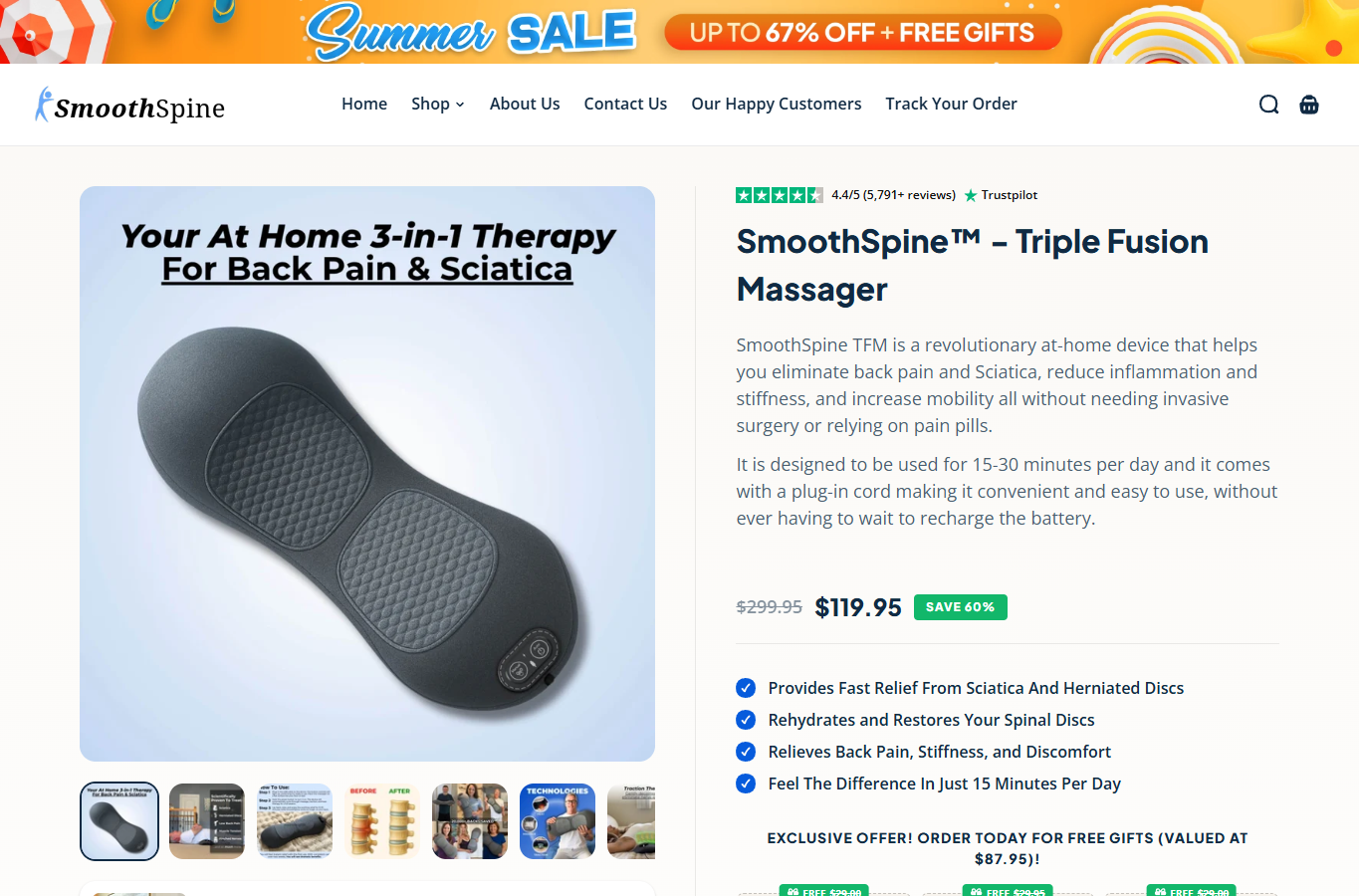
The SmoothSpine product page does not present the device as an ordinary heated back massager. It says the device can rehydrate and restore spinal discs, relieve pressure on the sciatic nerve, and provide results in 15 minutes per day.
The offer starts at $119.95 after a claimed 60% reduction from $299.95. Review graphics, free gifts, a 90-day guarantee, and language about avoiding pills or surgery make the purchase feel medically important rather than optional.
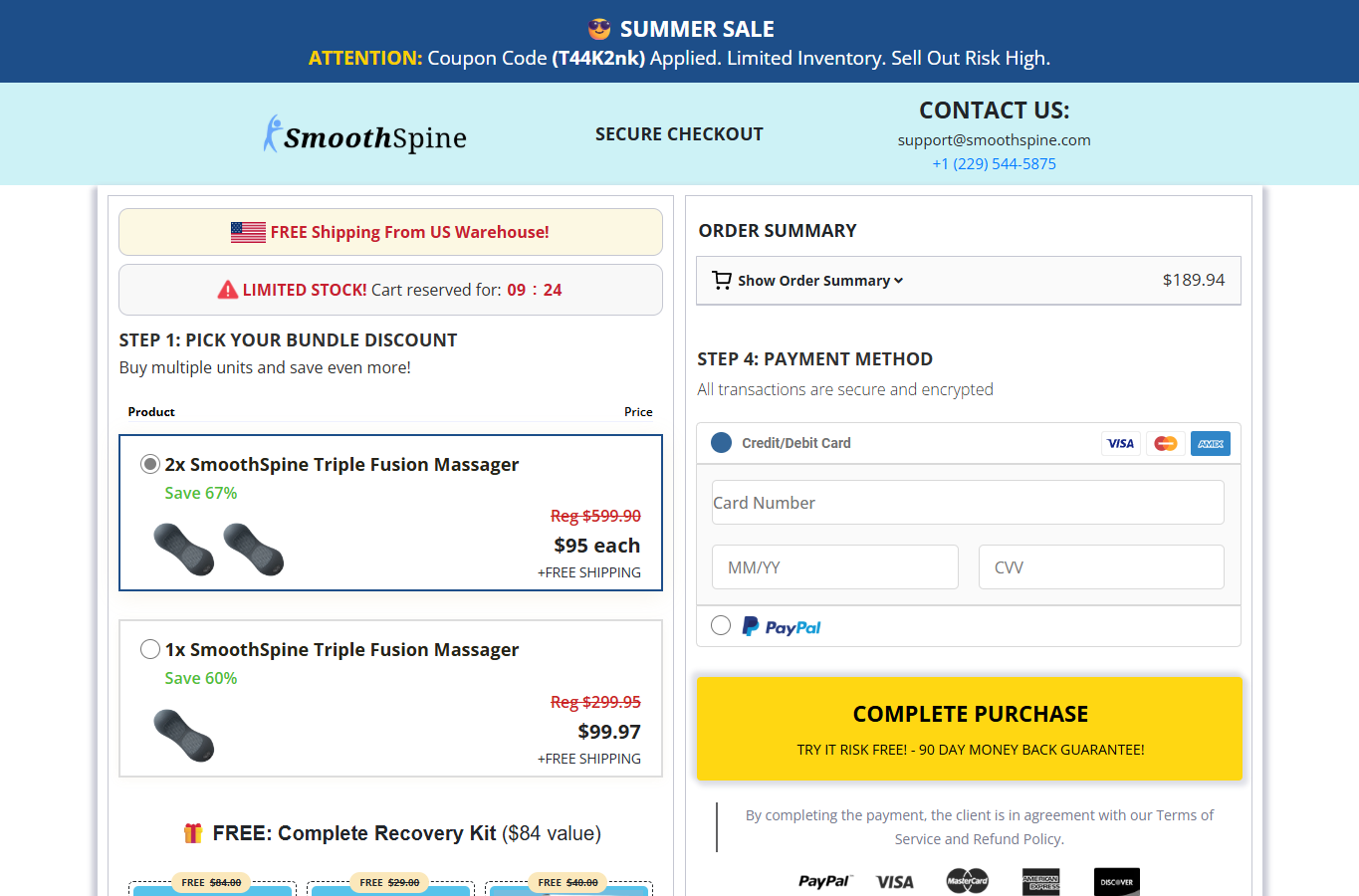
The checkout adds a second layer. It emphasizes bundle savings, limited inventory, a running cart timer, and a large payment button. A separate version of the checkout offers 30 patches and a free device gift for $39.95 per month after a free first month.
Overview
A comfort device is marketed like a medical breakthrough
Heat, massage, and gentle stretching may feel soothing for some people. That limited possibility is stretched into claims about reversing spinal damage, rehydrating discs, relieving herniated discs, and correcting the root cause of sciatica.
SmoothSpine's own terms state that its products are not FDA-approved medical devices unless otherwise stated and are not intended to diagnose, treat, cure, or prevent disease. That is far narrower than the promise on the product page.
A disclaimer does not erase the impression created by the rest of the funnel. When the headline promises disc restoration and the footer calls the product a comfort device, the buyer is receiving two very different messages.
The price presentation is built to make a large order feel safe
The page shows a high reference price, a large percentage reduction, thousands of positive reviews, free bonuses, free shipping, and a long guarantee. Each element lowers resistance before the buyer reaches the payment form.
The checkout can default to a two-device package and show a total near $189.94 while highlighting the smaller per-device amount.
Buyers who intended to test one unit must verify the selected radio button and the final total.
Cart reservation timers and limited-stock warnings create urgency, but browser timers can restart for every visitor. A device promoted for chronic pain should withstand a careful decision without a countdown.
The patch add-on can turn one purchase into monthly billing
One live checkout offers an add-on labeled as a patch subscription. It advertises the first month as free, then states that 30 patches cost $39.95 per month and can be canceled at any time.
A free first month is not a free product when it activates recurring billing. The important information is the renewal date, future price, cancellation method, shipping cost, and whether the option is already selected.
SmoothSpine's terms also say some products and services are offered on an automatically renewing subscription basis. Buyers should preserve the exact checkout because a general policy cannot show what one visitor selected.
- The product page uses disease-like claims that conflict with its own medical disclaimer.
- The discount and review graphics create an appearance of overwhelming proof.
- Bundle pricing can place more than one device in the order.
- A separate patch offer renews at $39.95 per month after the first month.
- Company and address information changes across pages connected with the brand.
- The same physical device is promoted through several domains and landing-page versions.
What SmoothSpine Claims the Device Can Do
The main story says spinal discs dry out and shrink as people sit, work, and age. That process supposedly narrows the space between vertebrae, compresses nerves, and creates the pain that conventional care fails to solve.
SmoothSpine then presents three ordinary comfort features as a coordinated therapy. Traction is said to separate vertebrae, massage is said to improve circulation, and heat is said to accelerate disc rehydration and healing.
The page goes beyond temporary comfort. It says consistent use can reverse damage to the spine and describes the device as a way to avoid expensive physical therapy, injections, pain pills, and surgery.
Testimonials reinforce the same message with stories about chronic pain disappearing, doctors being surprised, and people walking or sleeping normally again. The seller does not provide a transparent method for verifying those individual accounts.
The device itself resembles a generic heated back support with vibration and a curved profile. Its appearance does not establish that it can restore a spinal disc, treat a herniation, or safely address every cause of sciatica.
Back and leg pain can come from several conditions, and some require prompt medical assessment. A one-size-fits-all advertising story can encourage a buyer to delay diagnosis while believing that discomfort proves the device is working.
Why the 15-Minute Medical Promise Does Not Hold Up
A claim that a consumer device reverses spinal damage needs strong finished-product evidence. The sales pages do not identify a peer-reviewed clinical trial in which this exact device restored discs or treated sciatica better than an appropriate comparison.
The page repeatedly uses phrases such as designed with specialists and recommended by professionals. It does not clearly name the specialists, their credentials, their role in development, or a published protocol that can be examined independently.
Heat and massage can change how a person feels without repairing the structure causing the symptoms. Short-term comfort is not proof that a disc has rehydrated, a nerve has decompressed, or a herniation has healed.
The brand's terms explicitly narrow the product to a nonapproved device that is not intended to treat disease. That legal language matters because the main page repeatedly encourages a much broader medical interpretation.
The hidden commercial risk is separate from whether the device feels pleasant. A buyer can like the massager and still be enrolled in an unwanted $39.95 monthly patch shipment if the add-on was not noticed or understood.
How the 15-Minute Sciatica Fix Scam Works
Step 1: A pain-focused video finds people who are already exhausted
The ad appears on social media, a mobile game, a news page, or a video platform. It speaks directly to people who have tried stretching, medication, injections, or physical therapy without lasting relief.
The opening frames the viewer as someone conventional medicine has failed. That emotional positioning makes a home device feel like a final chance rather than another online product.
The advertiser may use synthetic customer clips, polished demonstrations, or medical imagery to suggest that the recommendation comes from patients and clinicians rather than a direct-response marketer.
Step 2: The landing page turns discomfort into a simple disc story
Complex causes of sciatica are reduced to one explanation: dry, compressed discs. The device is then presented as the obvious solution because it combines heat, vibration, and a curved stretching surface.
A simple story is easier to remember than a careful medical explanation. It also makes every feature look necessary, even though the page does not show that the three features produce the claimed structural change.
Words such as rehydrate, decompress, restore, and reverse sound clinical. Their scientific tone can hide the absence of a finished-product clinical trial.
Step 3: Social proof makes the claim feel settled
The page displays thousands of reviews and a high star rating near the purchase area. Testimonials describe dramatic relief after years of unsuccessful treatment.
Those ratings should be checked on the actual review platform, using the exact domain and recent one-star reports as well as the score promoted by the seller. A logo beside stars is not independent verification.
Review volume can also change quickly when a company solicits feedback immediately after delivery, before buyers have tested the product or tried to obtain a refund.
Step 4: The discount and timer move attention away from the total
A claimed $299.95 reference price is reduced to $119.95, while checkout pages can promote two devices at a lower per-unit figure. The eye lands on the savings before the full charge.
Free guides, patches, a travel bag, and shipping are assigned their own values. These additions create the feeling that waiting would mean losing much more than the device.
A cart timer and low-stock message discourage comparison shopping. Reload the page or return later and the same urgency may appear again.
Step 5: Checkout introduces the patch subscription
One checkout adds a patch program after the device has already won the buyer's trust. The first month is described as free and includes a promotional gift, while later months cost $39.95.
Because the initial add-on shows $0, a buyer may treat it as another bonus rather than an authorization for future charges. The recurring price sits in smaller explanatory text.
The safest action is to leave every optional toggle off, screenshot the order summary, and read the receipt immediately. If a subscription appears, cancel it the same day in writing.
Step 6: Multiple company details complicate accountability
SmoothSpine pages list a Florida operations address, while another campaign page lists a unit in Casper, Wyoming. A privacy page names Peak Reach B.V. in Spijkenisse, Netherlands.
Different entities can legitimately handle marketing, privacy, fulfillment, and payments. The problem is that buyers need a clear explanation of which one sold the device and which one must honor a cancellation.
When the receipt, package, policy, and card statement use different names, support disputes become slower and consumers can contact the wrong business.
Step 7: Refund friction can outlast the guarantee
A 90-day badge sounds simple, but buyers still need written authorization, the correct return address, proof of delivery, and confirmation of whether shipping is refundable.
Support delays can consume both the seller's return window and the card issuer's dispute period. Begin both conversations promptly instead of waiting for repeated promises.
Cancel the patch program separately from returning the device. A product return does not always terminate an automatically renewing add-on.
Company, Address, and Fulfillment Checks
The seller identity changes across connected pages
SmoothSpine is the consumer-facing brand, but a privacy page names Peak Reach B.V. in the Netherlands. Other pages use SmoothSpine LLC or provide no equally prominent legal entity beside the payment button.
Before paying, compare the legal name in the terms with the receipt and expected card descriptor. Ask support which entity owns the brand and which entity processes refunds.
A polished logo is not a company record. If support will not identify the merchant of record in writing, do not rely on the guarantee.
The addresses look like administrative points, not a manufacturer
The terms list 7901 4th Street North, Suite 300, St. Petersburg, Florida. Another campaign page lists 312 West 2nd Street, Unit A2299, Casper, Wyoming, while privacy information points to Spijkenisse, Netherlands.
Virtual offices, mailboxes, and fulfillment centers can receive paperwork without designing or manufacturing the product. None of these locations automatically proves where the device or patches were made.
Ask for the responsible manufacturer, country of origin, electrical certifications, and the authorized return location. Do not send a device to an address copied from an advertisement.
The support number must answer subscription questions
The current site lists +1-229-544-5875 and support@smoothspine.com. Contact the team before ordering and ask whether the exact checkout includes the $39.95 patch plan.
A real answer should identify the renewal date, cancellation method, return rules, and card descriptor. A generic response about customer satisfaction is not enough.
After purchase, keep communication in writing. Record the date, agent, request, confirmation number, and every promised refund amount.
The device and patches have an opaque supply chain
The marketing does not clearly establish the factory, technical testing, or responsible medical-device manufacturer behind the massager. The patch add-on needs its own ingredient list, warnings, lot code, and responsible company.
Generic wellness devices and patches are often mass-produced through private-label factories in China and other countries, then sold under rotating online brands.
That model is not proof of danger, but hidden sourcing makes defects and ingredients harder to trace.
Do not place an unknown patch on irritated skin or use a powered device over a recent injury, implanted device, pregnancy-related condition, severe osteoporosis, or unexplained neurological symptoms without professional advice.
What a Back Massager Can Realistically Do
A heated massager may provide temporary relaxation and make some muscle-related discomfort feel better. That is a comfort claim, not evidence that spinal discs were restored or a herniation was corrected.
Sciatica describes symptoms, not one universal cause. New weakness, loss of bladder or bowel control, numbness in the saddle area, fever, trauma, or rapidly worsening pain requires urgent professional assessment rather than an online device trial.
A credible seller would separate short-term comfort from medical treatment, publish clear safety instructions, identify the manufacturer, and place recurring billing beside the main price instead of inside an optional add-on.
The best decision is to ask a clinician what is causing the symptoms, then judge whether a simple heat or massage device is appropriate. The answer should not come from a timer on a checkout page.
Warning Signs to Watch For
- A consumer massager is said to reverse spinal damage.
- Disc rehydration is promised without a finished-product clinical trial.
- Thousands of reviews appear beside a medically framed sales claim.
- The reference price makes a $119.95 device look unusually discounted.
- A two-unit package can be selected at checkout.
- The first free month activates a $39.95 patch subscription.
- Company and address information varies across connected pages.
- A 90-day guarantee is more prominent than the return procedure.
The sharpest warning is the combination of a miracle medical promise and recurring billing. Temporary comfort from a device cannot justify a hidden monthly product that the buyer never meant to order.
What to Do if You Have Fallen Victim to This Scam
- Save the entire sales path before it changes. Capture the ad, video, landing page, claims, package choice, checkout total, recurring terms, receipt, shipping label, and card descriptor connected with SmoothSpine and the patch program. Save the SmoothSpine and the patch program files outside the browser because this campaign can replace domains and pages quickly.
- Cancel the order and every recurring feature in writing. Contact SmoothSpine support and state that you cancel the original order, add-ons, memberships, automatic shipments, and future charges. The cancellation for that 15-minute sales funnel should identify the refund amount and recurring features removed. Keep the merchant's written confirmation.
- Call the card issuer without waiting for support. For the SmoothSpine and the patch program transaction, explain what the advertisement promised, what you believed you were authorizing, and what was actually charged. Ask about blocking that merchant, replacing the card, disputing the SmoothSpine and the patch program merchandise, and the deadline for challenging a later refill.
- Check statements for several months. When reviewing SmoothSpine and the patch program billing, look for the brand, a fulfillment company, a generic wellness descriptor, and unfamiliar small test charges. A SmoothSpine and the patch program refill may use a different descriptor from the bottle, so compare amounts and dates rather than searching for only one word.
- Keep unopened products and all packaging. Photograph every SmoothSpine and the patch program label, seal, lot code, return address, tracking label, ingredient panel, and item in the box. Keep the SmoothSpine and the patch program packaging until the refund or dispute is complete, and use tracked shipping only if the seller truly requires a return.
- Protect your health first. Stop using the device or patches if pain worsens, skin reacts, weakness develops, or new symptoms appear. Contact a clinician or pharmacist with the exact label and device instructions, and seek urgent help for neurological warning signs.
- Secure any account or device exposed during the purchase. Change any password reused during the SmoothSpine and the patch program checkout and enable multifactor authentication if an account was created. If the SmoothSpine and the patch program page forced a download, browser extension, unofficial tracking app, or remote-support tool, remove it and run a full Malwarebytes scan.
- Reduce contact with the same advertising network. AdGuard can block many aggressive ad networks, pop-ups, and redirect chains that feed the SmoothSpine and the patch program funnel. Use AdGuard as a filter around this 15-minute promotion, not as a product endorsement. Independently examine the seller, claims, and checkout terms.
- Report the campaign with useful evidence. Report the ad to the social platform or video service where it appeared, the transaction to the FTC at ReportFraud.ftc.gov, and any serious reaction to the appropriate health regulator. The report for this 15-minute product case should connect the ad to the charge. Include page addresses, support details, statement text, and screenshots.
Frequently Asked Questions
Is SmoothSpine a real device?
A physical heated and vibrating back device is sold and may be delivered. The concern is the scale of the medical claims, the pressured checkout, unclear corporate trail, and optional recurring patch offer.
Can a massager rehydrate a spinal disc?
The sales funnel does not provide strong finished-product evidence that this device restores spinal discs. Feeling temporary relief does not prove a structural change inside the spine.
Does every SmoothSpine order include a subscription?
No. We verified a separate checkout add-on offering patches for $39.95 per month after a free first month. Buyers must check the exact order summary and receipt.
Why does the company list several addresses?
Different companies can handle privacy, operations, and fulfillment. The concern is whether the buyer can identify the merchant responsible for billing, manufacturing, returns, and safety.
What should I do about an unexpected $39.95 charge?
Cancel in writing, ask for a refund, preserve the checkout and receipt, and contact the card issuer promptly. Ask the issuer to block future merchant-initiated charges.
Should I return the device before disputing the charge?
Ask the card issuer and seller first. Obtain a written return authorization and correct address, use tracking, and keep the receipt. Do not let return delays pass the dispute deadline.
The Bottom Line
The 15-Minute Sciatica Fix Scam sells an ordinary comfort device with extraordinary claims about discs, nerves, and lasting recovery. The seller's own disclaimer describes a much narrower product.
The checkout pressure and $39.95 monthly patch option create a second risk that has nothing to do with back pain. A buyer can end up with more devices or recurring patches while still trying to decide whether the original product helps.
Treat the device as a consumer massager, not a cure. Verify the selected quantity, reject optional subscriptions, identify the merchant, and discuss persistent or worsening symptoms with a qualified professional.








