

A breaking health report claims that a suppressed discovery can finally stop burning feet, numb hands, and electric nerve pain. The people on screen look familiar, and the story sounds urgent. The Fake Nerve Pain News Report Scam is not a medical broadcast.
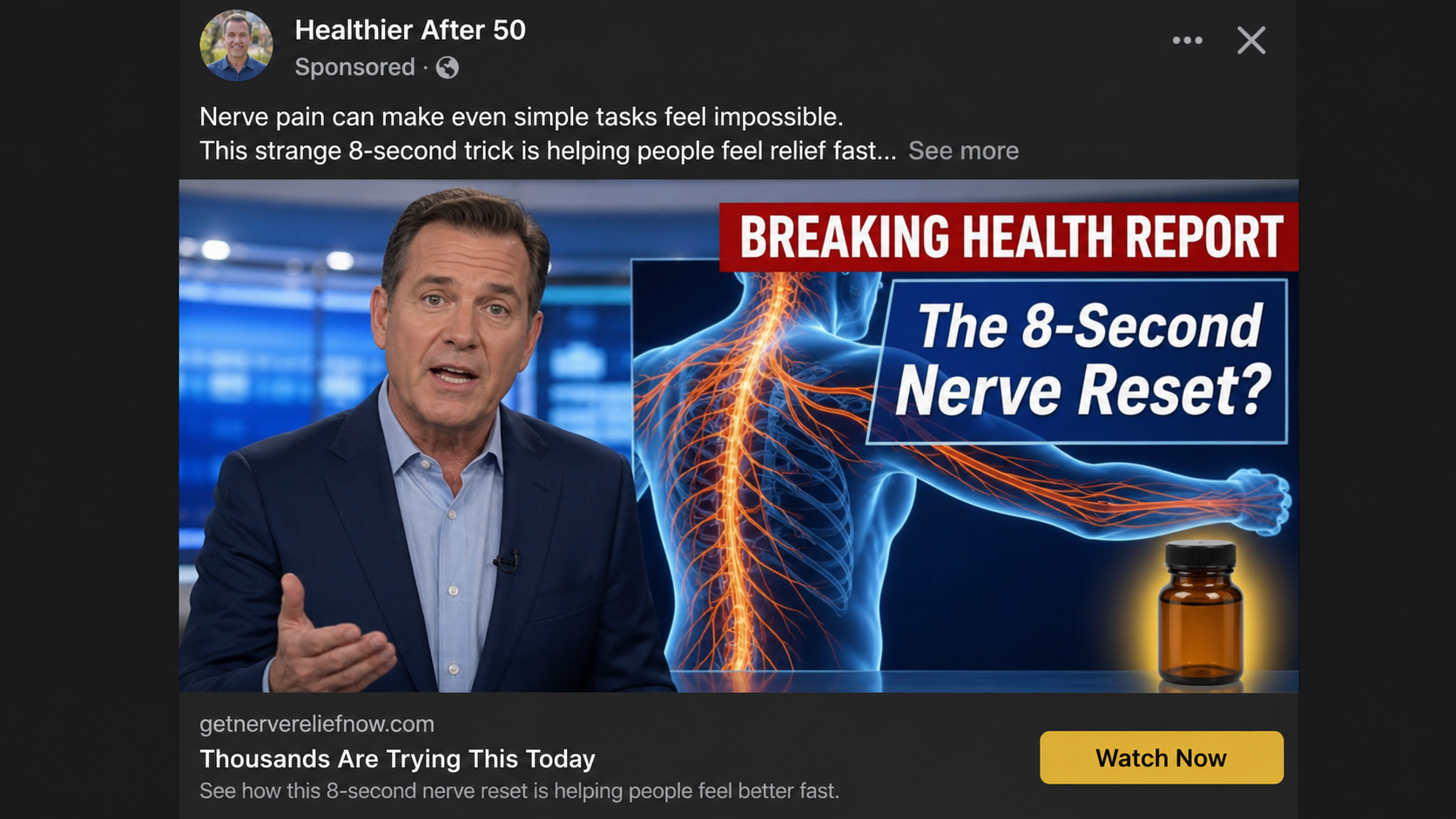
The first ad often looks like a short segment clipped from television. A presenter introduces a natural discovery, a medical animation shows damaged nerves, and a bottle appears only after the viewer has accepted the story as news.
Reported versions have used manipulated footage of real journalists and public figures, along with invented doctors and synthetic voices. The campaign also misuses the names Nervalis and NutraGreen, creating confusion with unrelated legitimate businesses.
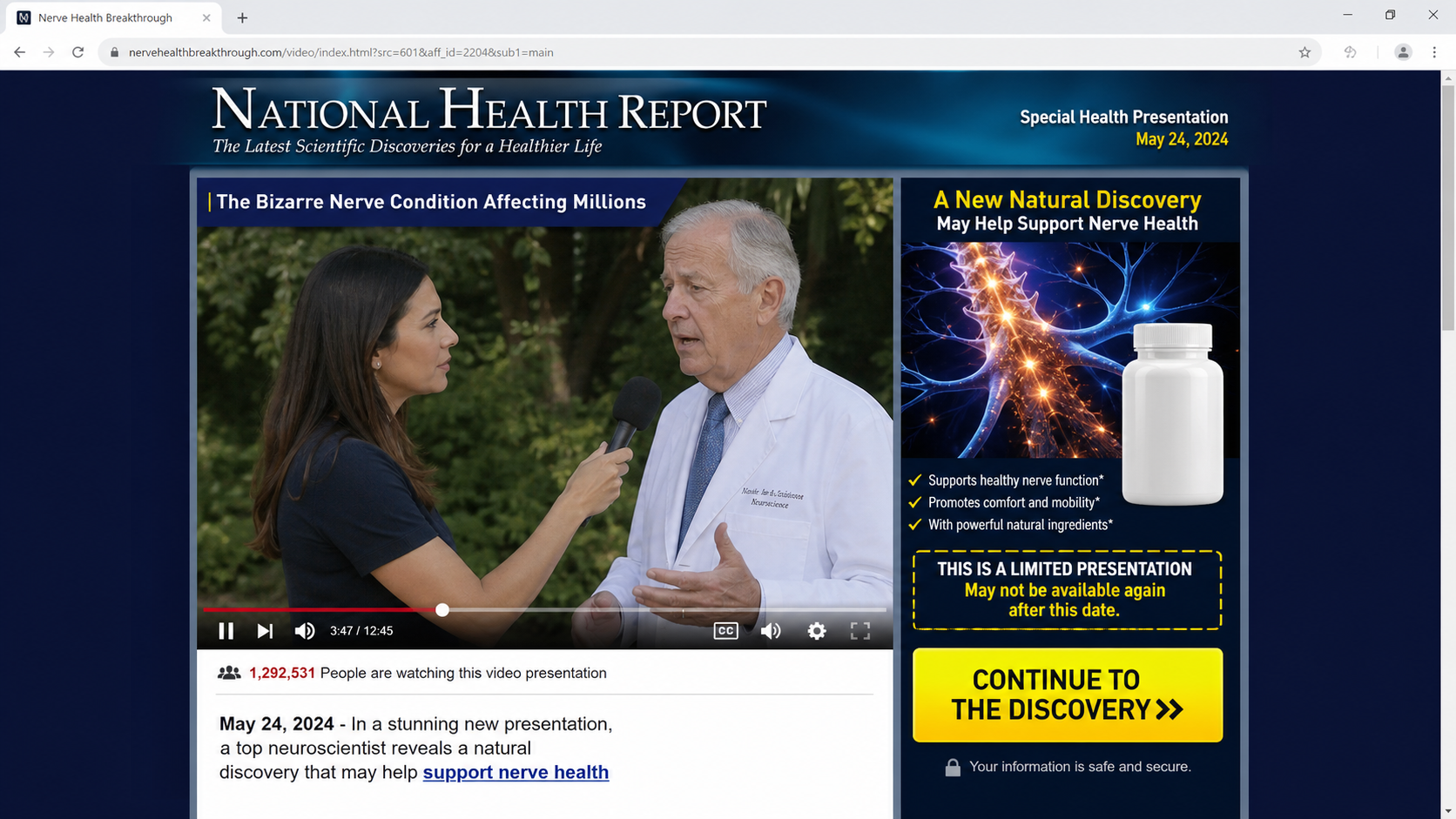
The click can pass through a promotional domain to a second video host that imitates a national broadcast. Normal navigation disappears, the presentation becomes difficult to skip, and the only obvious way forward is a button leading deeper into the funnel.
Overview
It is an AI-built sales funnel that borrows trusted faces, invents experts, and sends viewers toward pills with no accountable company behind them.
The campaign impersonates a news investigation
The page copies the pacing, lower-third graphics, interview format, and urgent tone of a real network report. That visual language encourages viewers to treat advertising claims as independently verified journalism.
Investigated versions have manipulated footage associated with Tom Llamas and Maggie Vespa, then added synthetic segments involving Elon Musk and Dr. Eric Berg. None of those appearances proves an endorsement.
A fake doctor named Michael Stevens can be placed beside the real public figures. Mixing invented and recognizable people makes it harder for viewers to separate authentic footage from generated claims.
Nervalis and NutraGreen are labels, not a transparent seller
The campaign uses Nervalis or NutraGreen Nervalis as if a known supplement company stands behind the offer. Investigators found no verifiable company matching the story and warned that innocent businesses with similar names were being contacted.
Bottle images may be borrowed from unrelated products, cropped, relabeled, or displayed without a readable Supplement Facts panel. The viewer cannot confirm what the checkout will actually ship.
The lack of a stable product identity is intentional. The same video can replace one bottle at the final step without rebuilding the expensive deepfake presentation.
The checkout removes the information a buyer needs most
Reported funnels route through anonymous or recently created domains and generic CartPanda-style order pages. Clear terms, a legal company name, a physical address, and a product-specific refund policy may be absent.
A guarantee badge cannot substitute for a merchant that can be identified and reached. Without a seller, the buyer cannot verify ingredients, adverse-event reporting, cancellation rules, or the return destination.
The product may arrive under another label, arrive from a fulfillment center, or never arrive. Any recurring authorization must be checked on the live payment page because the video does not explain it.
- AI voices place medical claims in trusted people's mouths.
- A fake news layout hides that the page is a direct-response advertisement.
- An invented doctor fills gaps between manipulated real clips.
- Nervalis and NutraGreen do not identify an accountable seller.
- The formula, manufacturer, and finished-product evidence are unclear.
- Anonymous checkout pages make refunds and billing disputes harder.
What the Fake Nerve Pain Story Claims
One version describes a miraculous nerve discovery from Mexico. The presentation says conventional medicine treats only symptoms while a natural formula repairs the real cause of burning, tingling, numbness, and stabbing pain.
The script creates a villain by claiming drug companies profit from ineffective or dangerous products. A deepfake public figure then appears to accuse the industry of hiding a cheaper answer.
An invented specialist explains the supposed mechanism with animated nerves and scientific-sounding phrases. No traceable hospital appointment, license, published study, or institutional biography supports the character.
The presentation broadens the audience by treating many symptoms as evidence of the same hidden condition. Diabetes-related neuropathy, sciatica, chemotherapy effects, circulation problems, and ordinary discomfort are folded into one sales story.
The solution remains vague until late in the video. Viewers are told to keep watching for an ingredient or ritual, but the practical answer becomes a bottle of capsules available only through the attached checkout.
The product name is less important than the route. A social ad, fake broadcast, conspiracy story, mystery doctor, and pressured payment page can sell a new label tomorrow without changing the deception.
Why the Fake Broadcast and Supplement Claims Collapse
A genuine television report can be found on the network's official website, channel, or verified social account. Copies hosted only on promotional domains are not evidence that the network aired the story.
A real clinical discovery identifies researchers, institutions, methods, participants, outcomes, limitations, and a publication. The campaign substitutes a dramatic video and an invented doctor for that traceable evidence.
The FDA does not approve dietary supplements for safety and effectiveness before they are sold. A claim that a facility is registered or follows manufacturing standards does not mean the product was approved to treat neuropathy.
Nerve symptoms can have different causes and may signal a condition that needs diagnosis. A mystery pill sold through an anonymous page can delay care, interact with medication, or expose the buyer to undisclosed ingredients.
The missing company is as important as the missing science. Even a clearly labeled supplement should identify the responsible distributor, lot, ingredients, warnings, and adverse-event contact. The reported funnel does not provide that accountability.
How the Fake Nerve Pain News Report Scam Works
Step 1: A frightening symptom ad appears in a normal feed
The ad names burning feet, pins and needles, numb hands, or pain that keeps someone awake. It sounds personal because the audience has been selected around health, age, or wellness interests.
A television presenter appears before any product. That choice makes the clip feel like public-service information rather than a commercial.
The page name can sound medical but provide no legal company, clinic, or editorial staff. A sponsored label is the first clue that the video is paid persuasion.
Step 2: The click moves through disposable domains
Reported campaigns used domains such as nutragrenn.offers-promotions-sales.com and nutraneurohealth.online. Neither resembles the official domain of the broadcaster being copied.
Redirects help operators replace blocked pages and show different content to reviewers. The domain in the address bar matters more than the logo drawn inside the page.
Save every URL in the chain. The ad account, redirect domain, video host, checkout, and payment processor can belong to different participants.
Step 3: AI turns unrelated clips into a fake special report
Synthetic audio rewrites what real presenters and public figures appear to say. Lip movement can be altered, and a new voice can be layered over footage taken from another subject.
The video inserts an invented physician between recognizable faces. Viewers assume the doctor was vetted by the apparent broadcaster even though the broadcaster is also fake.
Do not rely only on visual glitches. Search the exact quote through verified channels and look for the original footage. Context is a stronger test than counting blinks.
Step 4: The story blames an enemy and promises a cure
The narrator says powerful companies hid a cheap discovery because long-term treatment is profitable. That claim explains why the supposed breakthrough cannot be found in medical guidance.
Fear of medication is used to make the mystery formula feel safer before its ingredients are disclosed. Natural becomes a substitute for evidence.
The story may also warn that nerve damage becomes irreversible, creating pressure to buy before speaking with a clinician.
Step 5: The free discovery becomes mystery capsules
After a long presentation, the viewer learns that the natural method requires a commercial formula. The bottle may be labeled Nervalis, NutraGreen, or another nerve-support name.
Package cards encourage three or six bottles by calling them a complete protocol. The smaller per-bottle number receives more attention than the total charge.
Without a readable label and accountable manufacturer, buyers cannot know whether the delivered capsules match the bottle shown in the video.
Step 6: Checkout captures payment before proving identity
Generic order software can process a card while the page omits a meaningful About section, legal seller, address, and product-specific contact information.
Order bumps, shipping protection, or future shipments may be added near the final button. Screenshot the selected items and recurring language before submitting payment.
If the merchant cannot be identified from the page, leave. A promise of secure encryption protects data in transit, not the honesty of the seller.
Step 7: The campaign changes names after exposure
A new domain, bottle, and fake doctor can be swapped into the same video template. Complaints tied to the old name stop appearing useful even though the mechanism remains.
Search exact script phrases, phone numbers, card descriptors, return addresses, and images, not only the current product label.
The durable warning is a health ad that needs fake journalism to sell an unidentified formula. A legitimate supplement should not require identity theft and fabricated reporting.
Company, Address, and Fulfillment Checks
There is no verified Nervalis seller behind the broadcast
The pages investigated for this campaign did not identify a verifiable company that owned Nervalis or NutraGreen Nervalis. Similar names belonging to unrelated businesses should not be blamed for the fraudulent ads.
The legal entity accepting payment must appear in the terms, receipt, and card descriptor. If only a marketing label is visible, the buyer cannot establish who owes the refund.
Do not contact an innocent company found through a name search. Start with the merchant details on the actual transaction and report impersonation separately.
No reliable headquarters or return address is disclosed
The promotional and video domains provide no credible headquarters, clinic, laboratory, or manufacturer. A later package may show only a fulfillment address.
A warehouse can ship bottles without owning the formula or sales campaign. A virtual mailbox can receive returns without providing meaningful customer support.
Ask the card issuer to identify the merchant of record. Do not mail a return to an address collected from a search result unless the seller authorizes it in writing.
Missing phone and email support destroy the guarantee
A product-specific support number and working email should be visible before payment. Anonymous forms and generic checkout emails are not enough for a health product.
Call before ordering and ask for the formula, recurring terms, return procedure, and legal entity. If no one can answer, the guarantee has no practical value.
After payment, keep every message. Scam operators may delay with scripted replies until refund and dispute deadlines pass.
A mystery supplement supply chain can be dangerous
The campaign does not provide a dependable Supplement Facts panel, responsible distributor, country of origin, lot, or finished-product testing. Buyers cannot evaluate interactions or report a reaction properly.
Private-label pills can be mass-produced in China or other countries and placed in whatever bottle the marketer requests. Country alone does not establish safety, but a hidden source removes accountability for contamination, substitution, and dosage errors.
Do not take an unidentified nerve product with diabetes, blood pressure, anticoagulant, seizure, or pain medication without a clinician or pharmacist reviewing the exact sealed label.
Why Fake News Works So Well on People in Pain
Chronic nerve pain can interrupt sleep, mobility, and concentration. Someone who has tried several treatments may watch a long presentation because the cost of missing a real answer feels higher than the cost of one more bottle.
The fake broadcast supplies certainty. A presenter seems to have investigated, a doctor seems to explain, and a famous person seems to confirm. AI can manufacture all three layers without any participant agreeing to the message.
The conspiracy story protects the sale from outside facts. If a viewer cannot find the cure, the absence is described as proof that the discovery was suppressed.
The safest response is slower. Verify the original broadcast, identify the seller, demand a readable label, and ask a qualified professional what may be causing the symptoms before introducing an unknown product.
Warning Signs to Watch For
- A sponsored clip is styled as breaking television news.
- The domain does not belong to the copied broadcaster.
- Public figures appear to make unusually specific supplement claims.
- An expert has no verifiable license, clinic, or publication history.
- Drug companies are blamed for hiding a natural cure.
- The bottle appears before a readable ingredient panel or seller identity.
- The checkout lacks clear terms, address, and support.
- The campaign relies on recently created and disposable domains.
The central fraud is not one questionable ingredient. It is a complete chain of invented authority that ends with an unidentified merchant asking for a real card number.
What to Do if You Have Fallen Victim to This Scam
- Save the entire sales path before it changes. Capture the ad, video, landing page, claims, package choice, checkout total, recurring terms, receipt, shipping label, and card descriptor connected with the nerve pain supplement order. Save the nerve pain supplement order files outside the browser because this campaign can replace domains and pages quickly.
- Cancel the order and every recurring feature in writing. Contact the merchant named on the receipt or card statement and state that you cancel the original order, add-ons, memberships, automatic shipments, and future charges. Do not accept a vague cancellation promise for that nerve-pain sales funnel. Record the case number, refund amount, and payment-token status for that nerve-pain sales funnel.
- Call the card issuer without waiting for support. For the nerve pain supplement order transaction, explain what the advertisement promised, what you believed you were authorizing, and what was actually charged. Ask about blocking that merchant, replacing the card, disputing the nerve pain supplement order merchandise, and the deadline for challenging a later refill.
- Check statements for several months. When reviewing the nerve pain supplement order billing, look for the brand, a fulfillment company, a generic wellness descriptor, and unfamiliar small test charges. Another nerve pain supplement order refill may use a different descriptor from the bottle, so compare amounts and dates rather than searching for only one word.
- Keep unopened products and all packaging. Photograph every nerve pain supplement order label, seal, lot code, return address, tracking label, ingredient panel, and item in the box. Keep the nerve pain supplement order packaging until the refund or dispute is complete, and use tracked shipping only if the seller truly requires a return.
- Protect your health first. Stop taking any unidentified capsules and keep the bottle sealed if possible. Contact a clinician or pharmacist with the label, lot, and symptoms. Seek urgent care for sudden weakness, facial droop, severe swelling, breathing trouble, or a rapidly worsening neurological problem.
- Secure any account or device exposed during the purchase. Change any password reused during the nerve pain supplement order checkout and enable multifactor authentication if an account was created. If the nerve pain supplement order page forced a download, browser extension, unofficial tracking app, or remote-support tool, remove it and run a full Malwarebytes scan.
- Reduce contact with the same advertising network. AdGuard can block many aggressive ad networks, pop-ups, and redirect chains that feed the nerve pain supplement order funnel. AdGuard cannot establish that the product promoted through this nerve-pain promotion is legitimate. Verify the seller, evidence, terms, and billing separately.
- Report the campaign with useful evidence. Report the ad to Facebook, Instagram, YouTube, or the platform that delivered it, the transaction to the FTC at ReportFraud.ftc.gov, and any serious reaction to the appropriate health regulator. When reporting this nerve-pain product case, attach the destination addresses, advertisements, contact details, statement name, and exact sales claim.
Frequently Asked Questions
Is Nervalis a real nerve supplement?
The campaign uses Nervalis as a marketing label, but investigators could not verify a legitimate company behind the advertised formula. Unrelated businesses with similar names may be innocent.
Did the television network air this report?
No authentic broadcast was verified. The videos copy news graphics and manipulate footage. Check the network's official site and the original presenter's verified accounts.
Are the people in the video real?
Some footage may come from real people, but the words and context are manipulated. Other doctors and presenters can be entirely invented with AI.
What if I received a bottle with another name?
Photograph everything and do not assume it is equivalent. Compare the label with the receipt, contact the card issuer, and ask a pharmacist before taking an unfamiliar product.
Can a natural supplement repair damaged nerves?
Some nutrients are important to nerve health, but that does not validate a mystery formula or a universal cure. Treatment depends on the cause and should be discussed with a qualified professional.
How can I find the real merchant?
Use the card descriptor, receipt, payment processor notice, shipping label, and transaction reference. Your issuer may have a merchant phone number that was not shown on the page.
The Bottom Line
The Fake Nerve Pain News Report Scam creates a television investigation that never happened, fills it with altered and invented people, and uses the resulting trust to sell mystery capsules.
The absence of a stable company, formula, address, and support channel is not a minor website flaw. It means buyers cannot verify what they are taking or who is responsible for billing and refunds.
Close the video, verify the original source, and discuss persistent nerve symptoms with a qualified professional. A legitimate health product should survive those basic checks without a fake newsroom.








