

A governance page carrying Arc's polished visual identity asks the community to choose when the next rewards distribution should happen. Voting appears to be useful participation, and a Vote Now button is ready.
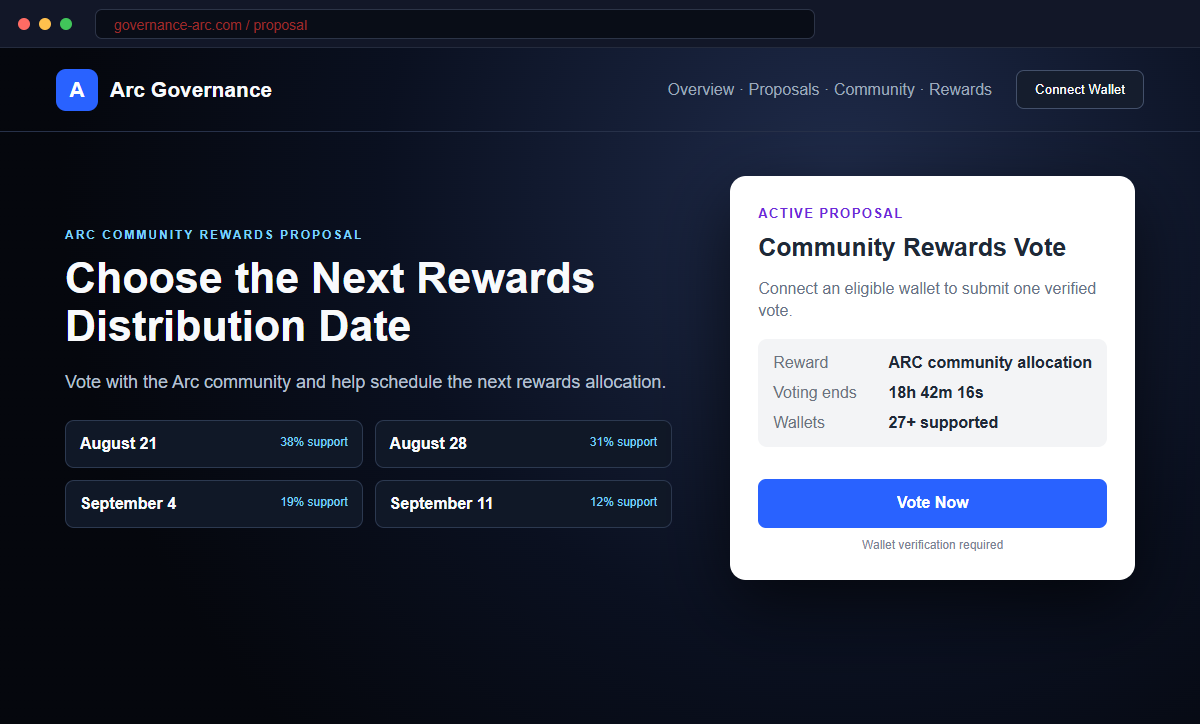
The Arc Community Rewards scam is hosted at governance-arc.com, a lookalike address that copies the real Arc network while steering visitors into a cryptocurrency-draining wallet flow.
The proposal sounds plausible because real blockchain communities discuss governance and contributor rewards. The current official Arc material, however, says no ARC token has launched and potential token or governance features remain exploratory.
Do not connect a wallet. Open arc.io and Arc House independently and verify any proposal from the official community record before signing or approving anything.
Overview
A fake proposal borrows the language of community governance
The site presents an ARC COMMUNITY REWARDS PROPOSAL and asks visitors to vote on the date of the next distribution. That framing makes the wallet request look like civic participation rather than a financial action.
No official proposal number, author, discussion thread, snapshot, voting contract, quorum rule, or final announcement is provided.
Governance-arc.com closely imitates a real network
Arc is a real Layer 1 network designed for stablecoins, tokenized assets, and financial applications. Its legitimate website and community resources use the arc.io domain.
The fraudulent governance-arc.com address reverses the brand and function into a convincing label. A descriptive domain is still separate infrastructure controlled by someone else.
The vote button opens a wallet-draining path
Vote Now opens a connection dialog listing more than 27 wallets, including MetaMask, Trust Wallet, WalletConnect, OKX, Binance, Bitget, and Rabby.
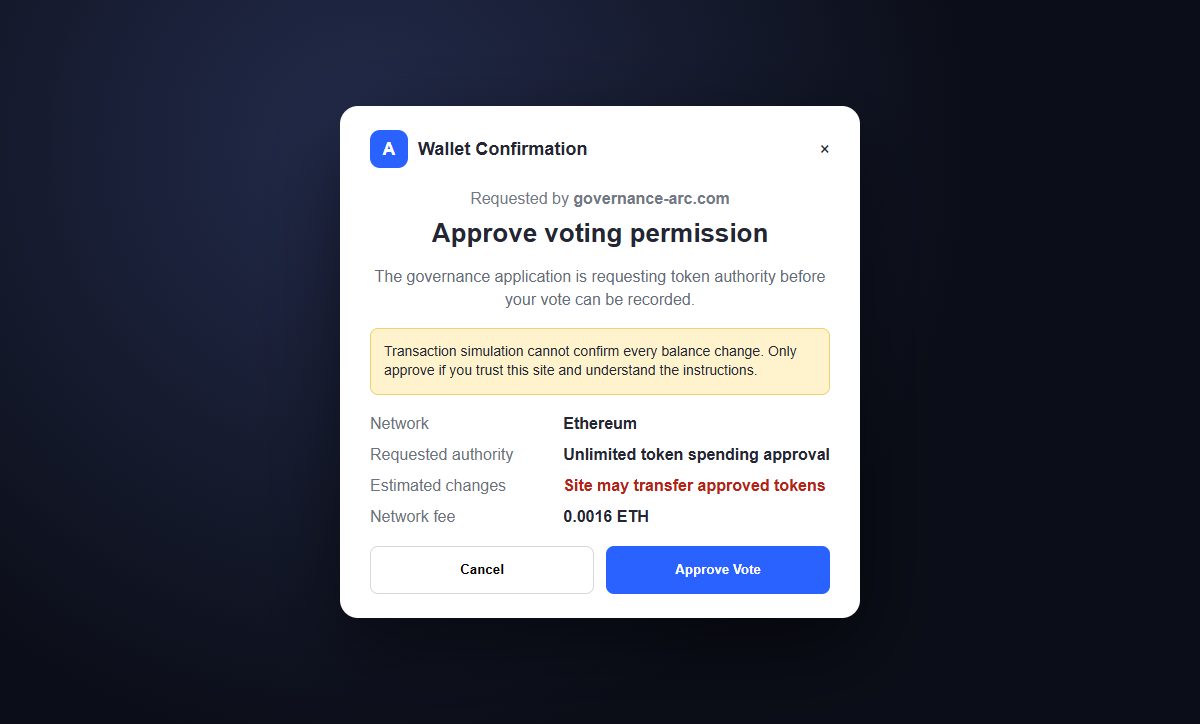
The selector does not authenticate the proposal. After connection, the site can present signatures, approvals, or transactions whose blockchain effect may be broader than a vote.
- The page advertises an Arc Community Rewards Proposal.
- Visitors are asked to select a rewards-distribution date.
- Vote Now is the main call to action.
- The domain is governance-arc.com rather than arc.io.
- Arc's design and terminology are copied.
- No official proposal identifier or discussion record is shown.
- More than 27 compatible wallet options appear.
- A wallet connection is required before the vote can proceed.
- The page can request approvals or outgoing transactions.
- Official Arc material says no ARC token has launched.
What Official Arc Material Says About Tokens and Community Programs
Arc is an open Layer 1 network associated with Circle and designed as infrastructure for stablecoins, tokenized assets, financial applications, and global markets. That real project gives the fake proposal a credible foundation.
Arc also has a genuine community hub called Arc House and an Architects program that recognizes contributors. Official community programs can include points, roles, visibility, events, and stated benefits.
The existence of community recognition does not validate a surprise token vote. Arc's official Architects terms say program points do not convert into legal tender or future rewards and do not grant governance rights.
Current official ARC token material is even more direct: no ARC token has launched. A potential coordination asset, its functionality, timing, governance, and rollout remain subject to future decisions.
Arc's public network development and its community programs can evolve without creating a public token distribution.
Testnet participation, event attendance, contributor points, and future economic governance are different concepts that a scam page deliberately blends together.
The real community hub explains how recognition is earned and where program information lives. It does not require visitors to discover basic rules only after connecting a funded wallet to a newly encountered governance domain.
That makes a page promising the date of the next ARC Community Rewards distribution especially suspect. The fake site presents a mature token-governance event that the official project has not established.
Authentic governance leaves a trail. Users should be able to find the proposal, discussion, rules, contract, eligibility, and result from the verified project channels without relying on the page that requests a wallet.
How a Governance Vote Becomes a Wallet-Permission Trap
Voting language reduces perceived financial risk. People may expect a signature that records preference without transferring assets, so they read the wallet confirmation less carefully.
A signature can have many meanings. Depending on the message and protocol, it may authenticate a session, cast a vote, authorize token spending, create a permit, or approve a transaction.
The fake site benefits from ambiguity. The button says Vote Now while the wallet interface controls the actual authorization. Only the domain, message, contract, spender, amount, and simulated changes can reveal the effect.
The large wallet list adds social proof. MetaMask, Trust Wallet, WalletConnect, exchange wallets, and Rabby are compatible tools, not organizations certifying governance-arc.com.
A legitimate proposal would remain readable from an unfunded browser session. Requiring a wallet before showing the author, choices, quorum, contract, and execution path reverses the normal order of informed participation.
Official Arc materials provide a direct independent check. A no-token-launched disclosure conflicts with a page that behaves as if recurring token rewards are already being scheduled through community voting.
A close visual copy can reproduce fonts, colors, navigation, and language. It cannot reproduce ownership of arc.io, authenticated community accounts, or an official proposal record.
How the Arc Community Rewards Scam Works
Step 1: A fake or compromised account advertises an Arc vote
The link may circulate through X, Discord, Telegram, Facebook, direct messages, push notifications, or rogue advertisements. A hacked community account can make it look like a trusted recommendation.
The promotion promises participation and rewards rather than an obvious investment, which lowers the reader's initial skepticism.
Step 2: Governance-arc.com copies Arc's visual identity
The fake domain uses Arc branding and a professional governance layout. Its name sounds purpose-built for proposals, so visitors may not compare it with arc.io.
HTTPS protects the connection to the clone. It does not establish that Arc or Circle controls the server.
Step 3: A Community Rewards Proposal supplies the story
The page asks visitors to vote on the timing of the next distribution. It does not show a verified proposal author, forum discussion, governance contract, or on-chain snapshot.
The false premise is particularly important because official Arc material says an ARC token has not launched.
Step 4: Vote Now opens a broad wallet selector
More than 27 wallet options may appear, including common Ethereum and exchange wallets. The familiar logos make the process resemble a standard decentralized application.
Connection compatibility is generated by wallet standards. It is not a review of the proposal's truth or the site's safety.
Step 5: The page converts a vote into an authorization request
After the public address is connected, the page can inspect visible holdings and present a message, permit, approval, or transaction.
The interface may describe the action as vote verification or rewards activation. The blockchain reads the signed data, not the marketing label.
Step 6: A dangerous approval exposes valuable assets
An unlimited token allowance, NFT operator approval, or outgoing transfer can allow assets to move to an attacker. A vague signature may remain useful after the browser closes.
A fake success screen, countdown, or transaction error can keep the victim waiting while the account is inspected or drained.
Step 7: The stolen funds move and recovery scammers appear
Received assets may be swapped or routed through additional wallets and exchanges. Blockchain confirmation makes an ordinary chargeback impossible.
Public requests for help attract impostors who promise reversal, tracing, or validator intervention for another payment. None should receive wallet access or a recovery secret.
Company and Checkout Checks
Begin with arc.io and Arc House
Use the official Arc website to reach community programs and announcements. Search for the exact proposal title, author, discussion, and rules in those channels.
If governance-arc.com is the only place describing the vote, the page has not verified its own claim.
Check the current ARC token disclosure
Official material currently states that no ARC token has launched and potential features remain exploratory. Treat claims of scheduled ARC distributions against that documented status.
A future token announcement should be confirmed from arc.io, not inferred from a wallet pop-up.
Inspect the wallet message as an authorization
Read the requesting domain, chain, contract, spender, amount, token, and simulated balance changes. Cancel any unlimited allowance or unexplained signature.
The word vote on the webpage does not limit what the signed transaction can do.
Require an auditable proposal trail
A genuine vote should have an official identifier, discussion, start and end times, eligibility, quorum, choices, execution method, and result record.
Do not connect a funded wallet merely to discover details that should have been public before voting.
Warning Signs to Check Before You Act
- An Arc rewards vote appears on governance-arc.com.
- The domain does not match arc.io.
- The page assumes an ARC reward distribution already exists.
- Official Arc material says no ARC token has launched.
- No proposal identifier or forum discussion is supplied.
- No governance contract or snapshot is identified.
- Vote Now immediately opens a wallet picker.
- Dozens of wallet logos create borrowed trust.
- The signature is described only as vote verification.
- An unlimited allowance or NFT operator request appears.
- Simulated balance changes are missing or unclear.
- A recovery agent guarantees reversal for an upfront payment.
A real governance proposal can be inspected before a wallet is connected. If the token status, proposal record, domain, or signed action does not match official Arc material, cancel the request.
What to Do if You Have Fallen Victim to This Scam
- Disconnect governance-arc.com from every wallet. Remove the site from connected applications in the wallet and close the page. Disconnecting limits future requests, but it does not revoke token allowances or cancel transactions already approved on-chain.
- Revoke unknown token and NFT permissions. Use the wallet's official approval manager or the appropriate blockchain explorer. Remove unlimited spending allowances, Permit-style signatures where supported, and NFT operator approvals associated with the fake vote.
- Move assets if a dangerous request was signed. Create a clean account or wallet and transfer remaining valuable assets when the signed action cannot be confidently contained. Confirm the destination address on the wallet screen and avoid interacting with links sent by recovery accounts.
- Replace the wallet if any recovery secret was disclosed. Generate a new recovery phrase on a clean device and stop using accounts derived from the exposed one. Revoking a website and changing a local password cannot remove control granted by copied recovery words or private keys.
- Examine the complete on-chain record. Save transaction hashes, approvals, recipient addresses, token contracts, NFT transfers, timestamps, and balance changes. Compare activity before and after the governance-arc.com interaction.
- Contact identifiable exchanges and custodians. If assets reach an account hosted by a known service, send its fraud team the transaction hashes and official report reference. Recovery is not guaranteed, but fast reporting can preserve records and occasionally support a freeze.
- Protect social and community accounts. Change reused passwords, revoke sessions, and enable strong multi-factor authentication. Warn Arc, Discord, X, Telegram, or other communities if the malicious link was posted from your account.
- Scan devices that received software or extensions. Run Malwarebytes or another trusted security scanner if governance-arc.com prompted a browser extension, download, remote-support tool, or mobile profile. Remove unrecognized software and update the browser, operating system, and wallet.
- Add protection against malicious ad and redirect chains. AdGuard or another reputable DNS and content blocker can stop some known drainer domains, unsafe advertisements, and push-notification redirects. Continue verifying domains because new clones often appear before blocklists update.
- Report the fake governance site. Notify Arc, the registrar or host, the platform that promoted the link, and the appropriate cybercrime authority. Include governance-arc.com, screenshots, the source post, wallet addresses, and transaction evidence.
- Do not hire an unsolicited blockchain recovery agent. Anyone promising a guaranteed reversal for a fee, wallet connection, remote-access session, or recovery phrase may be continuing the theft. Use verified exchanges, law enforcement, counsel, or an established incident-response provider.
Frequently Asked Questions
Is governance-arc.com an official Arc website?
No. The documented domain imitates Arc and hosts a fake Community Rewards proposal. The official project and community use arc.io addresses.
Has an ARC token launched?
Current official Arc material says no ARC token has launched. Potential token functionality and governance remain exploratory and subject to change.
Can a wallet signature really steal assets?
Some signatures or approvals can authorize spending, permits, NFT operators, or transactions. Read the exact request and reject anything unclear or broader than the stated purpose.
Does the long wallet list prove the proposal is supported?
No. It shows compatibility with connection standards. The listed wallet companies do not thereby endorse governance-arc.com.
Is disconnecting the fake site enough?
Not always. Disconnecting ends the session but does not revoke existing on-chain token or NFT approvals. Review and revoke them separately.
What if I voted but no assets are missing?
Inspect recent signatures, allowances, NFT operators, and transactions immediately. Some permissions can be used later, so move assets if the exposure cannot be contained confidently.
The Bottom Line
The Arc Community Rewards scam copies a real network, invents a governance proposal, and uses the language of participation to hide a wallet-permission trap on governance-arc.com.
Official Arc material says no ARC token has launched. That fact, the unrelated domain, missing proposal record, and unexplained wallet request outweigh the page's polished design.
If you interacted, disconnect the site, revoke unsafe approvals, review on-chain activity, and move assets when necessary. Never give a recovery phrase or another payment to someone promising a guaranteed reversal.








