

A parent searching for help with a child’s height can be unusually easy to pressure. GrowMax Height Gummies turns that concern into a polished sales story filled with growth deadlines, dramatic statistics, glowing reviews, and a product that appears ready to ship.
Look closer, however, and the reassuring picture begins to fracture. The product images carry obvious AI-generation clues, the company trail is incomplete, important guarantees contradict each other, and the ordering form quietly starts with recurring delivery selected.
This investigation follows the evidence from the ad-style promises to the label, subscription terms, address, domain history, and checkout configuration.
Overview
The product is sold as help for a child’s height
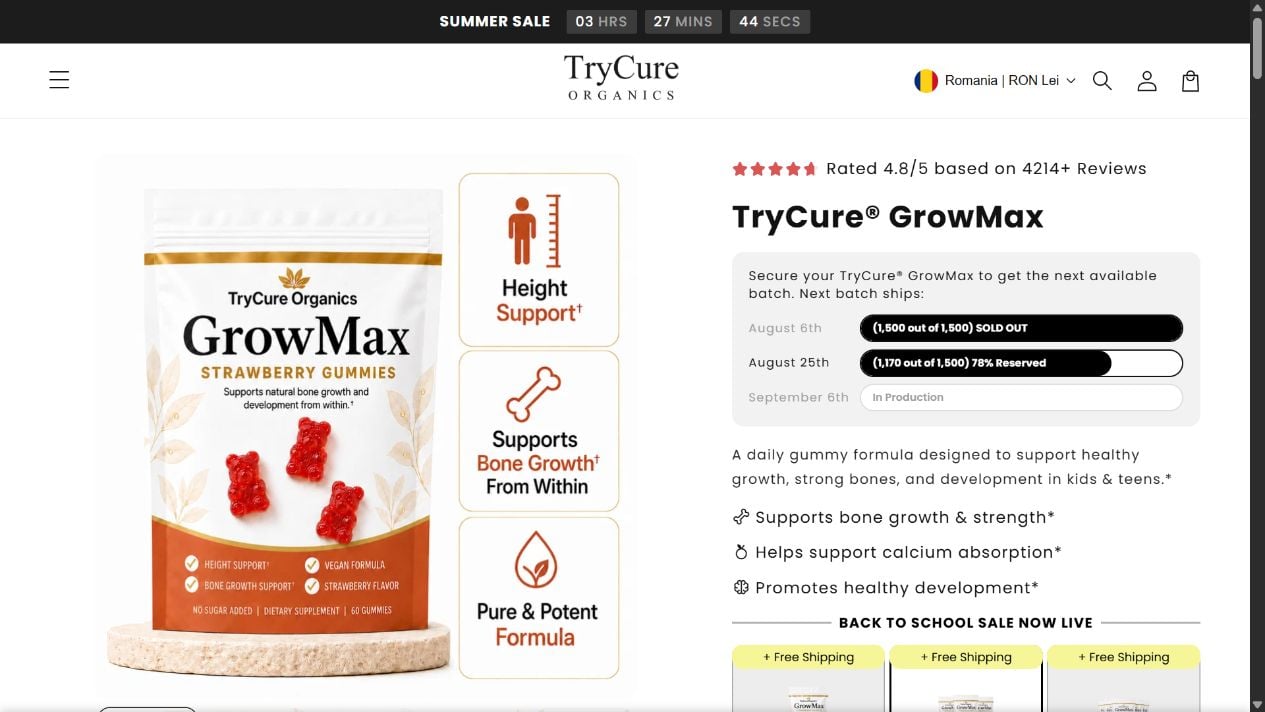
GrowMax Height Gummies is marketed by TryCure Organics as a strawberry gummy for children and teenagers. The page says it supports bone growth, calcium absorption, healthy development, and a child’s natural height potential.
The ingredients are presented through a simple story: calcium supplies building material, vitamin D3 helps absorption, and vitamin K2 supposedly directs calcium to growing bones. Amino acids and botanicals are then added to make the formula sound broader and more advanced.
That story blends basic nutrition facts with a much larger emotional promise. The page asks whether GrowMax can help a child grow taller and answers with an immediate “Yes,” even though no supplement can determine how tall a child will become.
The sales page applies pressure before presenting proof
The page uses a midnight countdown, a “Summer Sale,” sold-out batches, reservation meters, large bundle discounts, and messages about a child’s limited growth window. These elements encourage parents to decide quickly instead of examining the evidence.
It also displays a 4.8 rating based on more than 4,200 reviews and says more than 10,000 parents have joined the growth journey. Yet the current TryCure.org domain was only registered on August 11, 2026, while many displayed reviews are dated months earlier.
A review can predate a domain if a business migrated from another store. The problem is that the page does not clearly document such a migration or explain how those reviews were collected and verified.
The order begins as a recurring subscription
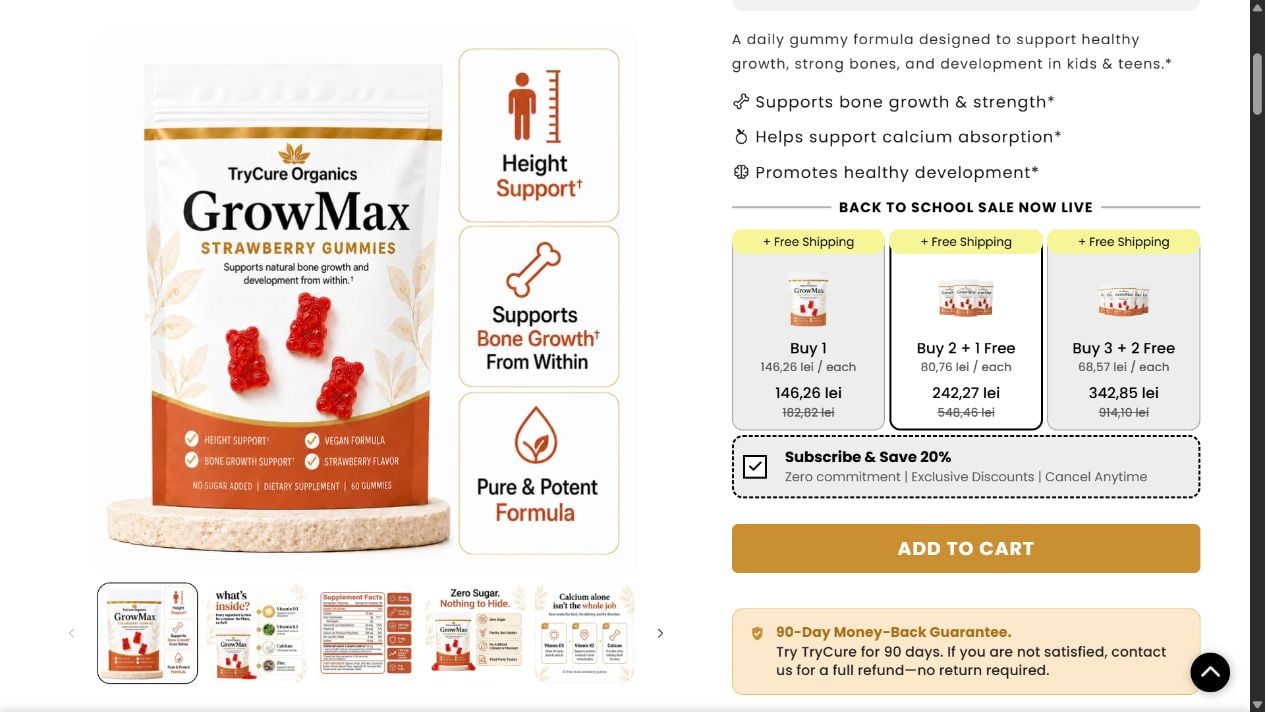
The strongest consumer warning is not hidden in fine print. On the live product page, “Subscribe & Save 20%” was already checked before we touched the form.
The store’s underlying Shopify data confirms that subscriptions are enabled and selected by default. The Buy 1 and Buy 2 + 1 Free options were tied to monthly delivery, while Buy 3 + 2 Free was tied to delivery every two months.
That does not prove every customer will be charged unexpectedly. It does mean a buyer can focus on the bundle price and miss that the order may continue. Before entering payment details, check all of the following:
- Whether “Subscribe & Save” is checked.
- How often the selected bundle will renew.
- The full recurring price after the first order.
- How cancellation must be requested.
- Which business name will appear on the card statement.
The Product Photos Were Generated With AI
The GrowMax page does not merely look artificial. Its own image filenames reveal how much generative material was used. Among the 10 unique files in the main product gallery, two begin with “ChatGPT_Image” and eight use an “hf_” naming pattern associated with Higgsfield exports.
Across the full product page, we found 19 unique assets with those patterns, including six files explicitly named “ChatGPT_Image” and 13 beginning with “hf_.” The main hero image itself is served from a file named “ChatGPT_Image_Aug_11_2026_06_14_08_AM.png.”
Using AI to create advertising is not automatically fraudulent. The serious issue is what the images replace. The page presents flawless pouch mockups and lifestyle scenes, but it does not provide a normal set of verifiable product photographs showing a physical package from multiple angles.
We could not find an authentic back-of-package photo with a printed manufacturer, lot number, expiration date, barcode, tamper seal, or country of origin. A digital mockup can show anything a designer types onto it. It cannot prove that the advertised product was manufactured, tested, or packaged as shown.
Some testimonial pictures may be ordinary photographs, so it would be wrong to label every person on the page as AI-generated. Those pictures usually do not show the supplement, however, and some review assets are delivered from a different Shopify store identifier. Their provenance remains unclear.
What the GrowMax Supplement Facts Panel Reveals
The public Supplement Facts image lists two gummies per serving and 30 servings per container. It shows vitamin D3, vitamin K2, calcium, zinc, sodium, and a 120 mg proprietary “Height & Growth Complex.”
That proprietary blend contains L-arginine HCl, spirulina, ashwagandha extract, L-glutamine, and astragalus. Because the five ingredients share one 120 mg total, the label does not tell parents how much of each botanical or amino acid a child would receive.
This matters because ingredients do not become harmless just because they are described as natural. The National Institutes of Health says long-term safety information for ashwagandha is limited, notes possible medication and thyroid interactions, and describes reports of liver injury in some users.
The National Center for Complementary and Integrative Health also warns that many dietary supplements have not been tested in children. A parent should show the full label to a pediatrician, especially when a child has a medical condition or takes medication.
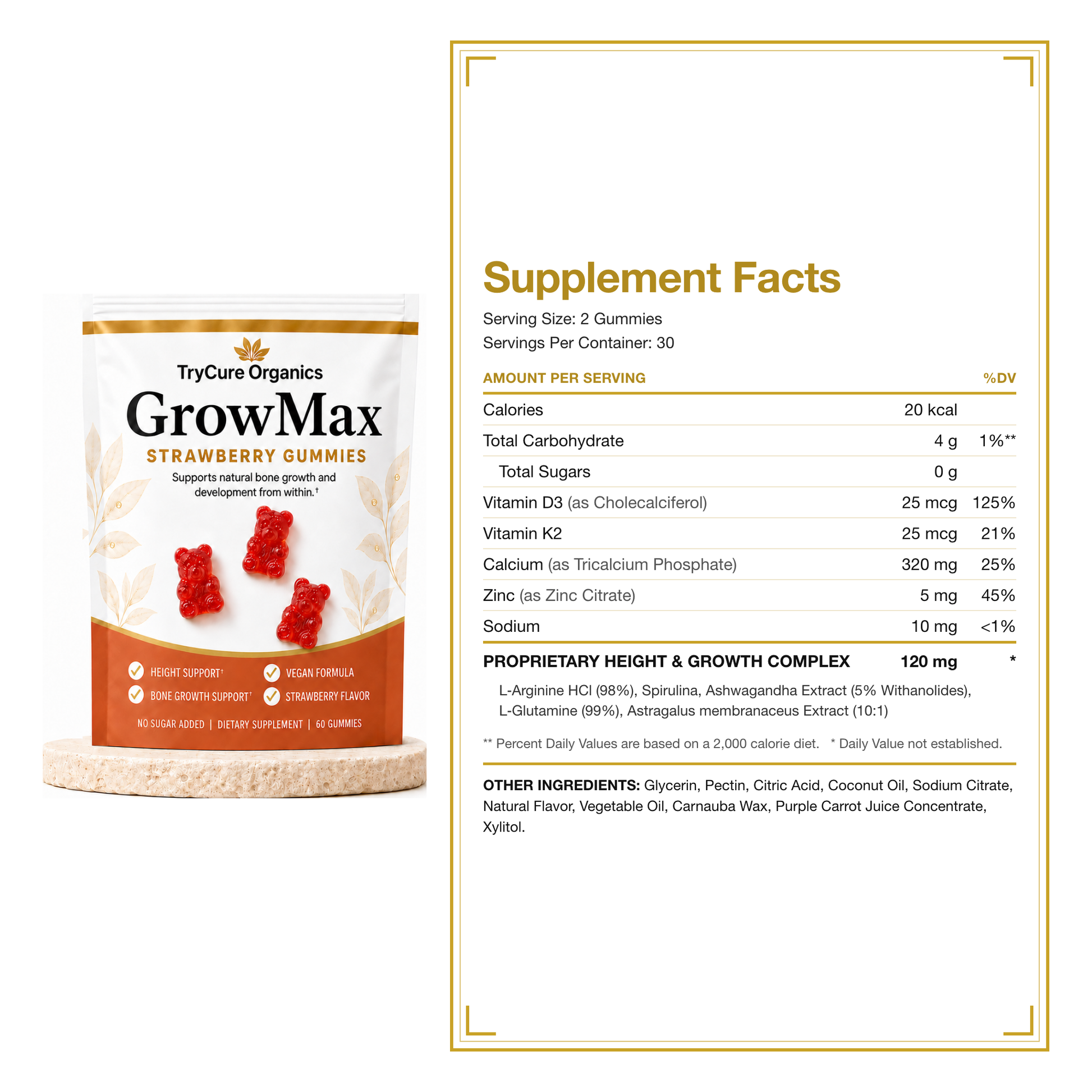
The label image creates another verification problem. It does not visibly identify the manufacturer, packer, or distributor. It also lacks a business address, country of origin, lot or batch information, barcode, and product-specific warnings.
NIH guidance on dietary supplement labels says the label should include the name and place of business of the manufacturer, packer, or distributor. A cropped website graphic is not necessarily the final package, but TryCure gives shoppers no better photograph to verify what the physical label contains.
There is also no responsible basis for saying the gummies come from China. We found no disclosed factory or country of manufacture. The accurate conclusion is sharper and more useful: the seller does not provide enough public information to verify who makes GrowMax or where it comes from.
The Height Claims Run Far Ahead of the Evidence
GrowMax’s ingredients may contribute to normal nutrition when a genuine deficiency exists. That is very different from proving that this particular gummy will make a child taller or deliver the timeline suggested on the page.
The sales copy says the body begins using the formula in the first 30 days, bone density and strength begin building within two to four months, and six months of use provides sustained growth support. No GrowMax clinical trial is cited to establish those stages.
We found no exact GrowMax study in PubMed or ClinicalTrials.gov. We also found no named laboratory report, certificate of analysis, or accessible document confirming the ingredient identity, purity, dosage, or contaminant testing of a purchased batch.
The homepage uses “Third-Party Tested,” but the claim has no public paper trail. A meaningful testing claim should identify the laboratory, product, batch, test date, and results. Without that information, the words function as reassurance rather than evidence.
The page’s statistic that 70% of children ages 6 to 11 are deficient in vitamin D is especially questionable. The NIH vitamin D fact sheet says most people in the United States have adequate blood levels.
NIH estimates that roughly one in four people have levels that are too low or inadequate. That is not the same population measure, but it shows why the dramatic 70% figure needs a direct, credible citation.
The regulatory context is equally important. The FDA does not approve dietary supplements for safety and effectiveness before they reach the market. A standard FDA disclaimer at the bottom of a page does not validate the claims above it.
In July 2026, the Federal Trade Commission finalized an order against the seller of TruHeight over unsubstantiated claims about supplements marketed to increase children’s height. The case also included allegations involving fake and incentivized reviews.
That action was not against GrowMax. It does illustrate the level of evidence marketers need before turning parental concern into a height promise.
How the GrowMax Height Gummies Scam Works
Step 1: The page turns normal parental concern into urgency
The funnel begins with a fear most parents understand: what if a child is not growing as expected? Instead of encouraging a growth-chart review first, the page announces that a child’s growth has a deadline and presents nutrition as the missing key.
Countdowns, sold-out batches, reservation bars, and sale labels add commercial pressure. The visitor is nudged to act during a supposedly limited window, even though a concern about height deserves a careful medical discussion, not a hurried supplement purchase.
Step 2: AI visuals make an unverified product feel established
The polished pouch, gummies, comparison cards, and lifestyle graphics give GrowMax the appearance of a mature retail product. Most shoppers will not inspect the filenames and discover that the gallery was built with ChatGPT and likely Higgsfield assets.
That visual confidence fills the gap left by missing real-world evidence. There is no clear photograph of a production pouch showing its lot, expiration date, manufacturer, seal, or barcode.
Step 3: Basic nutrition is stretched into a height story
Calcium and vitamin D are relevant to bone health. The page uses that true starting point to create a more dramatic chain in which K2 tells calcium where to build and the formula becomes “ESSENTIAL” for height growth.
The language sounds scientific, but the site never demonstrates that GrowMax produces extra height. It also places several ingredients inside a small proprietary blend, preventing parents from assessing the individual amounts.
Step 4: Reviews and statistics manufacture social confidence
Thousands of reviews, five-star graphics, parent stories, and dramatic percentages make the offer feel widely tested. Several reviews describe visible growth, improved appetite, or pediatrician-noticed changes, but testimonials cannot separate normal growth, puberty, diet, sleep, and measurement variation from a gummy.
The site also offers 10% off for leaving a review. Incentivized feedback is not automatically false, but it should not be treated like independent medical evidence.
Step 5: A larger bundle is placed in front of the buyer
When we examined the order panel, Buy 2 + 1 Free was the emphasized option and represented a quantity of three. The page also offered Buy 3 + 2 Free, turning a first purchase into several months of product.
Bundle math can make the per-pouch price look attractive while increasing the total commitment. It also makes a recurring order more expensive if the buyer overlooks the delivery schedule.
Step 6: Subscribe and Save is checked by default
The recurring-delivery box was already selected. The store configuration showed a monthly subscription for the one-pouch and three-pouch choices, and an every-two-month plan for the five-pouch choice. Each plan advertised 20% off.
The TryCure subscription policy confirms that subscription products renew automatically until canceled. A customer may believe the main decision is how many pouches to buy, while the form has already made the more important decision about whether future orders continue.
Step 7: Contradictory policies make the exit less predictable
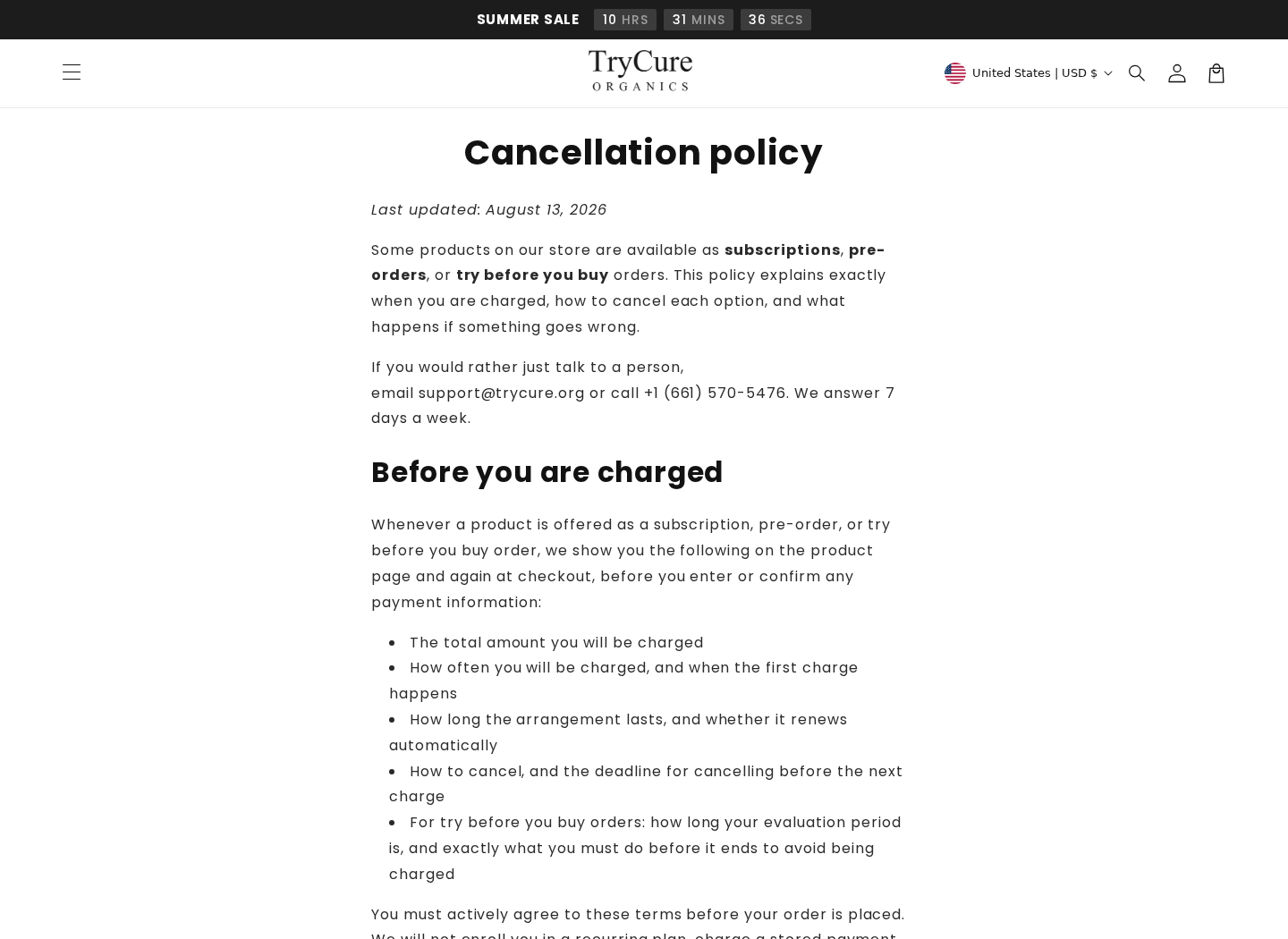
The product page promises a 90-day money-back guarantee and says no return is required. The About page repeats 90 days. The official refund policy, home page, footer, and terms instead refer to 60 days.
A customer should not have to guess which promise controls a refund. The terms and privacy policy also repeatedly refer to “cureorganics.store” rather than the current TryCure.org domain, suggesting that important legal text was copied or carried over without a careful update.
We did not place an order, so we cannot claim that TryCure refuses every cancellation or refund. The confirmed default subscription and policy contradictions are sufficient reasons to avoid buying until the seller gives clear, consistent terms in writing.
Company, Address, and Fulfillment Checks
TryCure is a brand, not a clearly disclosed legal seller
The site identifies itself as TryCure Organics, but its current policies do not clearly name the LLC or corporation accepting the order. Shoppers are not told which legal entity will appear on a receipt or card statement.
Third-party trademark records connect recent TryCure applications to Oklama LLC at the same Wyoming address. That is a clue, not proof that Oklama operates the store. The problem is that customers should not need to assemble third-party records to learn who is taking their money.
The Wyoming address does not look like a supplement factory
TryCure lists 3140 W. Main Street, Riverton, Wyoming 82501. A public property listing describes the location as a small residential property rather than a visible supplement manufacturing facility.
The same address appears in a BBB profile for an unrelated supplement company. The BBB says the address appears to be a commercial registered agent, which typically is not a physical place of business.
A registered-agent address can be legal and legitimate. It still does not tell a parent where GrowMax is manufactured, tested, stored, or fulfilled. The site never provides a separate headquarters, factory, laboratory, or returns warehouse that can be independently verified.
The phone and email do not establish accountable support
The site lists support@trycure.org and +1 (661) 570-5476. The domain has working mail routing, but we did not test whether a human responds, and the California phone prefix does not match the Wyoming address.
That geographic mismatch is not proof of fraud. It is one more reason to call before ordering and ask which legal company handles GrowMax, how recurring deliveries are canceled, where returns go, and what billing descriptor appears on a bank statement.
An older Trustpilot page for TryCure.shop shows the same telephone number and includes a consumer complaint about the bottle and website names not matching. The company’s public reply acknowledged a naming mismatch.
That report concerns an older store and remains a customer allegation. It still strengthens the case for verifying the exact product and seller before paying.
The manufacturer, laboratory, and supply chain are missing
The most important details are absent. TryCure does not identify the actual GrowMax manufacturer, country of origin, contract packer, independent laboratory, batch number, or publicly accessible certificate of analysis.
The site’s About page says the brand started in 2021 and presents itself as established in the United Kingdom. The footer and policies place it in the United States. Meanwhile, the official .org registry record shows that TryCure.org was registered on August 11, 2026.
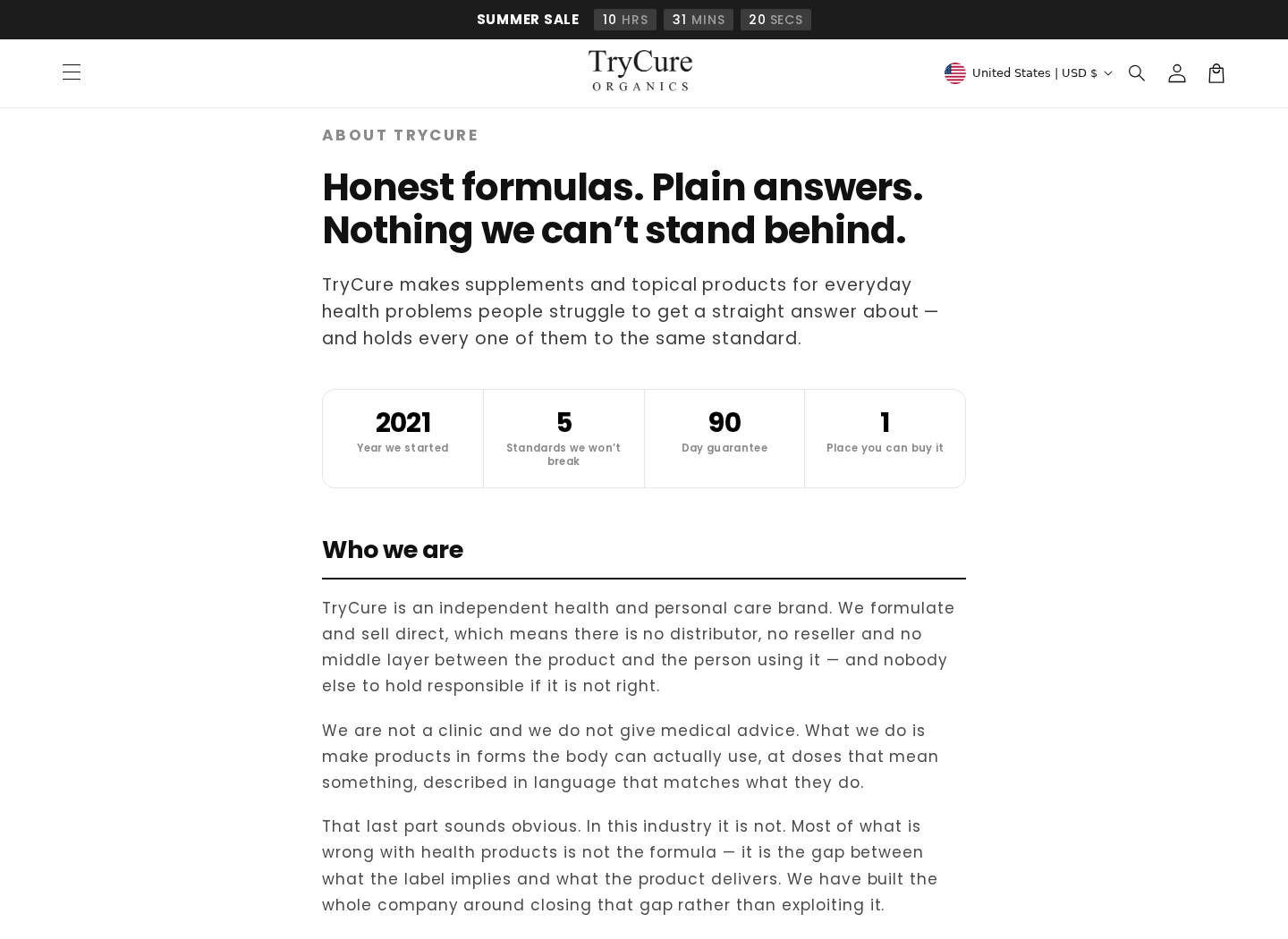
A company can operate before launching a new domain, but the site provides no transparent history connecting the 2021 claim, the United Kingdom language, the Wyoming address, the older Cure Organics domain in its policies, and the present storefront.
We also found no evidence supporting the theory that GrowMax is mass-produced in China. Making that claim without shipping, import, packaging, or manufacturer records would replace one unverified marketing story with another. What can be proven is that the supply chain is opaque.
For a product intended for children, “opaque” is not a minor paperwork issue. Parents need to know who formulated it, who manufactured it, whether the stated ingredients match the contents, and who is legally responsible if something goes wrong.
Warning Signs Parents Should Not Ignore
- The main product artwork includes files explicitly named as ChatGPT images.
- No authentic package photos show a manufacturer, lot, barcode, seal, or expiration date.
- The page answers “Yes” when asked whether GrowMax can help a child grow taller.
- No GrowMax clinical trial supports the claimed growth timeline.
- “Third-Party Tested” appears without a named lab or batch-specific report.
- The current domain was registered after many of the displayed review dates.
- The site offers 10% off for submitting a review.
- The subscription option is selected by default.
- Different pages promise either a 60-day or 90-day guarantee.
- Policies name a different domain from the store where the order is placed.
- The legal entity accepting payment is not clearly identified.
- The listed address does not establish a real factory, laboratory, or operating office.
One warning sign can have an innocent explanation. Here, the concerns reinforce one another. The marketing is exceptionally confident, while the product, testing, company, and subscription disclosures are much less solid.
Parents who are worried about height should begin with recorded measurements and a pediatrician. A child dropping across growth-chart percentiles, stopping growth, or showing unusually early or delayed puberty may need a medical assessment that a gummy cannot replace.
Our earlier TryCure Thyroid Support investigation found similar reasons to slow down and verify the seller rather than trusting the polished storefront at face value.
What to Do if You Have Fallen Victim to This Scam
- Save the evidence before the page changes. Take screenshots of the product offer, selected subscription box, bundle, order confirmation, guarantee, cancellation instructions, and every conversation with support. Download receipts and preserve the original emails.
- Identify the charge and renewal date. Check the confirmation email, customer account, PayPal activity, and card statement. Write down the merchant descriptor, amount, order number, and the date the next payment is expected.
- Cancel through every available channel. Use the customer portal if one exists, then send a written cancellation request to the support email. State clearly that you revoke authorization for all recurring GrowMax charges and want written confirmation.
- Ask for a refund using the promise you saw. Quote the 90-day guarantee if that was displayed when you ordered and attach your screenshot. If the seller cites a 60-day policy, point out the contradiction and ask which terms applied on the purchase date.
- Contact the payment provider quickly. If the seller does not cancel or continues billing, contact the card issuer, bank, PayPal, Apple Pay, or other provider. Explain that the transaction involved recurring billing you did not knowingly intend or that continued after cancellation. Ask about blocking future charges and filing a dispute.
- Do not rely only on replacing the card. Some recurring merchants receive updated card credentials automatically. Ask the issuer to stop the recurring merchant authorization or token, not merely send a new physical card.
- Report misleading marketing. U.S. consumers can report the offer to the FTC at ReportFraud.ftc.gov and adverse reactions to the FDA’s Safety Reporting Portal. Parents outside the U.S. can contact their national consumer-protection and health-product regulator.
- Speak with a pediatrician about use or side effects. Stop treating the supplement as a solution to a growth concern. Bring the label and ingredient list, especially if the child experienced symptoms or takes medication.
- Check the device used for payment. If you followed a suspicious ad, installed anything, or entered credentials on an unexpected page, scan the device with Malwarebytes and remove unwanted browser extensions. AdGuard can reduce exposure to aggressive ads and malicious redirects, but it cannot cancel a subscription or reverse a charge.
Frequently Asked Questions
Is GrowMax Height Gummies a scam?
We cannot prove that every pouch is fake or that every customer loses money. We can confirm a high-risk sales pattern: AI-generated product visuals, unsupported height-focused claims, unclear company and manufacturing details, contradictory guarantees, and a recurring subscription selected by default. Those findings are enough to recommend avoiding the offer.
Will GrowMax make a child taller?
No reliable GrowMax clinical trial was provided or found to prove that it increases a child’s final height. Adequate nutrition supports normal development, but height is influenced heavily by genetics, puberty, health, hormones, sleep, and overall diet. A supplement cannot promise extra inches.
Does GrowMax enroll buyers in automatic refills?
The product page had “Subscribe & Save 20%” checked by default during our review. The underlying store data associated the bundles with monthly or every-two-month plans, and TryCure’s subscription policy says subscriptions renew automatically until canceled.
Are the GrowMax product images AI-generated?
Yes, the evidence is unusually direct. Files in the product gallery are named “ChatGPT_Image” or use an “hf_” export pattern associated with Higgsfield. The site does not balance those mockups with verifiable photographs of a real pouch showing production identifiers.
Is GrowMax manufactured in China?
We found no reliable evidence establishing a Chinese origin. TryCure does not disclose a verifiable manufacturer or country of production. The responsible conclusion is that the origin and supply chain are unknown, not that China has been proven.
How can I cancel a GrowMax subscription?
Use the account portal if available and send a written cancellation to the support address listed on the order confirmation. Ask for confirmation, save all messages, and contact the payment provider if another charge is pending or the seller does not respond. Request a block on the recurring merchant authorization.
The Bottom Line
GrowMax Height Gummies is presented as a comforting answer for parents, but the evidence does not support that confidence. The product gallery was built with AI-generated assets, the height claims lack product-specific clinical proof, and the manufacturer, testing laboratory, legal seller, and supply chain are not clearly disclosed.
The subscription selected by default makes the offer even riskier. Until TryCure provides authentic package photographs, consistent refund terms, a named manufacturer, batch-specific testing, and an order form that requires an informed choice about refills, parents should keep their money and discuss growth concerns with a pediatrician.








