

TryCure Thyroid Support (also branded on-page as “Cure Thyroid Support”) is marketed as an all-in-one liquid drop formula for energy, metabolism, mental clarity, hormone balance, and even hair shedding. The pitch sounds reassuring, not extreme. It leans on “cofactors,” “conversion,” and the idea that standard thyroid testing misses what is really going on.
If you are already frustrated, that story feels personal. It feels like someone finally “gets it.”
This article is meant to slow the moment down. Not to shame anyone for wanting relief, and not to pretend every supplement is automatically a scam. But to look closely at what is being claimed, what is plausible, what is marketing theater, and what practical risks matter most before you spend money, share card details, or accidentally sign up for recurring billing.
If you are trying to decide “buy or don’t buy,” this is the full breakdown.
Overview
What the product claims to be
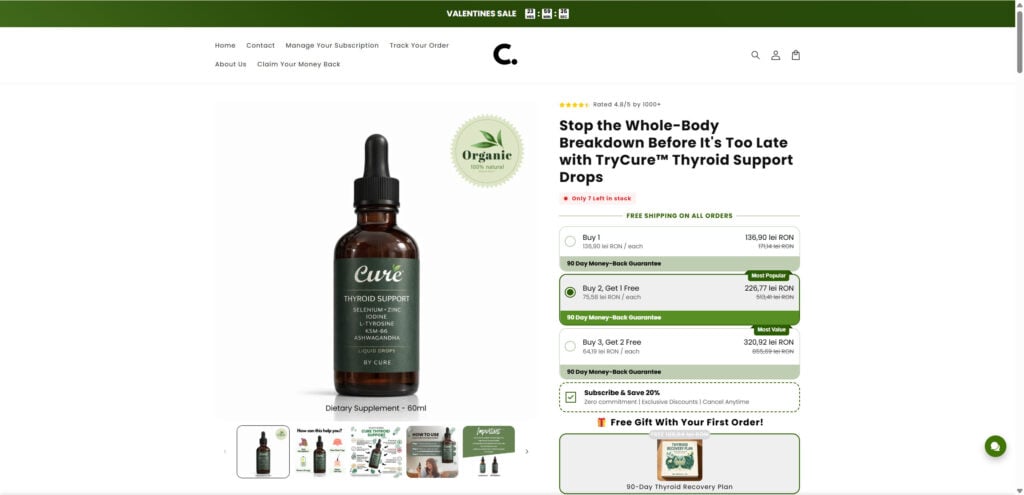
TryCure Thyroid Support is presented as a liquid thyroid support supplement, positioned as a daily routine you can take as drops. The marketing repeatedly ties thyroid function to whole-body symptoms, including:
- Low energy and “crashes”
- Brain fog and poor focus
- Stubborn weight changes or slowed metabolism
- Hair shedding and thinning
- Mood and “vitality” issues
The core explanation is that the thyroid influences nearly every cell in the body, so even mild dysfunction can ripple outward. That part is not controversial. Thyroid hormones play a major role in metabolic regulation, temperature, mood, and multiple organ systems.
Where the pitch becomes more specific is the “testing gap” narrative.
One prominent message is essentially: your doctor is only checking TSH, and TSH is just a signal from the brain to the thyroid, not proof your cells are receiving and using thyroid hormone. In real clinical practice, TSH is indeed an indirect marker. It is not a tissue-level thyroid hormone measurement.
But it is also true that TSH is a standard, widely used thyroid screening test, and it is not the only test doctors can use. Depending on symptoms and context, clinicians can add free T4, sometimes free T3, and thyroid antibodies. The point is not that TSH is “fake” or useless. It is that thyroid workups can vary, and interpretation depends on the full picture.
The ingredient story
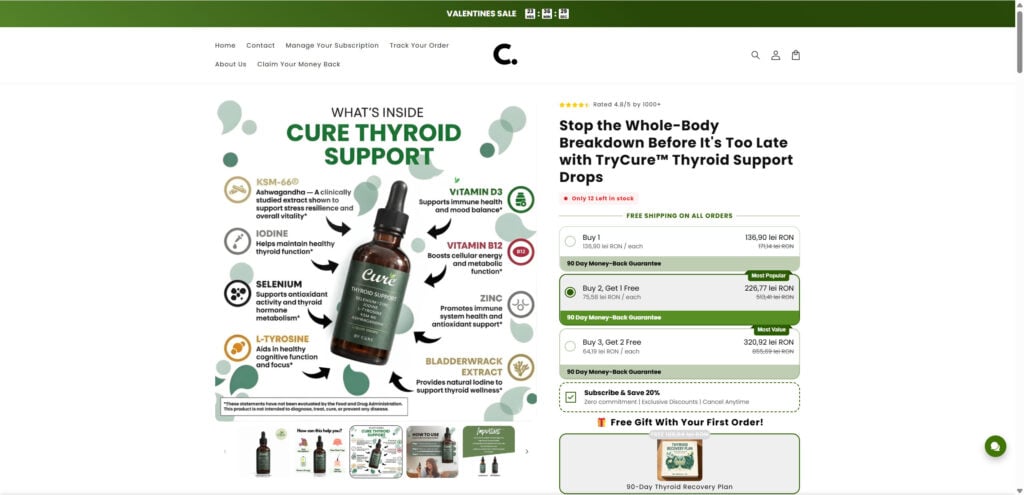
TryCure leans heavily on “thyroid cofactors,” basically nutrients that participate in thyroid hormone production, conversion, or broader endocrine support.
From the marketing materials, the formula centers on ingredients such as:
- Iodine sources (including seaweed-derived ingredients like bladderwrack)
- Selenium
- Zinc
- L-tyrosine
- Ashwagandha (often the branded extract KSM-66)
- Vitamins like D3 and B12 (featured in some visuals)
If you have read thyroid forums, none of this is random. These are familiar names. They are often discussed because nutrient deficiencies can overlap with fatigue and because thyroid hormone synthesis requires iodine.
This is the reason the product feels “smart.” It borrows real biology.
But “biologically relevant” is not the same as “clinically proven to fix your symptoms,” and it definitely is not the same as “safe for everyone.”
Iodine is the clearest example. Yes, iodine is required for thyroid hormone production. But excessive iodine intake can trigger or worsen thyroid dysfunction in some people, and the upper intake limits exist for a reason. The American Thyroid Association has cautioned against high-dose iodine and kelp supplements because excess iodine can cause thyroid problems, especially in susceptible individuals.
Selenium is another example. Selenium is important for thyroid function, but high doses over time can cause toxicity symptoms. The NIH Office of Dietary Supplements notes a tolerable upper intake level of 400 mcg/day for adults, and toxicity can include hair and nail issues, which is ironically the very symptom people are trying to improve.
Ashwagandha also deserves caution. It is widely marketed as an adaptogen, but there are published case reports associating ashwagandha use with thyrotoxicosis (an overactive thyroid state) in some circumstances.
So the ingredient narrative is a double-edged sword:
- It sounds credible because it references real nutrients and real physiology.
- It can be risky because thyroid biology is sensitive, and “more” is not automatically better.
The “subclinical thyroid” positioning
A major theme in the sales copy is subclinical dysfunction: the idea that you can have normal labs but still suffer because your thyroid is “underperforming.”
Subclinical hypothyroidism is a real clinical concept. But it is not diagnosed by vibes or fatigue alone. It is diagnosed by specific lab patterns and clinical judgment.
Marketing pages often blur that line. They frame ordinary uncertainty in medicine as proof that the brand has the “missing test” and the “missing solution.”
This matters because it can push people into self-treating what might be:
- Iron deficiency
- Sleep apnea
- Depression or anxiety
- Perimenopause
- Vitamin deficiencies
- Medication side effects
- A genuine thyroid disorder that needs proper evaluation
A supplement may coexist with real care. It should not replace it.
And to be fair, the brand messaging sometimes includes “this does not replace medication.” That is the safer claim.
But the emotional implication is still: “Doctors missed it. We fixed it.”
The branding and rebranding pattern
A separate credibility issue is packaging and branding flexibility.
In the material you provided, the product is called “TryCure Thyroid Support Drops,” but the bottle label emphasizes “Cure,” and the page design reinforces the Cure branding. That is not inherently wrong, but it signals a marketing-first posture.
More importantly, a near-identical “thyroid support drops” concept appears on a factory-direct listing that openly offers customization and logo design for bulk orders, priced at only a few dollars per unit. That does not prove the TryCure bottle is sourced from that specific listing, but it strongly supports a common pattern in this space: white-label supplements that are rebranded and sold at a much higher markup.
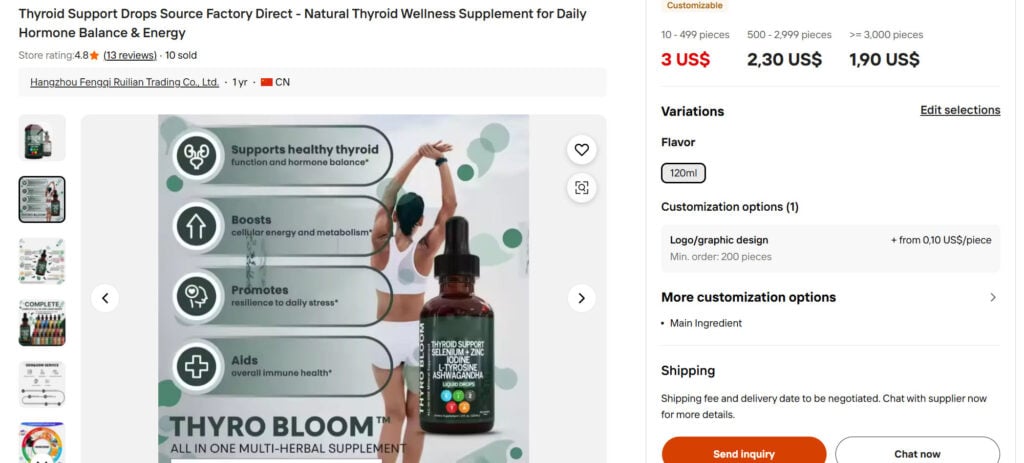
When a formula is easily private-labeled, the brand’s value depends less on unique research and more on the sales funnel.
What this means for “buy or don’t buy”
TryCure Thyroid Support is best understood as a supplement brand running a sophisticated direct-to-consumer conversion system.
Some people may genuinely feel better taking it, especially if they were deficient in something and the supplement corrected it. That does happen in real life.
But the central question is not “could any human feel a benefit?”
The question is:
- Are the claims presented in a balanced, medically responsible way?
- Are the risks and limitations clear enough for the typical buyer to make an informed decision?
- Is the business model optimized for long-term customer trust, or optimized for checkout conversion?
Once you look at how the operation is built, the answer usually becomes much clearer.
How The Operation Works
This is the part most buyers do not see clearly until after they have been charged.
The operation is not only the product. It is the entire persuasion and payment machine around the product.
Step 1: Target symptom searches and social feeds
The campaign tends to intercept people searching for:
- “fatigue”
- “brain fog”
- “slow metabolism”
- “thyroid symptoms normal labs”
- “hair shedding thyroid”
It also leans on social distribution, where short-form videos can make big claims without giving you enough time to interrogate them.
The goal is to meet you when you are already worried.
Not when you are casually shopping.
Step 2: Build a “you are not crazy” narrative
This is the most powerful part.
The messaging often implies:
- You have symptoms for a reason.
- Your doctor dismissed you.
- The standard test is incomplete.
- Your body is “starving at the cellular level.”
- The missing piece is cofactors for conversion and uptake.
There is usually a named “integrative thyroid specialist” quote or authority figure reinforcing the idea that TSH is not telling the full story.
Some of these statements contain partial truths. TSH is not literally measuring hormone uptake at a cellular level.
But the framing is designed to make a non-expert conclude something stronger:
“If my TSH is normal, my doctor is basically blind, and this supplement is the fix.”
That is not a medically careful conclusion. It is an emotionally satisfying conclusion.
And emotionally satisfying conclusions convert extremely well.
Step 3: Use pseudo-clinical structure to create authority
You will often see:
- A clean, clinical layout
- “Results” sections with percentages
- “Survey of customers” language
- “Rated 4.8/5 by 1000+” style badges
- “Research actually shows” headers
This is a common persuasion pattern: it looks like science without being science.
A customer survey can be real, but it is not the same thing as a controlled clinical trial. The results are self-reported, and there is no placebo control. The moment you see high percentages, your brain treats it like medical evidence.
It is not.
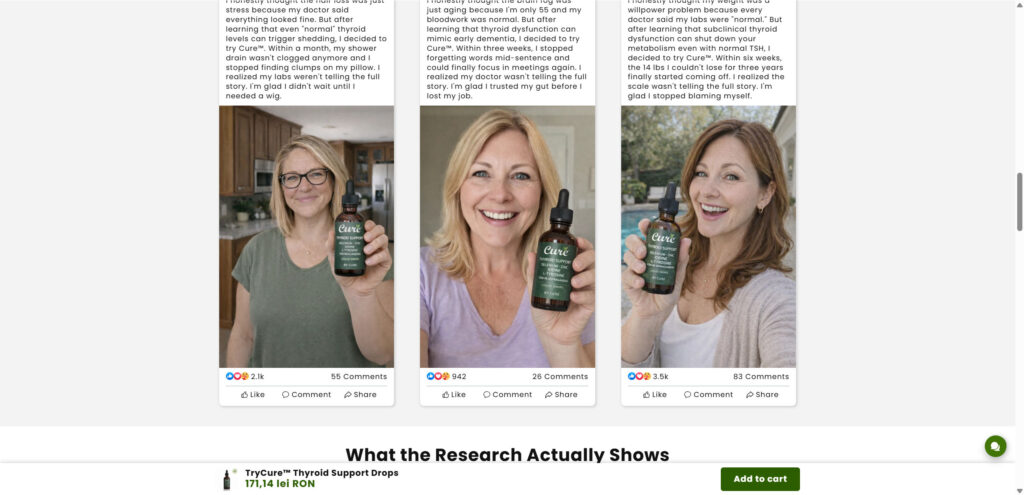
Step 4: Flood the page with social proof and lifestyle images
Another common tactic is a wall of photos that resemble social media posts: smiling people holding the bottle, engagement numbers, and the feeling that “everyone is using this.”
This creates “normalization pressure.”
Even skeptical buyers often think:
“If thousands of people are publicly showing this, it can’t be that shady.”
But in modern marketing, social proof is a tool. It can be real. It can also be curated, incentivized, or presented in a way that overstates what is typical.
The key is not whether some customers exist.
The key is whether the marketing uses social proof to replace evidence.
Step 5: Deploy urgency and scarcity
This is where the conversion dial gets turned up.
On these kinds of pages, you often see elements like:
- “Only X left in stock”
- A countdown timer for a seasonal sale
- “Valentine’s sale” style banners
- Constant discounting framed as temporary
Sometimes scarcity is real. Often it is a behavioral design choice.
The effect is consistent: it pushes you away from careful thinking and toward checkout.
If you are buying a supplement that affects hormones, you should not be rushed.
Step 6: Push bundles, “most popular,” and price anchoring
The pricing section usually does three things at once:
- Anchor a higher single-bottle price.
- Offer a bundle with a much lower “per bottle” price.
- Label one choice “most popular” and another “best value.”
This is classic price architecture. It makes the bundle feel like the rational decision, even if you do not want multiple bottles.
It also makes you commit more money before you have any personal proof the product helps you.
Sometimes a “protocol bundle” appears, including multiple bottles for different times of day. In the material you provided, there is also a “GLP-1 daily drops” product inside a larger bundle.
That specific term matters because GLP-1 is strongly associated with prescription weight-loss and diabetes medications. When supplements use that language, it can be an intentional association strategy: borrow the credibility and cultural momentum of real drugs without being a drug.
Step 7: Introduce subscription mechanics
This is where many buyers get burned.
The page often includes a “subscribe and save” option. Sometimes it is obvious. Sometimes it is subtle.
Continuity billing is common in supplement funnels. It can look like a discount checkbox, but it can function like automatic monthly shipments unless you cancel.
This is not automatically illegal. But it is a high-risk design for consumers, especially when checkout pages are optimized to reduce attention and increase speed.
If your goal is one bottle, you need to be hyper-alert for:
- Any mention of “subscription,” “autoship,” “monthly,” or “recurring”
- Pre-checked boxes
- Small-print billing terms
- Confirmation emails that reference future shipments
Step 8: Add a “guarantee” as friction remover, not protection
A “90-day money-back guarantee” sounds like consumer protection.
Sometimes it truly is. Sometimes it is a customer service maze.
The guarantee is often used primarily to reduce purchase anxiety at the exact moment you are about to enter payment details.
It is a trust tool.
Whether it functions as a real safety net depends on the return policy details, how responsive support is, and whether customers can actually get refunds without multiple rounds of back-and-forth.
Step 9: Use legal disclaimers to stay on the safe side of regulation
Many supplement pages include the standard disclaimer that the claims have not been evaluated by the Food and Drug Administration and that the product is not intended to diagnose, treat, cure, or prevent disease.
This matters because it sets the legal boundary:
- The marketing can strongly imply health transformation.
- The disclaimer quietly reminds you it is not a drug.
When a product is framed as “the missing answer,” but legally positioned as a supplement, the burden is on the buyer to read the gap carefully.
Step 10: After purchase, the real risk window begins
After you buy, the risks are practical:
- Was it a one-time purchase or a subscription?
- Are you charged again next month?
- Can you easily contact support?
- Is tracking provided and accurate?
- If you want to return, is the process straightforward?
And the risks are medical:
- Are you taking thyroid medication and timing it correctly?
- Are you sensitive to iodine or seaweed-derived ingredients?
- Do you have Hashimoto’s or a history of thyroid swings?
- Are you stacking multiple supplements with overlapping nutrients?
This is why “buy or don’t buy” is not just about whether the bottle looks professional.
It is about whether the entire system respects the customer.
What To Do If You Have Bought This
If you already purchased TryCure Thyroid Support, the goal is to protect your money, your accounts, and your health, without panic.
1) Check for subscription or recurring billing immediately
Do this first, before you even worry about delivery.
- Re-open your order confirmation email and look for words like “subscription,” “autoship,” “monthly,” “recurring,” or “continuity.”
- Log into any customer portal if one exists and see whether future shipments are scheduled.
- Screenshot or save the terms shown at checkout (if you can still access them).
If you see anything unclear, assume you might be enrolled and take action.
2) Cancel any subscription in writing
Even if there is a cancel button, also cancel in writing so you have a record.
- Email support and state clearly: “Cancel any recurring shipments and confirm in writing that my subscription is canceled.”
- Request confirmation of cancellation and confirmation that no further charges will occur.
Keep your message short and unambiguous.
3) Monitor your card for 30 to 60 days
Set a reminder for yourself to check your bank or card statements.
Continuity billing issues often show up on the next cycle, not immediately.
If you see a second charge you did not expect:
- Contact the merchant first (briefly).
- If the response is slow or unhelpful, contact your card issuer and dispute the charge.
4) Save everything
Keep a folder with:
- Order confirmation
- Any subscription terms you can capture
- Emails with support
- Tracking pages or delivery status
- Photos of what arrived (including labels)
If you end up disputing charges, documentation speeds everything up.
5) Do not change thyroid medication based on a supplement
If you take prescription thyroid hormone, do not adjust your dose because a supplement page promised better “conversion” or “cellular uptake.”
Talk to your clinician and use real lab monitoring.
Also, be cautious about timing. Some supplements and minerals can reduce absorption of levothyroxine if taken too close together. Many clinical resources recommend separating thyroid hormone from mineral supplements by hours, not minutes.
6) Watch for side effects that matter for thyroid health
Stop and get medical advice promptly if you notice symptoms that could indicate thyroid instability, such as:
- New palpitations or racing heart
- Tremors or intense anxiety
- Heat intolerance and sweating
- Unexplained diarrhea
- Worsening insomnia
- Sudden weight changes that feel extreme
These can have many causes, but they are not symptoms to ignore.
This is especially relevant if a supplement includes iodine or ashwagandha, which may affect thyroid activity in some individuals.
7) If you want to return, follow the policy exactly
If the brand offers a guarantee, use it, but treat it like a process:
- Follow the stated return steps precisely.
- Ask for an RMA or written return authorization if required.
- Keep proof of shipment and delivery if you send anything back.
If support delays, keep your emails calm and persistent.
8) If you feel you were misled, report it
If you believe you were enrolled in recurring billing without clear consent, or the refund policy is not honored, you can report the business to relevant consumer protection agencies in your country.
Even if nothing happens immediately, aggregated reports help pattern detection.
The Bottom Line
TryCure Thyroid Support is built on a message that feels personal: “Your labs look normal, but you still feel awful, and the medical system missed the real issue.”
That message contains pieces of truth, but it is also a powerful marketing lever.
The formula itself is a familiar thyroid supplement blend, centered on nutrients like iodine, selenium, and zinc, plus compounds like ashwagandha and L-tyrosine. Some of these nutrients matter for thyroid biology, but they also carry real risk when taken at unnecessary or high doses, especially iodine and seaweed-derived ingredients.
The bigger concern is not only what is inside the bottle.
It is how the purchase is engineered: urgency, scarcity counters, heavy social proof, percentage-based “results” from surveys, bundles, and subscription mechanics that can surprise buyers who thought they were making a one-time purchase.
So, buy or don’t buy?
If you want the most cautious answer: don’t buy based on marketing alone.
If you are still considering it, treat it like any hormone-adjacent supplement:
- Read the Supplement Facts carefully.
- Avoid stacking it with other thyroid products.
- Be especially cautious with iodine and ashwagandha.
- Make sure you are not enrolling in recurring billing.
- Keep your medical care anchored in proper evaluation, not in a sales page story.
Relief matters. But with thyroid symptoms, the safest path is slow, verified, and boring.
Marketing will always try to make it feel urgent.








