

BG Wealth Sharing Ltd has been promoted online as a crypto investment platform promising passive income, trading profits, and financial freedom.
But before trusting any platform with your money, it is important to look beyond the marketing and examine how it operates, who is behind it, and what financial authorities have said about it.
Quick Verdict: Is BG Wealth Sharing Ltd Legit?
No, it does not appear safe.
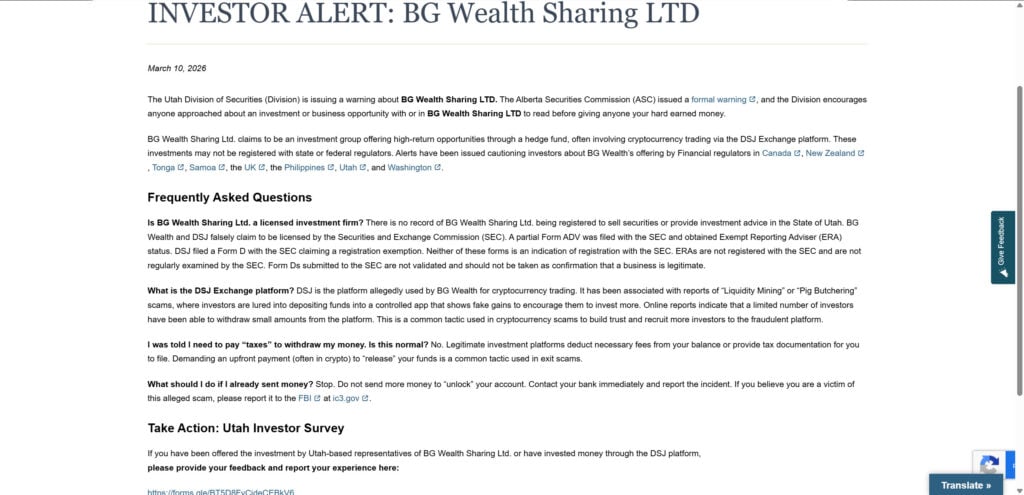
BG Wealth Sharing Ltd has been flagged by financial authorities in multiple countries. The UK Financial Conduct Authority warned that BG Wealth Sharing / dsjex.net may be promoting financial services without permission and advised people to avoid dealing with it.
The Financial Markets Authority in New Zealand, together with the National Reserve Bank of Tonga, described BG Wealth / DSJ EX as a Ponzi-style investment scam using multi-level marketing-type recruitment tactics.
That is not a normal risk warning. That is a serious red flag.
What Is BG Wealth Sharing Ltd?
BG Wealth Sharing Ltd presents itself as a crypto investment opportunity. It appears to promote wealth building, passive income, and trading profits.
According to regulator warnings, the scheme is connected to DSJ Exchange, also called DSJ EX. The Alberta Securities Commission lists websites associated with BG Wealth Sharing Ltd, including bg662.com and dsjex.net, and says DSJ Exchange is operating under BG Wealth Sharing Ltd.
The platform appears to target people through:
- Social media posts
- Online groups
- Messaging apps
- Investment workshops
- Community referrals
- Promoters claiming the system can generate strong crypto profits
This is common in crypto investment scams. The offer is made to look simple: deposit money, follow trading signals, earn returns, and invite others.
But the problem is that regulators say the company is not properly registered and shows signs of a dangerous investment scheme.

Why Regulators Are Warning People
The main concern is simple: BG Wealth Sharing is being promoted like an investment platform, but regulators say it is not authorized to offer those investment services in key jurisdictions.
The Alberta Securities Commission warned that BG Wealth Sharing is linked to DSJ Exchange and described it as a suspected investment scheme. The ASC said it was promoted through social media and messaging apps, claimed to use AI-generated trading signals, and promised guaranteed or near-perfect trades.
The Utah Division of Securities also issued an investor alert about BG Wealth Sharing Ltd and pointed investors to the Canadian regulator warning before giving money to the platform.
Washington State’s Department of Financial Institutions also published an alert about BG Wealth Sharing Ltd and DSJ, warning about crypto scam risks and fake trading platforms.
When several regulators in different countries warn about the same platform, investors should take that seriously.
The Biggest Red Flags
BG Wealth Sharing Ltd has many warning signs commonly seen in crypto scams.
1. It Promises Easy Money
The platform is promoted around the idea of strong profits, passive income, and financial freedom.
That sounds attractive, but real investing does not work that way. Crypto markets are volatile. No legitimate platform can guarantee daily profits, perfect trades, or fast wealth with little risk.
Any platform promising easy crypto returns should be treated with extreme caution.
2. It Is Linked to DSJ Exchange
Regulators have connected BG Wealth Sharing Ltd to DSJ Exchange / DSJ EX. The Alberta Securities Commission says DSJ Exchange is operating under BG Wealth Sharing Ltd and that related websites include bg662.com and dsjex.net.
This matters because scam platforms often use different names, websites, and apps. When one name becomes exposed, another version may appear.
3. It Is Not Properly Registered
Legitimate investment firms normally need proper licensing. They must follow financial rules, disclose risks, and operate under regulatory oversight.
BG Wealth Sharing Ltd has been flagged as not registered in Alberta to trade in or advise on securities or derivatives.
The UK FCA also warned that BG Wealth Sharing / dsjex.net may be offering financial services without permission.
That means investors may have little or no protection if something goes wrong.
4. It Uses Crypto Deposits
Crypto is commonly used in investment scams because payments can be difficult to reverse. Once victims send funds, recovery is often extremely hard.
Scammers also like crypto because they can move funds quickly between wallets, platforms, and countries.
If a platform asks you to deposit crypto before you can invest, trade, or withdraw “profits,” that is a major risk signal.
5. It Relies on Recruitment
The New Zealand FMA and the National Reserve Bank of Tonga warned that BG Wealth / DSJ EX uses multi-level marketing-type recruitment tactics.
This is one of the clearest warning signs.
A real investment platform does not need users to constantly recruit friends, family, and community members. In Ponzi-style schemes, recruitment is often the engine that keeps the scam running.
New investor money is used to create the appearance that earlier investors are making profits. When new deposits slow down, the scheme collapses.
6. Withdrawals May Become Difficult
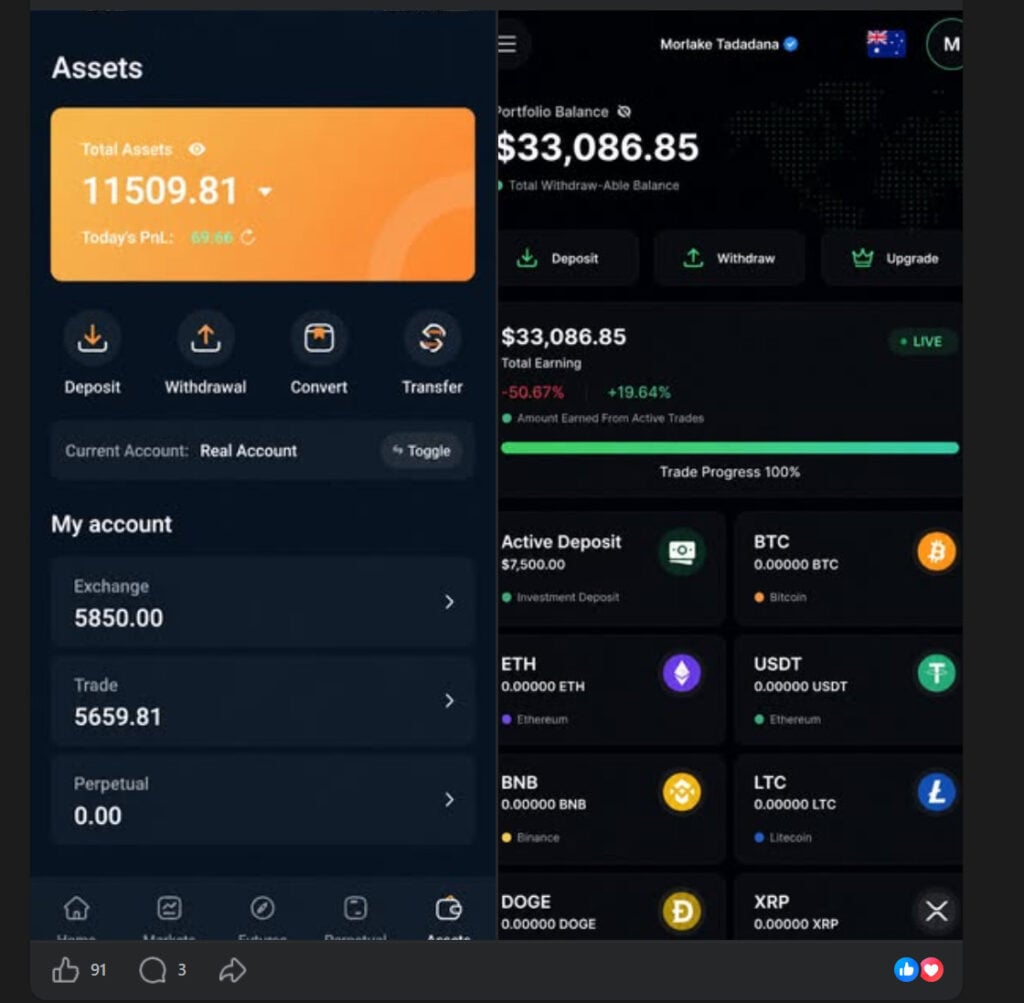
Many crypto scams let users see fake profits inside an app or dashboard. The balance appears to grow, which makes victims believe the investment is working.
But when users try to withdraw larger amounts, problems start.
They may be told to pay:
- Withdrawal fees
- Tax fees
- Verification fees
- Wallet unlocking fees
- Security deposits
- Account upgrade fees
These fees are usually another part of the scam. Paying them rarely releases the money.
How the Scheme Appears to Work
BG Wealth Sharing appears to follow a pattern often seen in crypto investment scams.
It usually starts with promotion through social media, online groups, private chats, workshops, or referrals from people who may already be involved. The offer is presented as a simple way to earn passive income through crypto trading.
Victims are then told that the platform uses trading signals, AI tools, expert strategies, or copy-trading methods to generate profits. This makes the opportunity sound more technical and legitimate than it really is.
From there, users are encouraged to deposit money, often in cryptocurrency. Crypto payments are a major red flag because they are difficult to reverse once sent.
After the deposit, the platform may show profits inside an online dashboard. The balance may appear to grow daily, giving victims the impression that the system is working.
In some cases, users may even be allowed to withdraw a small amount at the beginning. This is not proof that the platform is legitimate. Scammers often allow small withdrawals to build trust and convince victims to invest more.
Once trust is built, the pressure increases. Victims may be encouraged to add more funds, attend more events, or recruit friends and family into the platform.
The real problem usually appears when someone tries to withdraw a larger amount. At that point, the platform may create excuses, delay the withdrawal, freeze the account, stop responding, or demand extra fees before releasing the money.
These extra charges may be called tax fees, verification fees, withdrawal fees, wallet unlocking fees, or security deposits. In many scams, paying these fees does not release the funds. It only leads to more demands.
This is how many Ponzi-style crypto scams operate: they create the appearance of profit, use early trust to attract more money, and then block or delay withdrawals when victims try to cash out.
Why People Still Join
Many people join these schemes because the promotion feels personal and convincing.
The platform may be recommended by someone they know. There may be screenshots of profits. There may be group chats full of people celebrating payouts. There may be leaders, mentors, or “professors” explaining how the system works.
This creates social proof.
Victims think: “If all these people are making money, maybe it’s real.”
But scam groups are often carefully managed. Some testimonials may be fake. Some promoters may be paid. Some early participants may receive money only because newer members are still depositing funds.
That does not prove the business is legitimate. It only proves the scheme has not collapsed yet.
Is BG Wealth Sharing Ltd a Ponzi Scheme?
Regulators have used strong language around BG Wealth / DSJ EX. The FMA and National Reserve Bank of Tonga described it as a Ponzi-style investment scam, while Samoa’s Central Bank warning was reported as saying BG Wealth showed signs of a Ponzi or pyramid scheme.
A Ponzi scheme does not generate real profits from legitimate business activity. Instead, money from newer investors is used to pay earlier investors.
At first, the platform may look successful. People may post screenshots. Some users may receive payouts. The organizers may claim the system is growing fast.
But once new money slows down, the scheme usually collapses.
Most participants lose money.
What To Do If You Already Invested
If you already deposited money into BG Wealth Sharing, DSJ Exchange, or a related platform, take action quickly.
1. Stop Sending Money
Do not pay more fees to unlock your account or release your balance.
If they ask for extra money before you can withdraw, treat it as another scam attempt.
2. Save All Evidence
Keep copies of:
- Crypto transaction IDs
- Wallet addresses
- Screenshots of your dashboard
- Emails and messages
- Group chat records
- Names of promoters
- Phone numbers and usernames
- Any documents or receipts
This information may help if you file a report.
3. Contact Your Bank or Crypto Exchange
If you bought crypto through an exchange, contact that exchange and report the transaction.
They may not be able to reverse it, but they can sometimes flag suspicious wallets or preserve account records.
4. Report It to Authorities
Report the incident to your local financial regulator, cybercrime unit, police, or consumer protection agency.
If you are in the U.S., you can report crypto investment fraud to the FBI’s Internet Crime Complaint Center.
5. Warn People You Referred
If you invited friends or family, tell them immediately.
Many victims become promoters without realizing they are helping a scam spread.
6. Watch Out for Recovery Scams
After losing money, you may be contacted by people claiming they can recover your crypto.
Be careful. Many “fund recovery” services are scams too. They often ask for an upfront fee and disappear.
Final Verdict
BG Wealth Sharing Ltd does not look legitimate. It has been warned about by multiple regulators, linked to DSJ Exchange, and described as part of a Ponzi-style crypto scam structure.
The warning signs are serious:
- Unregistered investment activity
- Crypto deposits
- Promises of high returns
- Recruitment-based growth
- Trading signal claims
- Social media promotion
- Withdrawal problems
- Regulator warnings in multiple countries
The safest move is to avoid BG Wealth Sharing Ltd completely.
If someone is pressuring you to invest, attend a workshop, join a group, or recruit others, do not proceed. Real investments do not need hype, secrecy, pressure, or guaranteed profits.
FAQ
Is BG Wealth Sharing Ltd legit?
BG Wealth Sharing Ltd does not appear to be a safe or legitimate investment platform. Several regulators have warned the public about BG Wealth Sharing, DSJ Exchange, or related activity. The warnings mention unregistered investment activity, crypto deposits, recruitment tactics, and Ponzi-style red flags.
Why are regulators warning about BG Wealth Sharing Ltd?
Regulators are warning people because BG Wealth Sharing appears to offer investment services without proper authorization in several regions. It has also been linked to claims of high returns, crypto trading signals, and referral-style growth, which are common warning signs in investment scams.
What is DSJ Exchange?
DSJ Exchange, also called DSJ EX, is a trading platform that has been linked to BG Wealth Sharing in regulator warnings. Users are reportedly encouraged to deposit crypto and follow trading signals. This type of setup is risky because fake trading platforms can show false profits while preventing real withdrawals.
Is BG Wealth Sharing a Ponzi scheme?
Regulators have described BG Wealth / DSJ EX as having Ponzi-style characteristics. In a Ponzi scheme, money from new investors is used to pay earlier participants instead of profits coming from real business activity. These schemes eventually collapse when new deposits slow down.
Can I make money with BG Wealth Sharing?
Even if some people claim they made money, that does not prove the platform is legitimate. Many Ponzi-style scams allow early or small withdrawals to build trust. The bigger risk is that later users may lose everything when withdrawals are blocked or the platform disappears.
Why do people promote BG Wealth Sharing online?
Some promoters may believe the platform is real. Others may be earning referral bonuses or commissions for recruiting new members. Recruitment-based promotion is a major red flag, especially when the investment depends on bringing in more people.
What are the biggest red flags?
The biggest red flags include promises of high returns, crypto-only deposits, pressure to recruit others, lack of proper registration, social media hype, private group promotion, and difficulty withdrawing money.
What should I do if I already invested?
Stop sending money immediately. Do not pay any extra “tax,” “verification,” “unlocking,” or withdrawal fee. Save screenshots, wallet addresses, transaction IDs, messages, and promoter details. Then report the case to your bank, crypto exchange, local financial regulator, or cybercrime authority.
Can I recover money lost to BG Wealth Sharing?
Recovery may be difficult, especially if you paid with cryptocurrency. However, you should still report the case quickly. Avoid anyone who contacts you claiming they can recover your crypto for an upfront fee, because many recovery services are scams too.
Should I attend a BG Wealth Sharing workshop or seminar?
No. If regulators have warned about the platform, attending or promoting its events may expose you to financial and legal risk. Avoid joining, investing, recruiting, or helping promote the scheme.








