

GenciVie Dental Collagen Powder is being promoted online as a simple solution for receding gums, gum disease, and dental sensitivity. It is sold through sites such as GenciVie-Official.com, Vellora-Official.com, and other similar pages using bold health claims, expert-style stories, and aggressive sales tactics.
However, the product raises serious concerns. Buyers may receive a cheap product shipped from China, face difficult returns, be charged for more units than expected, or struggle with unwanted subscriptions. Before ordering, it is important to understand the red flags behind GenciVie and why this product should be avoided.already ordered it.
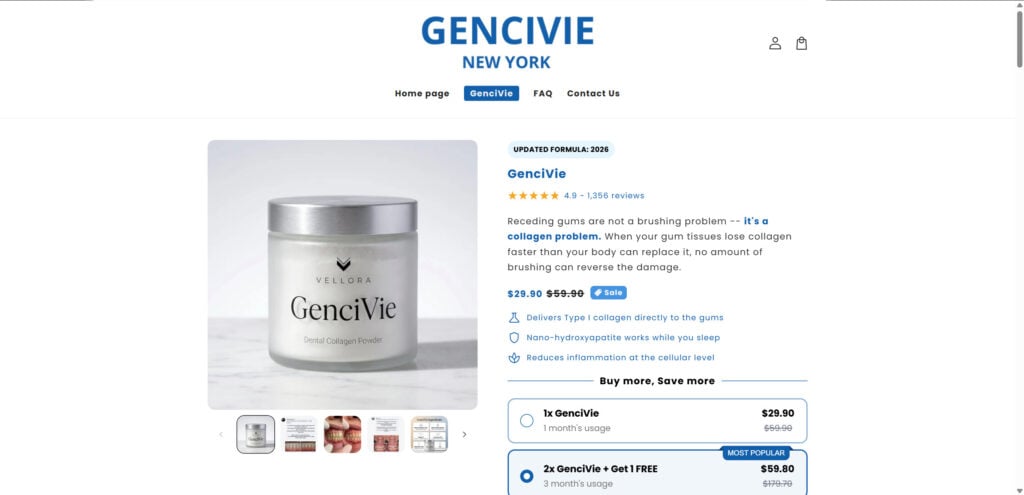
What Is GenciVie Dental Collagen Powder?
GenciVie is marketed as a dental powder that you brush along the gumline. The sales pages claim it contains ingredients such as marine collagen peptides, nano-hydroxyapatite, vitamin C, zinc citrate, hyaluronic acid, calcium carbonate, xylitol, myrrh resin, CoQ10, and peppermint. The product pages describe it as a formula designed to “support collagen” in gum tissue and claim it works differently from regular toothpaste.
On one sales page, GenciVie is sold for $54.90 CAD, marked down from $89.90 CAD, while the page claims a 4.9 rating from 1,356 reviews and says receding gums are “not a brushing problem” but a “collagen problem.”
That type of messaging is important because it does not simply promote a cosmetic oral-care product. It suggests the product can address a real dental condition.
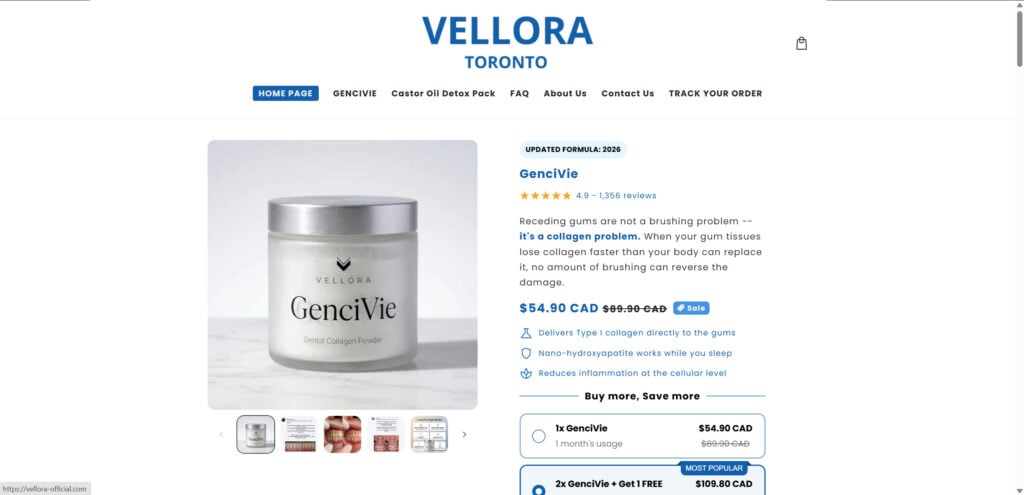
Why GenciVie Raises Major Red Flags
The main concern with GenciVie is not just the product itself. The concern is the way it is being advertised.
The product is promoted with claims that go far beyond normal oral-care language. GenciVie’s own website says it can “regenerate receded gums” and claims visible tissue regrowth is typically reported around weeks 10 to 12. It also says the product supports tissue regrowth between periodontal appointments.
Another Vellora page goes even further, claiming people should try a “30-second collagen ritual” before paying for a gum graft and saying it “reverses recession in 12 weeks.” The page is presented as an article by “Dr. Sophie Beaumont, DMD, MS | Certified Periodontist.”
That is a serious red flag because gum recession and periodontal disease are not minor cosmetic problems. They can involve bacterial infection, gum detachment, bone loss, tooth mobility, and possible tooth loss. The American Dental Association explains that gum disease is caused by plaque bacteria, and if left untreated, it can lead to bone and tooth loss. For more advanced cases, treatments such as scaling and root planing may be required.
A powder sold through social media ads should not be treated as a replacement for diagnosis or treatment from a dentist or periodontist.
The “Swiss Dentist” Story Looks Suspicious
Some ads reportedly promote GenciVie through a story about a dentist in Switzerland who discovered a secret method for gum disease. The name shown in these ads may appear as Dr. Sophie Bowmont or Dr. Sophie Beaumont, depending on the version.
The Vellora page reviewed here uses “Dr. Sophie Beaumont” and presents her as a certified periodontist. However, a public University of Melbourne profile for a real Dr. Sophie Beaumont identifies her as a Clinical Associate Professor at Melbourne Dental School in Australia, not as the Swiss/Canadian marketing persona described in the sales story.
That does not prove identity theft by itself, but it is a major credibility problem. When health products use expert personas, buyers should be able to verify exactly who the expert is, where they practice, what credentials they hold, and whether they actually endorse the product.
If the same “doctor” story appears with different photos, different locations, or slightly different names, that is even more suspicious. This tactic is common in scammy health-product funnels: create a believable expert, attach a medical-sounding story, then push the buyer toward a checkout page before they can verify anything.
The Gum Disease Claims Are the Biggest Problem
GenciVie’s marketing leans heavily on the idea that gum recession is mainly a collagen problem. It then suggests that brushing with collagen powder can rebuild or regenerate gum tissue.
That is not how consumers should evaluate periodontal disease.
Gum recession can have several causes, including periodontal disease, aggressive brushing, genetics, poor oral hygiene, tobacco use, teeth grinding, orthodontic movement, and other factors. Periodontal disease often requires professional evaluation because the visible gumline is only part of the problem. Deep pockets, tartar below the gumline, inflammation, bone loss, and tooth mobility cannot be properly assessed from an online ad.
The FTC’s health-product guidance states that advertising claims about health-related products must be truthful, not misleading, and supported by science. The FTC also says the same legal principles apply broadly to health-related products, not only supplements.
That matters here because GenciVie is not merely saying “supports oral freshness.” It is making or implying stronger claims about gum recession, tissue regrowth, collagen repair, sensitivity, inflammation, and avoiding gum grafts.
Without strong clinical evidence on the specific product, those claims should be treated with skepticism.
The “90-Day Risk-Free” Message Conflicts With the Refund Policy
Another red flag is the refund messaging.
On the Vellora site, the cart area says “Try it risk-free for 90 days.” But the Vellora return policy says there is a 30-day return policy and that items must be unused, with tags, and in original packaging.
The GenciVie-branded site shows the same pattern. Its cart also says “Try it risk-free for 90 days,” while the return policy says customers have 30 days after receiving the item to request a return.
That is exactly the type of inconsistency buyers should watch for. A “risk-free” guarantee sounds simple in an ad, but the actual policy may contain restrictions that make refunds difficult or impractical.
The China Return Trap
Many complaints about products like GenciVie follow the same pattern:
The ad suggests a local, trustworthy, premium brand.
The checkout page looks professional.
The buyer receives a product that appears generic, cheap, or shipped from overseas.
When the buyer asks for a refund, support requires the product to be returned to China at the customer’s expense.
This is a common dropshipping trap. The product may cost very little to source, but the return shipping can cost nearly as much as the refund. In practice, many people give up because returning the item is expensive, slow, and uncertain.
The public Vellora shipping policy says products are shipped “directly from our suppliers,” which is a phrase often seen in dropshipping-style stores. The policy does not clearly reassure buyers that returns will be handled locally, quickly, or without excessive cost.
Victims May Receive More Units Than They Ordered
Another complaint pattern tied to these viral product funnels is unexpected quantity inflation. A customer may believe they ordered one jar, bottle, or package, but the checkout flow may add bundles, upsells, or multi-pack offers.
Sometimes this happens through confusing buttons such as:
- “Best value”
- “Recommended package”
- “Limited-time bundle”
- “Buy more, save more”
- “Upgrade my order”
- “Yes, add protection”
- “Continue” buttons that actually add another item
If you receive more units than you ordered, document everything immediately. Take screenshots of your order confirmation, payment receipt, checkout page if available, package label, and the products received.
In the U.S., the FTC says companies cannot send unordered merchandise and then demand payment for it. Consumers do not have to pay for products they did not order.
Unwanted Subscription Complaints Are Another Warning Sign
Some buyers of viral health and beauty products report being charged again after the first order. This often happens when a trial, membership, “VIP savings plan,” or subscription checkbox is hidden in the checkout flow.
The FTC’s Negative Option Rule addresses recurring-payment programs and prohibits misrepresentations of material facts while marketing negative-option features. It also requires sellers to provide key information before charging consumers.
If you bought GenciVie and later noticed recurring charges, treat the situation seriously. Contact the seller in writing, cancel the subscription, save screenshots, and contact your bank or card issuer if the seller does not cooperate.
How the GenciVie Funnel Appears to Work
GenciVie appears to follow a familiar viral health-product sales pattern.
First, the buyer sees a social media ad. The ad may talk about gum disease, receding gums, loose teeth, bleeding gums, gum grafts, or a dentist who supposedly discovered a hidden solution.
Next, the ad builds fear. It may suggest that normal dental advice is incomplete, that dentists are missing the real cause, or that expensive procedures can be avoided with a simple home ritual.
Then the ad introduces a product. GenciVie is presented as a collagen-based brushing powder that supposedly targets the real cause of gum recession.
After that, the buyer is pushed toward urgency. The page may show discounts, fake-looking review counts, limited-time offers, bundles, or a “risk-free” guarantee.
Finally, problems may appear after purchase. Buyers may receive a cheap product, discover the refund policy is restrictive, be told to return the product overseas, receive extra units, or struggle to cancel recurring charges.
That pattern is why GenciVie should be approached with extreme caution.
Is GenciVie a Scam or Legit?
Based on the red flags, GenciVie looks highly suspicious.
The strongest concerns are:
- Claims that suggest receded gums can regenerate or regrow
- Marketing built around an expert persona that is difficult to verify
- Sales pages that frame gum recession as mainly a collagen problem
- Claims about avoiding expensive gum grafts
- “Risk-free” language that appears to conflict with a shorter written refund policy
- Dropshipping-style supplier language
- Reports of cheap products from China
- Complaints about difficult returns
- Reports of unwanted subscriptions or extra units
- Lack of clear, product-specific clinical proof shown to consumers
At best, GenciVie is an overpriced dental powder promoted with exaggerated claims. At worst, it is part of a misleading dropshipping operation designed to exploit people worried about gum disease.
Avoid it.
If you have gum bleeding, gum recession, tooth sensitivity, loose teeth, bad breath, gum pockets, or suspected periodontal disease, see a licensed dentist or periodontist. Do not rely on a social media powder ad to diagnose or treat a dental condition.
What To Do If You Already Bought GenciVie
1. Save all evidence
Keep screenshots of the ad, product page, checkout page, order confirmation, refund policy, emails, tracking details, and bank charges.
2. Contact the seller in writing
Ask for cancellation and refund by email. Keep the message short and direct. Do not rely only on phone calls.
3. Refuse unclear subscription charges
If you see recurring charges, contact the seller and demand cancellation. Then contact your bank or card issuer.
4. Start a chargeback if needed
If the product was misrepresented, the quantity was wrong, the seller refuses a refund, or you are charged again without consent, dispute the charge with your payment provider.
5. Do not pay expensive return shipping without checking your rights
If the seller demands return shipping to China, ask your bank or payment provider whether that is reasonable under your purchase protection terms.
6. Report the ads
Report the social media ad, the website, and any misleading health claims to the relevant platform or consumer protection agency.
7. See a real dental professional
If you bought GenciVie because of gum disease symptoms, book a dental exam. Delaying proper treatment can make gum disease worse.
The Bottom Line
GenciVie Dental Collagen Powder is marketed with bold gum-regrowth claims, expert-style storytelling, and refund language that deserves scrutiny. The product appears on multiple “official” sites and is promoted as a premium solution for serious dental concerns, yet the red flags are substantial.
Gum disease is not something to treat based on a social media ad.
If a product claims to reverse gum recession, rebuild gums, avoid grafts, or treat periodontal problems without clear clinical proof and transparent seller information, walk away.
GenciVie is not worth the risk.
FAQ
Is GenciVie Dental Collagen Powder legitimate?
GenciVie is a real product being sold online, but the marketing around it raises serious concerns. The claims about gum tissue regrowth, collagen repair, and reversing recession appear exaggerated and should not replace professional dental care.
Can GenciVie regrow receding gums?
Be very skeptical of that claim. GenciVie’s own pages claim gum regeneration and visible tissue regrowth, but serious gum recession should be evaluated by a dentist or periodontist, not treated based on an online ad.
Who is Dr. Sophie Beaumont or Dr. Sophie Bowmont?
Some ads and sales pages use a dentist-style expert story. The Vellora page presents “Dr. Sophie Beaumont” as a certified periodontist, but buyers should independently verify any doctor endorsement before trusting it. The expert identity and changing ad stories are major red flags.
Why are GenciVie ads suspicious?
The ads reportedly use emotional stories, medical-sounding claims, fake or questionable expert authority, urgency, testimonials, and promises about gum disease that go beyond normal oral-care claims.
Is GenciVie shipped from China?
Some buyer complaints allege that the product received appears cheap and is connected to overseas fulfillment or China-based returns. The Vellora shipping policy says products are shipped directly from suppliers, which is often seen in dropshipping-style operations
Can I return GenciVie?
The public return policies reviewed mention a 30-day return period and conditions such as unused items, original packaging, and prior approval before sending anything back. This may be much less generous than the “risk-free” impression created in the sales funnel.
What if I received more units than I ordered?
Take photos, save receipts, and contact the seller in writing. If you were charged for items you did not knowingly order, dispute the charge with your bank or credit card provider.
What if GenciVie charged me again?
Contact the seller and cancel in writing. Then contact your bank or card issuer to block future charges and dispute unauthorized recurring payments.
Should I use GenciVie instead of seeing a dentist?
No. Gum disease, gum recession, bleeding gums, loose teeth, and persistent sensitivity require professional evaluation. Do not delay dental care because of a powder advertised online.
What is the safest alternative?
See a licensed dentist or periodontist. They can check for gum pockets, tartar below the gumline, bone loss, infection, brushing trauma, and other causes of recession or sensitivity.








