

VisionPro Premium Glasses are being promoted as “Buy 1, Get 1 Free” eyewear that supposedly gives clear vision near and far instantly, reduces eye strain, protects against blue light, resists scratches, and uses premium-sounding materials like “CrystalVue” lenses and an “AeroTitan” frame.
But before ordering, buyers should look closely at the claims, the return policy, the shipping details, the vague company information, and the fact that very similar “auto focus,” “multifocal,” and “adjustable vision” glasses are widely available from low-cost Chinese suppliers. This appears to follow a familiar dropshipping-style eyewear pattern: bold optical claims, generic cheap glasses, inflated value through BOGO offers, social media urgency, and return rules that make refunds difficult in practice.
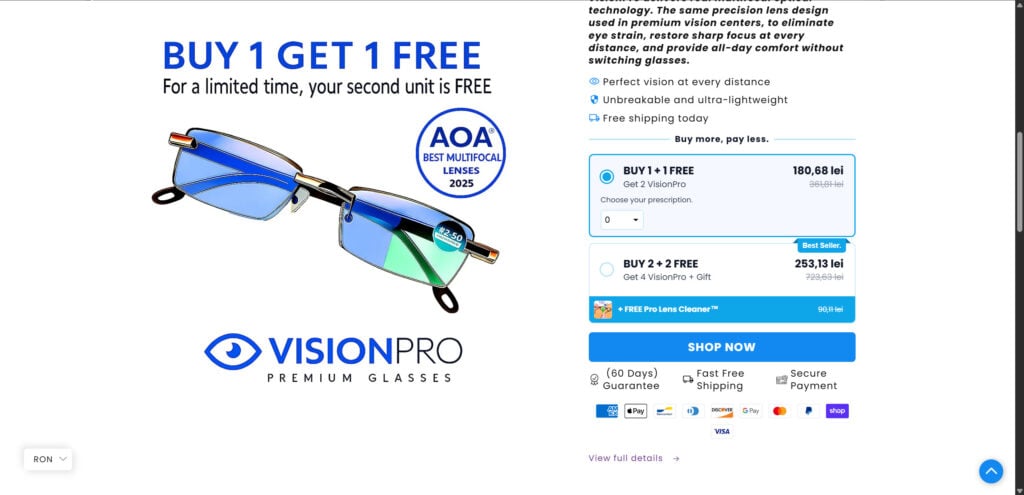
What Are VisionPro Premium Glasses?
VisionPro Premium Glasses are sold through VisionProGlasses.com as universal-fit glasses for men and women. The product page describes them as premium lenses that can provide clear vision at different distances without needing separate pairs of glasses.
The advertised claims include:
- Clear vision near and far instantly
- CrystalVue multifocal lenses
- High-purity “crystal” lenses
- Scratch resistance
- Eye strain protection
- AeroTitan ultralight frame
- Aerospace-grade titanium alloy
- Impact-resistant and flexible frame
- Less than 20 g weight
- Universal fit
- No need to choose a size
- Buy 1, Get 1 Free offer
- 60-day money-back guarantee
- 1-year warranty against manufacturing defects
- Free shipping
The page also uses strong result claims, saying users noticed immediate improvement in both near and distance vision and that customers found the glasses durable and scratch-resistant.
That sounds attractive. People who struggle with reading, screens, distance vision, or switching between glasses may be tempted by a cheap universal pair that claims to solve everything.
The problem is that vision correction is personal. Glasses are not one-size-fits-all medical accessories. A generic pair cannot replace a proper prescription, correct every vision condition, or automatically adapt to every person’s eyes.
Why VisionPro Raises Red Flags
1. The optical claims sound too broad
VisionPro claims to provide clear vision near and far instantly.
That is a major claim. Real eyeglasses are normally prescribed based on a person’s refractive error, pupillary distance, astigmatism, reading needs, distance needs, age, eye alignment, and overall eye health.
Some over-the-counter readers can help with near vision for people with presbyopia. Some multifocal or progressive lenses can help with multiple distances. But those are usually selected or prescribed according to a person’s actual needs.
A universal pair of cheap glasses cannot realistically correct every user’s near vision, distance vision, astigmatism, eye dominance, and comfort needs.
2. “Auto-focus” and “smart focus” style glasses are often marketing hype
Many online ads for these types of glasses use phrases like auto focus, smart focus, automatic zoom, dual focus, or adjustable vision.
Real adaptive autofocus eyewear is an advanced technology category. It typically requires sophisticated optical systems, sensors, electronics, liquid crystal lenses, or mechanical adjustment. Cheap generic glasses sold in BOGO funnels are not the same thing.
If VisionPro is simply a pair of multifocal readers or progressive-style lenses, then buyers should not expect true automatic focusing. If the lenses are fixed, they cannot intelligently adapt to every object distance and every user’s prescription.
3. Similar glasses are sold very cheaply elsewhere
Very similar “auto focus,” “adjustable vision,” “anti-blue light,” and “multifocal” glasses appear on Alibaba, Made-in-China, Walmart marketplace, Amazon, and eBay.
Some supplier listings show adjustable or auto-focus-style reading glasses for only a few dollars per pair in bulk. That strongly suggests VisionPro may not be a unique premium eyewear innovation. It may be a generic imported product sold through a polished landing page.
This is the typical dropshipping pattern:
- A seller finds cheap generic glasses from a supplier.
- The product is renamed with a premium-sounding brand.
- The page adds terms like “CrystalVue” and “AeroTitan.”
- The offer is framed as Buy 1, Get 1 Free.
- The customer is shown a generous guarantee.
- The actual return policy is much harder than the sales page suggests.
The buyer may receive glasses, but not necessarily the premium optical product they expected.
4. The “aerospace-grade titanium alloy” claim should be questioned
The product page claims the frame is made from an ultralight aerospace-grade titanium alloy and is impact-resistant, flexible, and built to last for years.
That is a premium material claim. Buyers should ask whether the seller provides:
- exact frame material certification
- manufacturing details
- lab test reports
- independent impact testing
- actual titanium content
- compliance certificates
- optical safety documentation
If a product is sold at a low promotional price and similar-looking glasses are available from low-cost suppliers, premium frame-material claims should be treated carefully.
5. The 60-day guarantee conflicts with the return policy
The product page says customers can try VisionPro for 60 days and get a full refund if not satisfied.
But the refund policy says dissatisfaction returns are available only up to 7 calendar days from receipt. The exchange and return policy also says this right is not the same as “trying out” the product and that the item must be unused.
That is a major contradiction.
The product page creates the impression that buyers can test the glasses risk-free. The policy pages suggest the opposite: if you use the glasses, you may not qualify for the dissatisfaction return.
For eyewear, that matters. You cannot know whether glasses work for your eyes without trying them on and using them.
6. Returns require inspection and prior approval
VisionPro’s policies say returns must be communicated in advance to the support email, the product must be returned with original packaging and accessories, and the refund is processed only after the item is received and inspected.
The policy also says products that do not meet the conditions may not be accepted and may be returned to the sender.
That makes the refund process far from “no questions asked.”
Buyers may face:
- short return window
- unused condition requirement
- inspection delays
- return approval requirement
- original packaging requirement
- non-refundable shipping costs
- rejection if the product shows signs of use
This is why returns may be practically difficult even if the site advertises a guarantee.
7. Damage reports must be made within 24 hours
The refund policy says visible delivery damage must be reported within 24 hours with photos or video of the product and packaging, including the shipping label.
That is a short window. If a buyer opens the package late or does not notice a scratch immediately, the seller may argue the issue was mishandling.
For glasses, scratches, bent temples, loose hinges, and frame defects may not be obvious until the buyer tries them.
8. The warranty wording is inconsistent
One section says there is a 1-year warranty against manufacturing defects. Another policy section mentions a 30-day manufacturing defect warranty. Another exchange policy references a 90-day warranty.
Inconsistent warranty language is a trust problem. Buyers should not have to guess whether the defect warranty is 30 days, 90 days, or one year.
If a seller advertises a long warranty, the policy pages should clearly match that claim.
9. The site uses a Gmail support address
The site’s contact and policy pages list support through a Gmail address.
A Gmail address does not automatically prove fraud. Small sellers sometimes use Gmail. But for a brand making premium optical claims, taking online payments, selling eyewear, and offering warranty support, a generic Gmail address is a weak trust signal.
A serious eyewear brand should provide clearer company identity, physical business details, professional support channels, and transparent optical documentation.
10. Shipping may come from international logistics centers
The FAQ says VisionPro works with logistics centers in the U.S., Europe, and Asia. The shipping policy says the company partners with international fulfillment centers and delivery may take 10 to 25 business days.
That is consistent with a dropshipping or international fulfillment model.
It also creates practical problems. If the product ships from Asia and returns must be approved through email, buyers may face long delays, partial shipments, confusing tracking, and difficult return logistics.
11. Delivery timelines are inconsistent
The product page says delivery may take 5 to 8 business days. The FAQ says estimated delivery is 5 to 12 business days. The shipping policy says estimated delivery is 10 to 25 business days.
That inconsistency matters.
Buyers may order expecting fast delivery, then later discover the policy allows much longer shipping windows due to international fulfillment.
12. The product may not replace an eye exam
The site itself includes an optical disclaimer saying its information should not replace professional medical advice, diagnosis, or treatment.
That disclaimer is important. If you have blurred vision, headaches, eye strain, double vision, sudden vision changes, eye pain, flashes, floaters, diabetes, glaucoma risk, or unexplained vision problems, you should not rely on generic glasses from an online ad.
A proper eye exam checks more than whether letters look clear. It can detect eye health issues and determine the right prescription.
How the VisionPro Sales Funnel Appears to Work
Step 1: The ad targets people frustrated with glasses
The marketing targets people who are tired of switching between reading glasses, distance glasses, screen glasses, and sunglasses. The idea of one universal pair is appealing.
This works especially well on people with presbyopia who struggle with near vision and want a cheap solution.
Step 2: The product is framed as premium technology
The page uses terms like CrystalVue, AeroTitan, multifocal technology, high-purity crystal, and aerospace-grade titanium.
These names make the product sound advanced. But without technical documentation, they are mainly brand terms.
Step 3: The BOGO offer creates perceived value
The product is sold as Buy 1, Get 1 Free. That makes the buyer feel they are getting a special deal.
But if the glasses are generic low-cost imports, the free second pair may not be as valuable as it looks.
Step 4: The page uses confidence-building guarantees
The product page advertises a 60-day money-back guarantee and a 1-year warranty.
This reduces hesitation. But the policy pages are more restrictive, especially the 7-day unused return rule.
Step 5: The buyer may receive a generic pair of glasses
The buyer may receive real glasses, but they may not perform as advertised. Possible outcomes include:
- they work only as basic readers
- they do not help distance vision
- they do not match the user’s prescription
- they cause eye strain
- they feel cheap
- they do not fit well
- lenses distort vision
- frame quality is lower than expected
- scratches or defects are hard to resolve
- returns are refused because the product was used
Step 6: Refund friction appears after purchase
If the buyer tries the glasses and finds they do not work, the seller may point to the policy requiring unused condition and a 7-day return window. That makes the “risk-free 60 days” message much less useful.
Main Red Flags
- Claims clear vision near and far instantly.
- Uses premium-sounding names like CrystalVue and AeroTitan.
- Claims aerospace-grade titanium alloy frame.
- Claims universal fit for most face shapes.
- Similar “auto focus” and adjustable glasses are sold cheaply by Chinese suppliers.
- Product page promises 60-day risk-free refund.
- Refund policy says dissatisfaction returns are only 7 days from receipt.
- Return policy says trying the product is not the same as withdrawal.
- Product must be unused and in original packaging.
- Refund is issued only after inspection.
- Shipping costs are non-refundable.
- Visible damage must be reported within 24 hours.
- Warranty wording appears inconsistent across pages.
- Support uses a Gmail address.
- Shipping may involve U.S., Europe, and Asia logistics centers.
- Delivery time claims differ across the site.
- Generic glasses should not replace an eye exam or prescription.
Is VisionPro a Scam?
VisionPro may ship a physical pair of glasses, so this may not be a simple “pay and receive nothing” scam.
The bigger concern is the marketing and refund structure.
A fair conclusion is this: VisionPro Premium Glasses appear to be a high-risk dropshipping-style eyewear offer because they combine broad vision-improvement claims, generic low-cost product-category similarities, BOGO pricing, vague premium material language, international fulfillment, and return terms that may make refunds difficult after the glasses are actually tried.
The product may help some people as a basic reader or multifocal-style pair. But buyers should not expect a universal prescription replacement, true auto-focus eyewear, or guaranteed clear vision at all distances.
What VisionPro May Actually Be Useful For
VisionPro may be useful for some buyers if they understand it as a basic generic eyewear product.
It may help with:
- mild near-vision tasks
- temporary reading needs
- basic screen or close-up use
- backup reading glasses
- casual use if the lens power happens to match your needs
It is less likely to help with:
- astigmatism
- complex prescriptions
- different prescription needs between eyes
- strong nearsightedness
- strong farsightedness
- prism correction
- eye alignment problems
- true distance correction
- progressive-lens needs
- sudden vision changes
- medical eye problems
If you already wear prescription glasses, do not assume VisionPro can replace them.
Why “Universal Vision” Glasses Are Risky
Vision correction is not universal.
Two people may both struggle to read, but they may need different lens powers. One may have astigmatism. One may need distance correction. One may need progressive lenses. One may need prism. One may have early cataracts, dry eye, glaucoma, or another condition affecting vision.
Generic glasses cannot diagnose those issues.
If glasses make your vision blurry, distorted, strained, or uncomfortable, stop using them and consult an eye care professional.
What To Do Before Buying
1. Compare similar products first
Search for:
- auto focus glasses
- adjustable focus glasses
- self adjusting vision glasses
- automatic zoom reading glasses
- anti blue light presbyopia glasses
- adjustable reading glasses wholesale
- VisionPro glasses review
If similar products are available for a few dollars or under different names, that is a warning sign.
2. Read the refund policy, not just the guarantee banner
The product page says 60 days. The policy says 7 days for dissatisfaction and unused condition.
That difference matters more than the sales headline.
3. Check whether you need a real prescription
If you have blurry vision at distance, headaches, double vision, eye pain, sudden vision changes, or different vision in each eye, do not buy generic glasses as a shortcut. Get an eye exam.
4. Screenshot everything before checkout
Save screenshots of:
- product claims
- 60-day guarantee
- 1-year warranty claim
- return policy
- exchange policy
- shipping policy
- final checkout page
- quantity selected
- final price
- merchant name
This helps if you need a dispute later.
5. Use a protected payment method
Use a credit card or PayPal when possible. Avoid payment methods that make disputes difficult.
What To Do If You Already Ordered
1. Check your order confirmation
Confirm:
- how many pairs were ordered
- total amount charged
- shipping cost
- merchant name
- delivery estimate
- tracking number
- whether the BOGO pair is included
2. Inspect the package immediately
Because visible damage must be reported within 24 hours, check the glasses as soon as they arrive.
Look for:
- scratched lenses
- bent frame
- loose screws
- missing accessories
- wrong product
- broken bridge
- poor lens clarity
- mismatched pairs
- cheap or damaged packaging
Take photos immediately.
3. Do not throw away packaging
The return policy requires original packaging and accessories. Keep everything until you are sure you will keep the glasses.
4. Be careful before using them extensively
If you want to attempt a return, note that the policy requires unused condition for dissatisfaction returns. Trying them may give the seller a reason to deny a return.
5. Contact support quickly
Email support as soon as possible if the glasses are defective or not as advertised. Include photos, order number, full name, and packaging images.
6. Request a refund clearly
Use direct wording:
“The product page advertised a 60-day money-back guarantee, but the glasses do not perform as advertised. I am requesting a refund to my original payment method.”
7. Dispute if necessary
Contact your bank, credit card issuer, or PayPal if:
- the product never arrives
- the glasses are not as advertised
- the seller refuses the advertised guarantee
- the return policy contradicts the sales page
- the product is defective
- support does not respond
- you were charged for more than expected
Use clear wording such as:
- “item not as described”
- “merchant refuses advertised refund”
- “misleading optical claims”
- “return policy contradicts sales page”
- “defective product”
- “support not responding”
FAQ
What are VisionPro Premium Glasses?
VisionPro Premium Glasses are online-sold glasses marketed as universal multifocal glasses that can help users see clearly near and far.
Is VisionPro a scam?
VisionPro may ship real glasses, but the offer has several red flags: broad vision claims, generic product similarities, BOGO pricing, inconsistent refund terms, Gmail support, and international fulfillment.
Are VisionPro glasses the same as Apple Vision Pro?
No. These are not related to Apple Vision Pro. They are marketed as ordinary glasses, not a mixed-reality headset.
Do VisionPro glasses really work for everyone?
Be cautious. No generic pair of glasses can correct every person’s prescription, astigmatism, distance vision, reading needs, and eye comfort.
Are VisionPro glasses from China?
The exact manufacturing origin is not clearly proven from the visible product page. However, the site says it uses logistics centers including Asia, and similar adjustable/auto-focus glasses are widely available from Chinese suppliers at very low prices.
Can I return VisionPro glasses after trying them?
That is risky. The product page claims a 60-day guarantee, but the return policy says dissatisfaction returns are limited to 7 days and the item must be unused.
Why is the refund policy concerning?
Because the sales page says “risk-free for 60 days,” while the policy pages say returns for dissatisfaction must be unused, requested quickly, approved, inspected, and may exclude shipping costs.
Do VisionPro glasses replace prescription glasses?
No. Generic online glasses should not be treated as a replacement for prescription eyewear or an eye exam.
Are blue light claims reliable?
Blue light glasses are heavily marketed, but eye health authorities say blue light-blocking glasses do not clearly improve digital eye strain symptoms for most people.
Should I buy VisionPro?
Be cautious. Compare similar products first, read the return policy carefully, and get an eye exam if you need actual vision correction.
The Bottom Line
VisionPro Premium Glasses are marketed as a simple, universal eyewear solution with premium-sounding lens and frame technology. The offer looks attractive because of the Buy 1, Get 1 Free promotion, 60-day guarantee, and claims of clear near-and-far vision.
The warning signs are significant. Similar glasses are sold cheaply under many names, the optical claims are broad, the brand uses vague premium terms, delivery may involve international logistics, support is through Gmail, and the real return policy is much more restrictive than the product page suggests.
VisionPro may work as a basic pair of generic readers for some buyers. But it should not be treated as a true prescription replacement, a universal vision fix, or a risk-free purchase. If you already ordered, inspect the product immediately, keep all packaging, document defects within 24 hours, and be prepared to dispute the charge if the refund process contradicts the advertised guarantee









Twice I ordered a pair of these glasses. The money was removed from my account by VisionPro but I never received the order. This is a big time scam.
Two paid orders with no delivery is strong evidence for a payment dispute, Thomas. Save the order confirmations, account statement, messages, and any tracking information, then contact the card issuer or payment provider and describe the purchases as goods not received. Ask them to block any further billing from the same merchant as well.
I ordered a pair, from company ID as Nevo Brands. Price listed in ad as $19.98, PayPal invoice showed price paid as $39.94. Because of price differential, I re-submitted order to see same pricing inconsistencies. This resulted in an unexpected order for 4 glasses. A company response to a refund request was an email from “Aviroo Home Support” I was informed that return is possible after receiving the order. I was then advised that for a refund, the package needed to be returned to China.
I asked for a refund on three of the glasses shipped at $39.94 for a refund total of $119.82. To return to China via UPS would cost $163.59.
The company contact phone number comes up as no connection to a West Virginia listing. So, I am stuck with a payment of $159.76 and no recourse. I have activated a PayPal investigation.
Jerry, the pricing discrepancy you documented is the strongest part of your case: advertised at $19.98, invoiced at $39.94, and an order for four when you expected one. That is not a currency or shipping quirk, it is how the funnel is built. Since PayPal was involved, you are in a good position – file it as significantly not as described rather than as a simple refund request, and upload the ad, the invoice and their emails. When a return abroad costs more than the goods, say so explicitly in the case; PayPal can and does refund without return in those circumstances. Do not post the parcel to China on their instructions before the case is decided.