

Orthora Footwear is marketed as a comfort shoe designed for long shifts, heel pain, plantar fasciitis, and all-day support. The offer looks appealing, especially for people who spend hours standing or walking, but several details on the website deserve closer review before buying.
What Is Orthora Footwear?
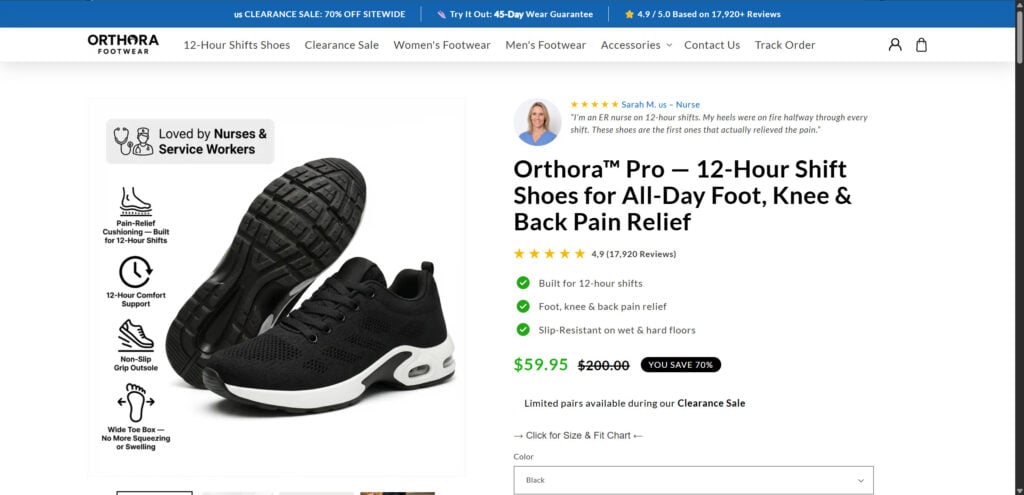
Orthora Footwear sells the Orthora Pro shoe, also described as “12-Hour Shift Shoes for All-Day Foot, Knee & Back Pain Relief.”
The product page claims Orthora Pro is built for people who stand or walk on hard, slippery floors for 8 to 12 hours a day. The page positions the shoe as a solution for workers who experience heel pain, arch pain, knee pressure, lower back pain, swelling, fatigue, and discomfort from long shifts.
The advertised claims include:
- Built for 12-hour shifts
- Foot, knee, and back pain relief
- Slip-resistant grip
- Wide toe box
- Reinforced cushioning
- Breathable mesh
- 4-layer shock-absorbing cushion
- Podiatrist-engineered alignment
- Relief for plantar fasciitis and heel pain
- Reduced knee and lower back pressure
- Improved posture during long shifts
- Support for swelling and wide feet
- 45-day money-back guarantee
- Free shipping
- Free exchanges
- Trusted by 500,000+ workers
- 4.9 rating based on 17,920+ reviews
- 70% off clearance sale
The product is listed at $59.95, reduced from a claimed regular price of $200.
At first glance, this looks like a serious comfort footwear brand. The issue is that several parts of the offer deserve scrutiny.
Why Orthora Footwear Raises Red Flags
1. The pain-relief claims are very broad
Orthora is not simply marketed as a comfortable walking shoe. The page claims it can help with foot pain, heel pain, arch pain, plantar fasciitis, knee pressure, back pain, posture, swelling, and end-of-shift throbbing.
That is a wide set of claims for one pair of shoes.
Supportive footwear can absolutely help some people. Proper cushioning, arch support, heel support, and a roomy toe box can reduce discomfort for certain users. But foot, knee, and back pain can have many causes, including plantar fasciitis, arthritis, tendon problems, nerve compression, poor gait mechanics, flat feet, high arches, obesity, injury, diabetes-related foot issues, spinal problems, or inflammatory conditions.
A generic shoe cannot diagnose or treat all of those causes.
If a buyer has persistent heel pain, numbness, burning, swelling, weakness, or pain that gets worse, they should not rely only on shoes from an online ad.
2. “Plantar fasciitis relief” should be treated carefully
Plantar fasciitis is a real medical condition involving pain around the heel and plantar fascia. Supportive shoes and orthotics can help reduce strain, but not every shoe marketed for plantar fasciitis is automatically effective.
A good plantar fasciitis shoe usually needs:
- stable heel support
- adequate arch support
- enough cushioning under the heel
- a comfortable fit
- proper width
- a sole that is not too flimsy
- a design that matches the user’s foot type and activity
Orthora claims to provide support for plantar fasciitis and heel pain, but the product page does not clearly show independent clinical testing on this exact shoe. It relies heavily on marketing claims, testimonials, and broad comfort language.
That does not mean the shoes cannot help some buyers. It means shoppers should treat the claim as marketing unless supported by real testing and professional evaluation.
3. The “podiatrist-engineered” claim needs proof
The page uses terms like “podiatrist-designed support” and “podiatrist-engineered alignment.”
That sounds authoritative, but buyers should ask:
- Which podiatrist designed the shoe?
- What are their credentials?
- Was the shoe clinically tested?
- Is there a published study?
- Are there biomechanical test results?
- Does the shoe have APMA acceptance or another meaningful professional review?
- Are the claims based on an actual podiatrist or just marketing language?
Without clear details, “podiatrist-engineered” may be more of a trust-building phrase than proof of medical-grade footwear.
4. The review numbers are hard to verify
Orthora’s product page claims a 4.9/5 rating based on 17,920+ reviews and says the brand is loved by 500,000+ American workers.
Those are large numbers. Buyers should be cautious unless they can verify them through an independent review platform.
On-page reviews can be curated, imported, filtered, duplicated, or displayed without full transparency. A brand-controlled review section is not the same as independent customer feedback.
Public review sources show a more concerning picture, with complaints about cheap materials, long delivery times, China shipping, and refund issues. That does not mean every buyer will have a bad experience, but it does mean the brand-controlled rating should not be accepted blindly.
5. The discount pricing may be inflated
Orthora lists the shoes at $59.95 with a crossed-out regular price of $200 and claims buyers save 70%.
This kind of crossed-out pricing is common in direct-response ecommerce. A high “regular price” makes the sale price feel like a major bargain.
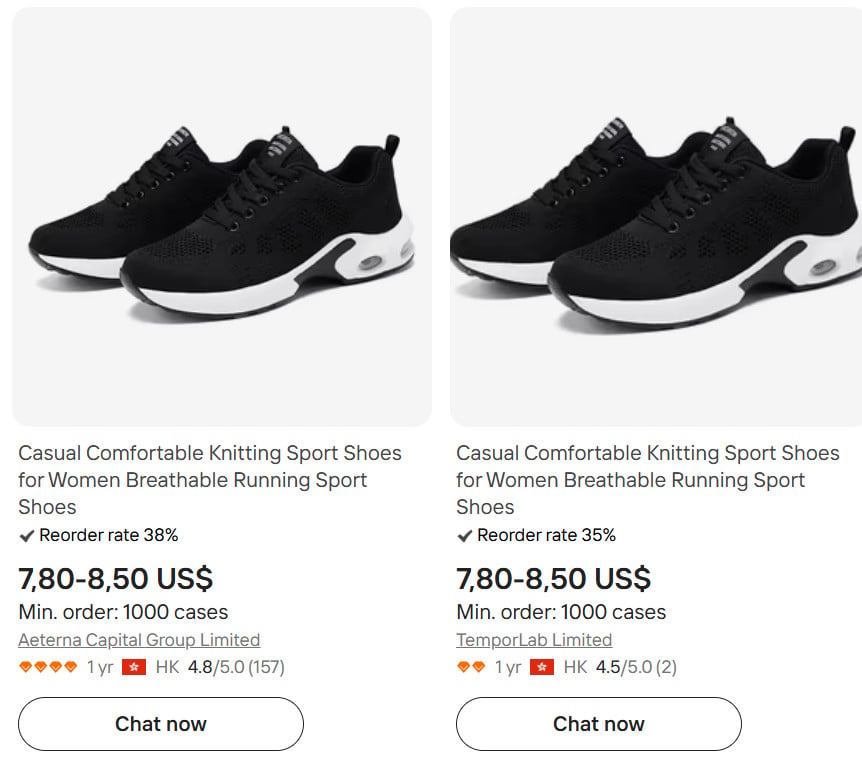
The real question is whether the shoe is actually comparable to a $200 professional work shoe from established brands. If similar mesh orthopedic-style shoes are available from wholesale suppliers and low-cost marketplaces for far less, the $200 reference price may be mostly marketing.
Buyers should compare similar products before accepting the discount as real value.
6. Similar orthopedic-style shoes are widely sold elsewhere
Orthora’s design fits a common online product category: breathable mesh “orthopedic” walking shoes with wide toe boxes, lightweight soles, slip-on construction, and pain-relief marketing.
Similar shoes are sold under many names on Alibaba, Amazon, TikTok Shop, Shein, Temu-style marketplaces, and other stores. Many use nearly the same claims:
- plantar fasciitis relief
- wide toe box
- arch support
- orthopedic comfort
- breathable mesh
- lightweight walking shoe
- non-slip sole
- nurse shoes
- work shoes
- diabetic shoes
- swelling support
This does not prove Orthora is fake. But it does suggest the product may not be a unique invention or premium medical shoe. It may be a generic footwear model marketed under a polished brand name.
7. The “45-day wear test” conflicts with the return policy
This is the biggest issue.
Orthora’s product page says buyers can try the shoes with a 45-day wear test. It says, “Feel real relief or get a full refund,” and the page claims customers can try the shoes, experience relief, and then decide if they want to keep them.
But the return policy says return eligibility requires items to be unused, unworn, and in original condition. It also says returns are not eligible if the shoes have been worn or used.
That is a major contradiction.
How can a customer complete a wear test if worn shoes are not returnable?
This kind of mismatch is a serious buyer risk. A customer may buy because the product page sounds risk-free, wear the shoes for several workdays as instructed, and then be told they are not eligible for a refund because the shoes were used.
8. Promotional and clearance orders may be excluded
Orthora’s product page heavily promotes a clearance sale with 70% off sitewide.
But the return policy says the comfort guarantee does not apply to orders purchased during promotional or clearance events, described as final sale items. It also says returns are not eligible if the item was purchased as part of a promotional offer.
That is another major issue.
If the product is being sold during a clearance sale, and clearance orders are excluded from the guarantee, then the advertised 45-day comfort guarantee may not protect many buyers.
The product page says “Try It Out: 45-Day Wear Guarantee.” The policy says promotional or clearance purchases may be final sale. Buyers should not ignore that gap.
9. Refunds may be replaced by exchanges or replacements
The return policy focuses heavily on free size exchanges, replacements, and adjustment guidance. It says the brand reviews each case, identifies the issue, and provides the most appropriate solution, which may be a size exchange, replacement, or guidance.
This means a buyer may not automatically receive a cash refund. They may be pushed toward another pair or another solution first.
The policy also says orders for which a replacement has already been issued are not eligible for refund.
That matters because a customer who accepts a replacement may lose the ability to get money back later.
10. Return shipping may be the customer’s responsibility
The policy says Orthora covers return shipping only if the item has a manufacturing defect, was damaged in transit, or the wrong item was received.
For standard returns, including change of mind, incorrect size, or wrong item ordered, the customer pays return shipping and must provide tracking.
That can make returns expensive, especially if the return address is not convenient or if the buyer is returning internationally.
11. The terms contain unfinished placeholder text
Orthora’s terms say disputes are governed by the laws of the United States and the State of “[insert state, e.g., Delaware or California].”
That placeholder text is a trust concern.
Legal terms should not contain unfinished template language. If a store is selling footwear nationwide and making comfort guarantees, its legal pages should be professionally completed and clear.
12. Company transparency is limited
The contact page mainly provides a contact form and support email. The terms identify the site as operated by “Orthora,” while the return policy footer mentions “Capture Commerce L.L.C.”
That is not necessarily proof of fraud, but buyers should be cautious when company identity, address, return location, and operating entity are not clearly presented.
A serious footwear company should make it easy to know:
- who owns the brand
- where the company is located
- where the shoes ship from
- where returns go
- who handles refunds
- what warranty actually applies
- whether clearance purchases are refundable
How the Orthora Sales Funnel Appears to Work
Step 1: The page targets workers with real pain
The marketing is aimed at people who spend long shifts on their feet: nurses, restaurant workers, warehouse staff, retail workers, caregivers, and service employees.
This is a powerful audience because the pain is real. Standing for 8 to 12 hours on hard floors can cause foot fatigue, heel pain, knee soreness, and back discomfort.
Orthora frames the problem clearly: normal shoes fail halfway through the shift, and Orthora Pro is built to last the full day.
Step 2: The shoe is positioned as medically supportive
The page uses terms like “podiatrist-engineered alignment,” “plantar fasciitis relief,” “heel alignment,” “shock absorption,” and “pain-free shifts.”
These terms make the product feel more serious than a regular sneaker.
But without independent testing, the product should be treated as a comfort shoe, not a proven medical device.
Step 3: Social proof creates trust
The page claims 17,920+ reviews and 500,000+ workers. It also includes testimonials from nurses and other workers.
This makes buyers feel that many people have already validated the product.
But on-page testimonials should be treated cautiously. Independent reviews and return experiences matter more.
Step 4: The 70% clearance sale creates urgency
The page advertises a 70% off clearance sale and limited pairs.
This pushes buyers to order quickly before reading the return policy.
The problem is that promotional and clearance purchases may be excluded from the guarantee. That makes the urgency tactic especially concerning.
Step 5: The 45-day guarantee reduces hesitation
The product page says buyers can try the shoes and decide after 45 days.
This removes purchase anxiety. But the return policy later says worn shoes and promotional purchases may not be eligible.
That is where the buyer risk appears.
Step 6: Returns may become exchanges instead of refunds
If the shoes do not fit or do not relieve pain, support may offer sizing guidance, an exchange, or a replacement. That can be helpful if the buyer wants another pair.
But if the buyer wants money back, the policy may be much harder to use than the product page suggests.
Main Red Flags
- Strong claims around foot, heel, knee, and back pain relief.
- Claims relief for plantar fasciitis and heel pain.
- Claims podiatrist-engineered alignment without clear proof of clinical testing.
- Claims 17,920+ reviews and 500,000+ workers.
- $200 regular price reduced to $59.95 during a 70% clearance sale.
- Similar orthopedic-style shoes are widely sold under many brand names.
- Product page says 45-day wear test.
- Return policy says items must be unused and unworn.
- Return policy says worn shoes are not eligible.
- Comfort guarantee excludes promotional or clearance purchases.
- The product is promoted as a clearance sale at the same time.
- Replacements may make orders ineligible for refund.
- Customer may pay return shipping.
- Legal terms contain unfinished placeholder language.
- Company identity and return location are not fully clear.
- Public reviews include complaints about China shipping, cheap materials, and refund difficulty.
Is Orthora Footwear a Scam?
Orthora may ship real shoes, so this may not be a simple “pay and receive nothing” scam.
The bigger issue is whether the product is being oversold and whether the return guarantee is reliable.
A fair conclusion is this: Orthora Footwear appears to be a high-risk direct-to-consumer comfort shoe offer because it combines strong pain-relief claims, generic product-category signals, inflated discount pricing, heavy social proof, and return-policy contradictions.
The shoes may feel comfortable for some buyers. They may help some people who need a wide toe box, soft cushioning, and lightweight support. But buyers should not treat Orthora as a guaranteed solution for plantar fasciitis, knee pain, back pain, or all-day work pain.
The refund policy is the biggest warning sign. A product page that says “wear test” while the policy says “unused and unworn” creates a serious risk that buyers may be denied refunds after doing exactly what the ad told them to do.
What Orthora Shoes May Actually Help With
Orthora may help some users with:
- mild foot fatigue
- casual standing comfort
- roomy toe space
- light cushioning
- breathable upper material
- basic walking comfort
- less pressure from narrow shoes
- better comfort than worn-out flats or unsupportive shoes
Orthora is less likely to fix:
- severe plantar fasciitis
- nerve pain
- diabetic foot complications
- structural foot deformities
- advanced arthritis
- tendon injuries
- swelling from medical causes
- severe pronation or supination
- chronic knee or back pain from non-foot causes
For serious or persistent symptoms, buyers should speak with a podiatrist, orthopedist, or physical therapist.
What to Look For in Real Work Shoes
If you stand for long shifts, look for shoes with:
- strong heel support
- stable midsole
- proper arch support
- adequate cushioning
- slip-resistant outsole
- correct width
- enough toe room
- removable insole
- durable construction
- clear return policy
- real customer reviews outside the brand site
- certifications where relevant
- availability from established retailers
For plantar fasciitis, supportive shoes can help, but they are only one part of management. Stretching, activity changes, orthotics, physical therapy, and medical evaluation may also matter.
What To Do Before Buying Orthora
1. Read the return policy first
Do not rely only on the product-page guarantee. Check the policy carefully.
The key questions are:
- Are clearance sale items refundable?
- Can worn shoes be returned?
- Does the 45-day wear test actually allow worn returns?
- Who pays return shipping?
- Is the return address domestic or international?
- Does a replacement cancel refund eligibility?
- Will you get money back or only an exchange?
2. Screenshot the guarantee
Before ordering, save screenshots of:
- 45-day wear test
- 45-day money-back guarantee
- clearance sale
- price
- product claims
- return policy
- final checkout page
- selected size and color
- order total
This evidence may help if the company later denies the guarantee.
3. Compare similar shoes first
Search for:
- orthopedic mesh walking shoes
- wide toe box work shoes
- plantar fasciitis work shoes
- slip resistant nurse shoes
- breathable orthopedic sneakers
- diabetic walking shoes wide toe box
- orthopedic shoes Alibaba
- Orthora alternatives
If similar shoes appear for much less, slow down.
4. Do not buy multiple pairs first
Avoid buying multiple colors or sizes before testing one pair. If the shoes do not fit or the return policy is difficult, extra pairs increase your loss.
5. Use a protected payment method
Use a credit card or PayPal if possible. Avoid payment methods that make disputes harder.
What To Do If You Already Ordered
1. Check the order confirmation
Confirm:
- size ordered
- color ordered
- total price
- shipping fees
- payment descriptor
- delivery estimate
- whether any shipping protection was added
- whether the product was marked clearance or final sale
2. Save all evidence
Save:
- product page screenshots
- guarantee claims
- return policy
- order confirmation
- tracking page
- support emails
- photos of the shoes
- packaging photos
- payment statement
3. Inspect the shoes immediately
Check for:
- wrong size
- wrong color
- cheap materials
- glue marks
- poor stitching
- loose soles
- damaged packaging
- outsole defects
- missing insoles
- strong chemical smell
- mismatch with product photos
Take photos before wearing them.
4. Be careful before wearing them
The product page says wear test. The return policy says worn shoes may be ineligible.
If you are considering a refund, ask support in writing before wearing them:
“Does the 45-day wear test allow me to wear the shoes at work and still receive a refund if they do not relieve pain?”
Save the answer.
5. Report defects quickly
If the item is defective or damaged, contact support within the policy window and include clear photos.
6. Do not accept a replacement if you want a refund
The policy says orders with a replacement already issued are not eligible for refund. If you want money back, be careful before accepting a replacement pair.
7. Dispute if necessary
Contact your bank, credit card issuer, or PayPal if:
- the shoes never arrive
- the product is not as advertised
- the return guarantee is denied after being advertised
- the company refuses refund despite the 45-day wear test claim
- the shoes are defective
- support does not respond
- you are told clearance sale items are not refundable despite the guarantee
Use clear wording such as:
- “item not as described”
- “merchant refuses advertised refund”
- “return policy contradicts sales page”
- “defective product”
- “misleading pain-relief claims”
- “promotional guarantee not honored”
FAQ
What is Orthora Footwear?
Orthora Footwear is an online shoe brand selling Orthora Pro, a comfort shoe marketed for workers who stand for 8 to 12 hours on hard floors.
Is Orthora Footwear a scam?
Orthora may ship real shoes, but the offer has several red flags: strong pain-relief claims, generic product similarities, inflated discount pricing, heavy social proof, and refund-policy contradictions.
Are Orthora shoes real orthopedic shoes?
The site uses orthopedic and podiatrist-style language, but buyers should look for independent testing, professional certification, and transparent design details before treating them as medical-grade footwear.
Can Orthora help plantar fasciitis?
Supportive shoes can help some people with plantar fasciitis, but Orthora should not be treated as a guaranteed treatment. Persistent heel pain should be evaluated by a healthcare professional.
Why is the return policy concerning?
The product page says there is a 45-day wear test, but the return policy says items must be unused and unworn and that worn shoes are not eligible. That is a major contradiction.
Are clearance sale orders refundable?
The return policy says the comfort guarantee does not apply to orders purchased during promotional or clearance events and that promotional purchases may not be eligible. That is concerning because the product is advertised during a 70% clearance sale.
Are returns free?
Only certain cases appear to qualify for free return shipping, such as defective, damaged, or incorrect items. Standard returns may require the customer to pay return shipping.
Is Orthora made in China?
The site does not clearly disclose manufacturing origin on the product page. However, public reviews mention China shipping, and similar orthopedic-style shoes are widely available from Chinese suppliers.
Should I buy Orthora shoes?
Be cautious. Compare similar shoes first, read the return policy carefully, avoid buying multiple pairs, and ask support in writing whether worn shoes are truly refundable under the 45-day wear test.
What should I do if Orthora refuses a refund?
Save screenshots of the 45-day guarantee and return policy, keep all emails, and dispute the charge with your payment provider if the advertised guarantee is not honored.
The Bottom Line
Orthora Footwear is marketed as a 12-hour shift shoe for workers dealing with foot, heel, knee, and back pain. The shoes may feel comfortable for some buyers, especially if they need a lightweight mesh shoe with a roomy toe box.
The warning signs are significant. The product page uses strong pain-relief claims, huge review and customer-count numbers, a 70% clearance sale, and a 45-day wear-test guarantee. But the return policy says worn shoes may not be eligible, promotional or clearance purchases may be excluded, and standard returns may require the customer to pay shipping.
Orthora may not be a complete fake, but it appears to be a high-risk comfort-shoe offer. Buyers should not treat it as a guaranteed medical solution for plantar fasciitis or chronic pain. If you still want to try it, screenshot the guarantee, ask support about worn returns before wearing the shoes, and use a payment method with buyer protection.








