

A social-media ad presents WellaCooler as an easy answer to a hot room: no installation, low power use, and a steep limited-time discount.
Several WellaCooler domains now appear in search results, but they do not tell one consistent product story. The name, specifications, and purchase route change depending on which page a buyer opens.
Following the buttons from advertisement to checkout reveals details that are easy to miss when the countdown timer is running.
Overview
One name, different devices
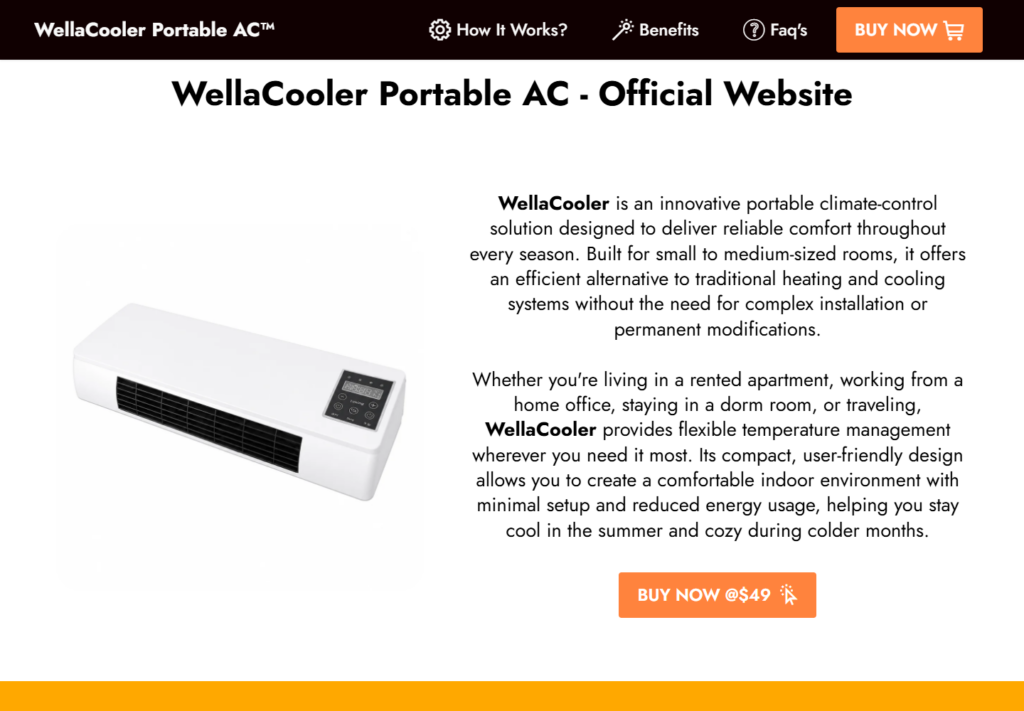
Wellacooler.net describes a 10-watt personal evaporative cooler with a 300 ml reservoir and a four-hour battery. Its main product image, however, resembles the same wall-mounted fan-heater body promoted elsewhere as a much more powerful appliance.
Wellacoolers.com makes a different pitch. It claims 1.6 kW, heating and cooling from 16°C to 45°C, and coverage of up to 51 square meters. The copy repeatedly calls the product EpiCooler instead of WellaCooler.
The name changes during the purchase path
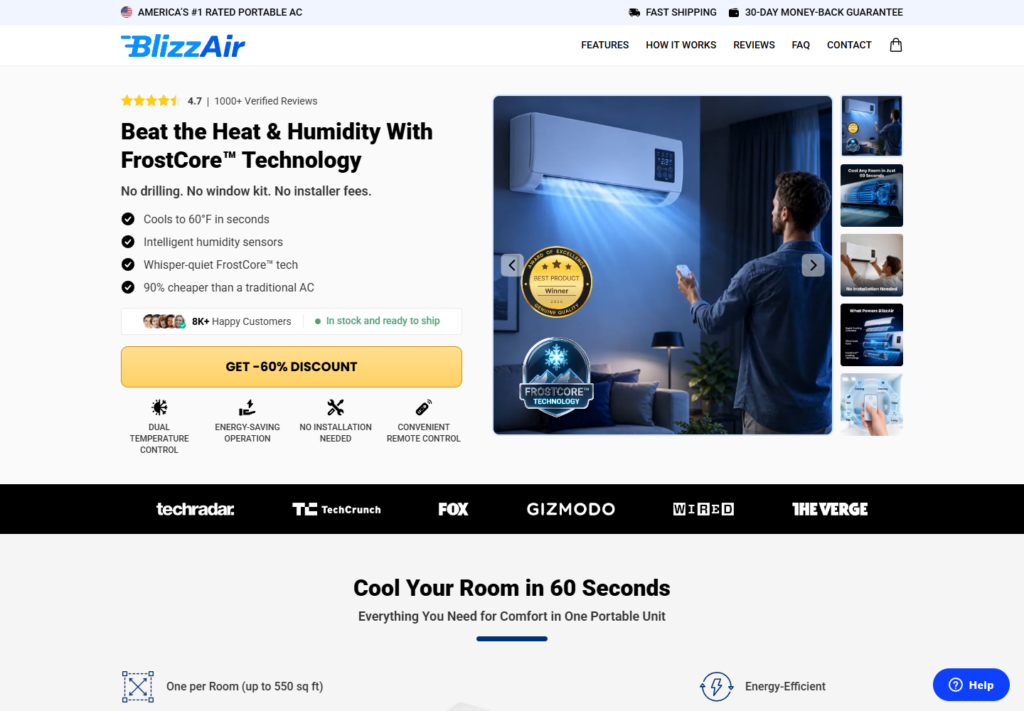
The buy buttons on wellacoolers.com pass through the affiliate tracker knownwalk.com. During our live test, that click opened a BlizzAir sales page rather than a WellaCooler checkout.
The next step used a topashopo.com subdomain. It selected two BlizzAir units, showed a $241.96 total, and preselected an extended warranty priced at $9.99 per unit.
The risk is the funnel, not the logo
A cheap fan or heater can be a real product and still be sold through misleading claims. The central question is whether the delivered hardware can perform like the room air conditioner shown in the advertisement.
WellaCooler’s pages provide no independent cooling test, recognized BTU rating, compressor specification, refrigerant system, or heat-exhaust method that supports the biggest room-cooling promises.
- Three WellaCooler domains were registered within 11 days in June 2026.
- Different pages describe incompatible power levels and product types.
- WellaCooler copy contains EpiCooler and supplement-template leftovers.
- The live buy path changed the brand to BlizzAir.
- The checkout selected a two-unit package and an optional warranty.
- Trustpilot currently shows 1.5 out of 5 from 43 reviews for wellacooler.com.
The Product Page Cannot Keep Its Own Story Straight
On wellacoolers.com, the page title promotes “WellaCooler Portable AC.” Inside the page, the copy repeatedly switches to EpiCooler. Testimonials, feature descriptions, and calls to action appear to have been reused without a complete brand change.
The most revealing error appears in the money-back section. It tells customers they can return the product “even empty bottles” and refers to the effects of a “formula.” Those words belong to a supplement template, not an electrical cooling appliance.
This is more than a spelling mistake. Return language is a material part of an online purchase. A page that promises one thing in a sales banner while its real policy says something narrower can create expensive surprises.
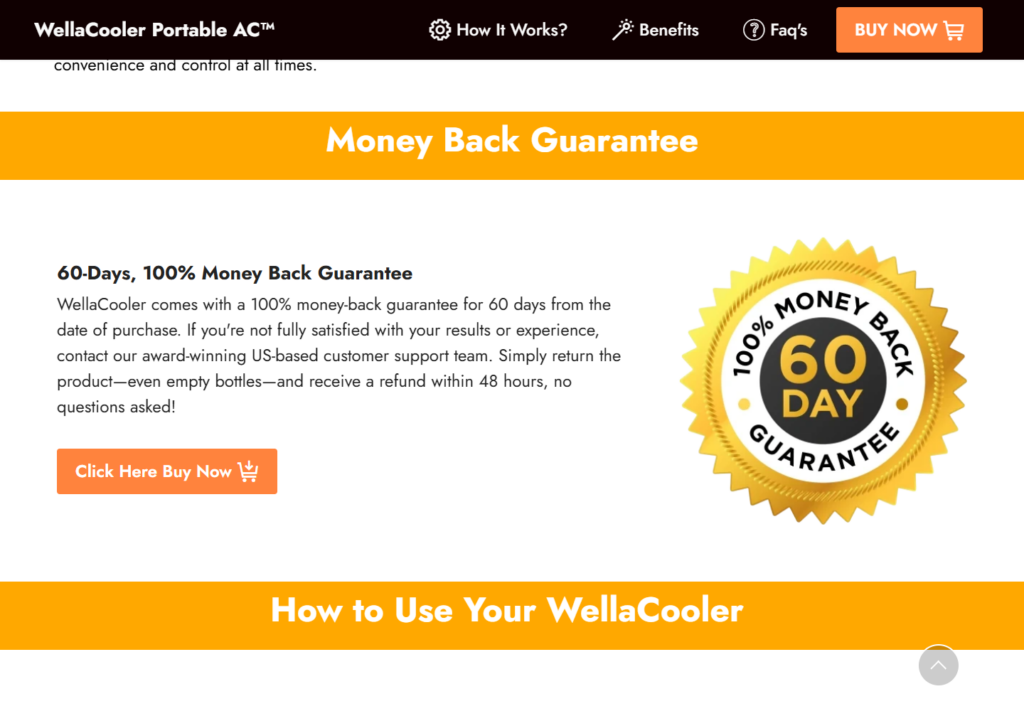
The same page claims a 60-day, 100% guarantee and a refund within 48 hours. The button below that promise does not open a dedicated WellaCooler order form.
During our August 2026 check, it passed through knownwalk.com and landed on get-blizzair.com. The destination promoted “FrostCore” technology, cooling to 60°F in seconds, and coverage up to 550 square feet.
That brand switch means the buyer cannot rely on the WellaCooler page alone to know what name will appear on the receipt, package, card statement, warranty, or return instructions.
How the WellaCooler Scam Works
Step 1: Heat anxiety drives the click
Short videos and social ads target people dealing with uncomfortable bedrooms, rental restrictions, high utility bills, or a heat wave.
The product is framed as a secret alternative to expensive air conditioning. Marketing emphasizes instant relief while avoiding the engineering details needed to evaluate the claim.
Step 2: A generic fan-heater becomes a “portable AC”
The white wall-style device resembles generic PTC fan heaters sold by multiple merchants. Comparable wholesale listings describe a heater with a fan or “cool wind” mode, not a compressor air conditioner.
A fan mode can move room-temperature air. It cannot continuously remove heat from a closed room without a refrigeration cycle and a way to discharge heat elsewhere.
Step 3: Specifications change with the domain
One WellaCooler site describes a 10-watt evaporative unit with water and a battery. Another describes a 1.6-kilowatt heating-and-cooling appliance for 51 square meters.
Those are not minor variations. They describe different technologies, power requirements, and expected performance.
Step 4: Template copy supplies instant credibility
The pages use testimonials, huge discounts, review counts, guarantee badges, energy-saving percentages, and “official site” language.
None of those elements replaces an independent lab result, verified manufacturer model, safety certification, BTU rating, or clear return address.
Step 5: The affiliate link changes the brand
A customer who presses Buy Now may expect WellaCooler. Our live route opened BlizzAir after an affiliate tracking hop.
This lets the advertising name change without rebuilding the payment system. It also makes it harder for a buyer to determine which company accepted the order.
Step 6: The checkout pushes a larger order
The BlizzAir checkout displayed two units as the “best seller.” The one-unit option cost $137.99, while the selected two-unit package cost $110.99 per unit.
A scarcity counter said only 103 items remained, and a reservation timer counted down. These devices create urgency but do not prove inventory or demand.
Step 7: An add-on is already selected
The order summary included an extended warranty option marked as selected. At $9.99 per unit, that could add $19.98 to a two-unit order if the buyer does not notice it.
There was no refill filter subscription in the inspected checkout. The terms contain generic subscription clauses, but we found no recurring product plan selected for this transaction.
Step 8: The refund promise narrows after purchase
The checkout advertises a “hassle-free” 30-day guarantee. The linked policy says change-of-mind returns must be unused, undamaged, in original packaging, approved in advance, and sent with an RMA.
Customers pay return shipping, original shipping is non-refundable, and the return address is supplied only after approval. That is very different from returning an opened appliance because it failed to cool a room.
Why This Is Not a 51 m² Air Conditioner
A real air conditioner moves heat from inside a room to somewhere outside it. A window unit does that across the window. A split system uses an outdoor condenser. A portable compressor AC uses an exhaust hose.
The WellaCooler promotional device has no visible outdoor section or exhaust hose. A fan can make skin feel cooler by increasing evaporation, but it does not lower the room’s total heat load.
A small evaporative cooler can reduce the temperature of the air stream when water evaporates, especially in a dry climate. It adds humidity and normally affects only the area close to the device.
A PTC fan heater can warm air with a ceramic heating element. When heating is off, its “cool” mode is generally just a fan. Calling that function air conditioning creates an expectation the hardware cannot meet.
Comparable wall-mounted PTC fan-heater listings on Alibaba were priced around $26 to $39 at the quantities we checked. Other mini evaporative fans can be cheaper, but we did not verify the exact WellaCooler unit at the claimed $2 to $5 wholesale price.
That distinction matters. The evidence supports a large markup on generic hardware, but the exact factory cost should not be invented.
What the Live Checkout Actually Adds
The WellaCooler button did not preserve the WellaCooler name. It loaded BlizzAir and then a checkout hosted on get-blizzair.topashopo.com.
The package selector favored two units. The order summary combined “2 BlizzAir + Warranty + Free Shipping” and showed a total of $241.96 during our capture.
Prices and timers can change dynamically. The important finding is the structure: a different brand, a multi-unit default, and a selected per-unit warranty.
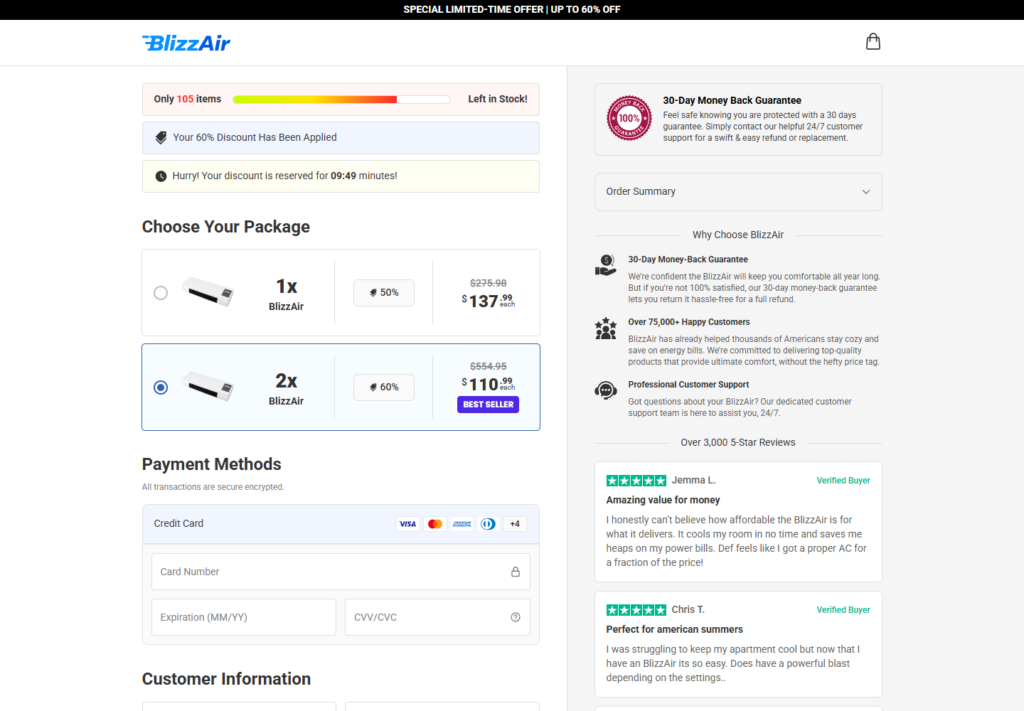
A careful buyer should expand the order summary, confirm the quantity, clear unwanted options, and take a screenshot before entering card details.
If the brand on the checkout differs from the brand in the advertisement, stop and identify the merchant of record. Search the checkout domain, support email, phone number, and company name separately.
Do not assume that a “free shipping” label means a free return. The linked policy makes return postage the customer’s responsibility for a change-of-mind return.
Company, Address, and Fulfillment Checks
The domains are extremely new
Verisign RDAP records show wellacooler.com was registered on June 10, 2026, wellacooler.net on June 16, and wellacoolers.com on June 21.
A young domain does not prove fraud. It does make claims of an established bestseller, thousands of customers, and a long performance history harder to verify independently.
The sites do not identify one consistent seller
Wellacooler.net uses “WellaCooler Inc.” in the footer but does not provide a verifiable company address on the landing page. Its privacy and terms links were dead anchors during our check.
Wellacoolers.com lists support@wellacooler.com but sends the purchase to another brand and another checkout domain.
The support trail crosses brands
Trustpilot’s wellacooler.com profile lists Lithuania and support@wellacooler.com. The live redirected sales page uses support@get-blizzair.com and a U.S. phone number.
Changing support identities can complicate a dispute because the buyer may not know which name to quote to the bank or payment provider.
The return address is withheld until approval
The final checkout policy requires prior authorization and an RMA. It warns customers not to send the package to a registered company address or any address not supplied by support.
That gives the seller control over the first step of the return. Buyers should request the address in writing and preserve every response.
What WellaCooler Customers Are Reporting
At the time of our capture, Trustpilot showed 43 reviews and a TrustScore of 1.5 out of 5 for wellacooler.com. The profile was claimed in July 2026 and listed contact information in Lithuania.
Reviewers alleged non-delivery, weak or missing support, bounced emails, refund difficulty, and receiving something different from the expected cooling product. These are customer allegations, not independently verified findings for every order.
Some company replies said orders were being reviewed. Trustpilot also states that it does not fact-check individual reviews, so the rating is one signal rather than proof by itself.
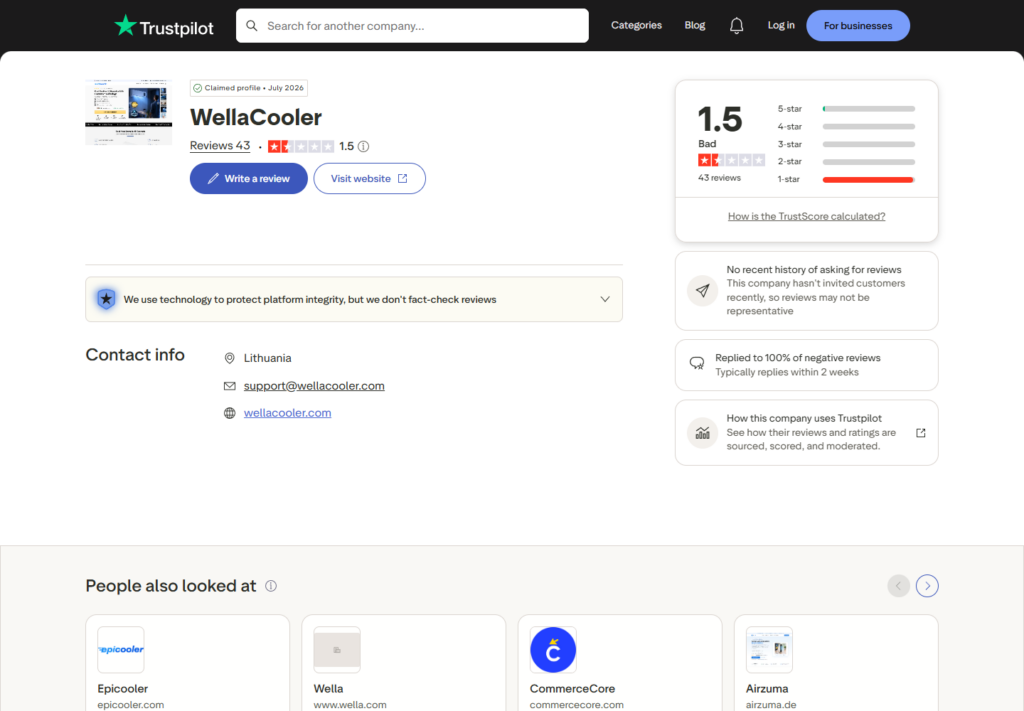
The strongest evidence does not depend on reviews. Anyone can reproduce the brand switch by following the live buy path, inspect the preselected checkout options, and read the return policy.
The rating becomes more relevant because the complaints align with risks visible in the funnel: unclear identity, changing product names, aggressive package selection, and a return process controlled by support.
Consumers should also distinguish wellacooler.com, wellacooler.net, and wellacoolers.com. Similar names do not prove common ownership, even when the pages promote related hardware.
What to Do if You Have Fallen Victim to This Scam
- Save the advertisement and sales page. Capture the cooling claims, price, guarantee, quantity, and promised delivery date.
- Open the order confirmation. Identify the exact product name, merchant descriptor, checkout domain, total, and any warranty or shipping add-on.
- Check for more than one unit. Compare the package you intended to buy with the quantity on the receipt.
- Check PayPal automatic payments and card activity. We did not find a refill plan in the inspected checkout, but review your payment account for any authorization you do not recognize.
- Request cancellation immediately if the order is wrong. Send a clear written message and keep the timestamp.
- Request an RMA in writing. Ask for the return address, deadline, required condition, and refund amount before shipping.
- Use tracked shipping. Photograph the product, serial label, packaging, and sealed parcel. Keep the carrier receipt.
- Dispute misleading or unauthorized charges. Give the bank the ad, checkout screenshot, receipt, support messages, and return-policy conflict.
- Report deceptive advertising. U.S. buyers can file reports with the FTC and their state attorney general.
If an ad redirect or download led to suspicious browser behavior, run a full device scan with Malwarebytes. This does not resolve an order dispute, but it can catch common unwanted software.
A blocker such as AdGuard can reduce exposure to aggressive ad networks and known malicious domains. It cannot make a misleading product claim true, so checkout review remains essential.
For the broader pattern, see our investigation of the 90-second portable AC scam and the long-running Cooling Ace rebranding network.
Frequently Asked Questions
Is WellaCooler a real air conditioner?
The inspected pages do not show the compressor, refrigerant, BTU rating, or heat-exhaust system expected from a room air conditioner. The hardware appears closer to a fan, evaporative personal cooler, or PTC fan heater.
Why does the WellaCooler page mention EpiCooler?
Wellacoolers.com contains repeated EpiCooler references, suggesting the page was copied or rebranded without a complete edit. That mismatch is visible directly in the live page copy.
Why does WellaCooler open a BlizzAir checkout?
The buy link uses an affiliate-tracking domain. During our live test, it redirected to get-blizzair.com and then a BlizzAir checkout on topashopo.com.
Does WellaCooler enroll buyers in a subscription?
We did not find a recurring refill plan in the inspected transaction. We did find a preselected extended warranty priced per unit. Buyers should still inspect PayPal automatic payments and future statements.
Can I return WellaCooler after trying it?
The live funnel’s policy says change-of-mind returns must be unused, undamaged, and in original packaging. It also requires advance approval, an RMA, and customer-paid return shipping.
What is the current WellaCooler Trustpilot rating?
Our August 2026 capture showed 1.5 out of 5 from 43 reviews for wellacooler.com. Ratings can change, so check the current profile and read the most recent verified details.
The Bottom Line
WellaCooler is not one stable product sold through one transparent store. Its pages contradict each other, reuse EpiCooler copy, and send buyers into a BlizzAir checkout with a larger package and selected add-on.
Do not buy based on the cooling video or discount timer. If the page cannot keep the product name, specifications, merchant, and return promise consistent, your card should stay in your wallet.








