

Mounja Gummies arrives with the kind of promise that makes a tired shopper pause: an easy daily gummy, a familiar weight loss story, and none of the cost or effort associated with prescription treatment.
The trouble begins when the name on the page, the label on the bottle, the order total, and the company handling the complaint do not tell one clean story.
We followed those details to see what buyers are actually being asked to trust.
Overview
What Mounja Gummies Is Supposed to Be
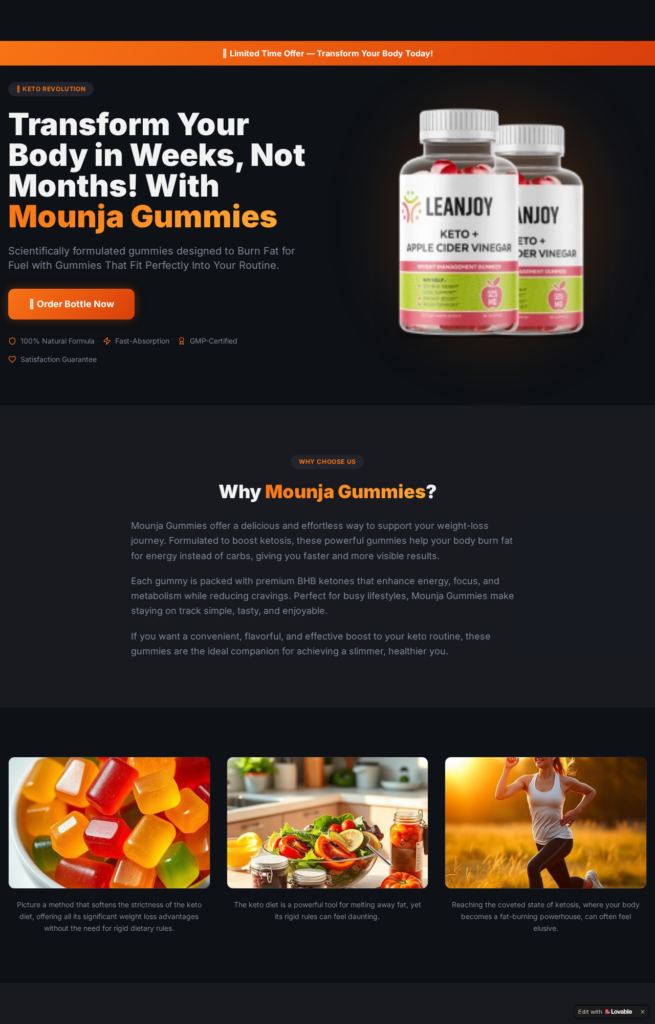
Mounja Gummies is marketed as a weight loss supplement that can help the body enter ketosis, burn fat for fuel, reduce cravings, and support faster results. The promotional language borrows heavily from the popularity of GLP-1 medications without establishing that the gummy works like a prescription drug.
The public product page describes BHB ketones and apple cider vinegar as the key idea. Yet the most visible product bottles on that same page are labeled “LeanJoy Keto + Apple Cider Vinegar,” not Mounja Gummies.
That is not a small design mistake. A buyer should know the exact brand, formula, serving size, ingredient panel, distributor, and refund policy before providing payment details.
Why This Offer Raises Serious Questions
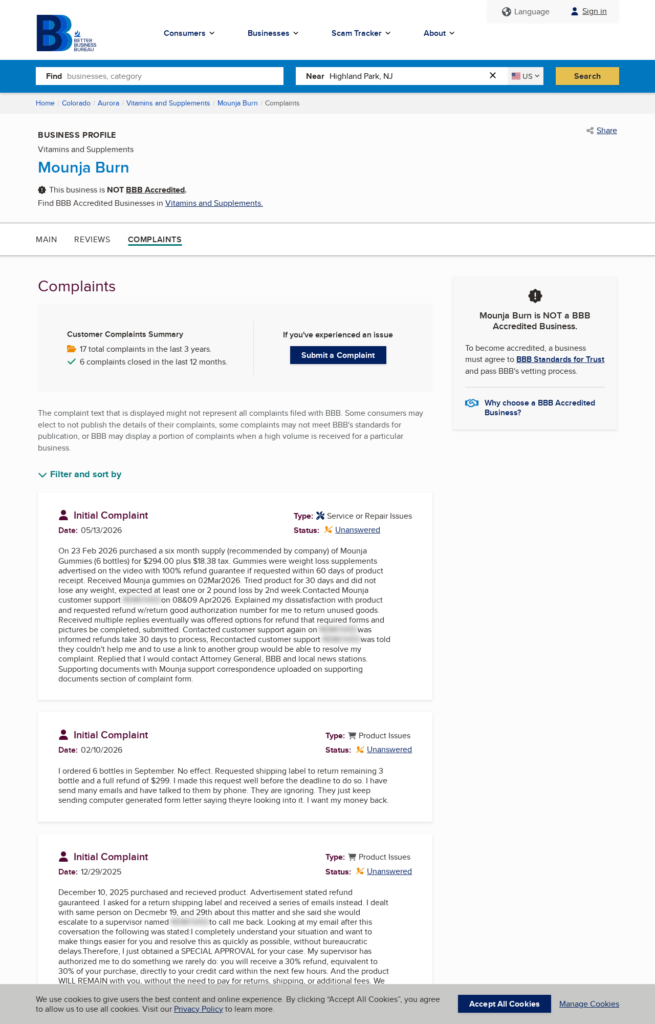
The sales path is surrounded by conflicting identities and unusually serious complaints. BBB records connect complaints involving Mounja Gummies with names including Mounja Burn, Vita Health Supplements, Returns Center, and the payment processor Cartpanda.
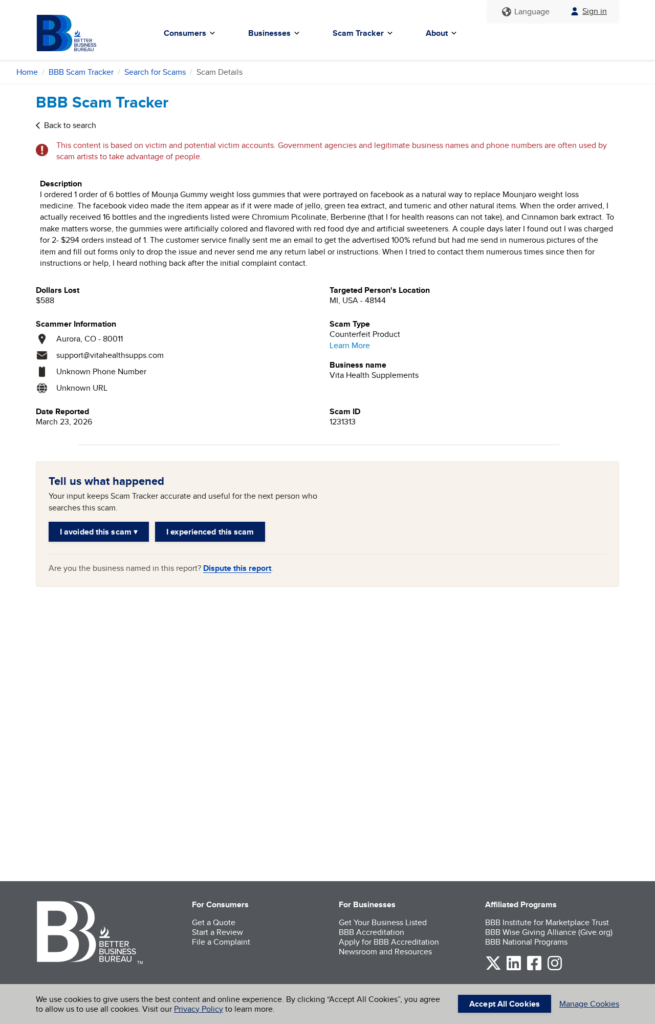
One BBB Scam Tracker report alleges that a shopper ordered six bottles, received 16 bottles, and saw two charges of $294. The consumer also said the ingredients on the delivered label differed from the ingredients described in the Facebook promotion.
Other complaints describe refund forms, requests for photographs, delayed responses, partial-refund offers, and returned packages that did not immediately produce the promised credit. These are consumer allegations, not court findings, but the pattern is too relevant to ignore.
Our Verdict on Mounja Gummies
We recommend avoiding Mounja Gummies offers promoted through social media videos and unfamiliar checkout pages. The name mismatch on the product page, the volume of complaint evidence, and the reports of quantity and billing disputes create a level of uncertainty that a weight loss supplement should not have.
This does not mean every bottle bearing a similar name comes from the same seller. It means buyers cannot safely assume that a polished ad, a familiar-sounding brand, or a money-back badge identifies the business that will answer after the charge posts.
The clearest warning signs are:
- The Mounja Gummies page visibly shows bottles labeled LeanJoy.
- The marketing leans on ketosis and GLP-1 associations without proving drug-like results.
- BBB complaints connect the product name with several business and processing identities.
- Consumers allege receiving more bottles and larger charges than expected.
- Refund experiences described online are much more complicated than “no questions asked.”
The Product Page Does Not Match the Product Name
A Mounja Headline Sits Above LeanJoy Bottles
The most immediate red flag is visible without reading any fine print. The page calls the offer Mounja Gummies, but its product photography shows “LeanJoy Keto + Apple Cider Vinegar” on the bottle labels.
That makes it impossible to tell whether the page is an unfinished template, a reseller page using the wrong assets, or a lead-generation page built around a popular search term. None of those explanations gives a buyer confidence about what will arrive.
A trustworthy supplement page should use consistent branding from the headline through the Supplement Facts panel, checkout, receipt, and shipping label. Here, the first two of those elements already conflict.
The GLP-1 Association Is Marketing, Not Equivalence
The word “Mounja” closely echoes Mounjaro, a prescription medication. The page also uses terms such as ketosis, fat for fuel, metabolic support, and rapid transformation to create a medical-adjacent impression.
A dietary supplement gummy is not interchangeable with a prescription GLP-1 medicine. A seller should not rely on name similarity or broad biological language to let consumers make that leap on their own.
Anyone considering weight loss treatment should discuss appropriate options with a licensed clinician. Replacing a prescribed plan with a gummy based on a Facebook video can delay care and expose the buyer to ingredients that may not be suitable for their health or medications.
The Ingredient Story May Change Between Ad and Delivery
The BBB Scam Tracker account is especially concerning because the consumer said the Facebook ad described ingredients such as gelatin, green tea, and turmeric, while the delivered product listed chromium picolinate, berberine, and cinnamon bark extract.
We cannot independently test that consumer’s shipment or confirm every advertisement in circulation. Still, a reported formula mismatch matters because ingredients are not interchangeable decorations. Berberine, for example, may be inappropriate for some people or interact with medications.
Do not take a delivered supplement merely because the outer package resembles the advertisement. Compare the physical Supplement Facts panel with the page you saved, and ask a pharmacist or clinician about unfamiliar ingredients before using it.
Complaints Show a Recurring Order and Refund Pattern
Some Buyers Say the Cart Became Much Larger
Several complaints are not simply about disappointing weight loss. They concern the transaction itself. One shopper reported ordering six bottles but receiving 16 and being charged twice at $294, for a total of $588.
Another BBB complaint involving Cartpanda alleges two payments totaling $562.17. The shopper said the product was returned within the stated period and that the seller agreed to a refund, but the credit had not arrived when the complaint was filed.
These reports do not prove that every checkout behaves the same way. They do show why a shopper must capture the final order summary before submitting payment and compare it with the confirmation email and card authorization immediately.
The Refund Promise Can Turn Into a Paper Trail
Advertising often reduces a guarantee to a comforting badge. The complaints describe a different experience: repeated emails, requests for photos, forms, return authorization numbers, tracked shipping, partial-refund negotiations, and long waits.
One Mounja Gummies complainant said support required forms and photographs, then directed the consumer to another group. Another reported sending the bottles back with tracking and continuing to chase the refund.
There are also complaints that eventually note a refund was received. That nuance matters. The issue is not that a refund is literally impossible, but that the path described by some buyers is more demanding and uncertain than the front-end promise suggests.
Independent Reviews Are Overwhelmingly Negative
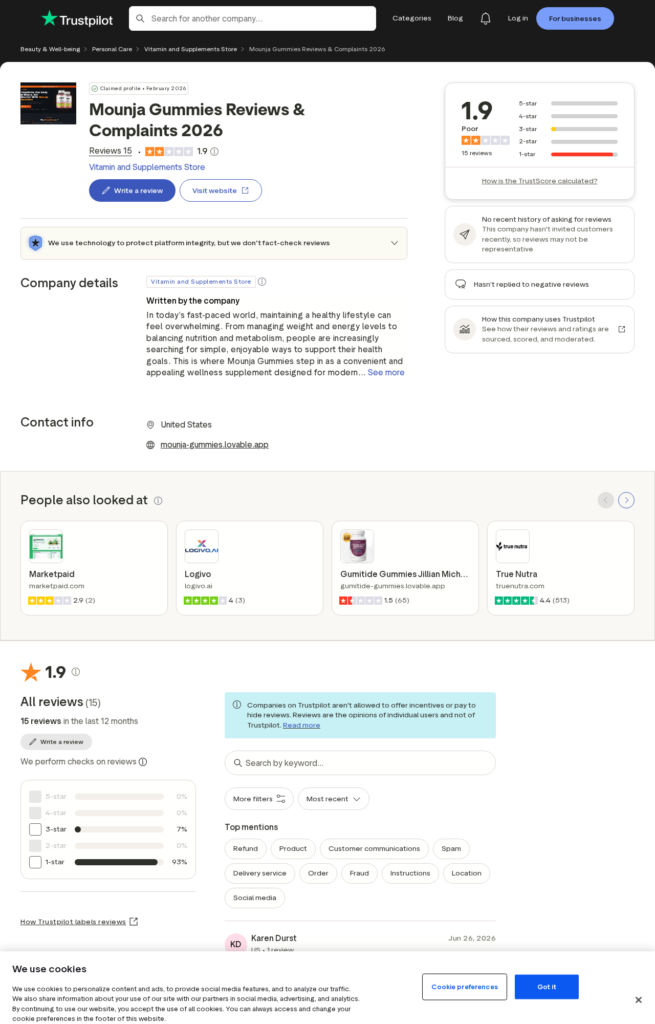
At the time of our review, the Trustpilot profile for the Mounja Gummies page displayed a 1.9 out of 5 score based on 15 reviews, with 93% rated one star. Trustpilot also noted that the company had not replied to negative reviews.
Trustpilot does not fact-check every review, so no single post should be treated as definitive proof. What matters is the consistency between those accounts and the themes in BBB complaints: confusing charges, difficult returns, contact problems, and dissatisfaction with what arrived.
A seller-controlled testimonial carousel cannot cancel out independent complaint evidence. Before ordering, look for reviews that describe the full process, including the cart total, card statement, package contents, return address, and refund outcome.
How the Mounja Gummies Scam Works
Step 1: A Social Media Video Borrows the Mounjaro Conversation
The funnel begins with a short Facebook, Instagram, or video ad built around fast weight loss. The wording may reference a natural GLP-1 alternative, a celebrity transformation, a simple gummy routine, or an ingredient that supposedly copies an injection’s effect.
The ad may avoid showing a clear label for long. That allows the same story to survive even when the product name, bottle design, or seller changes.
Step 2: The Landing Page Turns Familiarity Into Trust
After the click, a polished page presents benefits, ingredient icons, transformation language, and customer stories. Visitors recognize the weight loss vocabulary and may assume the product has been medically evaluated.
On the page we reviewed, the brand name and bottle label do not match. A shopper focused on the promise may miss that the “Mounja Gummies” page is actually displaying LeanJoy bottles.
Step 3: A Bundle Is Framed as the Sensible Choice
Direct-response supplement funnels commonly make one bottle relatively expensive while presenting three or six bottles as a dramatic saving. The recommendation to use the product for several months makes the largest package feel necessary.
The consumer is no longer deciding whether to try one supplement. The page quietly changes the decision into how many months to buy before any personal result is known.
Step 4: The Checkout Can Add Quantity, Upsells, or Another Offer
Complaints tied to Mounja Gummies describe duplicate charges, extra bottles, and related add-on products. We cannot confirm that every current checkout contains the same selections, which is precisely why the last payment screen matters.
Read every checked box and line item. Save a screenshot showing quantity, total, shipping, recurring terms, and merchant name before pressing the final button.
Step 5: The Statement May Name a Processor, Not the Ad
Cartpanda appears in multiple complaints as a payment processor connected with Mounja Gummies transactions. Other names include Vita Health Supplements and PureWellness.
A processor is not automatically the manufacturer or advertiser. The practical problem is that the buyer may end up contacting one party, returning to another, and disputing a descriptor that never appeared prominently in the original video.
Step 6: A Refund Request Becomes a Negotiation
Instead of a simple return instruction, some consumers describe being asked to send pictures, complete forms, accept a partial refund, wait for authorization, or contact another support group.
Time matters because the guarantee clock keeps running. A buyer who accepts repeated delays without documenting the first request can lose leverage with both the seller and the card issuer.
Step 7: The Brand Changes While the Funnel Continues
Names such as Mounja Gummies, Mounja Burn, Mounja Boost, LeanJoy, and other Mounja-style products appear across pages and complaints. Similar names can be separate sellers, related campaigns, or reused marketing templates.
That churn makes a product-only search less useful over time. Follow the merchant descriptor, support domain, phone number, return address, processor, and exact label, not only the large brand name in the ad.
Company, Address, and Fulfillment Checks
The Company Name Changes Depending on Where You Look
The page, the bottle, the receipt, and the complaint trail should identify one accountable seller. In this case, records and consumer accounts reference Mounja Gummies, Mounja Burn, Vita Health Supplements, PureWellness, Returns Center, and Cartpanda.
That does not prove all names are the same legal company. It proves the transaction is not transparent enough to assume that the brand in the video is the party responsible for returns and billing.
The Aurora Address Looks Like a Returns Destination
Complaints and Scam Tracker reports point to Aurora, Colorado, including ZIP code 80011. A return location or fulfillment warehouse can receive packages for many sellers without being the product’s headquarters, laboratory, or manufacturer.
Do not treat a warehouse address as proof of who formulated the gummies. Ask for the legal seller’s full name and verify whether the return name on your authorization matches the name the carrier will recognize.
The Contact Channels Have Drawn Response Complaints
One report lists support@vitahealthsupps.com. Other complaints describe calling a number on the receipt, reaching a processor representative, or receiving no useful answer from the product support channel.
Test the support address before ordering. Ask a specific question about the exact bottle, final quantity, recurring shipments, return address, and refund deadline. A vague answer is a warning, and no answer is an even clearer one.
No Clear Manufacturing Chain Means No Easy Safety Check
The strongest concern is not a slogan such as “made in the USA.” It is whether the buyer can identify the distributor on the physical label, the facility responsible for the finished product, a lot number, expiration date, complete ingredient amounts, and a reachable adverse-event contact.
We did not find evidence that proves these particular gummies are mass-produced in China, and we will not make that claim without documentation. The real problem is that the visible sales material does not give buyers a clean chain of accountability.
Unknown or mismatched ingredients can be dangerous for someone taking medication, managing diabetes, preparing for surgery, or avoiding a specific compound. Stop using the product and seek medical advice if the received label differs from the advertisement or if you develop symptoms.
What to Do if You Have Fallen Victim to This Scam
- Stop taking a mismatched product. If the bottle or Supplement Facts panel differs from what you ordered, do not keep using it to “see what happens.” Photograph every side of the bottle and packaging, then speak with a pharmacist or clinician about any ingredients already consumed.
- Preserve the complete sales trail. Save the ad, landing-page URL, final checkout, confirmation email, receipt, card descriptor, shipping label, bottle photos, lot number, and every support message. Record the dates of calls and the name used by each representative.
- Contact the seller in writing. State the order number, exact charge, delivery date, reason for cancellation, and the remedy requested. Ask for an RMA and confirmed return address. Do not mail the package to an address found in an unrelated complaint without written authorization for your order.
- Call the card issuer promptly. Explain whether the dispute involves an unauthorized amount, duplicate charge, goods not as described, canceled recurring billing, or a promised refund that never arrived. Use accurate language and provide your saved evidence.
- Watch for additional charges. Review the next several statements for the exact merchant descriptor and similar amounts. Ask the bank whether replacing the card alone will stop merchant-initiated recurring transactions and what additional block is available.
- Return with tracking only if instructed. Keep the receipt, tracking number, package weight, and delivery confirmation. Photograph the contents inside the box before sealing it. A tracked return can be decisive in a card dispute.
- Report the transaction. File a report with the FTC at ReportFraud.ftc.gov and, where appropriate, the BBB, your state attorney general, or your national consumer protection agency. Describe allegations as your experience and attach the evidence.
- Secure the device used for checkout. If the ad led through suspicious redirects or you downloaded anything, scan the device with Malwarebytes. AdGuard can also reduce exposure to malicious and misleading ad networks, but it does not cancel an order or replace a bank dispute.
Frequently Asked Questions
Is Mounja Gummies a legitimate weight loss product?
A physical supplement may be shipped, but that does not make the marketing or transaction trustworthy. The brand mismatch, complaint history, and billing allegations are serious enough that we recommend avoiding the offer.
Is Mounja Gummies the same as Mounjaro?
No. Mounjaro is a prescription medication. Mounja Gummies is marketed as a dietary supplement, and the similar name does not establish the same ingredients, mechanism, testing, approval, or results.
Does Mounja Gummies enroll everyone in a subscription?
We did not verify a universal automatic subscription for every checkout. Complaints focus more heavily on unexpected quantities, duplicate charges, add-ons, and refund friction. Read the specific order summary and monitor later statements.
Why does the Mounja Gummies page show LeanJoy bottles?
The page does not clearly explain the mismatch. It may reflect reused assets, a reseller template, or inconsistent branding. Whatever the cause, buyers should not proceed until the seller identifies exactly what product will be shipped.
Can I get a refund for Mounja Gummies?
Some complaint records say refunds were eventually received, while others describe delays or unresolved requests. Start in writing, request return authorization, preserve tracking, and contact the card issuer before its dispute deadline.
What should I do if I received more bottles than I ordered?
Photograph the unopened shipment, compare it with the confirmation, and contact the seller and card issuer immediately. Do not use extra bottles or return them without a trackable, written instruction tied to your order.
The Bottom Line
Mounja Gummies is not simply a question of whether a gummy can support weight loss. The more urgent issue is whether the buyer can identify the product, seller, quantity, formula, charge, and refund route before money leaves the account.
Here, those details repeatedly conflict. A Mounja page shows LeanJoy bottles, complaints name multiple businesses, and consumers describe unexpected quantities and difficult refunds. That is enough reason to step away and choose a product or medical plan with a clear label, accountable seller, and evidence that exists outside the sales funnel.








