

The ad does not begin with Memovance Pro. It begins with a worried family, a famous face, and a spoonful of honey that supposedly restores memory after age 60.
Only after the viewer has followed the “Honey Shield” story does the ordinary capsule bottle appear. That distance between the emotional promise and the product is where this investigation starts.
The product page is real, but the story used to sell it is not.
Overview
What Memovance Pro Actually Is
Memovance Pro, printed as “Memovance PRO” on the product page and label, is a once-daily dietary supplement marketed for memory, focus, mental clarity, and general cognitive wellness.
The published Supplement Facts panel lists niacin, calcium, L-arginine, L-arginine AKG, L-citrulline HCL, L-citrulline malate, and beta-alanine. It is not a honey product, and the disclosed formula does not resemble a cinnamon-and-honey home remedy.
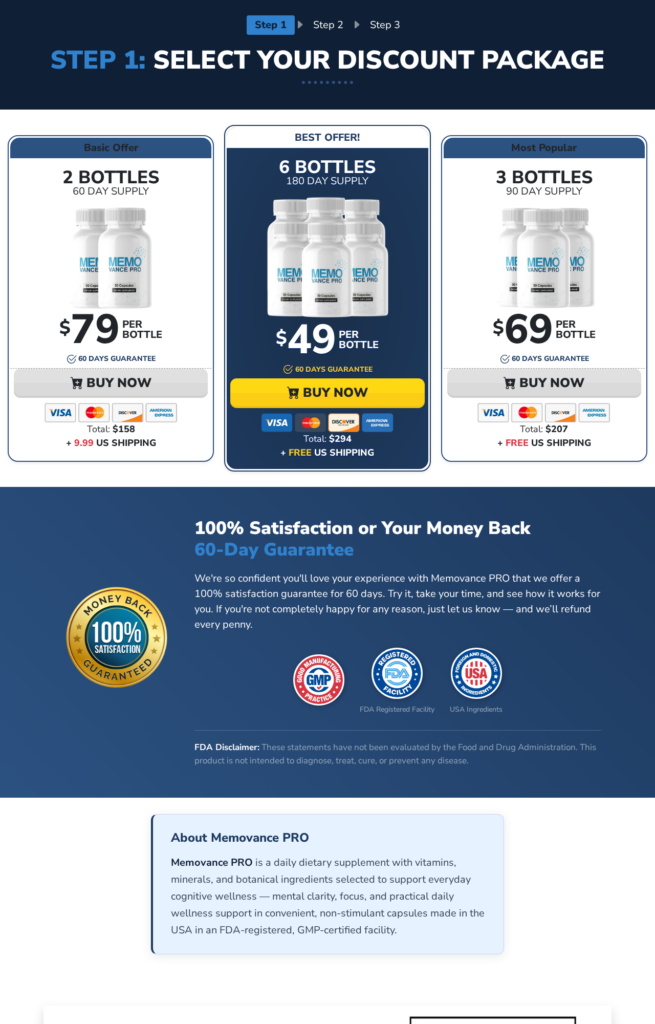
The current page sells two bottles for $158 plus $9.99 shipping, three bottles for $207, or six bottles for $294. BuyGoods is identified as the retailer, and the brand states that purchases are covered by a 60-day return policy.
How the Fake “Honey Shield” Story Enters the Funnel
Separate promotional pages and social media ads use a much more dramatic story. They claim that Bill Gates, his foundation, Steve Martin, doctors, or researchers discovered a honey-and-cinnamon protocol that can restore memory or reverse cognitive decline.
The ads have been documented using news-style layouts, AI or manipulated celebrity footage, fake authority signals, fabricated-looking comments, and unsupported stories about more than $100 million in research funding.
We found no credible evidence that Bill Gates, the Gates Foundation, or Steve Martin endorses Memovance Pro. The “Honey Shield” is a marketing hook, not a verified medical discovery.
Our Verdict on Memovance Pro
We recommend avoiding any Memovance Pro offer reached through the “Honey Shield” story, a celebrity video, or a fake news page. The promotional claims about reversing memory loss or Alzheimer’s disease are not supported by credible evidence.
The plain product page discloses a formula, prices, support details, a retailer, and return language. Those details are more transparent than the ad funnel, but they do not validate the fake endorsements or prove that the finished supplement delivers the dramatic cognitive results implied by the campaign.
Key concerns include:
- Fake Bill Gates Foundation and celebrity associations.
- A “Honey Shield” story unrelated to the actual capsule ingredients.
- No identified clinical trial of the finished Memovance Pro formula.
- “Botanical ingredients” language that does not match the published panel.
- Different company names across the return and terms pages.
- A near-identical product name, MemoVance, that belongs to a separate formula.
The Story and the Supplement Do Not Match
A Honey Recipe Becomes an Amino-Acid Capsule
The advertising invites viewers to learn a simple honey or cinnamon routine. That sounds inexpensive, familiar, and easy to try at home. The longer presentation then turns the promised recipe into a reason to order capsules.
The actual Memovance Pro panel lists amino-acid-family compounds, niacin, and calcium. Honey and cinnamon do not appear as the central formula described on the label reviewed for this investigation.
That disconnect matters. A consumer who clicks for a recipe may believe the bottle contains the active discovery from the story, even though the page does not establish a scientific bridge between the ritual and the listed ingredients.
The Bill Gates Funding Story Has No Credible Support
One version of the funnel claims that the Bill & Melinda Gates Foundation invested more than $100 million researching the “Honey Shield” protocol. That is a powerful detail because it sounds specific, philanthropic, and independently funded.
We found no credible foundation announcement, medical publication, grant record, or official statement tying that claim to Memovance Pro. Specific numbers can make a fabricated story feel researched, but a number without a verifiable source is still just sales copy.
Bill Gates’ image and name are frequently misused in AI-generated health and investment promotions. Confirmation should come from an official foundation or personal channel, not from the page selling the product.

The Celebrity Clip Is Not an Endorsement
Promotional versions have also associated the story with Steve Martin. Celebrity familiarity helps lower resistance, especially when the topic is aging, memory, or a family’s fear of dementia.
A video can be built from unrelated footage, synthetic narration, face animation, or a lookalike. The presence of a famous face in a player does not show that the person used, tested, or even heard of the supplement.
Search the celebrity’s verified channels and reputable reporting for the exact endorsement. If it cannot be found outside the funnel, assume the association is unauthorized.
The Disease Claims Cross a Critical Line
Versions of the campaign promise to restore memory after age 60, reverse cognitive decline, or address Alzheimer’s disease. Those are not ordinary “supports focus” statements.
Dietary supplements are not FDA approved to treat or prevent disease. The official product page’s disclaimer cannot erase a stronger disease-treatment message delivered earlier through an affiliate ad or fake news video.
Memory changes can have many causes, including medication effects, sleep problems, depression, vitamin deficiencies, infection, or neurological disease. A sales funnel should never replace a proper medical evaluation.
The Label and Website Create Their Own Questions
“Botanical” Copy Does Not Match the Published Panel
The product page uses language about vitamins, minerals, and botanical ingredients. The disclosed panel we reviewed lists no identifiable botanical ingredient.
Instead, it lists niacin, calcium, two forms of arginine, two forms of citrulline, and beta-alanine. Those ingredients may be familiar in exercise or cardiovascular contexts, but that is not evidence that this exact blend meaningfully improves memory.
Buyers should judge the bottle by the complete Supplement Facts panel, not by broad category words in promotional copy.
Ingredient Research Is Not a Trial of Memovance Pro
A sales page can cite research about an individual nutrient and leave the impression that the finished product has been clinically proven. That inference is not automatic.
The relevant evidence would test the exact formula, doses, population, duration, outcome measures, and comparison group. We did not identify a published controlled trial of the finished Memovance Pro product for the dramatic memory outcomes used in the funnel.
Testimonials and before-and-after stories cannot replace that evidence. They do not control for other treatments, expectations, natural variation, or selective publication.
A Near-Identical Name Can Send Buyers to the Wrong Product
“Memovance PRO” is not the same as “MemoVance,” a separately marketed supplement with a different formula and a different stated guarantee period.
The distinction is easy to miss in a spoken video or search result. A buyer can research one product, order another, and later cite the wrong support number or return policy.
Match the exact spelling on the bottle, the domain, the ingredient panel, the retailer, and the order number before contacting support.
Another “Official” Page Adds More Confusion
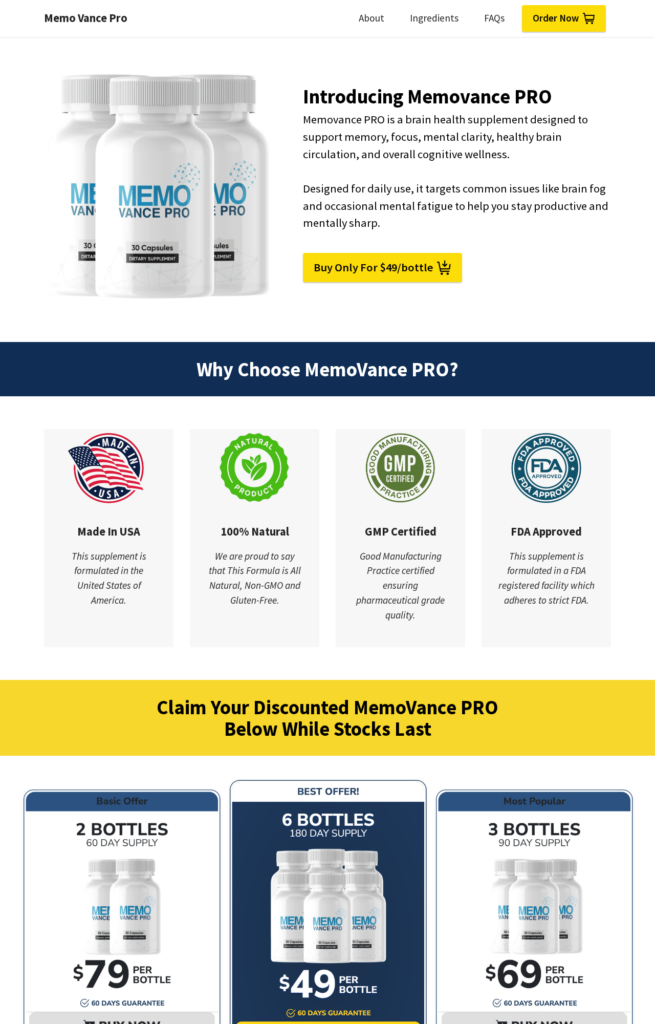
We also found memo-vancepro.com, a separate site presenting itself as an official source for the same product. It shows similar bottle packages and prominently displays an “FDA Approved” style badge.
The accompanying wording refers to manufacture in an FDA-registered facility. Those phrases are not equivalent. Facility registration is an administrative status, not approval of the supplement’s safety, efficacy, or memory claims.
Multiple official-looking domains create an attribution problem. Consumers need to know which page controls the current terms, which retailer processes the payment, and which company will accept a return.
How the Memovance Pro Scam Works
Step 1: A Social Ad Targets Fear About Memory Loss
The first ad uses a familiar older celebrity, a worried spouse, a forgotten name, or a claim that memory loss is not inevitable. The emotional focus is relief, not a transparent product description.
Words such as “seven-second habit,” “Honey Shield,” and “after age 60” make the story easy to remember and share.
Step 2: A Fake News Page Supplies False Authority
The click leads to a television-style or health-news page with a prominent video, a “LIVE” label, medical language, and apparent comments from satisfied viewers.
The domain is not the trusted broadcaster or research institution implied by the design. The format disguises a direct-response advertisement as reporting.
Step 3: Famous Names and Funding Numbers Make It Feel Proven
The presentation invokes Bill Gates, the Gates Foundation, Steve Martin, doctors, or large research teams. A precise funding claim creates the illusion that the discovery has already passed independent scrutiny.
None of those authority signals substitutes for a verifiable endorsement or a published clinical trial.
Step 4: The Promised Recipe Turns Into a Bottle
After delaying the answer, the video says ordinary kitchen ingredients are not enough or that the active components must be combined in exact amounts. Memovance Pro then appears as the convenient solution.
The actual label does not establish that the capsules are the “Honey Shield” described in the story. The transition works through narrative momentum, not scientific proof.
Step 5: Package Design Pushes a Multi-Month Order
The smallest available offer is two bottles at $158, not a low-cost sample. Three bottles cost $207, while six cost $294 and are framed as the best value.
That structure makes the $294 cart feel economical because the per-bottle price drops, even though the buyer has not tested one bottle or confirmed compatibility with medication.
Step 6: BuyGoods Processes the Transaction
The official page identifies BuyGoods as the retailer. BuyGoods is a payment and retail platform, but its presence does not verify the health claims, celebrity endorsement, or effectiveness of a specific supplement.
Check the final order for quantity, shipping, upsells, subscriptions, and the exact merchant descriptor. We did not verify that every Memovance Pro order creates automatic refills, so do not assume a subscription without reading your confirmation.
Step 7: The Guarantee Requires More Than the Badge Suggests
The published policy says the 60-day window begins on the shipping date. Buyers must contact support before returning, include empty or unopened bottles, and place identifying order details inside the package.
Refunds are stated to take 5 to 10 business days after receipt. Save the shipping date and request authorization early, because the clock may be running before the parcel reaches you.
Company, Address, and Fulfillment Checks
The Retailer Is Named, but the Brand Owner Is Less Clear
The product page identifies BuyGoods Inc. as the retailer. That tells buyers who facilitates the transaction, but it does not by itself identify who formulated the product, created the fake celebrity ads, or controls every affiliate page.
Ask for the legal entity responsible for the label and the entity that will appear on the refund record. Do not assume all parties in the funnel are the same company.
The Return Address Is a PO Box Shared With Another Name
The published return policy lists REDROCK, PO Box 12730, Ogden, UT 84404. The distributor line is also associated with the same PO Box under the Memovance Pro name.
A PO Box can be a valid mail destination, but it does not show a headquarters, manufacturing plant, or research laboratory. Treat it as a return channel unless the company provides evidence of a broader role.
The Terms Introduce a Second Company Name
The terms refer to “Thenorthscale” as responsible for approved return shipping costs, while the return policy uses REDROCK. Two names appear to handle parts of the same guarantee process.
That inconsistency does not automatically invalidate the policy, but buyers should obtain written confirmation of which name and address apply to their order before sending anything.
Support Details Exist, so Test Them Before Buying
The published support channels are support@northsupplements.online and (877) 257-0710, with stated weekday hours. Contacting them before purchase can reveal whether the team can answer product-specific questions.
Ask for the exact guarantee start date, return authorization process, responsible legal entity, recurring-billing status, complete label, and manufacturer information. Keep the response.
A support reply is not proof that the medical claims are true. It does, however, create a written record of the terms you were told to rely on.
What to Do if You Have Fallen Victim to This Scam
- Arrange a real medical evaluation. If you bought the product because of new or worsening memory problems, contact a licensed healthcare professional. Do not delay assessment because a video promised a natural reversal.
- Save the ad and product trail. Capture the social post, fake news domain, celebrity clip, package offer, checkout, receipt, label, and support correspondence. The false endorsement may disappear while the plain product page remains.
- Check the exact product name. Confirm whether you ordered Memovance PRO or the separate MemoVance product. Use only the support and return terms tied to the exact order and retailer.
- Request authorization early. The stated 60-day period starts on the shipping date. Email support with the order number, shipping date, reason for return, and a request for the current RMA and address.
- Review the card statement and confirmation. Look for upsells, additional products, recurring terms, and the merchant descriptor. Cancel any authorized refill in writing and dispute charges you did not approve.
- Return with documentation. Include the details required by the policy, photograph the box, use tracking, and retain delivery proof. Ask whether empty and unopened bottles must both be included.
- Report the deceptive endorsement. Send the ad to the FTC at ReportFraud.ftc.gov and report the social media placement. A false disease-treatment claim or supplement adverse event can also be reported to the FDA.
- Check the device used to purchase. Run Malwarebytes if the funnel caused downloads or suspicious redirects. AdGuard can help block deceptive ads and tracking in the future, but it is not a substitute for medical care or a financial dispute.
Frequently Asked Questions
Is Memovance Pro a real product?
Yes, a supplement page, published label, package pricing, retailer, and support details exist. That does not make the fake “Honey Shield,” celebrity, foundation, or Alzheimer’s claims legitimate.
Did Bill Gates or Steve Martin endorse Memovance Pro?
We found no credible evidence of either endorsement. The associations appear inside deceptive promotional funnels and should be treated as unauthorized or fabricated.
Can Memovance Pro reverse Alzheimer’s disease?
No reliable evidence presented by the seller proves that the finished supplement can reverse Alzheimer’s disease or restore memory in the way the ads claim. Seek qualified medical care for cognitive symptoms.
Is Memovance Pro the same as MemoVance?
No. They are different products with different formulas and stated guarantees. Check the exact spelling, label, retailer, and domain before using return information.
Does Memovance Pro have a subscription?
We did not verify mandatory automatic refills for every order. Inspect the BuyGoods checkout, confirmation, and later statements for any selected subscription, upsell, or recurring shipment.
How does the 60-day refund work?
The published policy says the period starts on the shipping date, requires contacting support first, and asks for the bottles and order details. Obtain written authorization and use tracked return shipping.
The Bottom Line
Memovance Pro demonstrates how a real supplement offer can sit at the end of a deceptive advertising funnel. The bottle, BuyGoods checkout, and return policy exist, but they do not make the Bill Gates “Honey Shield” story or the implied Alzheimer’s cure true.
If an ad needs a fake broadcaster, a celebrity face, a fabricated funding story, and fear about memory loss to sell an amino-acid capsule, close it. Medical concerns deserve evidence and accountable care, not a story that changes from honey in the video to pills at checkout.








