

A polished video claims that a hidden enzyme or exotic oil can solve stubborn blood sugar problems. It looks like a serious television investigation, complete with experts, universities, and a breakthrough discovery.
Keep watching and the investigation turns into a checkout. The promised discovery is a brown dropper bottle called GL-Defend.
We examined the advertising story, official-looking domains, product claims, billing language, retailer, contacts, return policy, and scientific evidence behind the offer.
Overview
What GL-Defend Claims to Do
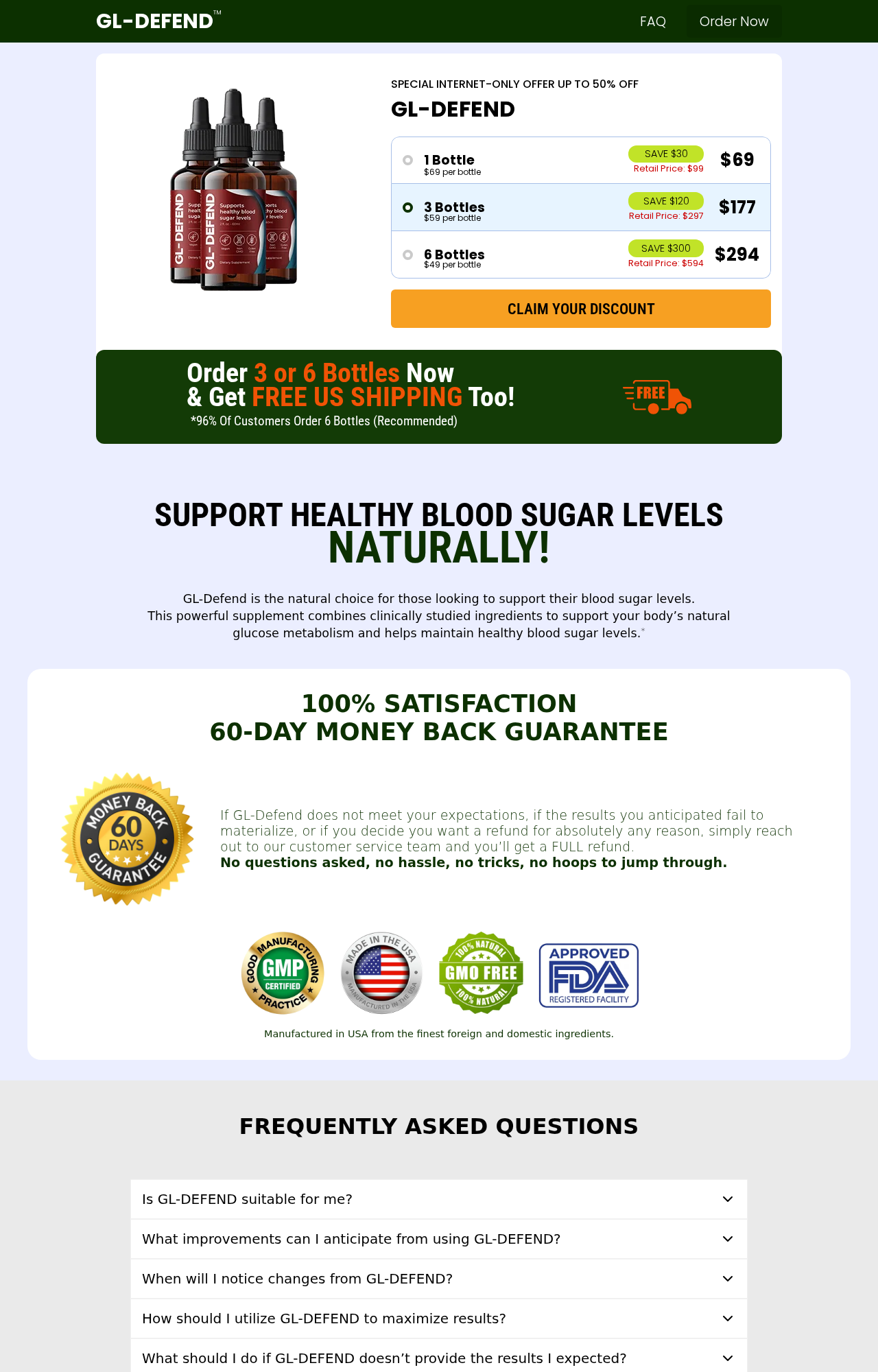
GL-Defend is marketed as a liquid supplement that supports healthy blood sugar, glucose metabolism, insulin response, energy, pancreatic function, heart health, and nerve health. The principal page describes a plant-based formula made in the United States from domestic and foreign ingredients.
The offer lists one bottle for $69, three for $177, and six for $294. It says more than 90% of customers choose the largest package and pairs the price with a 60-day money-back guarantee.
The main gldefend.com page explicitly says the transaction is a one-time payment with no recurring charges. We therefore found no basis to label that specific checkout an automatic refill subscription.
Why the Marketing Campaign Is Deceptive
Ads associated with GL-Defend have used fake television framing, invented medical discoveries, and references to institutions such as Oxford, Cambridge, and Ohio University. One variation imitates a 60 Minutes report and introduces a supposed expert called Neil Brown.
The story talks about an “insulin-eating enzyme,” an “exotic A1C oil,” and a suppressed Swedish discovery. These phrases sound scientific, but we found no finished-product clinical trial that supports the sweeping narrative.
The contradiction becomes especially clear when the video criticizes ordinary brown supplement bottles and then directs viewers to buy GL-Defend in the same familiar brown dropper format.
Our Verdict on GL-Defend
We recommend avoiding GL-Defend when it is promoted through fake news, fabricated expert, or miracle blood sugar stories. The physical product and BuyGoods checkout do not legitimize false advertising used to reach the offer.
The main page is more transparent than some funnels about one-time billing and the retailer. However, multiple official-looking domains make conflicting regulatory claims and publish different support details.
The key warning signs are:
- Fake news and television-style videos create borrowed authority.
- University and medical references are used without verifiable product evidence.
- Miracle phrases simplify a serious medical condition into a sales hook.
- Several near-identical domains present themselves as official.
- One page incorrectly labels the product or facility “FDA approved.”
- Support phone numbers and email addresses vary across domains.
- The finished GL-Defend formula is not supported by a published clinical trial.
- The return address is a shared fulfillment location used by other supplement offers.
The Fake Medical Story Behind GL-Defend
The Ad Imitates a Trusted Broadcast
A television-style frame is designed to make viewers lower their guard before they evaluate the claim. Familiar graphics, a formal presenter, and interview clips can create the impression that an independent newsroom investigated the product.
In reality, the presentation is part of a sales funnel. The supposed report does not link to a genuine broadcaster’s website or a verifiable episode archive.
A logo or studio background can be copied in seconds. The decisive question is whether the report exists on the verified channel of the news organization being imitated.
The “Insulin-Eating Enzyme” Is a Fear Device
The campaign gives blood sugar problems a single villain, then suggests the product addresses that hidden cause. This kind of language is memorable because it makes complex physiology feel simple.
Type 2 diabetes involves multiple factors, including insulin resistance, insulin production, genetics, weight, activity, sleep, medication, and other health conditions. A dramatic enzyme label is not a diagnosis.
We found no peer-reviewed trial of the exact GL-Defend formula proving that it removes a secret cause of diabetes or produces the outcomes implied by the video.
Prestigious Names Replace Verifiable Evidence
References to Oxford, Cambridge, Ohio University, Sweden, and a private hospital can make the story feel researched. Yet the offer does not provide a study title, authors, journal, trial registration, dose, or data that can be checked against the bottle.
The FTC expects objective health claims to be supported by competent and reliable scientific evidence. Customer testimonials, badges, expert-style narration, and ingredient citations are not the same as a trial of the finished product.
A legitimate study can be independently located and read. It should not disappear when the viewer leaves the advertiser’s page.
Multiple GL-Defend Domains Create Conflicting Claims
One Page Uses “FDA Approved” Incorrectly
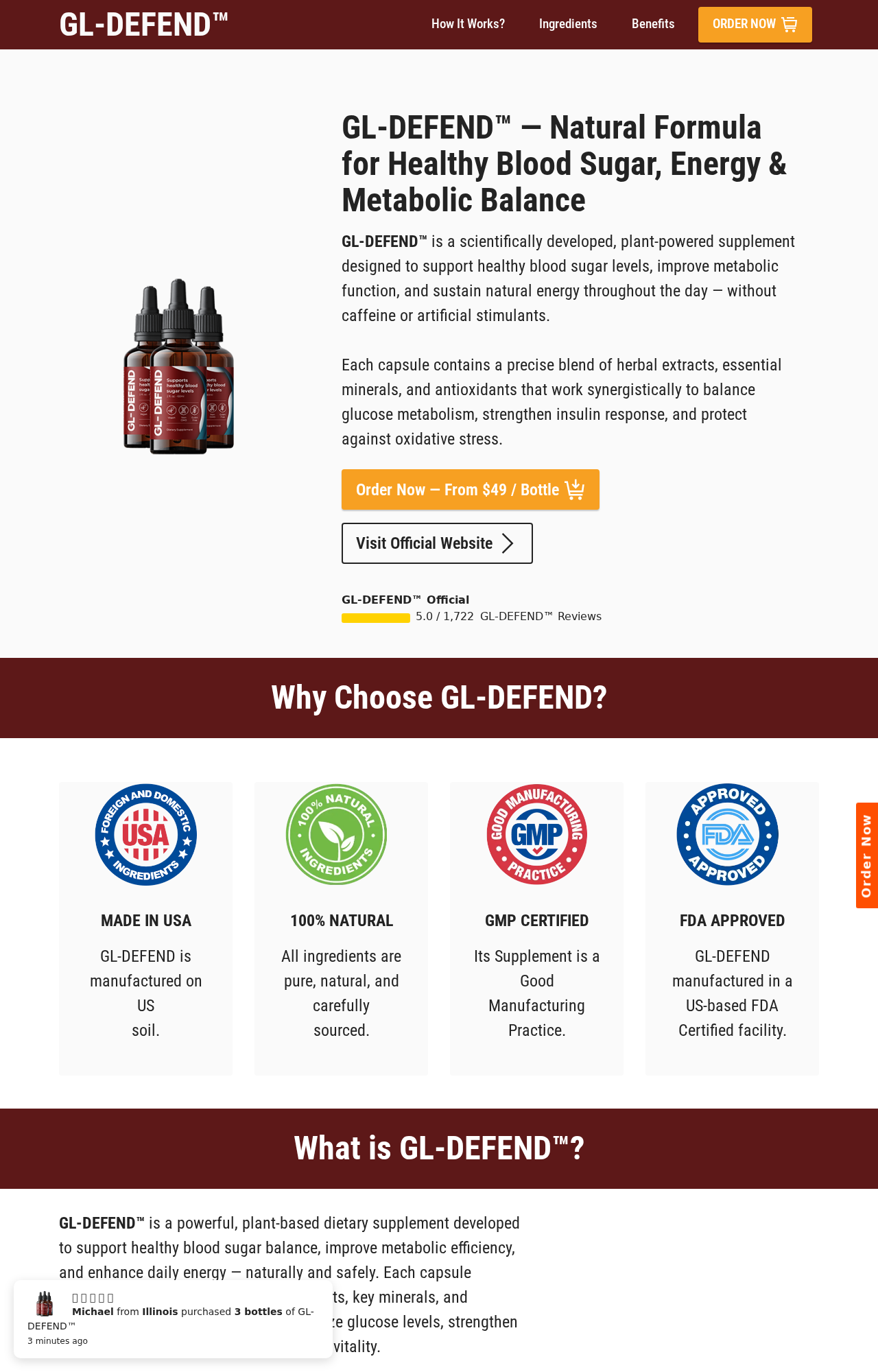
The gldefeend.com page displays a large “FDA Approved” badge and a section labeled “FDA APPROVED.” Nearby copy then shifts to the different claim that the supplement is made in an FDA-certified or FDA-registered facility.
Dietary supplements are not approved by the FDA before sale in the way prescription drugs are. Facility registration does not mean the FDA approved the product, formula, claims, or results.
This distinction matters because an approval badge can make an uncertain health product appear government-endorsed.
The Review Score Is Presented Without Independent Support
The same page shows a 5.0 rating and 1,722 GL-Defend reviews. We did not find a transparent review platform, methodology, or independently verifiable purchase records behind that exact number.
The page also says names in testimonials may have been changed for privacy. A changed name does not automatically make a story false, but it removes a basic way for readers to evaluate who is speaking.
Testimonials describe experiences. They do not establish that GL-Defend reliably improves glucose readings or that the product caused the result.
The Main Page Makes a Clear One-Time Billing Statement
The gldefend.com page says all transactions are straightforward, with a one-time payment and no recurring charges. That is important evidence and should not be ignored merely because similar supplement campaigns use subscriptions.
Buyers should still save the checkout and confirmation because affiliates, cloned sites, and later revisions may use different terms. The statement applies to the page we inspected, not every page that uses the GL-Defend name.
If the card is charged again despite a one-time promise, that second charge should be challenged immediately with the saved language.
How the GL-Defend Scam Works
Step 1: The Ad Targets People Worried About A1C
The campaign reaches people who are concerned about a new diagnosis, rising glucose readings, medication costs, fatigue, or diabetic complications.
It offers certainty at a moment when real medical care may feel slow, complicated, or frightening.
Step 2: A Fake Presenter Introduces a Hidden Cause
A broadcaster-style video claims that doctors misunderstood the condition or that a new discovery overturns conventional advice.
The presentation may use a manipulated former anchor, a fabricated expert, or an AI-generated voice. The viewer is rarely given credentials that can be independently confirmed.
Step 3: Universities and Hospitals Are Added to the Script
Prestigious institutions are named to make the mechanism sound documented. The references stay vague enough that most viewers will not stop to search for the exact study.
No verifiable link is established between those institutions and GL-Defend itself.
Step 4: The Video Attacks Ordinary Solutions
The story may criticize medications, doctors, supplement bottles, or products that address only symptoms. This isolates the viewer from alternatives and makes the advertised discovery appear uniquely honest.
The funnel then sells another supplement bottle, revealing that the criticism was part of the positioning rather than a neutral warning.
Step 5: The Visitor Reaches a Multi-Bottle Offer
One bottle costs $69, three cost $177, and six cost $294. The page highlights the six-bottle option and says the overwhelming majority of customers choose it.
That social proof is controlled by the seller. It is not an independently audited purchase statistic.
Step 6: A Guarantee Reduces Purchase Resistance
The page promises a 60-day refund and says there are no questions, tricks, or hoops. The separate return page still requires the physical product to be mailed back and makes the customer pay return shipping.
A guarantee can be useful, but it is not the same as risk-free. Time, postage, documentation, and the ability to reach support remain the buyer’s burden.
Step 7: Affiliate Domains Multiply the Same Offer
Misspelled and official-looking domains repeat the product name, bottle images, health claims, and checkout links. Some add their own badges, inflated review counts, or rewritten claims.
This distributed promotion makes it difficult to identify which statement came from the seller and which came from an affiliate seeking a commission.
Company, Address, and Fulfillment Checks
BuyGoods Is the Retailer, Not the Medical Endorser
The main page clearly states that BuyGoods is the retailer. It also says BuyGoods does not endorse, approve, or review the product or the claims used to promote it.
That separation is important. A functioning payment processor or marketplace does not verify that GL-Defend improves blood sugar or that an affiliate’s medical story is true.
The Support Details Change Across Domains
The main contact page displays +1 (302) 200-3480 and a protected email address. Another official-looking page lists support@GL-DEFEND.com and (925) 234-4535, while its home page uses contact@GL-DEFEND.com.
Buyers should use the contact information in their actual order receipt and ask BuyGoods to identify the seller if the affiliate page is unclear.
The Return Address Is a Shared Fulfillment Location
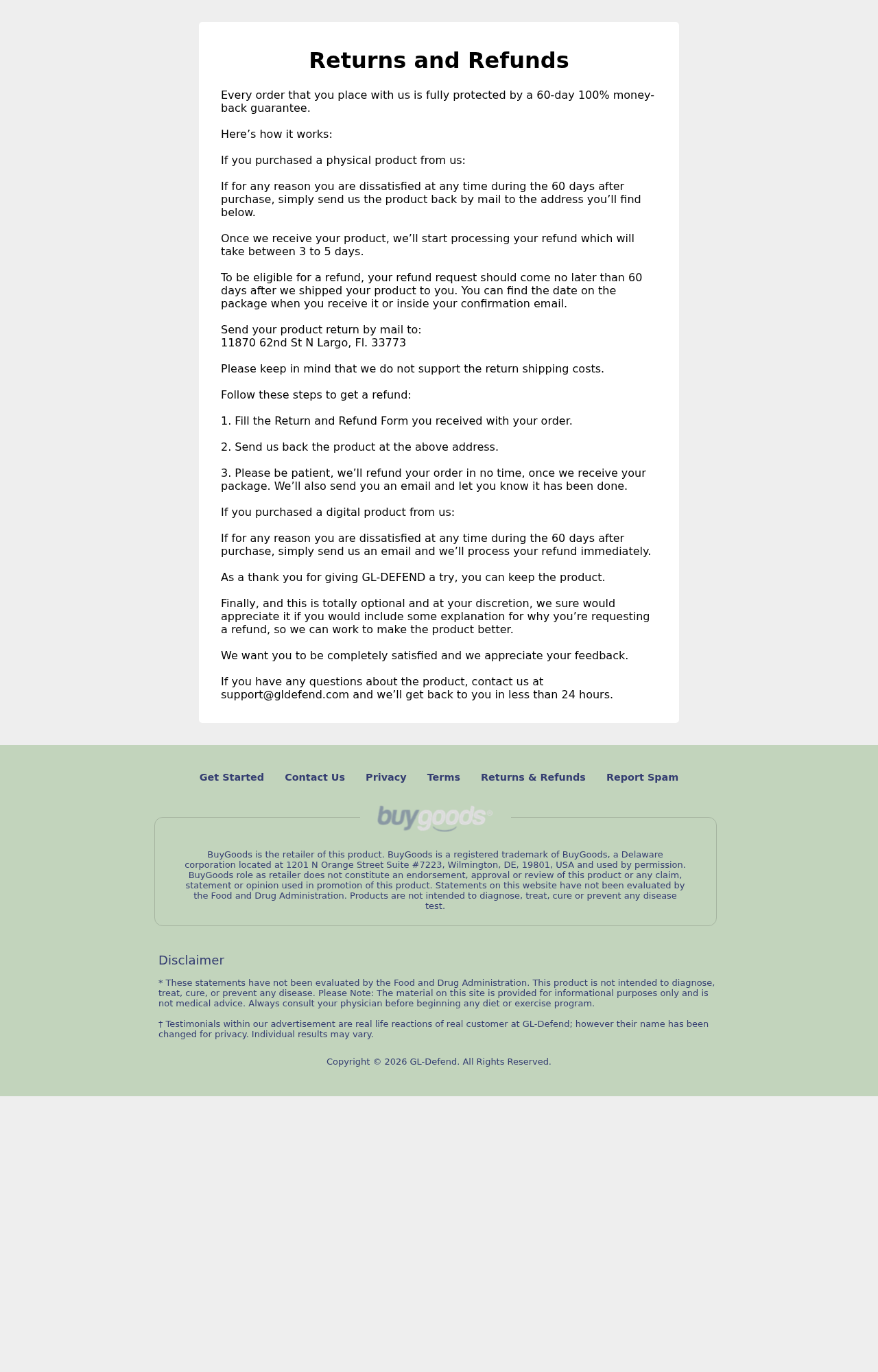
The refund page instructs buyers to mail physical returns to 11870 62nd St N, Largo, FL 33773. That address also appears in policies for other unrelated supplement brands.
This pattern is consistent with a fulfillment or returns warehouse. It does not identify the company that formulated GL-Defend, manufactured it, or created the deceptive ads.
The Actual Manufacturer Is Not Clearly Named
The pages say the product is manufactured in the United States from domestic and foreign ingredients and use GMP and FDA facility badges. We did not find the facility name or a public lot-specific laboratory report on the pages reviewed.
Do not assume overseas manufacturing without evidence. Instead, demand the manufacturer name, complete Supplement Facts panel, lot number, and independent certificate that matches the bottle received.
The Refund Promise Has Conditions
The Product Must Be Returned
The refund page says a dissatisfied physical-product buyer must mail the product to the listed address. It advises using the date on the package or confirmation email to determine eligibility.
The page states that the request should be made no later than 60 days after shipment. Consumers should not wait until the final days because delivery time can create a dispute.
The Buyer Pays Return Postage
The policy says return shipping costs are not supported by the seller. Use tracking and keep proof of delivery because the refund begins only after the returned product is received.
It says processing will take between three and five days after receipt. Bank posting time may add more delay.
Blood Sugar Treatment Should Not Be Replaced
The National Center for Complementary and Integrative Health says most diabetes supplements lack clear evidence of benefit. Some can cause serious side effects or interact with medication.
Never stop insulin or another prescribed treatment because an advertorial says it discovered a natural cure. Monitor blood glucose as directed and discuss the exact formula with a qualified clinician.
What to Do if You Have Fallen Victim to This Scam
- Preserve the ad and every sales page. Save the fake broadcast, institutional claims, package price, one-time billing statement, guarantee, receipt, and card descriptor.
- Identify the exact domain and merchant. A misspelled affiliate site may not be the seller. Use your BuyGoods receipt and statement to locate the transaction.
- Request a refund promptly. Contact the support address tied to the order and state that you relied on misleading claims if that occurred. Include the order number and amount.
- Return the bottles with tracking. Follow the merchant’s written instructions, photograph the package, and retain delivery proof. Do not send a return to an address copied from an unrelated page.
- Monitor for a second charge. The main page promises no recurring billing. If another charge appears, contact BuyGoods and the card issuer with a screenshot of that promise.
- Dispute unresolved or unauthorized charges. Give the bank a concise timeline, the checkout terms, refund request, and proof that the merchant did not resolve the problem.
- Protect your health. Do not change diabetes medication based on the ad. Contact your clinician about the ingredients, interactions, unusual glucose readings, or side effects.
- Report the campaign. Report fake news branding and AI presenter content to the platform. Send deceptive health claims to the FTC and adverse supplement events to the FDA.
- Check your device. Run Malwarebytes if the funnel downloaded anything or produced suspicious pop-ups. AdGuard can help block deceptive ads, tracking scripts, and repeat redirects.
Frequently Asked Questions
Is GL-Defend a real supplement?
GL-Defend is presented as a physical liquid supplement sold through BuyGoods. That does not prove the advertising story or the product’s promised medical results.
Is GL-Defend a subscription?
The main gldefend.com page we inspected explicitly says the payment is one-time with no recurring charges. Save that statement and verify your final checkout.
Is GL-Defend FDA approved?
No dietary supplement is FDA approved before sale like a prescription drug. A facility registration or badge is not product approval.
Does GL-Defend lower A1C?
We found no published clinical trial of the finished GL-Defend formula proving that it lowers A1C. Ingredient research cannot establish what this exact bottle will do.
Who processes GL-Defend orders?
The main page identifies BuyGoods as the retailer and expressly says that role is not an endorsement of the product or its claims.
How does the refund work?
The published policy gives a 60-day window, requires the physical product to be returned, and makes the customer pay postage. Use the instructions in your own receipt.
The Bottom Line
GL-Defend is sold through a deceptive medical narrative that borrows the appearance of journalism, universities, experts, and scientific discovery. The official-looking domains then add inconsistent claims of their own.
The main page’s one-time billing statement is clear, but billing transparency does not validate fake broadcasts or unsupported health promises. Avoid the campaign and rely on measured medical care, not an invented A1C breakthrough.








