

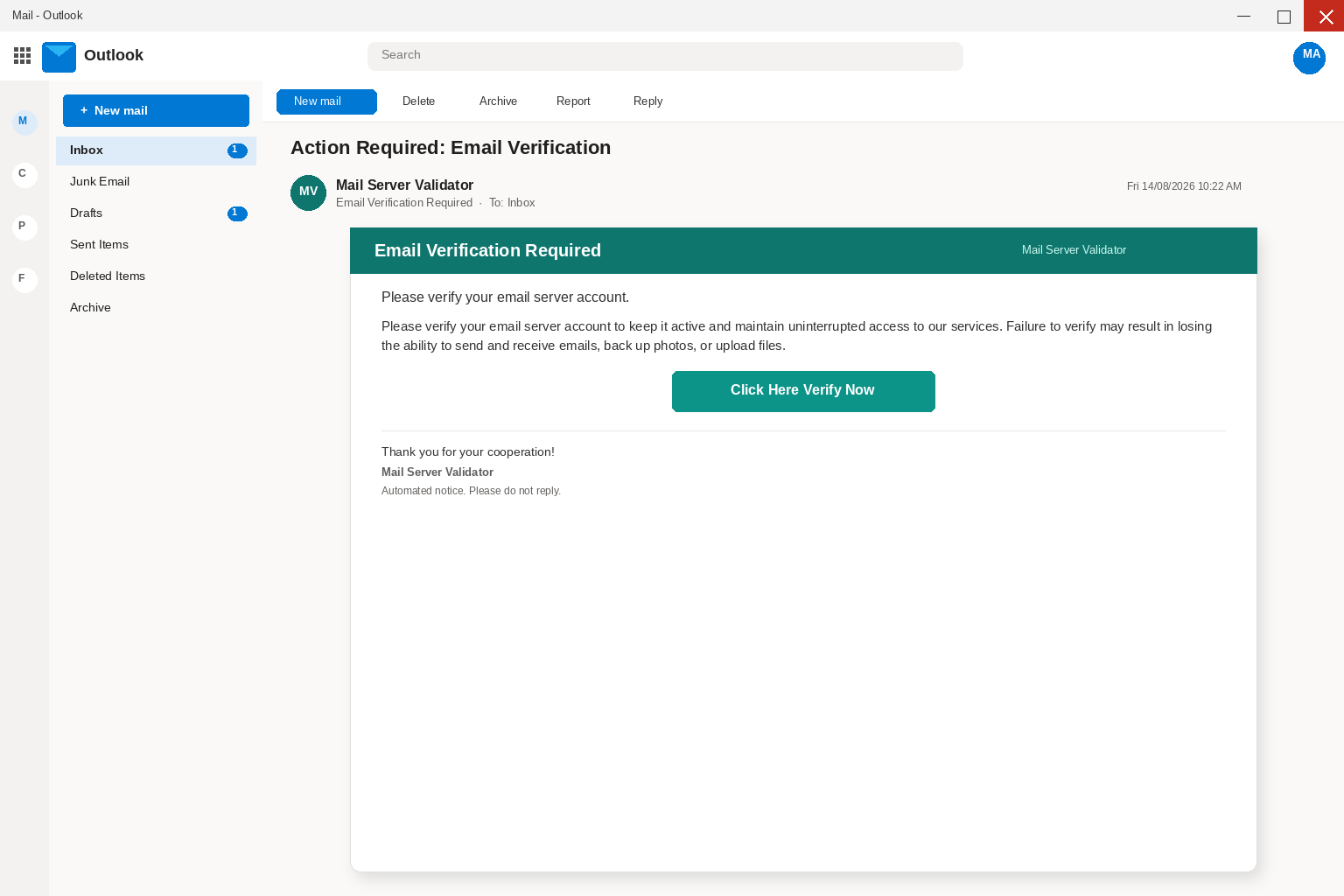
The subject sitting in the inbox is Action Required: Email Verification, which is the kind of line a mailbox already treats as a chore you can finish before the next meeting. Under that heading the card greets you as if a mail desk already ran the server, and it says your email server account has to be verified so the box stays active.
You have seen verification mail before, because hosts really do ask you to confirm a new device, and workplaces really do send a note when a password policy changes. This one is short enough to finish on a phone, and it does not attach a file you have to open before you can read the rest of the warning. It only says failure to verify may cost you the ability to send and receive emails, back up photos, or upload files, then offers a button labeled Click Here Verify Now.
People who live on webmail treat that kind of note as homework, because the mailbox is where invoices sit and relatives still send the one address they have used for a decade. Photo backups already live next to the same login, which is why a warning about the box feels like work rather than like junk. You read it so the inbox stays yours, so a send button still works this afternoon, and because the letter is already sitting inside the mailbox it claims to protect. Leave this card where it is while you check the mailbox the way you already check it every morning. A verification notice that cannot wait for a page you type is asking you to hurry for a reason the letter will not name.
Overview
Click Here Verify Now does not open a review your mail host already knows how to run from a page you type yourself. The click instead asks you to type the address and the password into a form the letter chose for you. The message poses as a notice from Mail Server Validator and claims the email server account must be verified to stay active. It also warns that skipping the step can cost you send and receive, photo backups, and file uploads. Once you press the button you are not opening a server check, because the next page is an activate form branded MailServer, waiting for the same login you used to open the inbox.
What they take first is the password for that mailbox, and after that they take the mailbox itself. That includes the threads with vendors, the reset codes that land an hour later, and the people who already answer when your name is on the From line. A verification story is useful costume for that harvest, because a server check sounds like operations rather than like a stranger asking for a secret. A threat about send and receive makes the errand feel like work you already meant to finish, which is why the photos and files are sitting in the same sentence. Once the activate form has the password, the people who wrote the notice can read the real mail, impersonate the address, and reset other logins that all send their recovery mail to the same place.
Mail Server Validator is letterhead on this card, not a desk you can call, and not a provider that scheduled a check on your behalf. The name is there so a five-second glance will survive, the way a heading that says Email Verification Required survives. None of those lines is a certificate you can take to a real help desk. A host you already pay already has a panel you can open without a surprise verify button, and a thief needs the costume because the thief is not inside that panel. There is no official Mail Server Validator site to type, which is part of why the letter never names the host you actually pay.
One copy of that next page has sat on a GitHub Pages site named emailactivator.github.io, which is not a mail product you type in the morning. That address is not a reason to go hunting the page after you close the tab, and curiosity is how they learn the bait landed. GitHub Pages is a real static hosting service that anyone can put a form on, and a real company did not send this letter to collect a mailbox password through a cold activate screen. The page brands itself MailServer, asks for the address, the password, and the same password again, then offers Activate and send as if a clerk were finishing a request you already made.
The Federal Trade Commission writes the same rule in consumer language in How To Recognize and Avoid Phishing Scams. The FTC says criminals use email to steal passwords, account numbers, or Social Security numbers, and a common story is that there is a problem with your account when there is not. Another common story is that you must confirm personal information right now, which is the same pressure this letter applies by claiming send and receive will fail if you skip the check. The Commission’s advice is to contact the company with a phone number or website you already know is real, not the information in the email. A Click Here Verify Now button counts as information in the email, which is why it is a poor place to start a server check.
CISA says it twice in shorter form that still applies to webmail, first on Avoiding Social Engineering and Phishing Attacks. CISA tells people not to reveal personal or financial information in email, and not to follow links in a message that asks for that information. On Teach Employees to Avoid Phishing, CISA tells staff that if a message feels off they should verify it without using any phone number or link in the message. That means using a number you already have and a site you already type. That habit is the opposite of fetching an account check from a validator letter you did not request, and it is the opposite of typing a mailbox password so photos and files can keep working.
A verification notice can be real, because mail products do ask you to confirm a new device and some workplaces do lock a session that does not match the usual computer. A real notice still lives on a page you reach the way you always reach the account, by opening the webmail you already use or by typing the host you already pay. It does not need you to prove the current password to a stranger’s form so send and receive can keep working, and the host already delivered the letter, so it already knows which mailbox received it.
The verification costume
Server checks are useful bait because they sound like help from a desk that already watches the mailbox. Most people will not argue with a desk that says it already watches the mailbox and only needs a confirmation to keep send and receive open. The letter borrows that relief and turns it into a chore, because you are not asked to study a log of cities and times. You are asked to verify now because photos and files might stop working if you wait. Helpful language hides a request for the key, and the key is the password the button pretends to confirm. That is why Email Verification Required is doing borrowed work rather than proving a server already paused.
The sentences inside the card are not random, because an email server account that must stay active makes you grateful that someone is watching. A warning about send and receive makes the account feel already half closed, and a photo backup that might fail turns that unease into a job you can finish before lunch. Each line is a reason to hurry, and none of them is a server log you can keep, screenshot, or compare with last week’s mail. Real verification mail, when a host actually sends it, usually points you into an account you already open. You sign in on the bookmark you already have and see the setting on a page that already knows your name.
A validator name that belongs to nobody
Mail Server Validator is a display name, and Thank you for your cooperation is a signature anyone can type at the bottom of a card. Both are easy to invent, and neither one is a badge that proves a mail company is talking to you. The lure is using the furniture of a real server desk the way a counterfeit uses a brand on a storefront. The storefront is not the company, and no company sent this letter to collect a password.
People who still use a personal inbox for everything are a good audience for this costume, which is why the letter talks about photos and files. The mailbox often sits next to the bank reset, the shopping account, the school thread, and the one address relatives have used for a decade. A threat against that mailbox does not feel like spam, it feels like a service notice, and the letter is counting on that mix of habit and mild dread. Display names are not badges, because anyone can set From to Mail Server Validator, and anyone can design a teal header that says Email Verification Required twice.
Microsoft’s guide to spotting phishing tells you to treat a mismatched sender as a warning, and to open the real product yourself instead of trusting the costume in the inbox. A message that wears a validator name and then asks you to verify on a surprise page is not the mail company talking to you. You do not need to collect the true From address to prove that, and you do not need to forward the letter to a neighbor so they can take a look. You need to stop treating the teal bar as a building you can walk into for a real check. If you still want to know whether a real check exists, open a new tab, go to webmail the way you always do, and leave this card where it is.
Losing send and receive is the clock
The verification request is only half of the scare sitting in the card. The other half is the claim that failure to verify may result in losing the ability to send and receive emails, back up photos, or upload files. That sentence does extra work, because a check you already survived is not urgent enough, while a mailbox that might stop sending tonight is. You do not have to believe a long story about servers, you only have to believe that waiting until after lunch might close the inbox for the afternoon.
Phishing lives on that kind of leftover risk, and the FTC’s page is blunt about urgent buttons, because slowing down when a message says you must act now is the whole defense. CISA tells staff the same thing: if the note feels off, verify it on a channel you already trust. A real identity check can wait for a page you type, while a fake one cannot, because the form dies, the page moves, and the crew would rather have the password this morning.
Photos and file uploads are the extra hook for careful people, because they sound like homework you should have been doing anyway. A backup that might fail feels more expensive than a letter you can ignore. In a real product, that confirmation is a list of devices, apps, and times. In this letter it is just another reason to press Click Here Verify Now, with no activity list behind the button, only a form waiting for the password. The clock is useful because it is specific and fake at the same time, and it does not name a fee, it names a mailbox that stops working.
Click Here Verify Now is the click
Read the button the way a tired person reads it between invoices, because verify sounds like a review you already own and now sounds like a lock a real panel already asks for. The subject has already done the action-required scare, and the send-and-receive line has already done the calendar. The photo warning has already done the threat, so by the time your eye hits the rectangle the errand feels mostly finished. A real identity check does not need that rectangle in a surprise email, because if a restriction actually posted, it would already be visible after you open the product yourself.
What the button actually does is take you off the inbox and onto a page the sender controls. On a phone, where hovering is awkward, many people never see the real destination before the next page fills the display. Do not hunt for the address behind the button, and do not paste it into a search bar just to see, because pages like this move and then disappear. A dead tab is not proof the letter was safe, because curiosity is how they learn the bait landed, and how a second copy of the password gets typed.
If you already opened it, the later section is for you, and if you have not, leave it alone. You are often already signed in to the inbox that received the letter. A real identity check would not need you to prove the password again on a surprise site so send and receive could finish. If the account were truly yours, the host would already know that, and the extra login is the tell you can act on without reading a single security paragraph.
The page that copies an activate form
After Click Here Verify Now, the story changes, because the inbox promised a server check while the next screen promises an activation. It is built to look like a MailServer activate page, with an email field, a password field, and a second box that asks you to type the same password again. Your address may already be sitting in the box, and the colors look calm. The language is the language of a clerk finishing a form, which is how a careful person finishes a login they never meant to start.
A padlock in the browser does not fix that, because encryption only means the path is private and does not mean the person at the other end is a mail company you already pay. HTTPS can wrap a stolen password as neatly as a real one, and a row of familiar mail logos is not a certificate. You trust the complete domain and the way you reached it rather than the artwork inside the page. Google’s advice on phishing in Gmail is blunt on this point: Gmail will not ask you for your password over email, and if a verification click then presents a login, you should not type it.
Do not finish that form to see whether a server check then appears, because a copied activate screen does not become safer when you only wanted to keep send and receive working. Open a new tab, type the mail service you already pay or open the app you already installed, and look at the account from the inside. A mailbox that is truly yours will still be there, and a fake restriction will not. If you already typed the password, treat it as burned even if the window now says the verification cannot be completed, because a dead tab is not proof the letter was harmless.
How The Scam Works
1. A verification notice lands
The message arrives in the same Outlook or Gmail you already trust, wearing a subject that stamps Action Required and then Email Verification. That is enough of a host-sounding ticket to survive the few seconds between the inbox list and the reading pane. The display name presents itself as Mail Server Validator, and the body heading says Email Verification Required. The whole note is built to fit on a phone screen as a courtesy a careful person already expected rather than as a midnight threat to delete the mailbox.
If you are already signed in to webmail, the folders on the left and the search bar on the top make the fake note feel native. You are not visiting a strange site yet, and you are only reading mail. The letter only has to survive the few seconds between the subject and Click Here Verify Now, and a warning about send and receive next to photo backups is enough to buy those seconds.
2. The name copies a mail validator
Mail Server Validator belongs to no mail company you already pay, and Thank you for your cooperation is a signature that sounds like a desk that already watches the account. When you have ever called a help desk, forwarded a ticket, or seen a validator line on a status page, you fill in the rest yourself. Even if you have never opened a server console, the phrase email server account still reads like a ticket you are supposed to finish.
The people who wrote the letter did not need to sit inside a real mail company to borrow a polite heading, a keep-it-active sentence, and a footer that would survive a five-second glance. The thief is only inside your inbox if the verify click works, which is why the name on the letter is doing borrowed work rather than proving a server already paused.
3. Losing send and receive is the hurry
The line about losing send and receive, photo backups, and file uploads is doing the work a closed mailbox usually does. An inbox that might stop sending tonight is a Monday a careful person already fears. A review can wait until after lunch when it is only paper, but a send button that might fail while you hesitate feels like a problem that grows. That is why the letter puts the clock next to the only button that works.
People live on that kind of clock, because hosts send reminders, workplaces lock sessions, and a mailbox that stopped accepting mail without a conversation is a real kind of afternoon. The lure is borrowing that afternoon, and it does not need a long pitch to get the click. A keep-it-active line, a photo-backup scare, and a verify button are enough for a tired person who already remembers last week’s real notice.
4. Verify Now is the handoff
You click Click Here Verify Now because that is what a verification button is for, and the click is the moment the costume can drop. The next page is not a server log of checks you can print, it is an activate form, and it wants the email address and the password. There is no honest reason for an identity check to live on a surprise page you reached from an unexpected email.
If the review were real, it would already be sitting inside the account you open yourself. The button does not start a check your host already knows, and it hands you to a page the letter already picked. CISA tells people not to follow a link in a message that then asks for that kind of information. Click Here Verify Now is the detour from a letter you trust to a page you should not finish.
5. The page copies an activate form
The page that follows copies the idea of a MailServer activate screen, with an email field, a password field, and a confirm box. The layout is one people who have finished a reset in a browser will recognize. At the bottom it often shows logos for Gmail, Yahoo, Outlook, ProtonMail, Zoho, and other mail brands, which is a way of saying the same tray will take whichever inbox you type.
The form wants three things, because the email field tells them which inbox they just bought and the password field is the prize. The confirm field is theater that makes the request feel like a real reset. Nothing on that page stores a server check for you to keep or print later. It collects what you type and sends it along, and if the page looks empty, slow, or already taken down, that is not a reason to try the button again later.
6. They want the mailbox password
If you type the password, they have the first key, and if a text, an authenticator prompt, or an email code arrives while that tab is still open, they want the second key too. The story will be helpful, because it will ask you to confirm so the activation can save, to approve so send and receive can stay open, or to enter the code to finish the restoration.
Each line is the same request for access, so treat the password as burned and treat the code as burned. Do not reuse either one on the next page that promises to finish the server repair. Once they can open the account they are not hunting for a verification log, and they are hunting for money and for other logins that already have your name on them.
Once they can open the account they are not hunting for a photo backup that failed to upload, because they are reading the last invoice you sent and the last invoice you received. They also read the thread with a vendor who pays by wire, and then they write the next message in your voice, which is how a verification notice becomes a payment problem. A bill that looks like last month’s bill is enough, and a new-account, same-firm line is enough. If they add a forwarding rule they can keep a copy after you change the password until someone deletes the rule.
7. A second crew sells recovery
A new name appears later, because they can restore the mailbox, reverse the failed verification, or offer a cleanup tool if you verify one more time. They sometimes even claim to be the validator desk that will fix the first letter.
That follow-up is a second trap, not a help desk, and recovery that asks for another password, a remote session, a gift card, or a fee is another harvest. Hang up and use the steps below, because you should not hire the person who found you through the same wound.
What To Do If You Have Fallen Victim to This Scam
If you only opened the email and closed it, you are not finished, but you are not doomed, and the work below is still worth doing once so the same letter cannot be reused on you. If you pressed Click Here Verify Now and then typed, treat the account as touched and move in this order, because speed helps on a live session while panic does not.
- Write down what you typed, then stop using that tab. Note the time, the subject about Action Required and Email Verification, whether you entered a password, and whether you approved a code or an app prompt, then close the Click Here Verify Now page. Do not keep checking that page to see if a server check appears, and do not paste the address into a second browser just to compare.
- Open the real webmail yourself and change the password. Use a new browser tab and type the host you already pay, or open the app you already trust, then pick a password you have not used on anything else. If you cannot sign in, use the official reset path rather than a link from the validator letter. If this is a work mailbox, call IT before you spend an hour hunting, because they can dump sessions faster than you can.
- Sign out everywhere and turn the extra lock back on. Review recent activity on a page you opened yourself, sign out of other sessions if that control is there, and confirm multifactor authentication is still on. If you approved a prompt you did not start, assume that session is not yours until you kill it. If the same password was reused on shopping, banking, or a payment app, change those too on pages you type yourself.
- Look for rules, forwarding, and mail that left without you. Check inbox rules, automatic forwarding, and the Sent folder for a new mailbox delegate, a new app that can read mail, or a filter that hides replies, then delete what you did not create. If a password updated note went out to your contacts, tell those people the next message from you this week is not a verification alert they need to click.
- Call the people who send you money and the people you pay. Use a number from last month’s bill, a card in the drawer, or a listing you already trust, and tell them a fake mail-server letter tried to take the mailbox. They should not honor a new account number or a rushed wiring note that arrives this week, and if invoices or payroll live in that inbox you should say that out loud.
- Tell the bank if the mailbox sits next to money. If a card statement, tax software, or a payment app lives in that inbox, call the bank and any payroll vendor the same day and ask them to watch for a change-of-account request. A charge you did not make and a transfer you approved because "you" asked for it are different problems, and time still matters on both.
- Report the email, then scan the device if you downloaded anything. In Outlook, use Report and then Report phishing, which is the path Microsoft publishes on its phishing help page. Then forward a copy to the Anti-Phishing Working Group at reportphishing@apwg.org and file at ReportFraud.ftc.gov. If a password, a bank account, or a Social Security number went into that page, use IdentityTheft.gov for the next steps, and you can also file at IC3. If Click Here Verify Now saved a file or pushed a player, run a full scan with Malwarebytes or the antivirus you already keep updated. The scan does not get a password back, and the password change is what does that.
- Ignore the recovery offer that arrives next. A new crew will sell a restore, a takedown, or a cleaner second confirmation, because they found you after the first crew already marked the address. They will want a fee, a fresh password, or a remote session, so close it. If you need help use the FTC plan, the bank, and the real host’s support on a number you already have rather than hiring the person who mailed you first.
If someone forwarded you the card, send them this page instead of the Click Here Verify Now button, because forwarding the original note only spreads the same click. These notices travel in family threads and in small-office inboxes because they look like homework from a mail desk, and that is part of how they move.
If you sent nothing and typed nothing, still report the email and leave the button alone, because you do not owe the letter a debate about whether mail servers are real. Mail servers are real and hosts are real, and the letter can still be a thief, which are facts that sit next to each other without a problem. If you actually keep mail on a host you already pay, treat this letter as a reminder to open that product from a bookmark you already keep, not from mail. Look at the real inbox from the inside of a page you typed yourself.
The Bottom Line
A verification notice is not your mail host talking, because Click Here Verify Now is a login form. The message poses as Mail Server Validator, claims the email server account must be verified while send and receive might fail, and sends the click to a page that copies a MailServer activate form. Mail Server Validator is a name anyone can type, and none of that makes this letter honest, because no real host collects a password through a surprise verify button in a cold activation note.
Open the real account yourself if you need to know whether a verification is waiting, by typing the site you already pay or by calling the number on last month’s bill. If you already typed the password, change it on the official page, kill the other sessions, and tell the people who send you money before the next email goes out as you. The notice was cover for a grab at the inbox rather than a real server check.








