

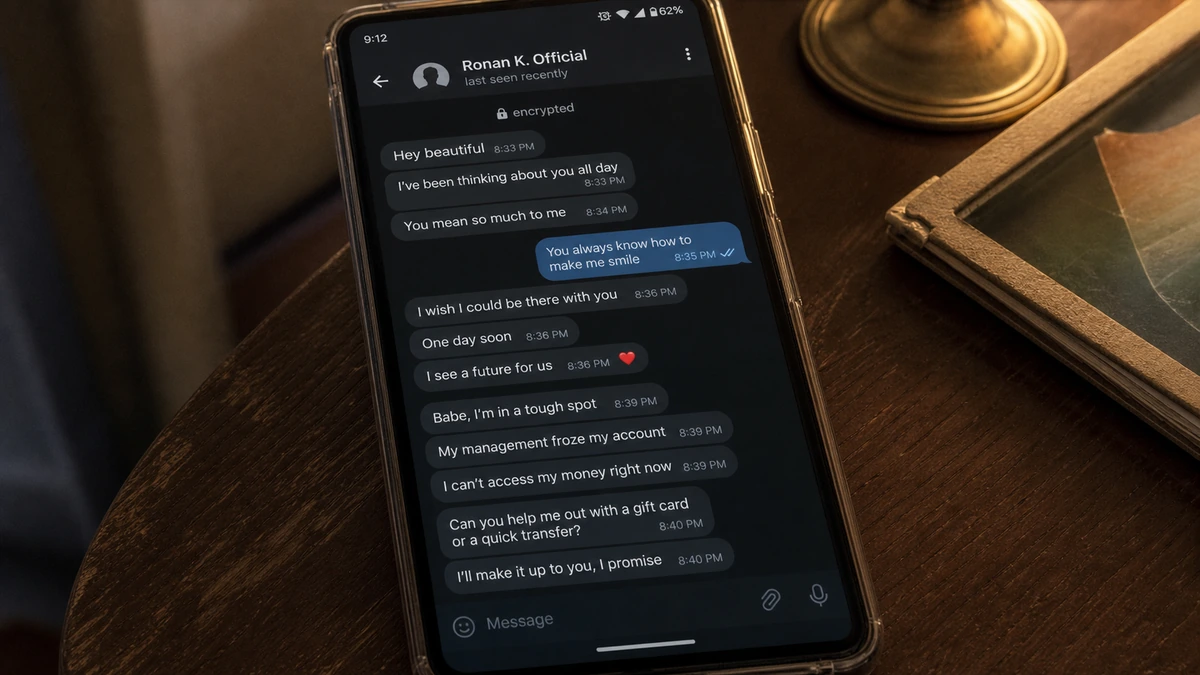
A famous singer sends a private message, remembers the small things, and starts talking about a future together. The attention feels personal in a way public fan pages never do.
Months later, the promised visit is still just out of reach. There is always one more banking problem, travel fee, or urgent payment standing in the way.
Overview
The celebrity identity opens the door
The case examined here involved a 78-year-old grandmother who had spent at least a year talking to someone pretending to be Ronan Keating. The contact began around Facebook and moved into private messaging.
WhatsApp and Signal made the conversations feel exclusive. The impersonator used affection, pet names, and promises of a life together while public facts about the real singer were explained away as part of a cover story.
That is a classic celebrity-romance setup. The real person’s photographs, career, interviews, and schedule provide endless material, but none of it proves who controls the private account.
The future is always one payment away
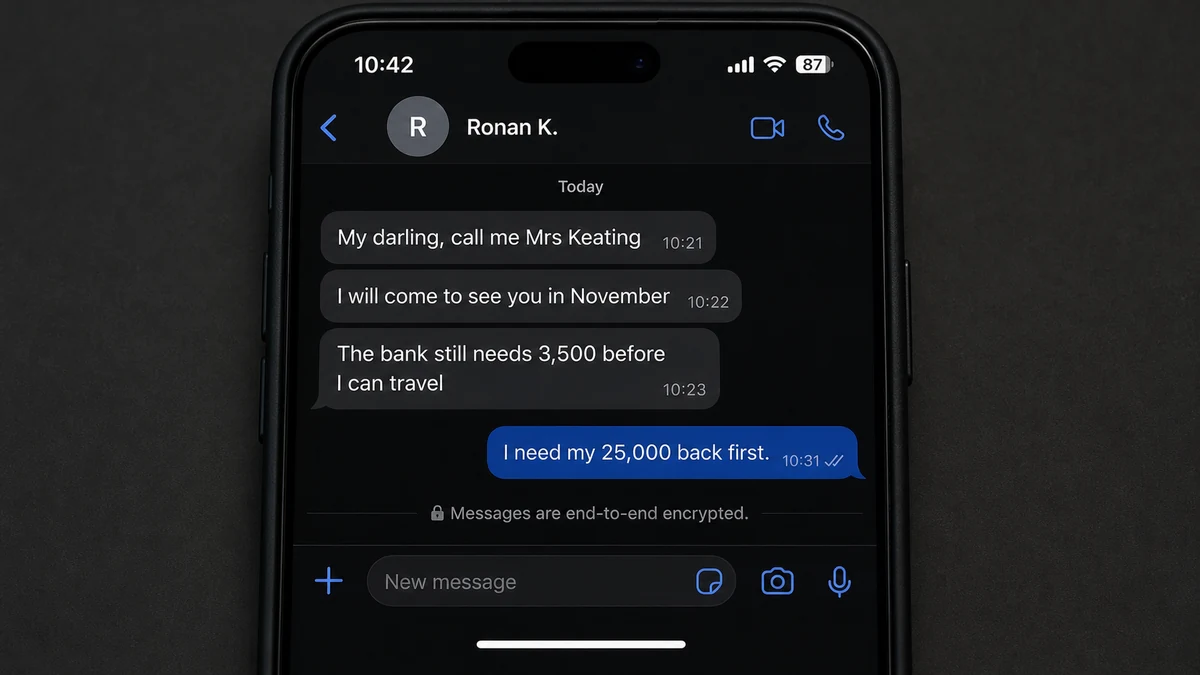
The victim was reportedly called “Mrs Keating” and promised a visit, private travel, and a shared future. Those plans gave every money request a reason that sounded temporary.
Family members found a message asking for 25,000 back before another 7,500 would be sent. Later, the supposed celebrity allegedly asked for 3,500 more before a visit could happen.
The precise payment trail was not published, so it is important not to invent one. What is clear is the repeating pattern: money had already gone out, repayment had not arrived, and another request followed.
Secrecy keeps the relationship alive
When relatives challenged the story, the victim reportedly locked her phones, deleted her own replies, and insisted the public version of the celebrity’s life was false.
This reaction is not evidence that a victim is foolish. A long romance scam creates attachment, routine, shame, hope, and fear of loss. A harsh confrontation can make the impostor feel like the only safe person left.
Warning signs include:
- A celebrity initiates a private romantic conversation with a fan.
- The chat quickly moves away from the public platform.
- Pet names and future promises arrive before a real meeting.
- Public facts are dismissed as staged or contractual.
- A visit remains scheduled for some later date.
- A wealthy person claims to be temporarily unable to use money.
- New payments are requested before old money is returned.
- Family concern is described as jealousy or interference.
How the Fake Ronan Keating Romance Scam Works
Step 1: A private message feels like extraordinary access
The first contact may come from a duplicate profile, fan page, supposed management account, or compromised social account. The sender says the celebrity noticed the recipient personally among thousands of fans.
That unlikely access becomes part of the appeal. The victim feels trusted with a hidden, authentic side of someone the rest of the world knows only through publicity.
Step 2: The conversation leaves the original platform
The impersonator suggests WhatsApp, Signal, Telegram, or email. Privacy is blamed on managers, a partner, intrusive fans, or the press.
Moving the chat also protects the operator. A fake Facebook profile can be reported and removed while the relationship continues under a phone number or fresh username.
Step 3: Daily attention turns into emotional dependence
Good-morning messages, songs, prayers, pet names, and concern arrive every day. The operator learns when the victim is alone, who they trust, and what kind of reassurance works.
The scam is built from hundreds of ordinary messages, not one perfect performance. Eventually, replying feels normal and stopping feels like abandoning a genuine partner.
Step 4: Contradictions become proof of a secret life
If the real celebrity appears with family, the impersonator says the photographs are old, contractual, or required by management. If a concert is scheduled, the private visit is supposedly arranged around it.
The story becomes difficult to disprove because every contradiction receives a private explanation. People who question it are described as jealous, controlling, or unable to understand the bond.
Step 5: A future meeting keeps hope alive
The operator promises a visit, holiday, private flight, marriage, or backstage meeting. The date is far enough away to allow more conversation and usually moves when it gets close.
A manager blocks the trip. A bank freezes an account. Security needs a deposit. Customs holds a package. Each obstacle sounds temporary and gives the next payment a purpose.
Step 6: Money is described as a bridge, not a gift
The impersonator insists the celebrity is wealthy but cannot access funds privately. The victim is promised immediate repayment once the current problem is resolved.
Earlier losses make the next request harder to refuse. One more payment can feel like the only way to recover everything already sent and finally prove the relationship is real.
Step 7: Family intervention is turned into betrayal
The scammer warns that relatives will ruin the visit, expose the secret, or steal the victim’s money. Police and bank warnings may be described as misunderstandings.
If the family responds with ridicule or force, the victim may hide the messages more carefully. That gives the operator even more control over the version of events the victim hears.
Why the Impostor’s “Proof” Proves Very Little
Celebrity photographs and backstage images are public. Copies of IDs, contracts, boarding passes, and management letters can be edited, generated, or stolen from unrelated people.
A voice note is not decisive. Public interviews provide clean samples, and modern tools can clone or imitate a voice well enough for a short affectionate message.
Even a video call can be staged. Recorded clips, face filters, poor connections, dim lighting, and brief camera appearances help the operator avoid a normal unscripted conversation.
Verification badges inside screenshots can be copied. A badge must be checked on the live platform, and a real verified account can still be compromised.
A management email deserves the same scrutiny. The domain must match an independently confirmed official site, not simply include the singer’s name or the word “management.”
Payment receipts and refund notices can also be fabricated. Only the victim’s own bank can confirm that money arrived and cannot be pulled back.
The clearest evidence is behavioral: a famous stranger who has never met the recipient is asking for private financial help while resisting independent verification.
How Families Can Help Without Pushing the Victim Away
Start with the behavior, not an insult. “I am worried because every visit is postponed and another payment follows” is easier to hear than “How could you believe this?”
Acknowledge that the relationship felt real. A real operator invested time in creating affection and routine, even though the identity and promises were false.
Ask concrete questions. Which live verified account started the conversation? Has there been a normal, uninterrupted video call? Why would a wealthy celebrity need a fan’s money? Why must the family stay silent?
Focus first on stopping new transfers. Recovering 25,000 may be uncertain, but preventing the next 3,500 request is an immediate goal everyone can understand.
Call the bank’s fraud or vulnerable-customer team. It can review recipients, attempt recalls, add payment friction, and provide a professional voice that is not part of the family dispute.
Keep ordinary contact going. Invite the person for coffee, meals, or familiar activities that have nothing to do with the scam. Isolation increases the impostor’s importance.
Do not secretly impersonate the victim or send threats from their account. That can destroy trust, warn the scammer, and create safety or legal problems.
If the victim is in immediate danger or cannot protect their finances, seek advice from the bank, police, adult safeguarding services, or a qualified local professional.
How the Money Requests Keep Multiplying
The first payment may be small enough to feel harmless. It tests whether the victim will act and teaches the operator which explanation is most effective.
After payment, a new obstacle appears. A fee was miscalculated, a manager intervened, a transfer is frozen, or travel must be booked again.
The next amount often promises two rewards at once: the long-awaited visit and the return of everything already sent. Hope of romance becomes tangled with hope of financial recovery.
If the victim hesitates, affection may switch to guilt. The impostor sounds hurt, questions their loyalty, or threatens to cancel the relationship. The emotional reward becomes a punishment.
Recipients can change. Money may be sent to an assistant, travel agent, security officer, charity, bank employee, or friend. Multiple names do not make the network legitimate.
A refund screenshot is not a refund. The transaction may be fake, reversible, or funded through another victim’s compromised account.
Ask the bank to map every recipient and payment method, not only the latest request. A year-long relationship may hide transactions described as gifts, loans, fees, or emergency help.
The Risk Goes Beyond the Money Already Sent
A long private relationship collects valuable identity data. The operator may know the victim’s address, date of birth, bank, family structure, daily routine, and security answers.
Documents may be requested for travel, marriage, a fan club, or a legal agreement. Passport and license images can support identity theft long after the romantic account disappears.
The scammer may ask to use the victim’s bank account to receive money. Funds from another victim can turn the account holder into an unwitting money mule and cause serious banking or legal trouble.
Apps, video-call tools, attachments, and “management portals” can collect passwords or install remote access. Romance is the lure, but account takeover can become a second line of attack.
Blackmail is possible if intimate images or messages were shared. Paying usually does not erase the material. Preserve evidence and seek police guidance rather than negotiating alone.
The same operator may return as a bank investigator, lawyer, police officer, or recovery specialist. A person desperate to undo the first loss is an ideal target for a second scam.
Emotional recovery matters too. Losing a relationship that felt genuine can cause real grief. Support should address the financial harm without pretending the attachment disappears the moment the profile is exposed.
Company, Address, and Fulfillment Checks
The real celebrity is the bait, not the sender
Ronan Keating’s real career and public images provide convincing material for the impersonation. They do not connect him to the private accounts or money requests.
A recognizable face can make a profile familiar, but it cannot prove who is typing.
Messaging apps do not certify identity
Facebook, WhatsApp, and Signal transport messages. They do not verify that a contact represents a singer, manager, bank, or travel company.
Encryption protects a conversation in transit. It does not make the person at the other end honest.
No verified business address supports the story
The private relationship was not backed by an independently confirmed management office, contract address, or payment recipient tied to the real celebrity.
A real venue, hotel, or agency address copied into a message can be checked, but its existence does not connect the sender to it.
Fulfillment is permanently postponed
The visit, private jet, repayment, and shared future remain events that will happen after one more obstacle is paid away.
Repeated postponement is not a temporary problem with the relationship. It is the product being sold.
What to Do if You Have Fallen Victim to This Scam
- Stop all new payments. Do not send a smaller amount to recover earlier transfers or prove loyalty.
- Contact the bank immediately. Ask for the fraud team and request recalls or freezes on recent payments.
- Preserve the conversations. Save usernames, profile URLs, phone numbers, chat exports, voice notes, and payment instructions.
- Secure email and social accounts. Change passwords, end unknown sessions, and review recovery settings from a clean device.
- Check financial accounts. Look for new recipients, linked devices, loans, cards, or applications you did not authorize.
- Protect identity documents. Follow local identity-theft steps if a passport, license, tax record, or Social Security number was shared.
- Run a full Malwarebytes scan. Do this if you opened an attachment, app, extension, or remote-access tool.
- Use AdGuard as preventive support. It can block many malicious links, but it cannot verify a person inside a messaging app.
- Report every profile. Save the evidence first, then report the impersonation on each platform.
- File an official fraud report. Use Action Fraud in the UK or ReportFraud.ftc.gov and IC3.gov in the United States.
- Ask for compassionate support. A trusted relative, counselor, bank specialist, or victim advocate can help without humiliation.
- Reject recovery agents. Anyone demanding an upfront fee to trace the impostor or release money may be targeting you again.
Frequently Asked Questions
Would Ronan Keating privately ask a fan for money?
Treat any unsolicited private account requesting money as an impersonation. Fame, public photographs, and copied personal details do not authenticate the sender.
Can a Signal conversation still be a scam?
Yes. Signal can encrypt messages, but it does not verify that the account holder is the celebrity shown in the profile.
Why might a victim keep believing after a warning?
The relationship may provide attachment, hope, routine, and relief from loneliness. Shame or confrontation can make the victim defend it more strongly.
Can the bank recover the 25,000?
Recovery depends on timing, method, recipient accounts, and local rules. Contact the bank immediately and identify every connected payment.
Should family members take the phone away?
Immediate safety may require firm action, but taking control without support can drive the contact underground. Seek professional safeguarding advice.
What if the impostor promises repayment tomorrow?
Do not send anything else. A promised refund that requires another payment is an extension of the scam, not proof that recovery is near.
The Bottom Line
The fake Ronan Keating romance does not survive because of one perfect photograph. It survives through attention, secrecy, postponed meetings, and the belief that one more payment will rescue both the relationship and the money.
Stop new transfers, involve the bank, preserve the evidence, and keep a trusted human connection open. Protecting the victim works better than punishing them for believing someone who spent months earning that belief.








