

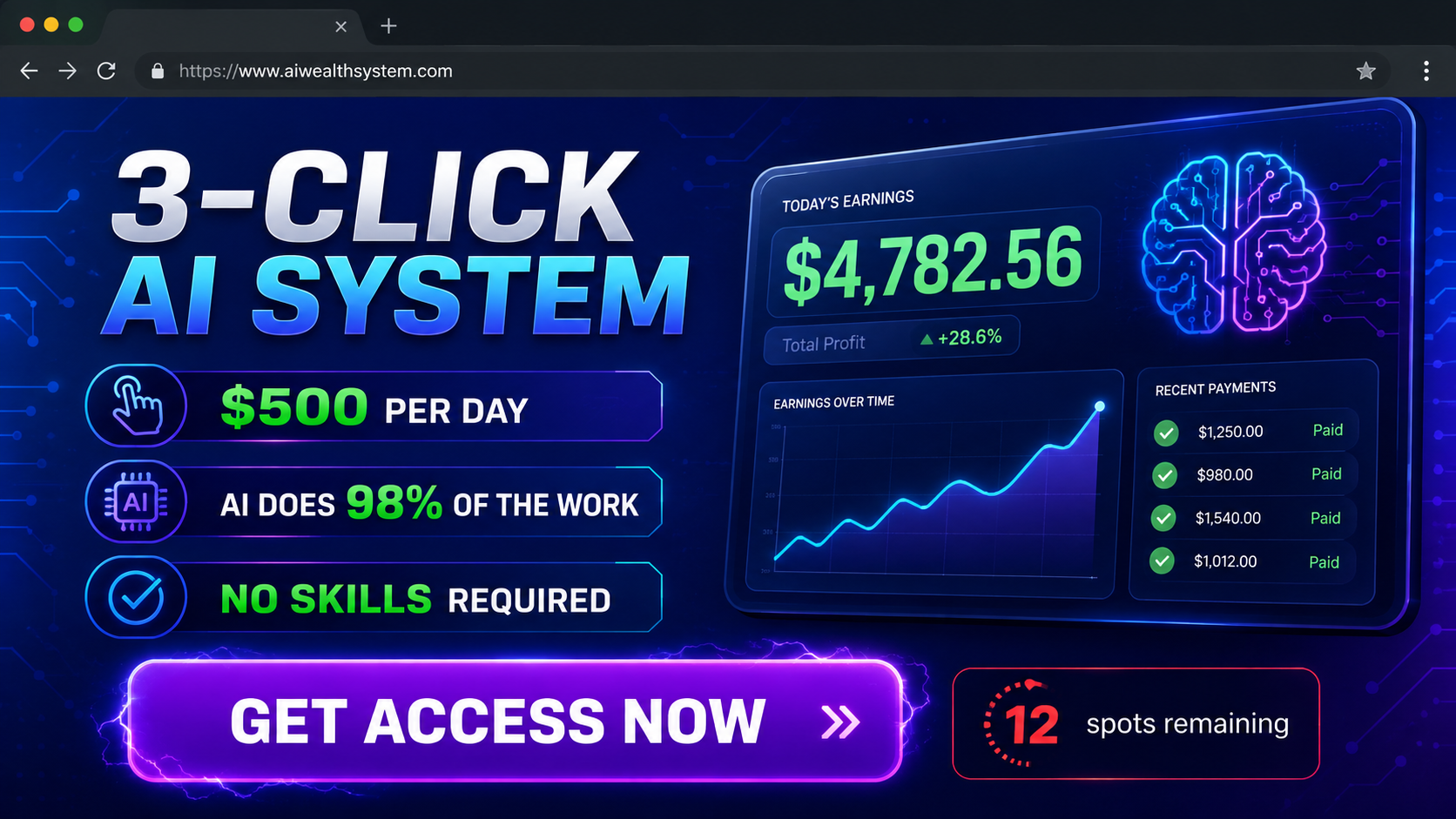
Three clicks before breakfast, an artificial intelligence working all day, and $500 arriving almost automatically. The invitation is designed to feel effortless.
Behind the polished dashboard sits a longer sales journey whose changing names and prices deserve much closer attention.

Overview
The promise keeps changing its label
The campaign has circulated under names including AI Money Taps, AI Money Tap, AI Profits, and the 3-Click AI System.
Its central claim remains familiar: software supposedly completes 98% of the work while the user performs three simple actions each morning.
Advertisements frequently attach a $500-per-day figure to the opportunity, implying that technical skill, an audience, and meaningful experience are unnecessary.
Changing the brand allows a tired campaign to feel new without answering the hard questions about customers, costs, traffic, and realistic outcomes.
What the current funnel actually offers
The current AI Money Taps page redirects the story toward an “AI Acquisition Model” for selling digital products.
It still opens with the suggestion that a visitor could be earning $500 daily, then promotes a route followed by alleged online millionaires.
Displayed figures include more than 1,200 entrepreneurs and average monthly results above $18,105, without independently auditable support on the page.
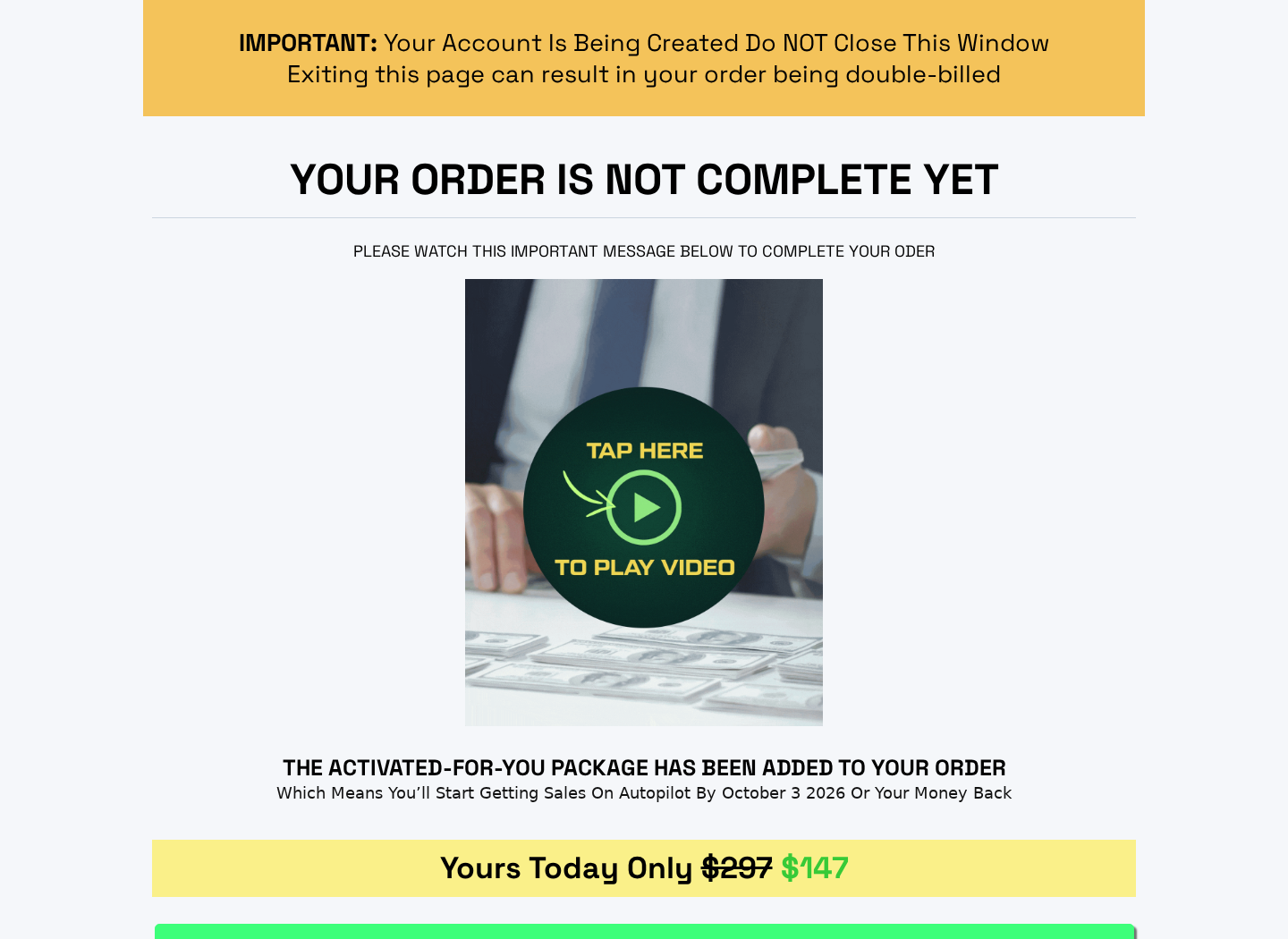
A later screen offers an additional package for $147, reduced from $297, while warning visitors not to close the page.
- No transparent evidence demonstrates ordinary users consistently earn $500 per day.
- The offer has used multiple names and explanations while preserving the same income hook.
- The purchase path includes at least one confirmed post-purchase upsell.
- The current footer identifies AIAA Limited and links policies on another domain.
- The refund headline requires comparison with the complete written conditions.
This is a sales system, not an automatic income account
Digital products can be sold legitimately, and automation can help with research, drafting, customer service, or advertising.
Those tools do not create buyers by themselves. Someone must select a market, build an offer, attract traffic, handle refunds, and comply with advertising rules.
The three-click framing minimizes those tasks while maximizing attention. It turns a complicated business model into a button-pressing fantasy.
We found no basis for treating the advertised $500 daily result as typical, predictable, or available merely because a visitor reaches the page.
What Is Really Being Sold?
The current public presentation describes training, software, templates, and a process for acquiring customers and selling digital products.
That is materially different from an AI machine quietly generating money in the background.
The business model may require paid advertising, email lists, sales calls, content creation, platform accounts, and further software subscriptions.
Those costs and tasks determine whether a participant earns anything. They should appear before payment, not emerge gradually through upgrades.
The page does not provide the audited distribution of customer results needed to interpret its bold averages.
An average can also be misleading if a small number of high results sit beside many customers earning little or nothing.
How the Scam Works
Step 1: A simple income claim catches attention
The opening advertisement compresses an entire online business into three clicks, a few minutes, or an AI assistant completing nearly everything.
Bright earnings figures appear beside dashboards, payment notifications, or anonymous testimonials to make the opportunity feel established.
The advertisement focuses on the outcome rather than the customer acquisition process that would have to produce those sales.
People facing bills, job uncertainty, or disappointing side hustles are especially likely to pause at a precise daily figure.
Step 2: The presentation separates effort from earnings
A narrator explains that traditional businesses require inventory, websites, experience, or long hours, while this system supposedly removes those obstacles.
AI becomes the universal explanation. It is credited with finding products, creating assets, attracting customers, and converting sales.
Actual tools can automate pieces of work, but none guarantees market demand or profitable advertising.
The gap between automation and guaranteed earnings is where the sales story becomes misleading.
Step 3: Names and narratives rotate
When a particular title accumulates critical reviews, the same promise can reappear under a nearby name or a redesigned landing page.
AI Money Taps now introduces an AI Acquisition Model, while older promotions emphasized a more mysterious three-click money mechanism.
This evolution complicates research because buyers may search only the newest phrase and find little history.
Search the support details, company name, policy domain, checkout descriptor, and distinctive claims rather than relying on the product label alone.
Step 4: A low-friction purchase opens the funnel
The first payment is often framed as inexpensive access, a starter package, or a small commitment compared with the promised earnings.
Price anchoring makes the fee look trivial beside $500 per day or $18,105 per month.
The page may emphasize instant access and a guarantee, encouraging visitors to buy before understanding the complete system.
At checkout, record the exact product name, legal seller, total, recurring terms, and refund deadline.
Step 5: Post-purchase upgrades increase the spend
After the initial order, a second page can present an advanced package as essential for faster or larger results.
We observed a $147 upsell discounted from $297. The page said an account was being created and warned against closing it.
It also suggested that closing the page could result in duplicate billing, an unusual warning that pressures a worried customer to remain inside.
Additional upgrades may follow. A buyer should not assume the first price represents the complete cost of the promoted method.
Step 6: The customer receives information rather than earnings
Access to videos, templates, or software can allow the seller to argue that the purchased product was delivered immediately.
Yet delivery of training is not delivery of the advertised financial result.
The customer may discover they must choose a niche, create products, purchase traffic, write campaigns, and manage buyers independently.
When results do not arrive, the system can blame incomplete implementation and recommend another tool or upgrade.
Step 7: Refund requests meet policy details
The upsell page advertises a 30-day money-back guarantee, but a customer still needs to follow the governing terms and document the request.
Digital sellers may argue that content was accessed, work was not completed, or a particular condition was missed.
We do not claim every refund is denied. The risk is that the bold guarantee communicates simplicity while the full policy controls eligibility.
Request cancellation immediately, identify every order separately, and keep proof that the message arrived before the deadline.
Why the Earnings Math Does Not Add Up
A $500 daily claim implies approximately $15,000 during a 30-day month. That is a substantial business result, not ordinary passive income.
To earn it from digital products, revenue must come from real customers. Those customers require traffic, trust, payment processing, and ongoing support.
If advertising produces the traffic, acquisition costs must be subtracted. Refunds, chargebacks, tools, taxes, and platform fees reduce the remaining profit.
Revenue is also not income. A screenshot showing sales says nothing about expenses, refunds, or whether the operator owns the displayed account.
A responsible opportunity would disclose typical net results, sample size, measurement period, participant expenses, and the number who earned nothing.
Without those details, a precise daily number is a marketing device rather than a dependable forecast.
Company, Address, and Fulfillment Checks
The public identity crosses multiple domains
The current AI Money Taps footer names AIAA Limited, while policy links point to AI Acquisition rather than the promotional domain.
Multiple domains are not automatically improper, but the relationship should be clear before a customer enters payment information.
Save each domain and document because one page may disappear while the legal terms remain elsewhere.
Verify the entity that actually takes payment
The checkout receipt and card statement should identify the contracting merchant. That name matters more during a dispute than the logo in an advertisement.
Search the entity in the jurisdiction where it claims registration, then compare officers, address, support details, and current status.
A company registration confirms an entity exists. It does not verify income claims or prove customers achieve advertised results.
Digital fulfillment can happen instantly
Unlike a physical order, access credentials may be delivered immediately. That can start refund deadlines before the buyer explores the material.
Do not click through every module while deciding whether to cancel. Some policies distinguish between accessing content and merely receiving login details.
Take screenshots of the dashboard, lesson list, promised features, and anything missing from the purchased description.
Support must answer specific questions
Ask whether the initial purchase is complete, which upgrades are optional, whether recurring software charges apply, and what actions preserve refund eligibility.
Generic reassurance is not enough. Request written answers that name your product, order number, amount, and deadline.
If support avoids those details, do not continue buying upgrades in hope that the next purchase unlocks the advertised outcome.
Questions the Sales Page Should Answer
Before purchasing any AI income course, insist on answers that connect the marketing promise to a workable business model.
- What exact product or service will customers buy from me?
- Where do prospective customers come from, and who pays for that traffic?
- Which tasks does the software perform, and which remain my responsibility?
- What percentage of buyers earned a net profit after all expenses?
- How many participants requested refunds or stopped using the system?
- Are advertising, hosting, email, or AI subscriptions required separately?
- Does the checkout contain order bumps, upsells, or recurring charges?
- What written conditions apply to the advertised guarantee?
If the promoter answers only with testimonials or screenshots, the essential economic questions remain unresolved.
A legitimate training product should tolerate careful comparison. Artificial scarcity should not replace transparent curriculum, costs, and outcome disclosures.
How to Evaluate the Training After Purchase
Make an inventory during the first login. List every promised tool, template, support channel, coaching element, and automation feature.
Note which items are genuinely included and which require another payment. This prevents a series of small upgrades from disappearing into one total.
Examine whether lessons teach original, concrete processes or simply repeat motivation and broad advice available freely elsewhere.
Search sample text from the modules. Material copied from generic articles or recycled across unrelated products weakens claims of a proprietary system.
Do not spend on advertising merely to satisfy a guarantee condition until you understand the refund policy and realistic testing budget.
Calculate net results, including every fee. A single sale does not demonstrate profit when obtaining that buyer cost more than the revenue.
If essential software fails, capture the error with the date and browser visible. Ask support for a written repair timeline.
Submit a refund request while the deadline is open, even if support suggests waiting for another module or coaching appointment.
What to Do if You Have Fallen Victim to This Scam
- List every transaction. Record the initial payment, order bumps, upsells, subscriptions, merchant descriptors, dates, and amounts separately.
- Request refunds in writing. Identify each order and cite the guarantee visible during purchase. Ask for confirmation that no further billing will occur.
- Save the marketing claims. Preserve the $500-per-day promise, three-click description, AI automation claims, testimonials, pricing pages, and guarantee language.
- Contact your payment provider. If the seller refuses or does not respond, ask about a dispute for materially misrepresented or unauthorized charges.
- Cancel related services. Review advertising, email, hosting, and software accounts opened during training so separate renewals do not continue.
- Report deceptive earnings claims. File a report with the FTC and the platform that displayed the advertisement. Provide destination URLs and receipts.
- Change exposed passwords. Use unique credentials, enable multifactor authentication, scan downloads with Malwarebytes, and use AdGuard against malicious advertising redirects.
- Ignore recovery agents. Anyone promising guaranteed charge recovery for another upfront fee may be targeting victims a second time.
Stay factual when communicating with the bank. Explain what was promised, what was delivered, and which attempts you made to resolve the difference.
Do not exaggerate. A clear timeline with screenshots and separate order amounts is more persuasive than a broad claim that everything was fraudulent.
Frequently Asked Questions
Can a three-click AI system really make $500 per day?
We found no reliable evidence that three clicks produce that typical result. Real online sales require customers, work, expenses, and risk.
What does AI Money Taps currently sell?
The current page promotes an AI Acquisition Model involving digital products, training, templates, and software rather than an automatic cash account.
Is the $147 offer the original purchase?
No. We observed it as a post-purchase upgrade discounted from $297, showing that the first payment may not be the final offer.
Are the displayed earnings figures verified?
We found no independently auditable records supporting the daily and monthly figures as typical customer results.
Does the program include a refund guarantee?
The observed upsell displayed a 30-day guarantee. Buyers must still review the complete policy and submit each request before applicable deadlines.
Is every AI business course a scam?
No. The warning signs here are the effortless earnings framing, unsupported precision, rotating identity, and expanding purchase funnel.
The Bottom Line
The 3-click AI money system turns a difficult digital-sales business into an effortless $500-a-day story that available evidence does not support.
Current pages offer training, software, and templates, then introduce additional purchases. Those products should be judged without the automatic-income fantasy.
If you paid, document every transaction and act before the refund window closes. Do not buy another upgrade merely to rescue the first purchase.








