

A trading page promises 91.4% accuracy, instant market intelligence, and technology so advanced that ordinary analysis suddenly looks obsolete.
The numbers appear precise, the interface looks expensive, and the word “quantum” encourages visitors to assume the difficult work has already been solved.

Overview
The campaign uses scientific language as a shortcut to trust
The promotion calls itself QuantumTrades and describes “next-gen market intelligence powered by Quantum AI.”
Its most striking figure is a claimed 91.4% prediction accuracy, presented without a verifiable methodology, audited history, or complete performance record.
References to quantum computing make the service sound inaccessible to ordinary scrutiny. Yet impressive terminology does not establish profitable execution.
Any trading system can display a percentage. The meaningful questions concern time period, asset selection, losses, fees, and independent verification.
The destination we examined lacked essential transparency
The campaign directed visitors to aistock.pics, where the QuantumTrades name appeared in promotional material.
We could not identify a transparent regulated broker, responsible investment firm, or independently verified technology provider behind the advertised result.
Domain ownership was hidden, and the site later returned an error during our checks. Temporary downtime alone does not prove fraud.
Combined with extraordinary financial claims and unclear ownership, however, instability leaves prospective customers with little reliable accountability.
- The 91.4% accuracy claim lacks an independently audited basis.
- The campaign does not clearly identify a regulated financial service provider.
- AI-themed promotional material uses urgency and technological mystery.
- The destination domain should not be confused with unrelated businesses using similar names.
- Deposits should never be sent until registration and withdrawal rules are independently verified.
This investigation concerns one specific campaign
Businesses elsewhere use similar “Quantum Trades” wording. Our findings address the promotion associated with aistock.pics, not every unrelated company sharing those words.
Name confusion benefits deceptive campaigns because searches may surface legitimate firms, old reviews, or unrelated software.
Always match the exact domain, legal entity, support details, and payment recipient before relying on any review or regulatory record.
A familiar-sounding name is not proof that the website belongs to the established company a visitor assumes it does.
Why 91.4% Accuracy Is Not the Same as Profit
Accuracy can mean almost anything unless the seller defines what was predicted and how success was measured.
A system might correctly predict tiny price movements while losing money on the fewer, larger mistakes.
It could also count broad directional calls, remove failed predictions, change timeframes, or test retrospectively on data already known.
Profitable performance requires position sizing, entries, exits, spreads, commissions, slippage, and losses to be included.
An independently audited track record would show all signals over a fixed period, not a collection of winning screenshots.
Without that record, 91.4% is an advertising claim rather than evidence a customer can reproduce.
How the Scam Works
Step 1: An AI trading advertisement promises unusual certainty
The first page uses stock charts, technical language, and a precise success rate to suggest that uncertainty has been engineered away.
Some campaigns add synthetic presenters or familiar technology figures to strengthen the impression of insider access.
We found signs that promotional media used AI-generated narration or manipulated presentation techniques rather than a verifiable financial professional.
The visitor is encouraged to request a free analysis, activate software, or learn which trades the system has supposedly identified.
Step 2: Registration collects valuable personal information
The next screen may request a name, email address, telephone number, country, and trading experience.
That information is valuable even if no software exists. It identifies someone interested in high-return financial offers.
Details can be passed to aggressive sales operations or reused for unrelated investment, cryptocurrency, and recovery pitches.
Once a telephone number enters a lead network, calls may arrive from different names, countries, and supposed account managers.
Step 3: A salesperson converts curiosity into a deposit
A representative may call quickly and describe a limited opening, assisted account, or small starter deposit.
The conversation usually avoids proving the 91.4% figure. Instead, it focuses on how soon the customer can begin.
The caller may claim the platform connects to a partner broker, creating distance between the advertisement and the company receiving money.
Do not accept that arrangement without independently checking the broker in the official register for your jurisdiction.
Step 4: A dashboard manufactures confidence
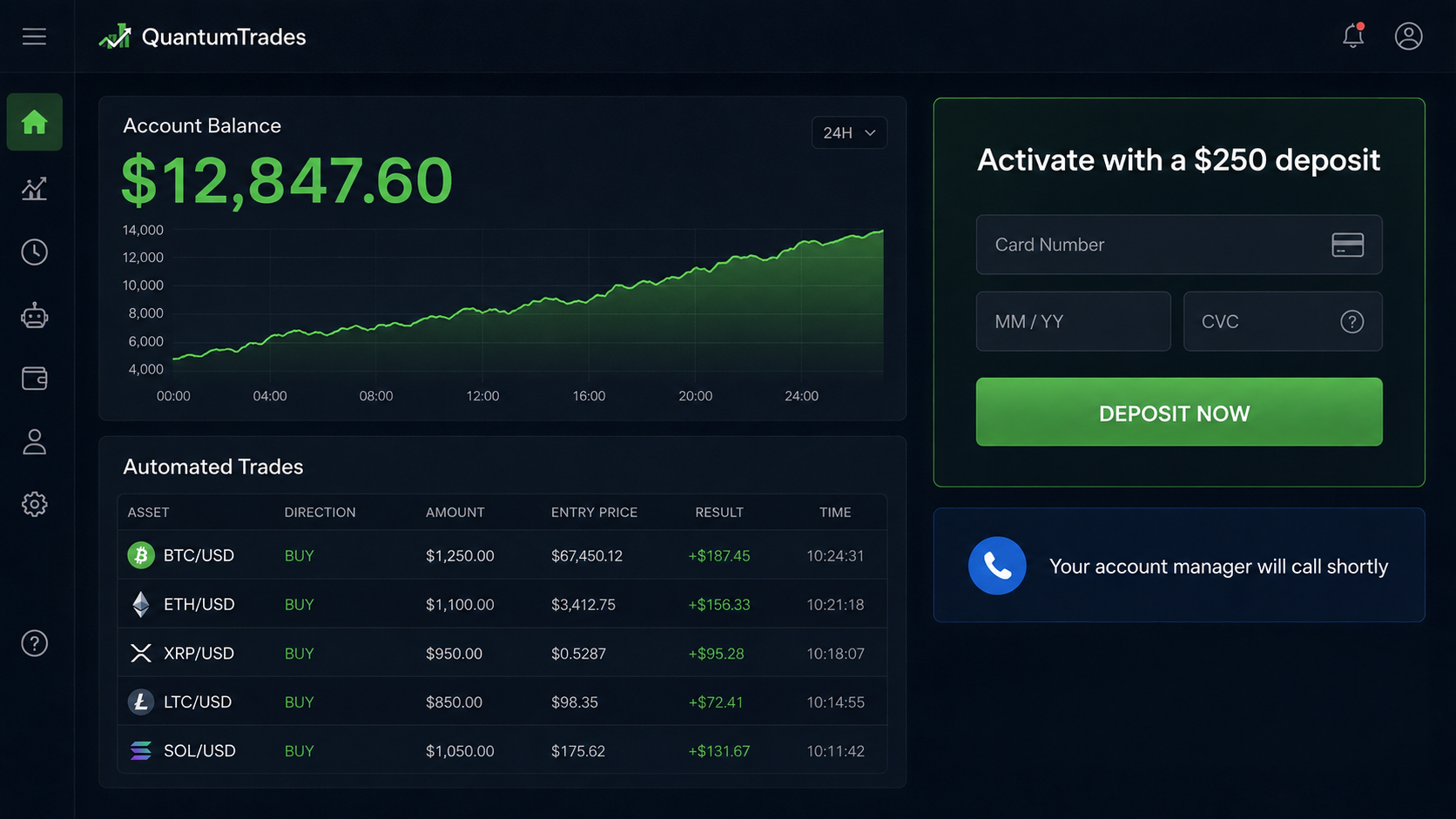
After payment, an online balance may show winning trades and rapid growth, whether or not the underlying activity occurred on a real market.
The example shown above illustrates how a polished interface can make unverified numbers feel like withdrawable money.
A screen balance is only a database value controlled by the website. It proves nothing until funds return to the customer’s own account.
Small early withdrawals may occasionally be allowed to build confidence and encourage a much larger deposit.
Step 5: Pressure rises after apparent profits
An account manager may recommend upgrading, copying a special trade, protecting a position, or depositing before an upcoming market event.
Because the dashboard shows gains, sending more money can feel less risky than the original deposit.
Victims may be urged to borrow, use cryptocurrency, or install remote-access software while the representative “helps” with payment.
Remote access is particularly dangerous because the caller can view banking sessions, move funds, and conceal confirmation messages.
Step 6: Withdrawal requests trigger new conditions
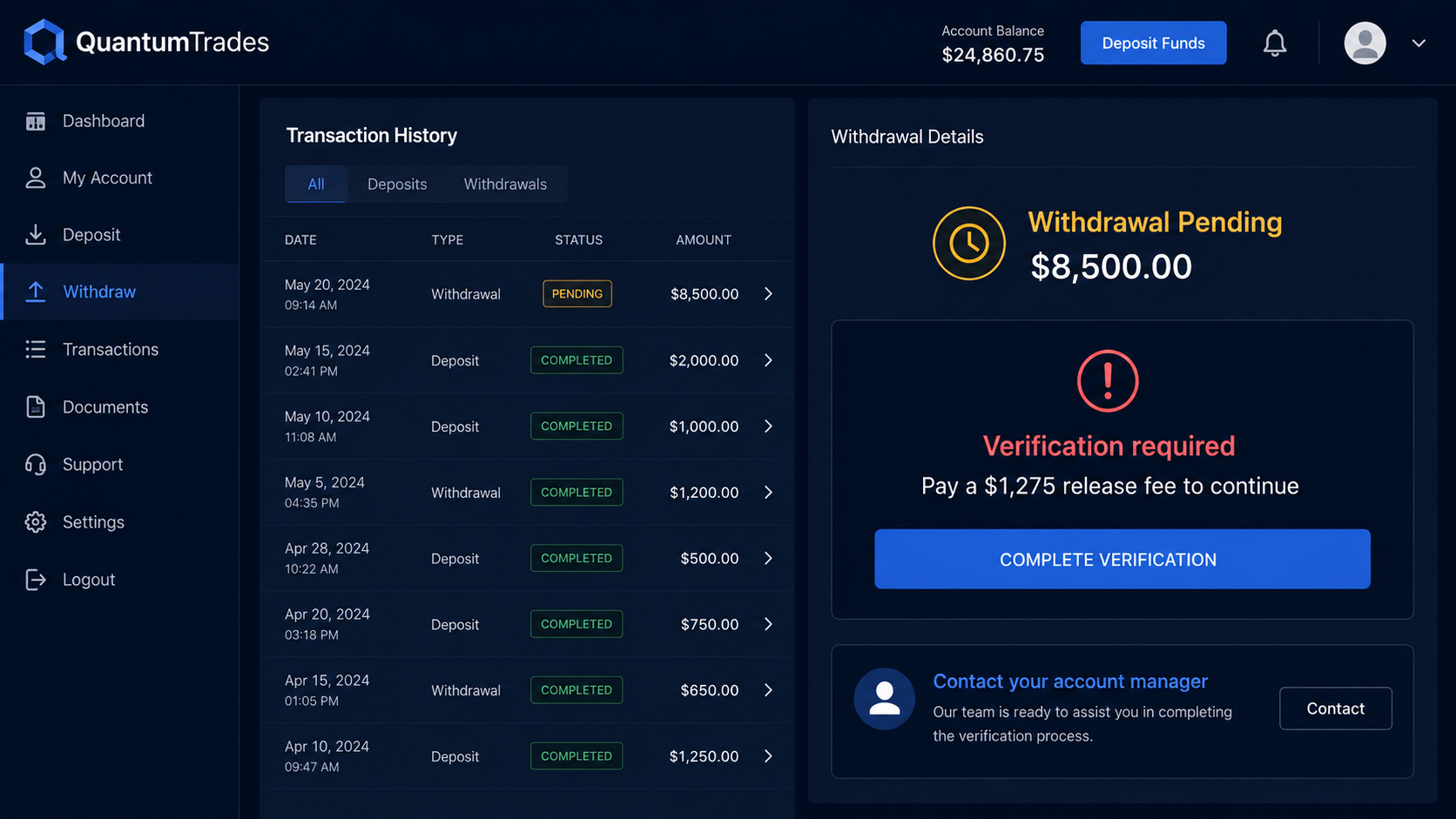
When the customer asks to withdraw, the platform may demand tax, insurance, verification, commission, liquidity, or a release fee first.
Legitimate taxes are not normally unlocked by sending more cryptocurrency to an anonymous wallet.
The illustration below shows a common withdrawal-fee pattern. It documents the mechanism, not a verified screen from the unavailable campaign site.
Paying one fee often produces another because the displayed balance was designed to motivate continued transfers.
Step 7: The operation disappears or changes identity
Once deposits stop, the account manager may become unreachable, the login may fail, or the site may move to another domain.
Later callers can pose as regulators, blockchain investigators, lawyers, or recovery specialists who already know details about the loss.
That knowledge does not prove legitimacy. It may come from the same lead records that powered the first approach.
A demand for an upfront recovery fee is another warning sign, especially when payment must be made through cryptocurrency.
How to Check an AI Trading Platform Before Depositing
Begin with regulation, not the technology presentation. A service handling investments should identify the exact legal entity and permissions under which it operates.
Search the regulator’s official database manually. Do not follow a certificate or registration link supplied by the salesperson.
Check whether the registered domain, telephone number, company address, and permitted services match the offer exactly.
A company registration is not a brokerage license. Likewise, a valid SSL certificate protects data in transit but does not validate the business.
Ask for audited results covering all trades and losses. Marketing accuracy percentages, simulated backtests, and selected screenshots are inadequate.
Finally, test the withdrawal process with a small amount before considering any increase. Refusal or new fees should end the relationship.
Company, Address, and Fulfillment Red Flags
The domain does not establish the operator
Aistock.pics used privacy protection for its registration details. Privacy services are common, but financial promotions require stronger transparency elsewhere.
We did not find a clear legal entity on which a customer could perform meaningful licensing and enforcement checks.
If a salesperson names a different broker, record that entity and repeat every check using the exact receiving account.
Similar names create dangerous false reassurance
An unrelated business may own a similar QuantumTrades name or domain. Positive information about that company does not transfer to aistock.pics.
Scammers exploit this ambiguity by choosing generic technology and trading terms already present across the internet.
Compare full web addresses character by character. Do not contact an unrelated company about money sent through this campaign.
Telephone support may be a sales desk
A responsive caller is not necessarily customer support. The same person may concentrate on deposits while avoiding written answers about withdrawals.
Ask for the licensing number, legal entity, complaint process, custodian, and withdrawal policy by email.
Refusal to provide written details is more informative than a confident voice or a local-looking caller identification number.
There may be no real financial fulfillment
A supplement seller can mail a bottle. A fake trading platform can “fulfill” its promise by displaying numbers on a private dashboard.
Only independent trade confirmations, regulated custody, and successful withdrawals can demonstrate that real market activity occurred.
Never install remote-access software or share a one-time banking code so a representative can supposedly verify the trading account.
Warning Signs That Require an Immediate Stop
- A guaranteed return or prediction rate above 90%.
- An unnamed AI system described as proprietary or impossible to explain.
- A broker relationship disclosed only after registration.
- Calls arriving within minutes from several unfamiliar numbers.
- Requests to deposit through cryptocurrency, gift cards, or personal accounts.
- Pressure to share the screen or install remote-control software.
- A dashboard profit that cannot be withdrawn without another payment.
- Taxes or release fees demanded before any funds are returned.
- Regulatory claims that cannot be matched in an official register.
One warning can have an innocent explanation. Several together indicate that the safest decision is to stop sending money and preserve evidence.
Do not allow a caller to rush verification. Real regulated firms can provide written information and wait while a prospective client checks it.
Why AI and Quantum Language Can Mislead Investors
Artificial intelligence can assist legitimate analysts, but its output depends on data quality, assumptions, changing markets, and risk controls.
Quantum computing is a real research field. Invoking it on a landing page does not prove the advertised system uses quantum hardware.
A credible provider would explain the model’s inputs, testing design, limitations, and the distinction between simulations and live performance.
It would also disclose losing periods. Markets change, and a strategy fitted to historical data can fail when conditions shift.
Statements about “instant personalized reports” do not establish trade execution, custody, or responsibility for losses.
Technology cannot remove counterparty risk. Even brilliant software would be unsafe if customers send money to an unlicensed or anonymous operator.
Regulation does not guarantee profit either, but it establishes conduct rules, capital requirements, complaint channels, and an identifiable entity.
When the promoter treats basic questions as evidence you do not understand the technology, walk away. Complexity should invite better disclosure.
What Evidence Would Change This Assessment?
A named legal operator, confirmed license, and domain matching the regulator’s record would resolve the most basic identity concerns.
An independent audit covering live trades, deposits, withdrawals, fees, drawdowns, and all losing positions would give the accuracy claim meaningful context.
Clear custody arrangements and successful customer withdrawals would need verification outside a dashboard controlled by the promoter.
Until that evidence appears, the prudent assumption is that the displayed certainty has not been earned.
What to Do if You Have Fallen Victim to This Scam
- Stop all transfers. Do not pay a tax, release fee, verification charge, or recovery deposit, regardless of the displayed balance.
- Contact your bank immediately. Ask whether wires, card payments, or transfers can be recalled, disputed, blocked, or traced.
- Secure compromised accounts. Remove remote-access software, change banking and email passwords from a clean device, and enable multifactor authentication.
- Preserve evidence. Save the advertisement, domains, chats, email headers, telephone numbers, wallet addresses, receipts, dashboard balances, and withdrawal messages.
- Notify relevant authorities. Report the incident to financial regulators, local police, the FTC, and the FBI’s IC3 when appropriate.
- Alert cryptocurrency services. Provide destination wallet addresses and transaction hashes to the exchange used for payment as quickly as possible.
- Check the device. Run Malwarebytes after removing remote tools, then use AdGuard to reduce malicious advertisements and redirects that may retarget you.
- Reject recovery pitches. Never pay an unsolicited person promising guaranteed retrieval, special blockchain access, or regulator-approved recovery.
Tell your bank if a representative watched or controlled the payment. That detail may affect the security response and investigation.
Cryptocurrency transfers are difficult to reverse, but reporting quickly still helps exchanges flag accounts and investigators connect related complaints.
Frequently Asked Questions
Is QuantumTrades a regulated broker?
We found no transparent regulated brokerage identity behind the aistock.pics campaign. Verify any newly supplied entity directly with your official regulator.
Can an AI trading tool achieve 91.4% accuracy?
The campaign provides no independently audited evidence for that figure. Accuracy alone also cannot establish profitability after losses, fees, and execution costs.
Is a dashboard balance proof of real profits?
No. A website controls its displayed numbers. Successful withdrawal to an account you control is the practical test.
Should I pay a fee to release my withdrawal?
No additional payment should be sent to an unverified platform. Contact your bank and regulator before responding to any release demand.
Is QuantumTrades.com connected to this campaign?
We found no basis to connect unrelated similarly named businesses with the aistock.pics promotion covered here.
Can a recovery company retrieve my cryptocurrency?
Be extremely cautious. Guaranteed recovery and upfront cryptocurrency fees are common signs of a second scam targeting previous victims.
The Bottom Line
The Quantum AI trading campaign uses a precise 91.4% claim and futuristic language without the audited record or accountable operator such confidence requires.
Do not confuse a polished dashboard with regulated custody or real profits. Verify the exact domain, entity, license, payment recipient, and withdrawal process independently.
If money was sent, stop now and contact financial institutions immediately. Another fee will not transform an unverified balance into recoverable funds.








