

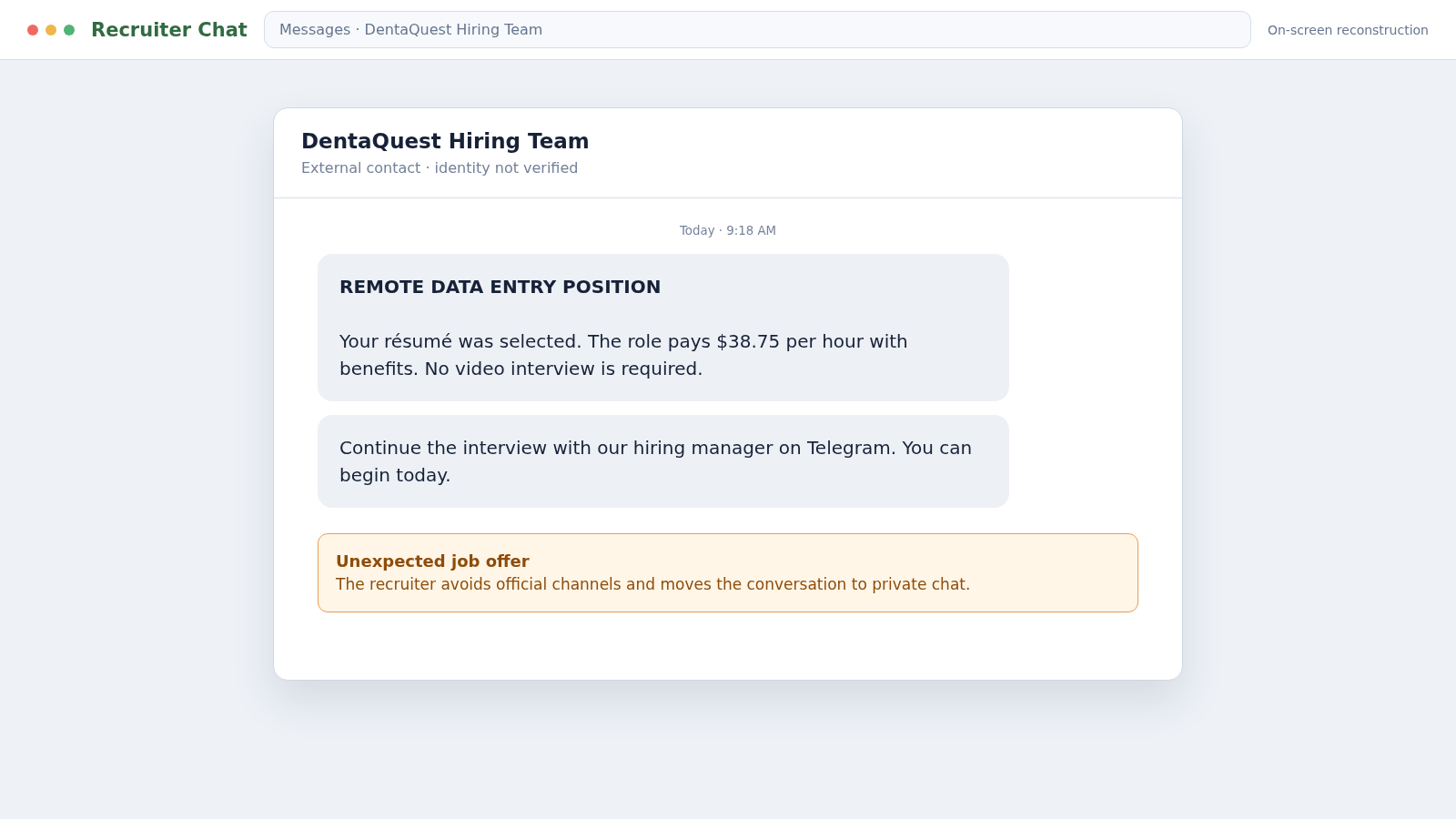
A recruiter says DentaQuest has noticed your résumé and can put you into a well-paid remote role within hours. The interview is short, the welcome sounds unusually warm, and the next message already treats you like an employee.
The DentaQuest Careers scam becomes dangerous after that easy beginning, when an ordinary job search turns into a request involving money, documents, or a private chat account.
Overview
The scam impersonates a real dental benefits company
DentaQuest is a legitimate dental benefits administrator within the Sun Life U.S. organization. Criminals borrow that familiar name when contacting people who are looking for remote customer service, data entry, administrative, billing, or claims positions.
The fraudulent contact can begin through text message, email, LinkedIn, Facebook, WhatsApp, Telegram, or a job-board profile. The company is real, but the person making the approach is not an authorized recruiter.
The hiring process moves much faster than a real one
The supposed recruiter may conduct the entire interview by typed chat and offer the job almost immediately. A high hourly rate, flexible schedule, benefits, and paid training are used to make the applicant afraid of losing a rare opportunity.
There may be a copied logo, employment agreement, offer letter, employee number, or supervisor name. None of those items proves that the sender has access to DentaQuest’s real hiring system.
The final target is money or a complete identity profile
Some victims receive a fake check and are told to buy equipment from an approved vendor. Others are asked to pay for training, software, a background check, or account activation before their first day.
The scam may also collect enough information for identity theft. Requests can include:
- A Social Security number and date of birth
- Photos of a driver’s license or passport
- Bank routing and account numbers for “payroll”
- A selfie holding identity documents
- Copies of tax forms or proof of address
- Online banking screenshots or login details
- A payment to a designated equipment supplier
A legitimate employer may need payroll and tax information after formal hiring, but timing and channel matter. Sensitive onboarding does not begin through a stranger’s chat link before the applicant can independently verify the role.
Warning Signs in the Fake DentaQuest Job Offer
The strongest warning is not a spelling error. Modern employment scams can use polished writing, copied employee profiles, convincing interviews, and professional documents.
Look at how the entire process fits together. A real role should exist on an official careers system, the recruiter should be independently verifiable, and no applicant should have to move company money through a personal account.
- The first approach is unsolicited and promises unusually high pay.
- The interview happens only by text, Telegram, Signal, or WhatsApp.
- The recruiter refuses a live call or cannot join a company meeting.
- The sender uses Gmail, Outlook, or a lookalike company domain.
- You are hired before anyone meaningfully discusses your experience.
- A check arrives for computers, software, or home-office equipment.
- You must send part of the deposit to a named “approved vendor.”
- The offer requires a fee for training, screening, or registration.
- Identity and banking data are requested inside an ordinary form.
- The recruiter becomes urgent when you try to verify the vacancy.
Do not assume the contact is genuine because the recruiter knows where you worked. Résumés, professional profiles, and breached databases can reveal enough detail to personalize a message.
Also check the job identifier rather than only the job title. Scammers copy plausible titles and sometimes reuse the number from a real listing that has different duties, location, or application instructions.
How the DentaQuest Careers Scam Works
Step 1: The fake recruiter finds an active job seeker
The scammer searches job boards and professional networks for people who advertise that they are open to work. Another route uses résumés collected by fake application forms or data sold by lead brokers.
The opening message often names a role close to the applicant’s experience. That match feels personal, but it may have been copied directly from a public profile.
Step 2: A remote role removes practical obstacles
The job is described as fully remote, with flexible hours and equipment supplied by the company. This gives the fraudster a reason to avoid an office visit and later introduces the equipment-payment story.
Pay is usually generous for the experience required. The promise is designed to replace healthy caution with relief, especially when the recipient has been searching for work for weeks.
Step 3: The conversation moves to private messaging
The applicant is instructed to install Telegram, Signal, Teams, or another service and contact a hiring manager using a code. Moving away from the job platform makes reporting harder and lets the criminal control a disposable account.
A real employer can use chat during hiring, but chat alone is not enough. Refusal to provide a verifiable corporate email, live conversation, and official application route is a serious warning.
Step 4: A scripted interview creates legitimacy
The interviewer asks common questions about reliability, teamwork, typing speed, customer service, and availability. Answers may receive immediate praise, regardless of what the applicant writes.
The process looks organized because the questions were prepared in advance. A script is easy to reuse across hundreds of targets and does not show that a genuine manager reviewed the application.
Step 5: The victim receives an instant offer
Within minutes or hours, the interviewer announces that the board has approved the applicant. An offer letter may list salary, vacation, insurance, and a start date, complete with a copied signature.
The criminal encourages the victim to sign quickly and keep the role confidential until onboarding is complete. Secrecy prevents friends or former colleagues from noticing the inconsistencies.
Step 6: The fake check or upfront expense appears
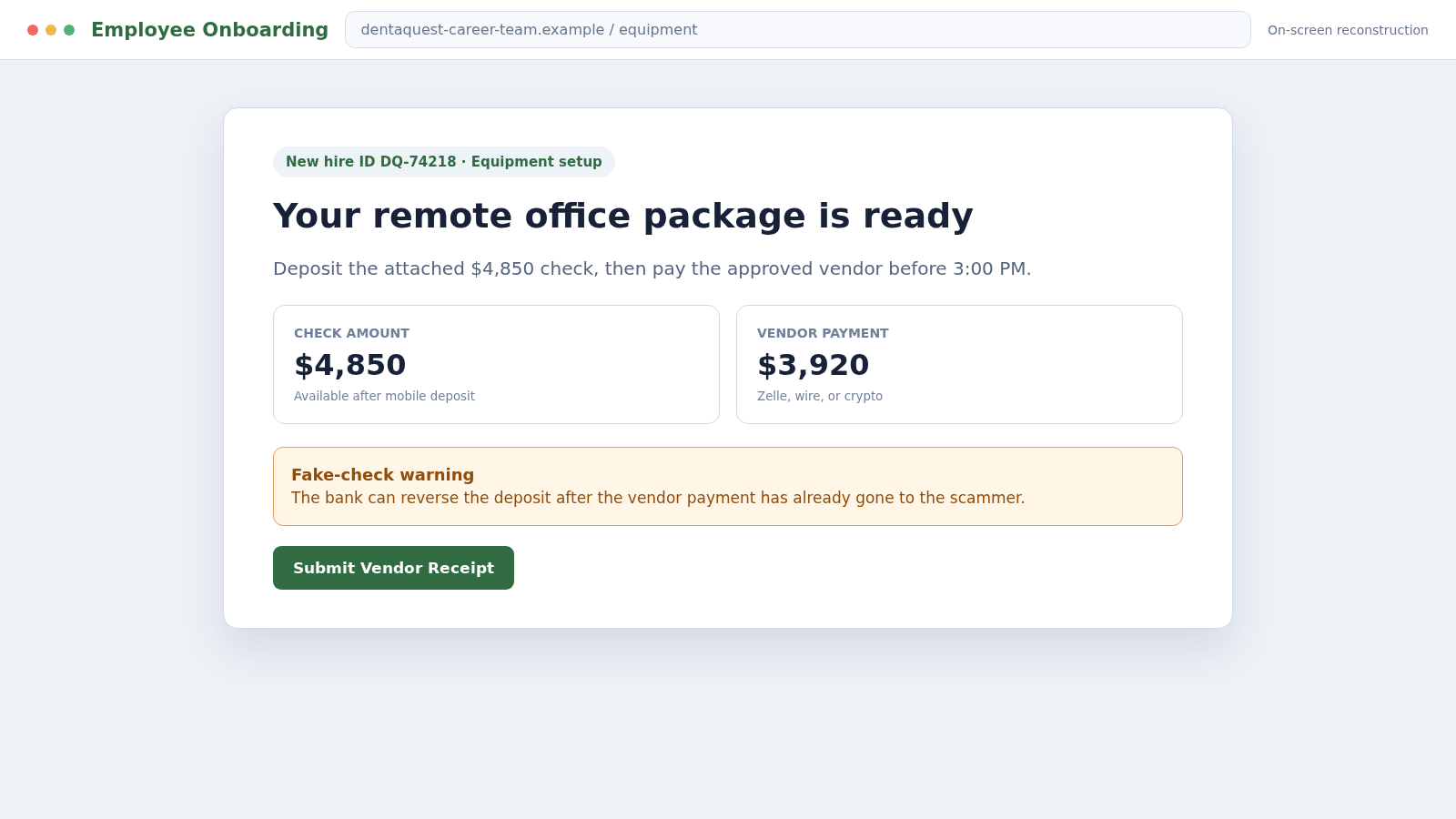
The new employee is told to deposit a digital or mailed check, keep part for a signing bonus, and use the rest to purchase a computer, printer, or accounting software from a specific supplier.
The bank may show funds as available before determining that the check is counterfeit. The vendor payment is real and goes to the scammers, while the deposit is later removed from the victim’s account.
Step 7: Sensitive onboarding data is collected
A fake payroll form requests banking information, an SSN, address, identity documents, and perhaps a credit report. The scammer may say the details are required before shipping equipment or creating a company profile.
Some campaigns ask the victim to create accounts at banks, cryptocurrency exchanges, or payment services. Those accounts can be used to move stolen funds and may expose the victim to further financial or legal trouble.
Step 8: The recruiter disappears or demands more
When the bank questions the check, the equipment vendor stops responding and the recruiter removes the chat account. If the first payment succeeds, another charge may be invented for shipping, insurance, or software licensing.
The personal data does not disappear with the conversation. It can support new-account fraud, tax fraud, targeted phishing, or a second approach pretending to recover the original loss.
Why a Fake Check Can Look Like Spendable Money
Depositing a check and seeing a larger available balance does not mean the check has finally cleared. Banking rules can make some funds available while the bank continues checking whether the account and payment are valid.
A convincing counterfeit can survive long enough for the victim to send a wire or app payment to the fake vendor. When the check is returned, the bank reverses the deposit, but the money sent onward does not automatically return.
The scammer may tell the applicant that the company cannot buy equipment directly because of accounting rules, regional suppliers, or remote-work policy. That explanation is backwards. A genuine employer can purchase its own equipment or reimburse a documented expense through established payroll procedures.
Never send money based on a check from a person you met online. Ask the bank when the item is finally settled, and explain the full story before moving any funds.
Company, Address, and Fulfillment Checks
Find the job through DentaQuest’s official route
Open the DentaQuest site independently and follow its careers link into the Sun Life employment system. Search for the exact role, location, and requisition number rather than trusting a link supplied in a message.
A copied listing may be real while the recruiter is fake. Submit through the official application route and ask whether the person contacting you is assigned to that requisition.
Verify the recruiter outside the conversation
Do not use the telephone number, meeting link, or email signature in the suspicious message. Find the organization through its official website and request confirmation through a separately obtained channel.
Compare the complete email domain carefully. Added words, swapped letters, hyphens, and recently created lookalike domains are not the company’s official identity.
Check the workplace and legal employer
An offer should clearly identify the employing entity, manager, department, work location, and reporting structure. Search the address and confirm it belongs to the same organization named in the agreement.
A mailbox, virtual office, unrelated residence, or copied Sun Life address does not prove that the sender works there. Public addresses are easy to paste into a letter.
Confirm equipment without moving company funds
Ask how equipment is ordered, owned, inventoried, and returned. A legitimate employer can ship a device from its own supplier without asking a new hire to deposit a check and pay a stranger.
Do not accept responsibility for purchasing gift cards, cryptocurrency, or expensive hardware on behalf of a business before the first day of verified employment.
Before accepting, ask for the written name of the supervisor, a normal start-day agenda, and a company contact who can confirm the hire. A genuine team can answer practical questions about training, payroll timing, equipment support, and who owns each step.
A scammer usually brings every answer back to the check, the vendor, or the need to act before the bank closes. That narrow focus reveals what the supposed recruitment process was built to accomplish.
What to Do if You Have Fallen Victim to This Scam
- Stop the conversation and do not send another payment. A shipping charge, check correction, or final software fee will deepen the loss.
- Tell your bank about the fake-check story immediately. Do not wait for the deposit to be reversed. Ask the fraud team to protect the account and try to recall any outgoing payment.
- Contact the payment service. Report wires, transfers, gift cards, and crypto transactions through the provider’s official fraud channel and keep every case number.
- Secure the email account first. Change its password from a trusted device, sign out unknown sessions, review forwarding rules, and enable multifactor authentication.
- Freeze your credit. Contact all three major credit bureaus if an SSN, driver’s license, passport, or detailed employment history was shared.
- Create an identity-theft recovery plan. Use IdentityTheft.gov and follow the steps that match the documents and accounts exposed.
- Contact DentaQuest through its real website. Send the recruiter name, address, job title, and screenshots so the company can investigate the impersonation.
- Report the fake listing. Notify the job board, social network, email provider, and messaging service so the account and advertisement can be removed.
- Preserve evidence before blocking anyone. Save the offer letter, check image, envelope, chat export, domains, telephone numbers, payment receipts, and vendor instructions.
- Report the fraud. File at ReportFraud.ftc.gov and contact local police if money or identity documents were stolen.
- Scan any device used for onboarding. If you opened files or installed interview software, run a complete Malwarebytes scan and remove unrecognized remote-access tools.
- Reduce exposure to repeat links. AdGuard can block many known phishing pages and deceptive advertising domains, although it cannot reverse information already submitted.
Frequently Asked Questions
Is DentaQuest a real company?
Yes. DentaQuest is a real dental benefits business associated with Sun Life U.S. The scam is an impersonation campaign, not proof that the genuine organization offered the job.
Does DentaQuest hire remote employees?
A legitimate company can advertise remote roles. Verify the exact opening through the official careers system and confirm the recruiter independently before providing sensitive information.
Can a real employer interview me through chat?
Chat may be one part of recruiting, but a text-only interview followed by instant hiring, no verifiable company contact, and a money request matches a common employment scam.
Why did my bank make the check funds available?
Availability is not final settlement. The bank can later identify the check as fraudulent and remove the deposit, leaving you responsible for money already sent to the fake vendor.
What if I sent documents but no money?
Treat the documents as compromised. Freeze credit, secure email, review financial accounts, and use IdentityTheft.gov to build the appropriate recovery plan.
Should I pay for a background check or equipment?
Do not pay a stranger to obtain a job. Verified employers arrange legitimate screening and equipment through accountable business processes, not gift cards, crypto, or personal transfers.
The Bottom Line
The DentaQuest Careers scam turns a recognizable company name into a fast remote-job offer, then uses the excitement of being hired to introduce a fake check, equipment vendor, or sensitive onboarding form.
Find the vacancy through the official careers route, verify the recruiter separately, and never move employer money through your own account. If the process asks you to pay before you work, stop before the “job” becomes a debt.








