

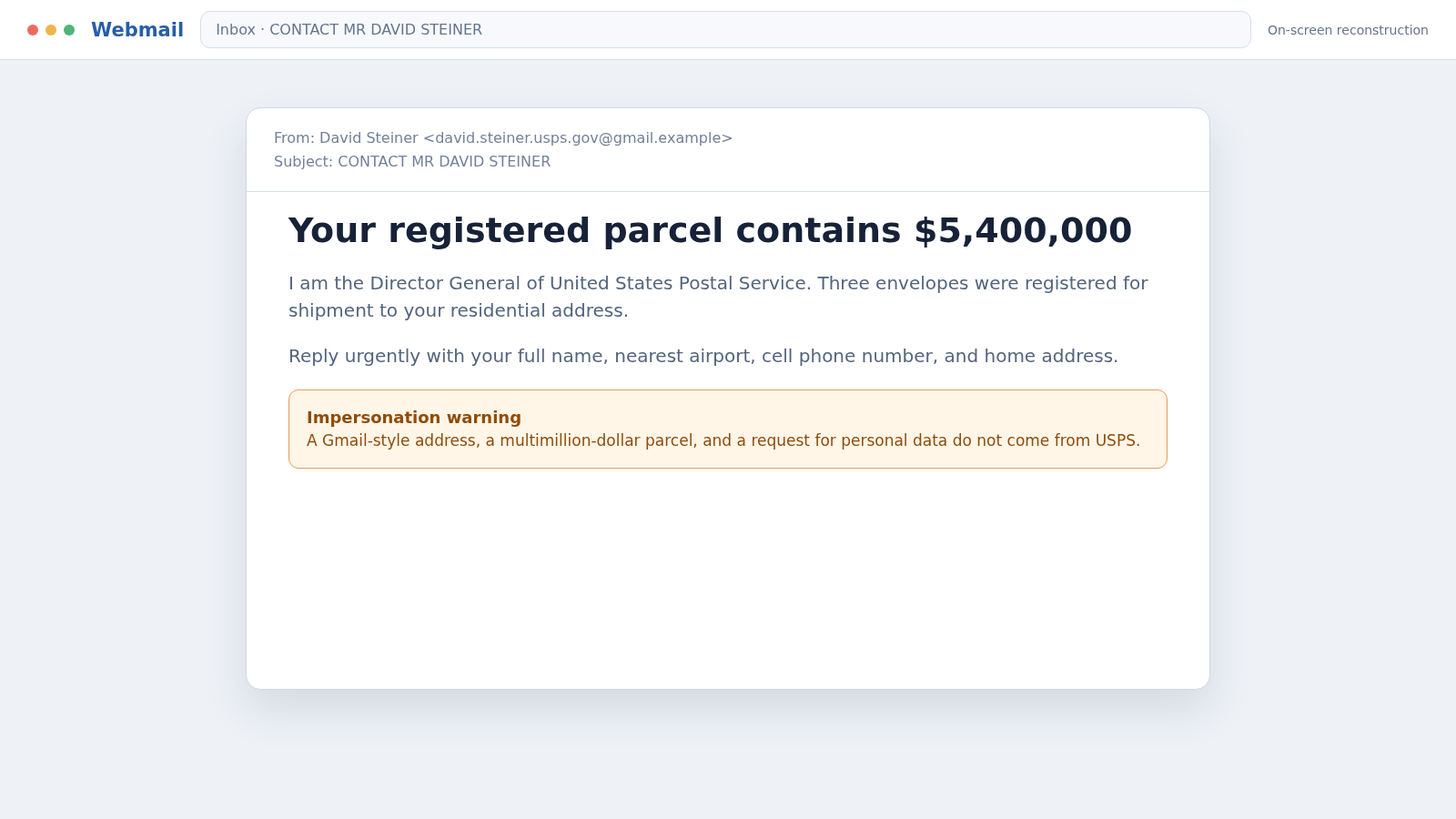
An email signed by “David Steiner” says the United States Postal Service has been holding three registered envelopes for you. Together, they supposedly contain a $5,400,000 money order waiting for delivery.
The David Steiner USPS scam email is written to make an impossible windfall feel like a delayed parcel. Before anything can arrive, the sender wants personal details and a series of invented delivery payments.
Overview
The sender impersonates a senior USPS official
The message introduces David Steiner as the “Director General” of the United States Postal Service. That title is not how USPS identifies its top executive, but it sounds official enough to someone reading quickly.
The email may use an address that places USPS or “gov” inside a Gmail-style username. Words before the final domain do not make a free mailbox a government account.
The parcel supposedly contains $5,400,000
The story says the United Nations and U.S. government registered three envelopes, each worth $1,800,000, for delivery to the recipient’s home. The message never explains why the recipient is legally entitled to that money.
Cash and money-order language turns the promised payout into a shipment. That lets the criminal invent ordinary-sounding courier problems instead of proving a real award, estate, or financial transaction.
Personal information leads to an advance-fee trap
The first reply may request a full name, home address, mobile number, nearest airport, occupation, and identity document. After the victim responds, an insurance or handling fee appears.
Later requests can include:
- Airport handling and diplomatic delivery charges
- Customs, insurance, storage, or security fees
- Passport and driver’s license photographs
- Bank details for the promised money order
- Gift cards, cryptocurrency, or wire transfers
- A signature for a fake delivery certificate
- Remote access to “verify” a banking account
There is no registered package. The millions provide emotional leverage while the scammers collect smaller real payments and identity information.
Why the Message Is Not From USPS
USPS does not email random people to announce that secret money orders worth millions are waiting in envelopes. A genuine shipment has a sender, lawful contents, an actual tracking number, and a delivery process that can be verified through USPS independently.
The title “Director General” is another inconsistency. USPS is led by a Postmaster General, and an executive would not personally contact a recipient through a free email account to arrange a cash windfall.
A username such as david.steiner.usps.gov can be placed before the @ sign of a consumer mailbox. The part after the @ controls the domain. If that part belongs to Gmail or another unrelated provider, the address is not a USPS government account.
The message may ask for the nearest airport even though USPS already delivers to physical addresses. That detail creates room for a fictional diplomatic courier, airport official, or customs officer to join the scheme later.
Unusual capitalization, repeated phrases, and requests for an “urgent respond” are useful clues, but perfect grammar would not repair the underlying contradictions. The money still has no lawful source and the sender still has no verified USPS role.
Do not use a link or telephone number from the email to check the claim. Type the official USPS address yourself or take a real tracking number to a local post office.
How the David Steiner USPS Scam Email Works
Step 1: A bulk “good news” message reaches the inbox
The email is sent to many addresses collected from breaches, websites, and mailing lists. It may be addressed to undisclosed recipients or use a generic greeting because no real parcel record exists.
The subject often says “CONTACT MR DAVID STEINER” or “YOUR REGISTERED PARCEL.” Capital letters make the message look urgent without supplying evidence.
Step 2: USPS and government names create authority
The sender mentions USPS, the United Nations, and the U.S. federal government in the same paragraph. Combining respected institutions makes the story seem larger and harder to question.
No agency contact is independently verifiable. Every route back to the claim is controlled by the person who sent it.
Step 3: The $5,400,000 parcel creates curiosity
Three envelopes supposedly contain $1,800,000 each. Breaking the total into specific amounts gives the fiction the texture of a shipping record.
The message may say a confidential letter is also inside but cannot be discussed by email. That promise keeps the recipient wondering why they were chosen.
Step 4: A reply confirms a responsive target
The criminal first asks for ordinary contact information rather than money. Providing a name, airport, address, and mobile number feels like completing a delivery form.
The reply identifies someone willing to entertain the story and gives the scammer details to personalize future documents and telephone calls.
Step 5: A fake parcel record is created
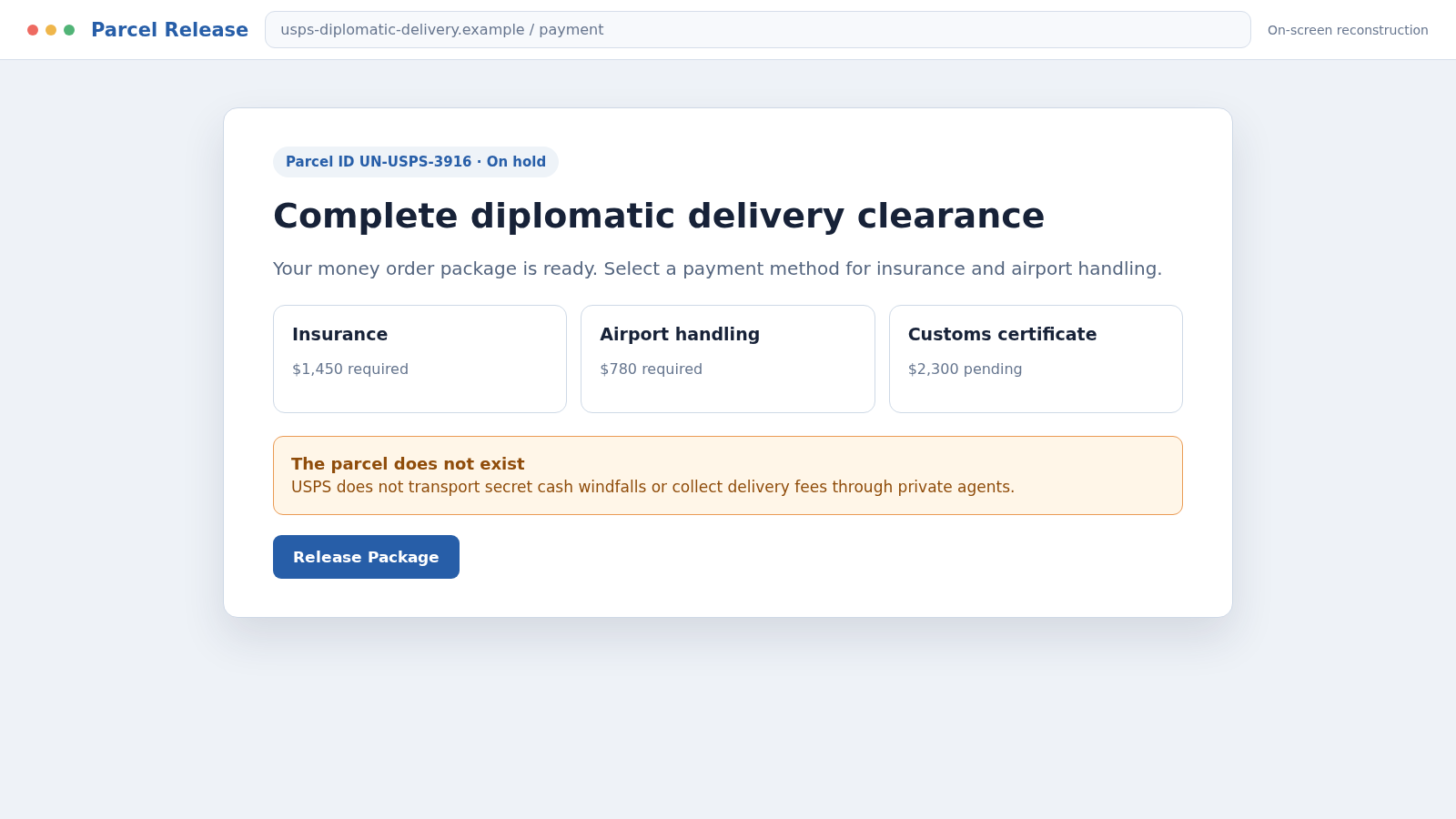
The victim may receive a tracking number, delivery certificate, money-order image, courier identity card, or website login. The parcel appears to move between a vault, airport, customs office, and dispatch center.
These updates are staged. A website controlled by the sender can display any status, and a document with a barcode is not a record inside USPS systems.
Step 6: The first delivery fee is demanded
An agent says insurance, airport handling, anti-terror clearance, or diplomatic paperwork must be paid before dispatch. The amount is tiny compared with $5,400,000, which makes refusal feel irrational.
Payment is often directed to an individual, money-transfer service, gift card, or crypto wallet. Those routes do not resemble a documented USPS transaction.
Step 7: The package repeatedly encounters new holds
After payment, customs supposedly discovers another certificate is missing. Storage charges accumulate, an officer requests a stamp, or the courier needs security escort money.
Each demand is called final. The package stays one payment away because it never existed and therefore can never be delivered.
Step 8: The loss becomes another opportunity for fraud
When the victim stops, the parcel team may threaten confiscation or investigation. Later, a fake postal inspector, lawyer, or recovery agent offers to retrieve the money for another fee.
The identity data can also be reused in loan applications, account takeovers, and more targeted prize or inheritance messages.
Tracking Numbers, Money Orders, and Fake Courier Pages
A real USPS tracking number can be entered at the official USPS site without paying for access. If the number works, compare the route and destination, because scammers sometimes copy tracking numbers from unrelated packages.
A nonworking number does not become valid because a private tracking page recognizes it. The sender may control both the email and that page.
Images of money orders are also easy to fabricate. Do not deposit a payment instrument connected to an unsolicited windfall, and never send part of its apparent value elsewhere.
If a check or money order is deposited, a bank may make funds available before discovering the item is counterfeit. The later reversal can leave the account holder responsible for every payment made from the temporary balance.
Diplomatic-package language is meant to discourage inspection. No supposed immunity requires a private recipient to pay a stranger by gift card or crypto.
A real postal problem can be resolved at a post office or through official customer service. The claim does not need a private Gmail conversation, nearest-airport form, or secret government courier.
Company, Address, and Fulfillment Checks
Inspect the complete sender domain
Read the characters after the @ sign. A government name placed in the username portion does not change who provides the mailbox.
Do not trust the display name or reply-to label. Expand the message headers and preserve them for reporting.
Check USPS through a channel you open yourself
Type the official USPS address into the browser, use the official mobile app, or visit a local post office. Never let the email choose the website or telephone number used for verification.
Ask whether the tracking number exists and whether any fee is actually due. Do not mention sensitive identity or bank details to an unverified caller.
Verify the alleged sender and shipment origin
A real parcel has a sender who can explain why it was sent and a lawful chain of custody. The scam provides government names but no independently documented entitlement to $5,400,000.
Search official leadership information. A mismatched executive title and private mailbox expose the impersonation.
Confirm delivery only through official records
A copied seal, tracking screenshot, courier page, or payment receipt is not fulfillment. The package should exist in USPS’s own system and move without payments to private agents.
Never pay to make a secret money shipment appear. If someone sends an unexpected negotiable instrument, ask your bank to inspect it before depositing or spending anything.
A Safe Way to Check an Unexpected USPS Message
Begin without replying. Write down the claimed tracking number, sender address, subject line, and telephone number. Do not open an attachment merely to find those details, and do not copy a link from the message into a browser.
Open a new browser window and type the USPS site address yourself. Enter only the tracking number. A genuine record should make sense without asking for a password, bank login, identity document, gift card, or private transfer.
Compare the destination and mailing history with something you actually ordered. A valid number can be copied from another person’s parcel, so a result showing movement somewhere in the country does not automatically connect it to you.
If you remain uncertain, visit a post office or call customer service using contact information from the official site. Explain that an email claims money is inside the parcel. That detail helps staff distinguish an ordinary delivery question from an advance-fee scheme.
Do not negotiate with the sender while checking. Every reply gives the criminal another chance to explain away a contradiction, change the tracking story, or create a new deadline.
Delete the message only after saving anything needed for a report. Keeping the original preserves routing details that a screenshot may not show.
What to Do if You Have Fallen Victim to This Scam
- Stop sending money and information. No final customs, insurance, airport, or recovery payment will make the fictional parcel arrive.
- Contact the payment provider immediately. Ask the bank, wire service, card issuer, gift card company, app, or crypto exchange whether the transaction can be frozen or recalled.
- Do not spend a deposited check or money order. Tell the bank’s fraud team the complete story and ask it to examine the item before more funds leave the account.
- Preserve the evidence. Save original emails with headers, attachments, tracking pages, phone numbers, account details, receipts, wallet addresses, and every name used.
- Secure your email. Change the password from a trusted device, remove unknown forwarding rules and sessions, and enable multifactor authentication.
- Protect your identity. Freeze credit and create a recovery plan at IdentityTheft.gov if you shared an SSN, passport, license, or banking documents.
- Report the impersonation. Give USPS Postal Inspection authorities and USPS customer support the sender address, telephone numbers, and payment instructions through official channels.
- Report the financial fraud. File at ReportFraud.ftc.gov and with the relevant police or national cybercrime service.
- Scan devices used to open attachments. Run a complete Malwarebytes scan and uninstall any remote-access application the sender requested.
- Block repeat destinations. AdGuard can stop many reported phishing pages and malicious redirects used in follow-up messages.
- Warn contacts if the mailbox was exposed. Tell them not to trust parcel or money requests sent from your account.
- Reject recovery agents. Work with the payment provider and official investigators, not a stranger who promises guaranteed recovery for another fee.
Frequently Asked Questions
Is David Steiner the Director General of USPS?
No verified USPS role is established by the message, and “Director General” is not the title of the USPS chief executive. The email identity is part of the impersonation.
Could USPS be holding a $5,400,000 parcel for me?
An unsolicited secret-money parcel with no lawful sender or entitlement is not credible. Verify any real shipment using USPS systems you open independently.
Does a USPS-looking Gmail address belong to the government?
No. The domain after the @ sign identifies the mailbox provider. Government words inserted before @ do not turn a consumer email account into an official address.
Why does the email ask for my nearest airport?
The question prepares a fictional diplomatic-delivery story and gives the scammer more personal information. Normal USPS delivery does not need this private arrangement.
What if the tracking page shows my package?
A page controlled by the sender can display any status. Check the number only through the official USPS site or a post office and compare the actual destination.
Can I recover a delivery fee I already sent?
Contact the payment provider immediately and report the fraud. Recovery is not guaranteed, but acting quickly offers the best chance and helps protect connected accounts.
The Bottom Line
The David Steiner USPS scam email disguises a classic advance-fee windfall as a postal delivery. The fictional $5,400,000 parcel gives the criminals endless reasons to request one more handling, customs, or insurance payment.
USPS does not deliver secret government fortunes through private Gmail conversations. Do not reply, pay, or submit identity documents; verify real tracking only through the official postal service and report the impersonation.








