

An unexpected email says your career has earned national recognition. There was no application or interview, yet a committee has selected you for a prominent biography and needs an answer within days.
Who’s Who in America scam emails use flattering language that can make normal caution feel almost impolite. The important question is not whether the praise sounds deserved, but who sent it and what happens next.
Overview
The phrase Who’s Who can describe very different offers
Who’s Who in America is associated with an established biographical publisher, but similar wording can be used by unrelated directories, aggressive marketers, and outright impostors. A familiar phrase in a subject line does not identify the sender.
Some solicitations offer a real listing and optional products. Fraudulent versions copy the prestige, invent a selection committee, or hide the fact that payment is the main purpose of the contact.
Flattery opens the door to data collection and sales pressure
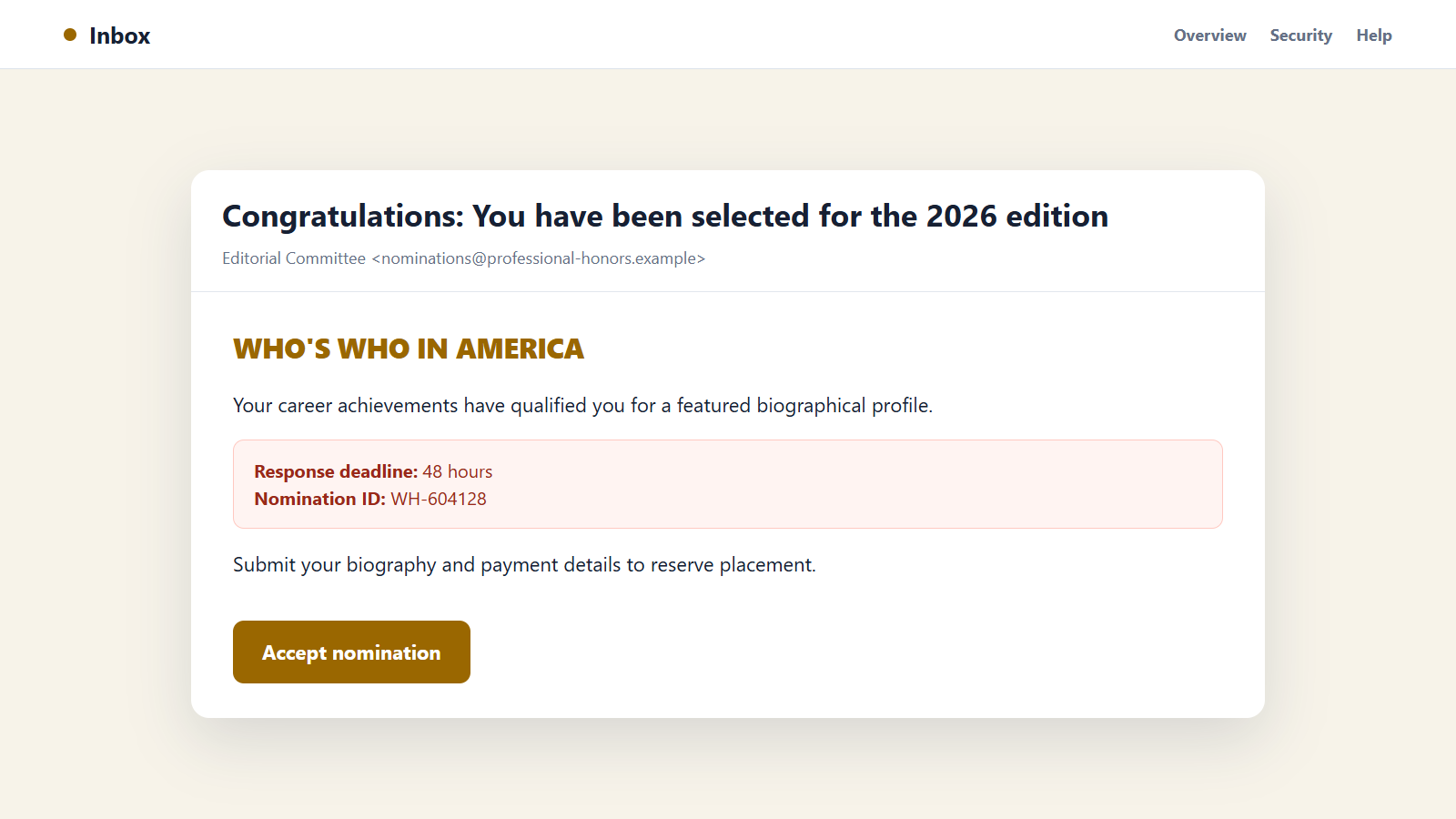
The recipient is told that professional achievements, leadership, or community service led to a nomination. A biography form then requests employment history, education, home address, birth details, references, and payment information.
The conversation may end with expensive plaques, books, memberships, press packages, or directory upgrades. In a phishing version, the form exists mainly to steal identity and card data.
Verification separates a real organization from borrowed prestige
A legitimate company should be identifiable through its own domain, corporate records, published address, clear terms, and independently obtained support channels. The offer should explain what is free and what costs money.
Warning signs include:
- You were selected without a visible nomination or review process.
- The sender domain does not match the organization named in the email.
- A short deadline threatens to remove the honor.
- The form asks for sensitive personal details unrelated to a biography.
- Inclusion is presented as prestigious, then made conditional on payment.
- Prices appear only during a high-pressure telephone interview.
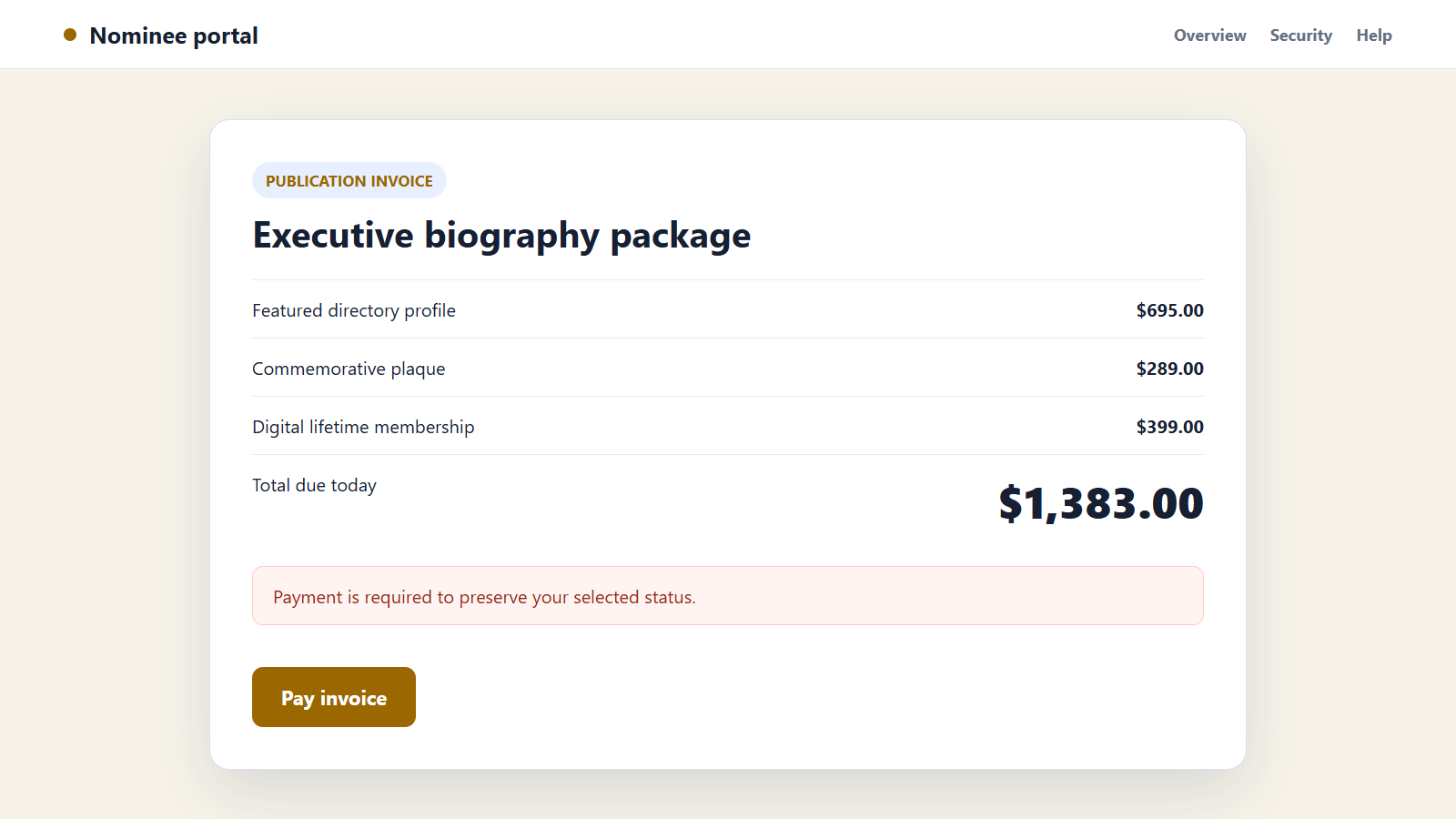
- An invoice arrives for a listing nobody clearly ordered.
- Support avoids written terms, refunds, circulation, or audience figures.
Do not reject or accept the offer based on the name alone. Verify the exact company, product, and contract before providing a biography or card.
Legitimate Publication, Vanity Offer, or Impostor Scam?
These categories can look similar at first, yet they create different risks. A genuine publisher may research and select biographical subjects while separately selling optional commemorative products.
A vanity publication may provide the promised listing but rely on broad nominations and emotional sales tactics. The product exists, though its independent professional value may be far smaller than the marketing suggests.
An impostor borrows another organization’s name, logo, history, or publication title. Its form, invoice, and payment account lead to a different operator.
A directory invoice scam can begin with a call that sounds like a free confirmation. Later, the business receives a bill and is told that an employee already authorized the listing.
The FTC describes directory listing scams in which a business is told a listing is free or merely being renewed, then receives a bill for something it never agreed to buy.
Marquis Who’s Who states on its official publication page that qualified listees are entitled to a complimentary listing and are not required to buy commemorative products. That policy gives recipients a concrete point to verify directly.
The safest conclusion is precise: an unexpected nomination is not automatically fraudulent, and it is never automatically valuable. Both identity and terms must be checked before the recipient commits.
How Who’s Who in America Scam Emails Work
Step 1: Professionals are selected from public information
Scammers and mass marketers collect names, job titles, company biographies, licences, awards, and email addresses from professional networks, conference pages, business directories, and public records.
The resulting message can mention a real position or achievement. Personalization makes a broad campaign look like careful editorial research.
Step 2: A prestigious nomination creates curiosity
The subject announces selection for a national edition, leadership registry, executive honor, or lifetime achievement award. The recipient is invited to accept recognition rather than evaluate a sales offer.
The email may cite a long publishing tradition or imply that peers nominated the recipient. Those claims can be copied from a real organization or invented without evidence.
Step 3: A deadline discourages outside research
The biography must be submitted within 48 hours, a place is about to close, or the editor needs an immediate interview. The supposed honor becomes scarce.
Real editorial schedules exist, but a respectable organization can answer written questions about identity, terms, and costs. Verification should not cancel a deserved recognition.
Step 4: The biography form gathers valuable data
The form asks for work history, degrees, associations, publications, addresses, telephone numbers, family details, and references. Some of that may be relevant to a biography, while some can support identity fraud.
A phishing page may also request an email login to save progress or verify professional status. That password can expose business correspondence and reset other accounts.
Step 5: A congratulatory interview becomes a sales call
The interviewer praises the recipient’s accomplishments, confirms the profile, and then introduces plaques, books, digital memberships, press releases, or enhanced placement.
Prices may be framed as a contribution, processing charge, preservation fee, or one-time opportunity. The emotional high of being selected makes declining more difficult.
Step 6: Payment terms remain deliberately unclear
The salesperson may describe a total quickly, divide it into instalments, or ask for a card before sending written terms. Optional products can sound necessary to preserve inclusion.
In a pure scam, the card is charged by an unrelated merchant or enrolled in recurring billing. A fake checkout may claim failure and invite repeated submissions.
Step 7: A listing, certificate, or invoice supplies apparent proof
The victim may receive a digital badge, profile page, certificate, or invoice. Existence alone does not prove the promised audience, editorial review, or professional benefit.
Another version sends an invoice after a supposed verification call. The sender claims a recording proves consent, even if the employee only confirmed contact information.
Step 8: Collection pressure and follow-up offers continue
Recipients who resist may face repeated calls, overdue notices, or threats to damage credit. Those who paid may be offered higher tiers, renewal, distribution, or publicity packages.
Personal and professional data can also support targeted phishing. A later message may impersonate a colleague, association, publisher, or award program.
Questions to Ask Before Accepting a Nomination
Ask who nominated you and which published criteria were used. A refusal to describe the selection process weakens claims of independent recognition.
Request the exact legal company name, publication title, edition, expected release date, format, circulation, and audience. Marketing phrases such as global exposure are not measurable answers.
Ask whether inclusion is free and whether declining products affects the profile. Get the answer in writing before any sales conversation.
Request an itemized price list for books, plaques, memberships, digital profiles, publicity, shipping, renewal, and cancellation. Avoid giving a card simply to hold a place.
Ask how the biography will be edited, verified, corrected, removed, and licensed. Personal details can remain online long after the physical book is forgotten.
Search libraries, independent catalogues, professional associations, and the publisher’s actual database to understand where the work is used. Testimonials selected by the seller are not independent evidence.
Contact the organization from an address or number you found yourself. Forward the solicitation to official support and ask whether the sender, domain, nomination ID, and product are genuine.
Finally, decide whether the product has value without the flattering title. A plaque or profile should be evaluated like any other purchase, with price, terms, audience, and refund rights.
Ask whether the publisher can provide a sample contract before the interview. Reading it without a salesperson on the line makes recurring fees, arbitration terms, licensing rights, and cancellation deadlines easier to notice.
Check the card descriptor in advance. If the organization says another legal entity will process payment, request the relationship in writing and verify that company too.
Speak with your employer before submitting a workplace biography. Company policy may limit the use of titles, logos, client names, internal achievements, or contact lists in outside publications.
Search the exact telephone number, sender domain, legal name, and invoice wording. Repeated complaints are useful leads, but compare them with the contract and official response rather than treating any single review as decisive.
Company, Address, and Fulfillment Checks
The legal company must match the name in the message
Compare the sender, invoice, card descriptor, privacy policy, and contract. Several organizations can use similar directory language, and an impostor can borrow a real publication title.
Verify the company through its independently found website and corporate records before sending identity documents or payment.
The address and contact details must be independently verifiable
Check whether the address belongs to the stated publisher and whether official support recognizes the employee. A virtual office or mailbox is not automatically fraudulent, but it requires stronger evidence.
Call the number published on the verified site, not the one in the nomination. Ask support to locate the invitation without coaching them with every answer.
The contract must separate inclusion from optional products
Written terms should show whether the profile is free, which items cost money, when charges recur, and how cancellation works. Oral praise should not replace a clear order.
Do not agree to a bundle whose parts, prices, delivery dates, and refund rules are still unknown.
The promised publication must be observable
Ask where the profile will appear, who can access it, when the book ships, and how corrections are handled. Confirm fulfillment after the stated date.
A badge created immediately by the same sales portal does not prove independent editorial recognition or the audience promised in the pitch.
Warning Signs in a Nomination or Directory Invoice
- The praise could apply to almost any professional.
- The sender cannot identify the nominator or selection criteria.
- The domain differs from the publisher named in the message.
- A card is required before written prices are provided.
- Optional products are described as necessary for inclusion.
- The salesperson will not allow time to review the contract.
- An invoice refers to a free confirmation call as an order.
- The promised audience cannot be measured or independently found.
Flattery is not evidence of fraud, but it should never be the evidence that overrules missing terms, mismatched identities, or unexplained charges.
What to Do if You Have Fallen Victim to This Scam
- Stop further payments and sales calls. State in writing that you dispute unauthorized charges or misleading terms. Do not provide another card for a supposed refund.
- Contact the card issuer or bank. Explain what was promised, what was delivered, and whether the company identity was false. Ask about charge disputes and recurring-payment blocks.
- Preserve the complete offer. Save the email headers, nomination form, contract, invoice, receipt, web address, recordings, employee names, and screenshots of product claims.
- Contact the real publisher if it was impersonated. Use independently found support details and provide the fake sender domain, telephone number, payment account, and copied materials.
- Withdraw unnecessary personal data. Ask the operator in writing to remove information where applicable. Review the privacy terms and document the request.
- Change exposed passwords. If the biography portal requested an email or social login, replace it from the real service, end unknown sessions, and enable multi-factor authentication.
- Protect business processes. Tell accounting staff that the invoice is disputed and require written purchase approval before any related bill is paid.
- Report deceptive directory billing. File with the FTC at ReportFraud.ftc.gov, your state attorney general, postal inspector when mail was involved, and local authorities when appropriate.
- Scan files from the message. Run a full Malwarebytes scan if you downloaded a nomination form, attachment, browser extension, or application.
- Block known malicious pages. AdGuard can reduce exposure to known phishing sites, trackers, and deceptive advertisements. It cannot evaluate the value of a real publication.
- Monitor identity and company accounts. Watch for new invoices, password resets, credit applications, vendor changes, or messages using details from the biography.
- Reject paid recovery offers. A stranger who promises to erase the listing, repair credit, or recover every charge for an upfront fee may be another scammer.
Frequently Asked Questions
Is every Who’s Who invitation a scam?
No. Established publishers and other real directories exist. Verify the exact legal entity, domain, selection process, price, and product instead of judging only the phrase.
Should a legitimate listing require payment?
Policies vary, but payment should never be hidden. Ask whether basic inclusion is free and whether purchases are optional, then get the answer in writing.
Why did the email know my job title?
Professional details are often public on company pages, networks, conference programmes, licences, and biographies. Correct data does not prove editorial selection.
Is a plaque proof that the honor is meaningful?
No. A plaque proves that an item was produced. Evaluate the selection criteria, publisher, audience, and independent recognition separately.
Do I have to pay an invoice for a listing I never ordered?
Do not ignore legal documents, but dispute an unauthorized invoice promptly and request the contract or purchase record. Seek legal advice for persistent collection threats.
Can I safely submit a biography without buying anything?
Only after verifying the organization and understanding how the information will be stored, published, shared, licensed, corrected, and removed.
The Bottom Line
Who’s Who in America scam emails use professional recognition as the emotional wrapper for impersonation, phishing, hidden sales terms, or directory invoices that were never clearly authorized.
Pause before accepting the praise. Verify the exact sender, separate free inclusion from paid products, demand written terms, and judge the offer by what will actually be delivered rather than how important it makes you feel.

Join the discussion
0 commentsShare your experience or ask a question about this article.
Discussion
Start the conversation
Have a question or something useful to share? Add the first comment.