

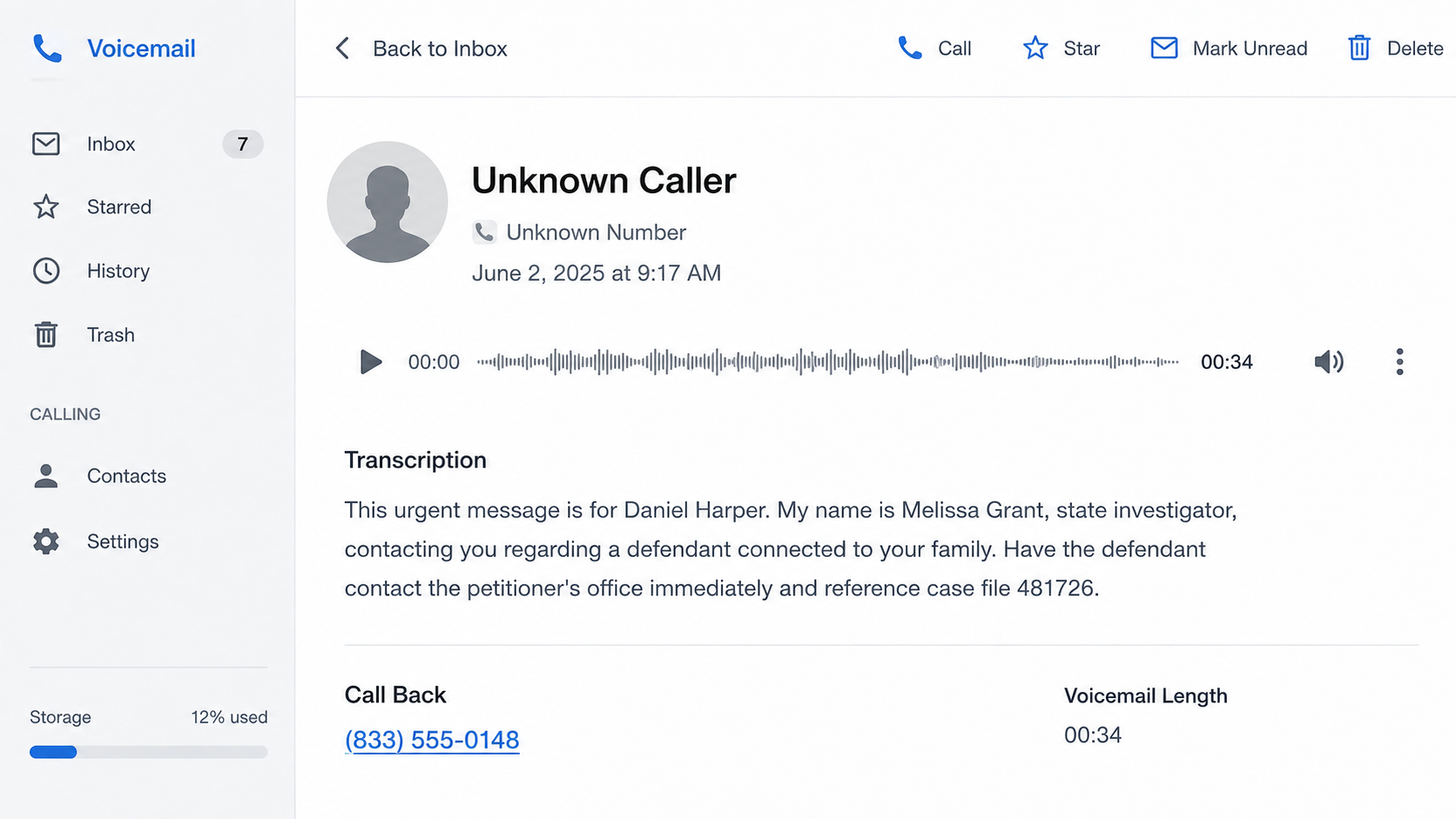
The voicemail does not accuse you directly. A fast-talking “state investigator” says a parent, former spouse, or other relative is a defendant and must contact the petitioner’s office before legal documents are processed.
The state investigator voicemail scam adds a case number, a toll-free callback line, and just enough legal language to make ignoring it feel dangerous.
The vagueness is not an accident. It is the hook.
Overview
The message uses a relative’s name to create panic
The state investigator voicemail scam begins with an unexpected message for someone connected to you. The caller may name your mother, father, spouse, ex-partner, sibling, or a person who merely shares your surname.
The speaker identifies herself as a “state investigator,” “county investigator,” or “case investigator” without clearly naming the agency, state, court, badge number, or allegation. You are told to have the “defendant” contact a petitioner’s or plaintiff’s office and quote a six-digit file number.
Contacting a relative instead of the supposed defendant serves two purposes. It creates a family emergency, and it gives the scammer another person who may pressure the target to call before checking the story.
Legal-sounding words hide the absence of real details
“Petitioner,” “processing,” “service,” “release of order,” and “statement on file” sound official when delivered quickly. Yet the message often never identifies a real court, case caption, public docket, law-enforcement agency, or licensed law firm.
The callback number may answer as a “legal department.” An operator then claims charges, a civil complaint, a warrant, or document service can be paused if the defendant cooperates. Personal details from data brokers or leaked records are used as proof that the file is real.
Official warnings establish the broader impersonation pattern. The California Department of Consumer Affairs has documented multiple schemes in which callers pose as agency employees or investigators, spoof official numbers, threaten suspension or arrest, and demand money or personal information.
A BBB Scam Tracker report illustrates the specific family-member variation: a caller claiming to be a state investigator, felony threats involving an ex-husband, and a callback line answering as a legal department.
The call ends in payment or identity theft
The first voicemail may not mention money. That omission is deliberate because a vague callback request feels less like a scam than an immediate demand for gift cards.
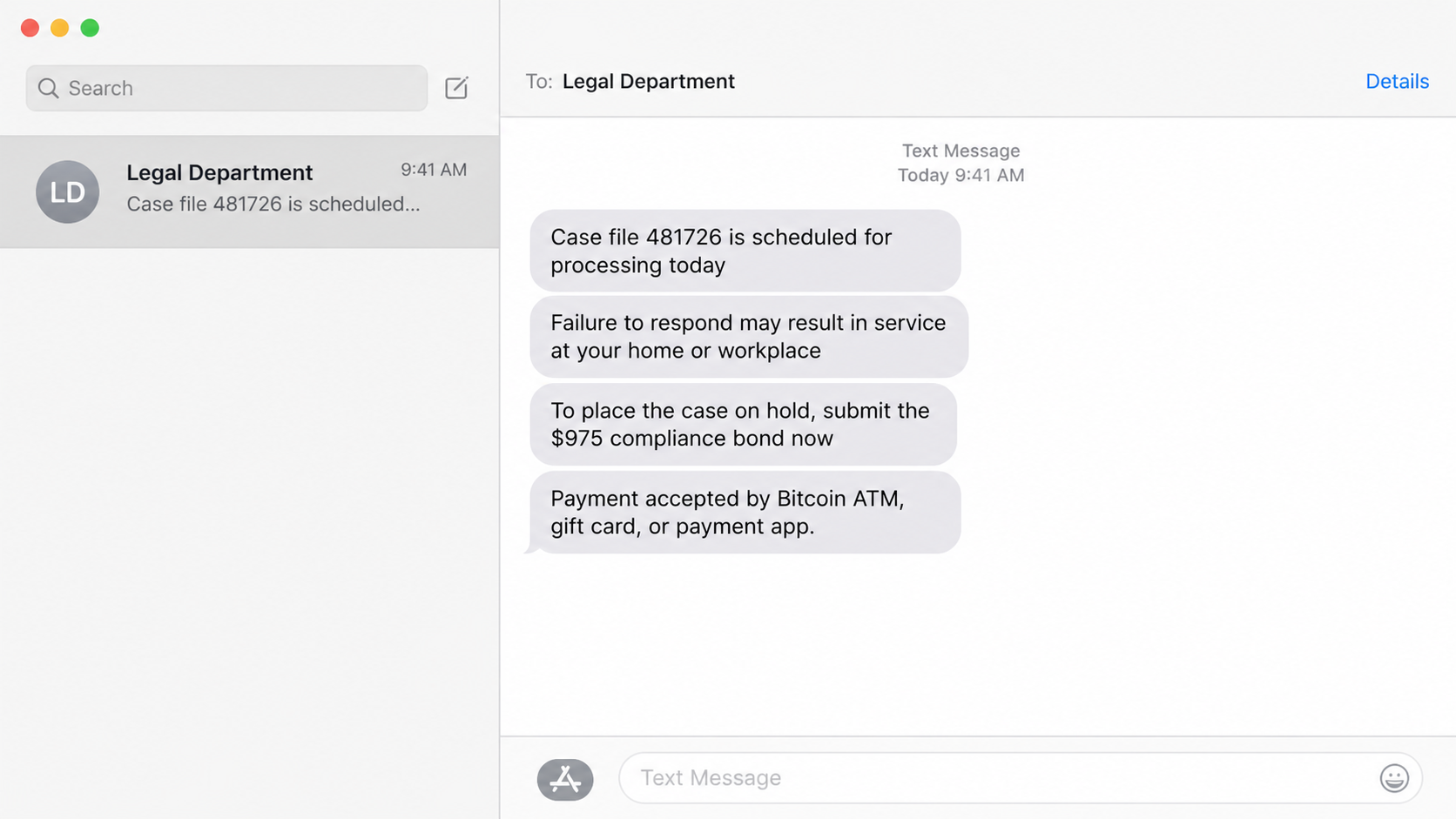
Once the target calls, the operator can demand a “compliance bond,” settlement, processing fee, bail payment, or transfer to stop service at home or work. Other versions collect a Social Security number, date of birth, bank details, or copies of identity documents.
Warning signs include:
- The caller uses the title “state investigator” without naming a specific agency.
- A relative or associate is contacted instead of the supposed defendant.
- The message uses “petitioner’s office” or “plaintiff’s office” but gives no court.
- A generic six-digit case file is presented as proof.
- The caller threatens service at home or work if nobody responds immediately.
- The callback line answers as a legal department with a different name.
- The operator refuses to provide a mailing address, court docket, or verifiable credentials.
- Payment will supposedly place the matter on hold.
- Gift cards, cryptocurrency, a payment app, cash, or wire transfer are requested.
- You are told not to contact police, an attorney, the court, or family.
How the State Investigator Voicemail Scam Works
Step 1: Public and leaked data identify family connections
Names, phone numbers, addresses, relatives, and former spouses can be collected from people-search sites, public records, old marketing databases, or breached data. The scammer does not need a real case file to know who your mother is.
A partially correct family link is often enough. If the caller reaches the wrong person with the same surname, anxiety may still push that person to return the call and reveal more.
Step 2: A vague investigator leaves a polished voicemail
The message is often pre-recorded or read from a script at high speed. It identifies the caller by name and title, drops the relative’s full name, and provides a case number.
What it avoids is more important: a real agency name, office address, court, judge, docket, and independently published callback route. The message gives just enough structure to sound urgent while remaining reusable across many targets.
Step 3: The family member carries the threat forward
The recipient calls the named relative and repeats that an investigator is looking for them. Now the warning comes from someone trusted, not only from an unknown number.
This social pressure can be powerful. The relative may say, “Call them just in case,” which is exactly the response the operator intended.
Step 4: The callback line changes the story
A “legal department,” “case resolution unit,” or supposed law office answers. The operator asks for the file number, confirms names and addresses, then reveals a more serious accusation than the voicemail contained.
Different targets may hear about unpaid loans, fraudulent checks, identity theft, civil complaints, or felony charges. The case is tailored in real time from the information the caller collects.
Step 5: Immediate consequences are threatened
The operator says documents will be served at work, police will be dispatched, a warrant will activate, wages will be seized, or the case will be filed that day. A timer converts uncertainty into action.
The FTC warns that real law enforcement does not call to threaten arrest or demand payment by cash, gift card, cryptocurrency, payment app, or wire transfer to make a crime disappear.
Step 6: Payment is framed as cooperation
The criminal may avoid the word “fine.” Instead, the money becomes a bond, settlement, restitution hold, processing amount, or refundable verification. Changing the label does not make it lawful.
Victims may be kept on the phone while traveling to a store, bank, or Bitcoin ATM. They are told not to discuss the matter because the investigation is confidential.
Step 7: The file expands after the first payment
Once a target pays, a second charge may appear for another count, a release document, taxes, or an error in the first transaction. The operator knows that someone who paid under pressure may pay again to protect the first amount.
If identity details were collected, they can also be used for account access or sold to other criminals. Follow-up recovery calls may claim a government fund can return the money after one final fee.
How to Verify a Real Legal or Government Contact
Do not call the number in the voicemail. Write down what was said, then search for the named agency or court independently. Use a government website ending in .gov when appropriate and call its published public number.
Ask whether the caller’s name, unit, and case number exist. A clerk may not discuss every detail, but they can tell you how genuine notices are delivered and how to verify a docket.
If the message claims to come from a law firm or debt collector, obtain the full legal name, physical mailing address, and written validation through channels you independently verify. Do not provide a Social Security number simply so a cold caller can “find the file.”
The California agency’s advice for these calls is straightforward: end the conversation and contact the board or department directly, even when caller ID appears genuine.
Caller ID, personal details, and a confident voice are not verification. A real matter survives a callback through an official switchboard. A fraudulent script depends on keeping you inside the number it supplied.
What the Voicemail Carefully Avoids Saying
Listen for nouns without names. “The state,” “the department,” “the petitioner,” and “the case” sound formal, but none identifies an institution you can check. A genuine contact should not become less specific each time you ask who is calling.
The message may also avoid a direct payment demand. That keeps the voicemail from sounding like familiar gift-card fraud and encourages you to make the first move. Once you call back, the operator knows you are concerned and can build the payment story around your reaction.
Another omission is a safe written route. The caller may claim documents are about to be served but refuse to send a notice containing the court, parties, allegations, and response instructions. A threat is not converted into legal process by adding a reference number.
Be careful not to reveal the missing details yourself. If you ask, “Is this about the old loan from North Valley Credit?” the operator can immediately agree and repeat that name. Ask the caller to state the information without hints, then verify it elsewhere.
A legitimate debt collector, lawyer, process server, or investigator is not automatically fraudulent because they call. What makes this campaign dangerous is the reusable vague script followed by unverifiable threats, sensitive-data collection, or payment to stop consequences.
If the contact is genuine, independently calling the real organization will not make the matter disappear or become worse.
Relatives should follow the same rule. Pass along the recording, but do not tell the named person that the “case” has already been verified. The family’s concern is evidence that the manipulation worked, not evidence that the allegation is real.
Company, Address, and Fulfillment Checks
Demand the exact agency or legal entity
“State investigator” and “legal department” are descriptions, not traceable identities. Record the full entity name, department, physical address, and jurisdiction without confirming personal information.
Find the contact route yourself
Use an official government or court website, bar directory, or licensing database. Do not trust a website or phone number dictated by the caller.
Verify the case independently
Ask the real court clerk or agency how to check the docket or notice. A random file number has no evidentiary value until the institution named in the story confirms it.
Refuse payment as proof of cooperation
No legitimate investigator needs a gift card, Bitcoin ATM receipt, or payment-app transfer to delay arrest or document service. End the call if money is tied to avoiding immediate consequences.
What to Do if You Have Fallen Victim to This Scam
- End the conversation. Do not call back, argue, or stay on the line while traveling to make a payment.
- Contact the payment provider immediately. Report the transaction as scam-induced and ask whether it can be frozen, recalled, or disputed.
- Notify your bank or card issuer. Replace exposed cards or accounts and review recent activity for tests and follow-up charges.
- Report gift cards quickly. Contact the issuer using the number on the card, keep the card and receipt, and give the details to law enforcement. Do not send photos to anyone else.
- Report cryptocurrency details. Save the wallet address, ATM receipt, transaction ID, and exchange account. Contact the exchange or ATM operator immediately, though recovery is not guaranteed.
- Protect exposed identity data. If you disclosed a Social Security number, use IdentityTheft.gov for a recovery plan and consider fraud alerts or a credit freeze.
- Verify the legal claim separately. Call the real court, agency, or law firm using a published number. Tell relatives not to use the callback line.
- Preserve evidence. Save the voicemail audio, transcription, caller ID, callback number, names, file number, messages, and receipts.
- Scan after links or downloads. If the operator sent a document, app, or portal, update the device and run a full Malwarebytes scan.
- Use blocking as a second layer. AdGuard can stop many known phishing or malicious-ad pages, but it cannot determine whether a voice on a phone call is an investigator.
- File reports. Report government impersonation to the FTC at ReportFraud.ftc.gov and to local law enforcement. Report spoofed calls to the FCC where appropriate.
- Reject recovery promises. A new caller who knows about the loss may be using information shared by the first crew.
Frequently Asked Questions
Can a real investigator leave a voicemail?
Yes, legitimate investigators can call. The scam is identified by the unverified identity, vague agency, pressure, threats, and demand for money or sensitive information. Verify every unexpected contact through an independently published number.
Why did the caller know my relative’s full name?
Family links are widely available through public records, people-search databases, social media, and breached data. Knowledge of a name is not proof of a case.
Is an 833 number automatically suspicious?
No. Legitimate organizations use toll-free numbers. The issue is that anyone can obtain one, so it must be matched to an official entity through a source the caller did not provide.
Would a court warn me before serving papers?
Procedures vary by jurisdiction, but a demand to pay an unknown caller to stop service is a major warning sign. Ask the court clerk or a qualified local attorney through independently verified contact details.
Should I give the caller my date of birth to find the file?
No. Do not supply sensitive identity data to an unsolicited caller. A real agency can explain a safe verification method after you contact it through its official channel.
What if the caller ID shows a government office?
Caller ID can be spoofed. End the call, find the office’s number on its official website, and dial it yourself.
The Bottom Line
The state investigator voicemail scam makes uncertainty feel like a legal deadline. A relative’s name, a case number, and a string of courtroom words can sound impressive while proving nothing.
Do not let the callback number verify itself. Contact the named institution through its official public route, refuse payments tied to threats, and give the vague “file” no more authority than the facts support.

Join the discussion
0 commentsShare your experience or ask a question about this article.
Discussion
Start the conversation
Have a question or something useful to share? Add the first comment.