

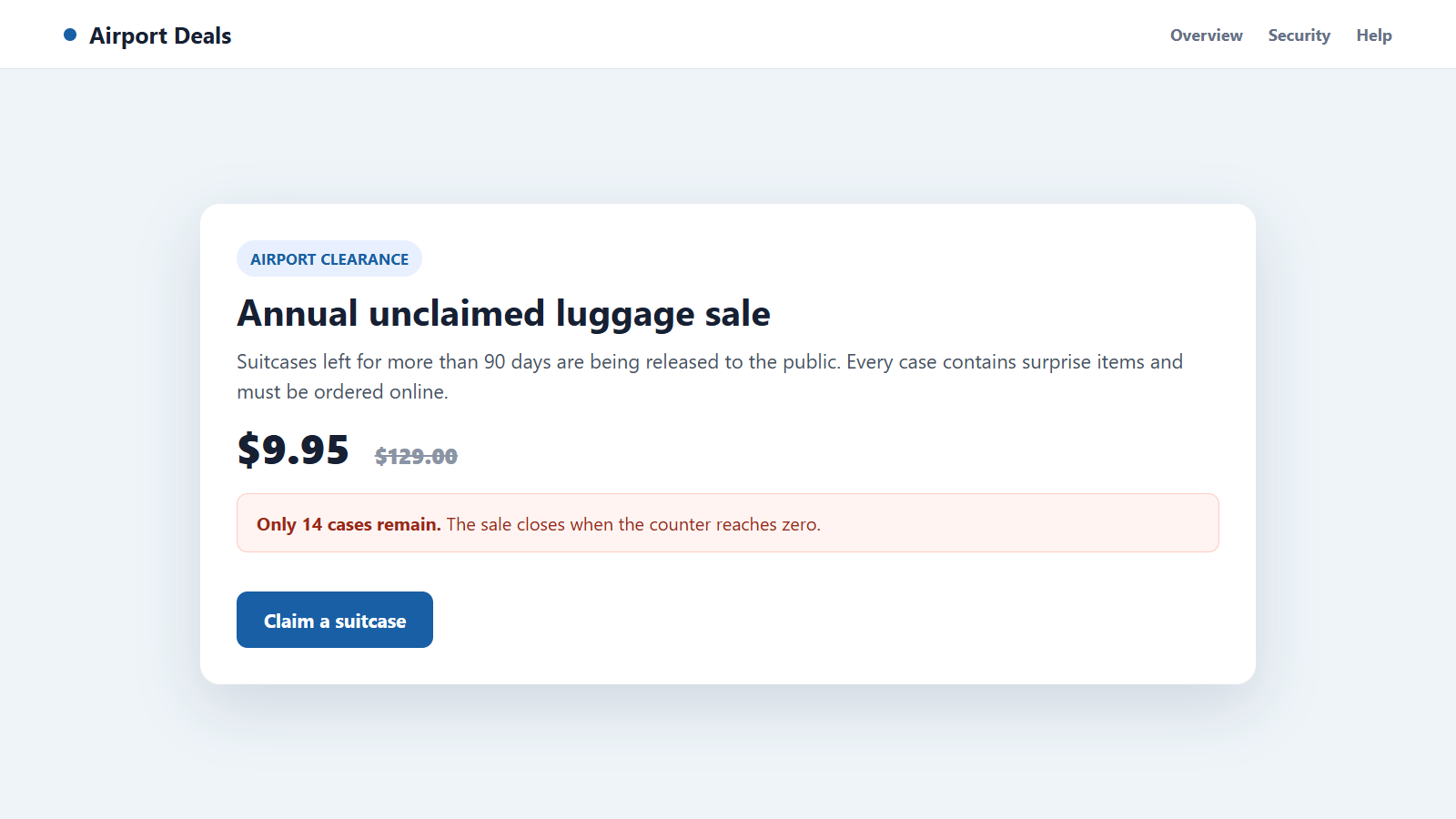
The post looks like an airport clearing space in a crowded baggage room. For less than the price of lunch, it promises a sealed suitcase filled with whatever its owner left behind.
An unclaimed luggage sale scam turns that little mystery into a remarkably effective trap. The offer feels unusual but plausible, and the countdown leaves just enough time to act before common sense catches up.
Overview
The offer borrows an airport’s name and authority
Fraudulent posts claim that an airport, airline, or baggage company must dispose of suitcases that were never collected. The supposed clearance is presented as an annual event or a warehouse emergency.
The airport name is familiar, so the post gains instant credibility. A copied logo, terminal photograph, and official-sounding page title can make a recently created social account seem established.
The mystery-bag price is deliberately easy to risk
A suitcase may be advertised for $9.95, $12.99, or another small amount. The low price shifts attention away from verification and toward the imagined electronics, jewelry, clothing, or travel gear inside.
The real target is often the payment card and personal data, not merely the advertised charge. A cheap checkout can lead to repeat billing, unauthorized purchases, or more tailored fraud.
Nothing proves that real luggage will be delivered
The checkout may issue an order number and confirmation email, yet no legitimate airport inventory is connected to it. Victims may receive nothing, a worthless item, or a tracking page that never reaches delivery.
Common warning signs include:
- A newly created page speaks as if it were an airport’s official account.
- Every suitcase has the same tiny price despite supposedly unknown contents.
- Comments repeat generic praise or appear to come from copied profiles.
- A counter says only a few bags remain, then resets when the page reloads.
- The website address has no connection to the airport’s real domain.
- The checkout requests card data before explaining ownership or sale rules.
- There are no collection terms, auction records, or traceable seller details.
- The offer is available worldwide even though it claims to clear local baggage.
Do Airports Really Sell Unclaimed Luggage?
Lost baggage does exist, but the recovery process is not a casual social-media giveaway. Airlines, handling agents, security teams, customs authorities, and airport lost-property offices follow procedures designed to reconnect items with owners.
What happens after the retention period varies by airport and jurisdiction. Property may be donated, recycled, destroyed, transferred to a contractor, or sold through a documented auction channel.
A legitimate disposal arrangement does not make every viral suitcase offer genuine. The decisive question is whether the named airport publicly confirms the exact sale through a website or verified account it controls.
Prague Airport has issued an official warning about fraudulent Facebook accounts offering lost baggage for sale. The airport explained that unclaimed suitcases are rare and that the fake pages were not connected to it.
The Cayman Islands Airports Authority also warned about a fake annual unclaimed-baggage sale. Its public alert directed travelers to official airport channels for genuine announcements.
These warnings expose the central trick. Criminals take a real concept, property that occasionally remains unclaimed, and attach it to a fictional direct-sale process.
The result feels more believable than an ordinary giveaway. A buyer may think the airport is simply recovering storage costs, even though the linked store provides no evidence that it owns a single suitcase.
How the Unclaimed Luggage Sale Scam Works
Step 1: Scammers create an airport-themed social page
The operation begins with a page named after a real airport, terminal, airline, or baggage office. The profile may copy branding and public photographs from the genuine organization.
Some pages are only days old. Others are older accounts that were renamed, purchased, or taken over, which lets the operator display an earlier creation date.
Step 2: A sponsored post announces a clearance
The advertisement says storage is full or a legal retention period has ended. It offers sealed suitcases to local residents as part of an anniversary, warehouse clearance, or recycling campaign.
Paid promotion can place the post in front of people who recently searched for flights or travel. Seeing it among ordinary travel content makes the claim feel less random.
Step 3: Curiosity is reinforced with staged comments
Replies show supposed buyers praising designer clothing, headphones, cameras, or cash found in their cases. Photographs may be stolen from unrelated unboxing posts or online listings.
Critical comments can be hidden while fake questions receive friendly answers. The conversation creates the impression that other buyers already verified the offer.
Step 4: Scarcity pushes the visitor toward checkout
A timer, stock counter, or same-day deadline says the opportunity is disappearing. The website may claim that the airport releases only one suitcase per household.
That rule makes the low price appear fair rather than absurd. It also discourages visitors from waiting while they search the airport’s real website.
Step 5: A short survey builds commitment
Before the sale page appears, the visitor may answer questions about age, location, travel habits, or preferred suitcase size. None of this proves eligibility.
The survey makes the promotion feel selective and can collect marketing data. After several clicks, the buyer is more likely to finish because the process already feels underway.
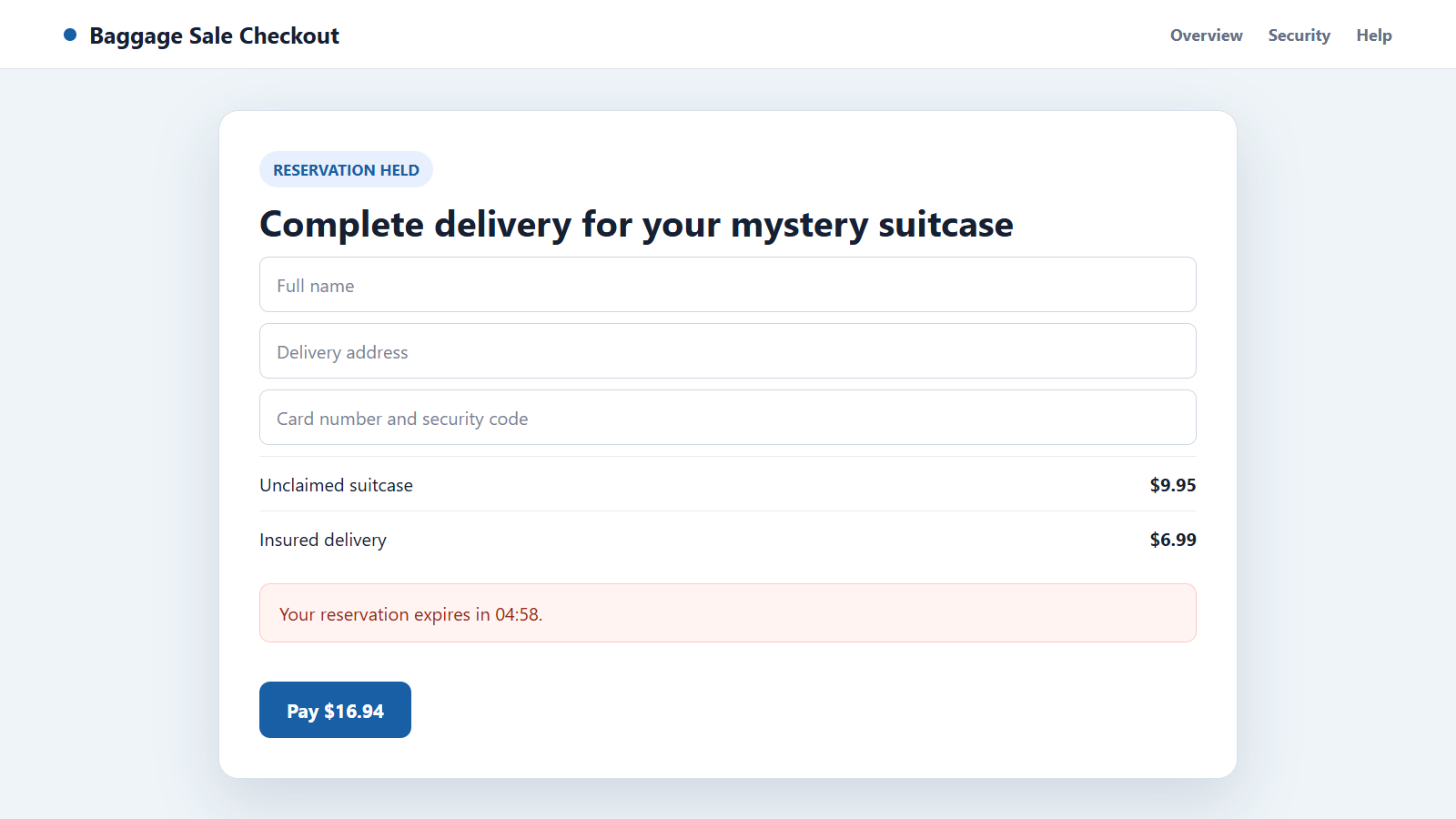
Step 6: The checkout captures payment and identity data
The page requests a full name, delivery address, email address, telephone number, and card details. A small shipping or insurance fee may be added near the final button.
Some checkouts hide a recurring membership in faint terms. Others deliberately return an error so the buyer submits a second card, giving criminals two sets of payment details.
Step 7: A fake fulfillment trail delays complaints
The buyer receives an order confirmation and a tracking code. The tracking page may cycle through labels such as processed, transferred, or awaiting local carrier.
Each update buys time while the payment settles and the website moves elsewhere. Customer service responds with templates or asks for another customs fee.
Step 8: The victim is targeted again
Card data can support unauthorized purchases, while the contact details feed new delivery, travel, and refund scams. A caller may later claim to investigate the original order.
That follow-up can be more convincing because the criminal knows the amount, date, product, and email used. A fake recovery agent then asks for another payment or security code.
Why the Fake Sale Looks So Convincing
The story contains just enough truth to survive a quick glance. Travelers know bags are lost, airports have storage limits, and abandoned property must eventually go somewhere.
The scam fills the unknown part of that process with a simple retail story. It never explains who acquired legal title, removed protected contents, or authorized online shipment.
Low pricing also changes the buyer’s risk calculation. People who would investigate a $500 purchase may accept a $10 mystery order as harmless entertainment.
Social proof does the rest. A lively comment section can feel more immediate than a formal policy page, even when every enthusiastic account is controlled by the seller.
Airport names are especially useful because travelers associate them with security and government oversight. The borrowed reputation quiets concerns that would be obvious on an unknown shop.
The simplest test is independent confirmation. Leave the advertisement, find the airport’s official website yourself, and search its news and lost-property pages for the advertised sale.
How to Verify an Airport Luggage Offer Safely
- Open the airport website from a trusted search result or saved address.
- Check its official social-account links instead of trusting a blue badge image.
- Ask the lost-property office whether it operates the advertised program.
- Search the exact wording of the promotion and the checkout domain.
- Review the page’s creation date, earlier names, and posting history.
- Reverse-search promotional photographs when they seem familiar.
- Read the full checkout terms before entering any personal information.
- Do not rely on comments, reaction counts, or a padlock icon as proof.
A verified social page helps, but it should not be the only check. Accounts can be compromised, and advertisements can falsely display a familiar organization in the creative.
Call a number published on the airport’s own domain. Do not use the contact details in the sale post, its comments, or the linked store.
If an airport genuinely uses an auction company, its website should name that contractor. Open the contractor through the airport’s link and review the auction rules before registering.
Real auctions usually identify the seller, location, inspection terms, taxes, buyer fees, collection method, and legal conditions. A mystery checkout that promises worldwide delivery offers none of that accountability.
Company, Address, and Fulfillment Checks
The seller must identify its legal business
Look for a complete company name, registration details, support channel, and terms that name the contracting party. A generic airport-deals label is not enough.
Compare that identity with public business records where available. If the listed entity sells unrelated products or does not exist, stop before payment.
The return address must be real and relevant
Map the address and check whether it belongs to the named seller. A residence, mailbox, empty lot, or unrelated office does not demonstrate access to airport property.
An airport logo beside an overseas return address should raise immediate questions. The seller must explain how it obtained, inspected, and exported the baggage lawfully.
The inventory story must withstand basic questions
Ask which airport released the bags, when the sale was authorized, and what process removed identity documents, medicines, prohibited goods, and other sensitive property.
A real operator should have written rules. A scammer usually answers with scarcity, secrecy, or a repeated instruction to complete checkout.
Delivery promises must be independently traceable
Do not treat a tracking page controlled by the seller as proof of shipment. A recognized carrier should confirm the parcel number on its own website after physical acceptance.
Check whether the promised delivery cost is plausible for a heavy suitcase. A tiny worldwide shipping fee often exposes a fulfillment story that cannot work.
What to Do if You Have Fallen Victim to This Scam
- Stop all further payments. Do not pay a release, insurance, customs, redelivery, or cancellation charge, even if support says the first order is already in transit.
- Call the card issuer promptly. Explain that the merchant impersonated an airport and may have collected your complete card details. Ask about blocking the card, disputing the transaction, and stopping recurring billing.
- Review the checkout receipt. Note the billing descriptor, amount, time, domain, and any subscription language. A descriptor different from the store name can help the bank trace related charges.
- Change exposed passwords. If the fake shop asked you to create an account, replace that password everywhere it was reused. Protect the connected email account with a unique password and multifactor authentication.
- Preserve the evidence. Save the advertisement, page URL, account name, checkout screens, confirmation, tracking page, emails, and card statement before the content disappears.
- Report the impersonation. Notify the real airport through its official website and report the advertisement, page, and seller account to the social platform.
- File a fraud report. In the United States, use ReportFraud.ftc.gov. Elsewhere, contact the national consumer-protection or cybercrime service and include the evidence you saved.
- Watch for identity misuse. Monitor payment accounts and credit reports if you submitted an address, birth date, identification number, or other sensitive information.
- Scan anything you downloaded. If the site supplied an app, attachment, or browser add-on, remove it and run a complete Malwarebytes scan before using online banking.
- Block risky follow-up pages. AdGuard can reduce exposure to known phishing domains, malicious ads, and tracking. It does not verify whether a marketplace owns the goods it advertises.
- Warn other shoppers carefully. Share the exact fake page and domain with friends who interacted with the post, but avoid reposting its live checkout link.
- Reject recovery offers. Anyone promising a guaranteed refund for an advance fee may be using your victim status to start a second scam.
Frequently Asked Questions
Are all unclaimed baggage sales fake?
No. Property can be disposed of through legitimate contractors or auctions, depending on local rules. The specific sale must be confirmed through the airport or airline’s own official channel.
Why would a scammer charge only $9.95?
The small amount lowers resistance and opens the door to card theft, recurring charges, added fees, and future targeted fraud. The visible price is only one part of the risk.
Does a large number of comments prove the offer is genuine?
No. Comments can be purchased, copied, generated, or posted by accounts controlled by the operation. Verify the sale outside the social platform.
Can I trust the website if it uses HTTPS?
No. HTTPS encrypts the connection between you and the site, but criminals can obtain certificates for fraudulent domains. It does not verify the seller or its inventory.
What if I received a cheap item after ordering?
A low-value item does not make the airport claim true. Save the parcel label and product, compare them with the advertisement, and ask your payment provider about a misleading-goods dispute.
Should I contact the people praising the sale?
That is unlikely to provide reliable verification. Profiles may be stolen or part of the promotion. Contact the named airport and payment provider through independently found details.
The Bottom Line
An unclaimed luggage sale scam sells curiosity through a borrowed airport identity, a tiny price, and a disappearing-stock story. Its polished checkout cannot prove that the seller owns any baggage.
Before entering a card, leave the post and confirm the exact program with the airport’s official lost-property office. If that independent path does not lead back to the sale, keep your money and data out of it.

Join the discussion
0 commentsShare your experience or ask a question about this article.
Discussion
Start the conversation
Have a question or something useful to share? Add the first comment.