Your Password Expires Today Scam Exposed: Fake 3-Hour Alert Reviewed
Written by: Lapain Epuran
Published on:
“Your password expires today” is the kind of sentence that can interrupt a busy morning. Nobody wants an email account to stop working halfway through the day.
The notice offers an easy way to keep the current password for six more months. Before accepting that convenience, there are several details worth checking.
Overview
The message creates a same-day password emergency
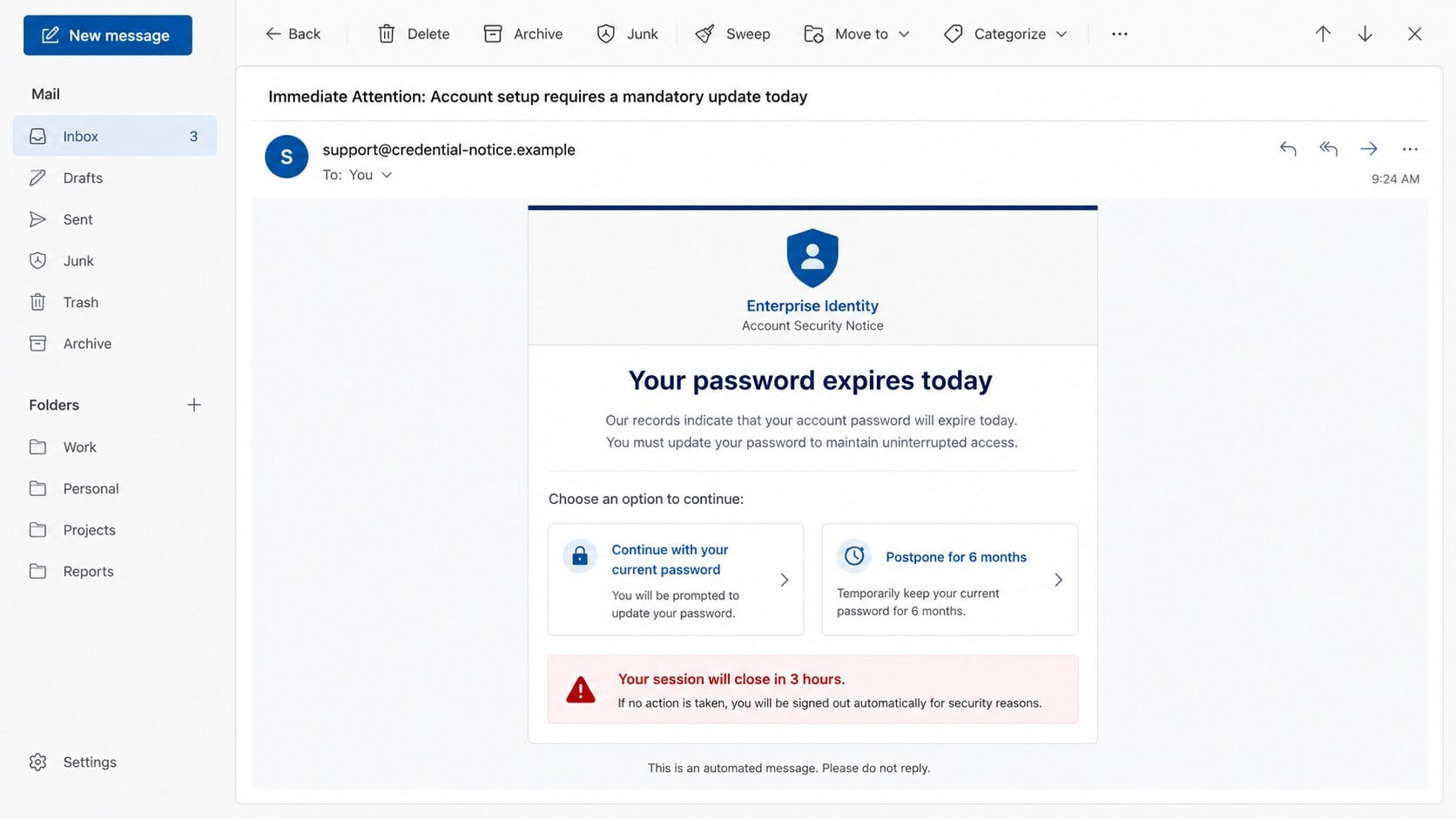
The Your Password Expires Today email claims the recipient’s password has reached an administrative deadline and will stop working within hours.
One variation warns that the active session will close after three hours. It presents a button for continuing with the existing password.
Another option may promise to postpone the change for six months. Both choices encourage the recipient to use a route supplied by the email.
The subject announces immediate password expiration.
A short countdown threatens interrupted email access.
A button promises to preserve the current password.
The sender avoids a verifiable provider-specific support path.
The warning borrows a real workplace routine
Some employers genuinely require periodic password changes. Scammers exploit that familiar process because recipients may have handled similar notices before.
The imitation often uses restrained colors, a small lock icon, and administrative language. It does not need obvious spelling mistakes to be malicious.
What matters is whether the policy exists inside the real account and whether the destination belongs to the organization responsible for that account.
The button can lead into several different traps
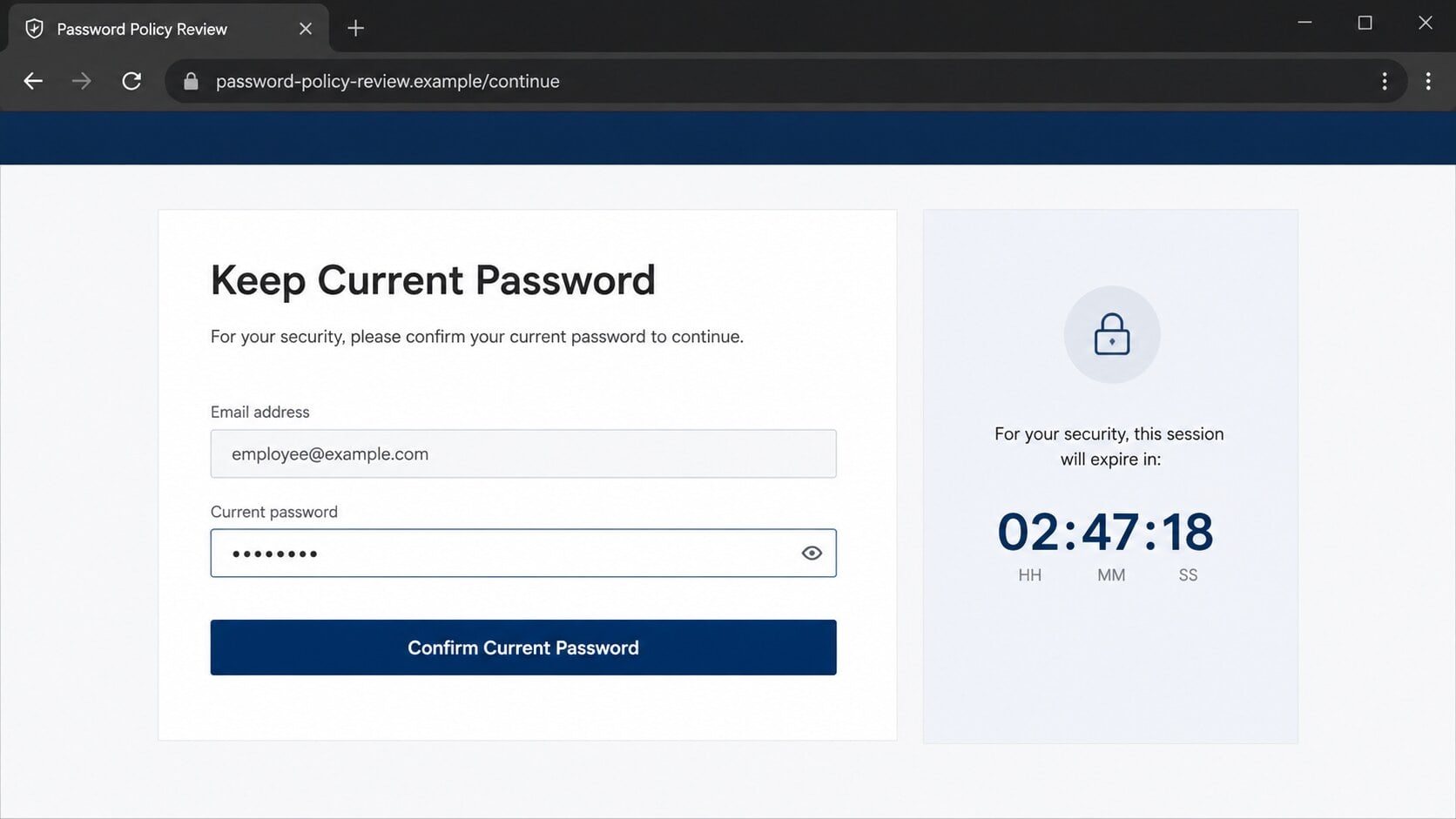
Many versions open a counterfeit email login that records the current password. Others redirect through advertising, survey, notification, or download pages.
The page may recognize the email address from data embedded in the link. It can also copy the organization name from the address after the @ symbol.
That personalization is assembled by the campaign. It is not proof that the visitor reached an authorized password-management service.
Why the Three-Hour Deadline Is So Effective
Password expiration sits in an awkward category. It sounds routine enough to accept, but disruptive enough that people feel unable to ignore it.
The supposed three-hour window compresses the decision. A recipient may act before a meeting, commute, or shift ends because waiting appears risky.
The promise to retain the current password removes another source of friction. Remembering a new credential feels harder than clicking one confirmation button.
That convenience is part of the persuasion. A real security policy would rarely encourage somebody to preserve an expiring password through an unsolicited email form.
The message can also arrive near a genuine password change. Coincidence makes it feel connected, even when the sender has no access to the account.
Generic branding broadens the target pool. A notice labeled “Webmail” or “IT Service” can be delivered across many organizations without substantial customization.
Business recipients may assume their administrator sent it. Personal users may think it came from their hosting company or email provider.
Neither assumption should replace verification. The sender must be evaluated against the actual password policy and the genuine service domain.
A familiar display name is not enough. Email headers, links, and account notifications provide more useful evidence than the words beside the sender icon.
How the Your Password Expires Today Scam Works
Step 1: A generic expiration notice reaches the inbox
The campaign sends a short administrative message to a personal or workplace address. Its subject says the password expires today or has already expired.
The visible sender may be “Administrator,” “IT Helpdesk,” or “Email Support.” Those labels can be entered by anyone sending mail.
Some versions insert the recipient’s domain into the footer. Automated software can extract that word from the destination address.
The notice avoids details that might be disproved, such as the policy name, administrator contact, or date of the previous password change.
Step 2: The email threatens a near-term interruption
The recipient is told that sending and receiving may stop. A timer of three hours or one day creates urgency without allowing comfortable verification.
The consequence is framed as automatic. If the victim hesitates, the message suggests a mailbox session, files, or communication will become unavailable.
This pressure matters most at work, where losing email can sound like a professional problem rather than merely a personal inconvenience.
The countdown may not be connected to a live clock. The same static deadline can appear whenever each recipient opens the message.
Step 3: A convenient extension is offered
Instead of demanding a new password immediately, the lure may offer “Continue Current Password,” “Keep Same Password,” or “Extend for 6 Months.”
The wording lowers resistance. The recipient believes the task requires confirmation rather than choosing and storing a new secret.
Both an extension link and a change-password link can point to the same destination. Their different labels create an illusion of administrative choice.
The safe response is to ignore both and open the account settings through a known route.
Step 4: The destination imitates a password portal
The linked page may resemble Microsoft 365, Outlook, a hosting control panel, or a generic webmail service.
Copied logos and background graphics are inexpensive. The address bar remains the more important place to inspect.
The domain may be newly registered, misspelled, or unrelated. Some campaigns abuse a compromised legitimate website to make the address appear less suspicious.
Other links pass through several redirects. Each handoff can obscure the final location from basic email scanners.
Step 5: The form requests the existing password
The page asks for the current credential, supposedly to authorize the extension. That request gives the operator exactly what an account takeover requires.
Entering a new password does not make the page safe. The criminal can record both the old and proposed credentials.
A fake progress message may say the policy is updating. The page can reject an entry and ask again to capture a second variation.
Once the form is submitted, the information may be transmitted instantly. Closing the tab afterward does not retrieve it.
Step 6: The operator tests and entrenches access
Valid credentials can be used against the genuine mail service. Criminals may act immediately or wait until the victim is less alert.
After signing in, they can review recovery settings, active sessions, mail rules, and connected applications. Small changes help maintain access quietly.
A rule can forward valuable messages or hide security notifications. An added recovery method can support another takeover after a password reset.
For workplace accounts, attackers often search payment conversations, shared documents, internal directories, and vendor relationships.
Step 7: The mailbox supports further fraud
A compromised inbox can reset passwords for other services. Reused credentials may also work directly on shopping, financial, cloud, or social accounts.
Messages sent from the victim’s real address can target colleagues and contacts. Familiar conversation history gives those follow-up lures unusual credibility.
Business email compromise can culminate in altered bank details or urgent transfer requests. Personal compromises can produce identity theft and recovery scams.
The promised extension never mattered. It simply converted fear of losing access into the disclosure that enabled actual loss of control.
How Legitimate Password Expiration Usually Differs
An employer may enforce expiration through its identity platform. The requirement normally appears after signing in through the established portal or managed device.
The notice should match a documented policy. Employees can confirm it with an internal help desk using contact details they already know.
A genuine provider may send a reminder, but the user can reach the same setting without the email. Independent navigation remains the safest test.
Legitimate support does not ask an employee to email a password, read it over the phone, or type it into an unrelated domain.
Modern services may avoid scheduled password changes unless compromise is suspected. Policies differ, so familiarity alone should never settle the question.
How to Investigate the Warning Without Risk
Start with the account, not the email
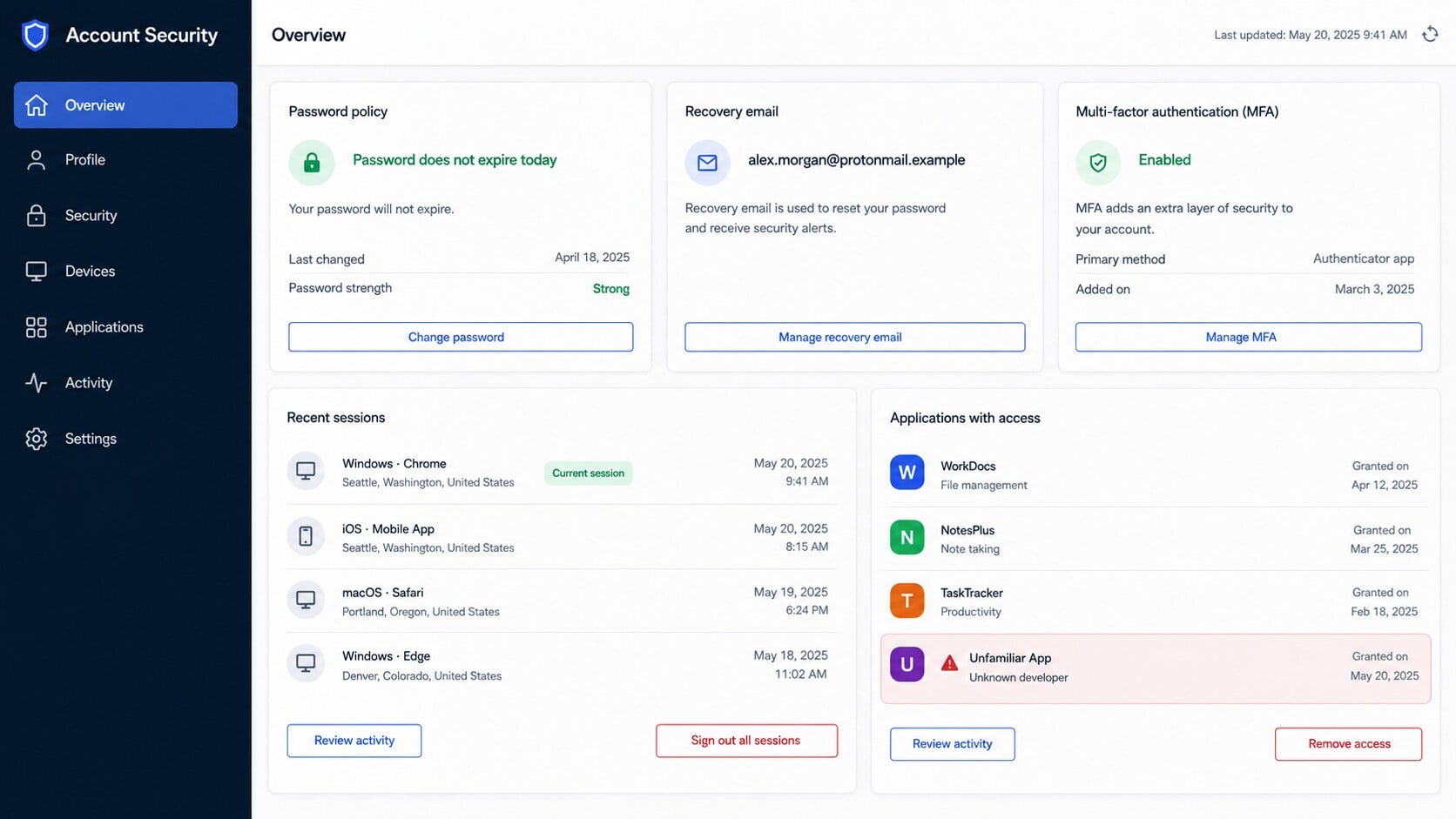
Open the provider’s app or use a saved bookmark. Check security settings and notifications for an expiration requirement.
If nothing appears, do not assume the email knows more than the authenticated account. Contact support through the official site when uncertainty remains.
Workplace users should ask whether the organization actually uses three-hour warnings or six-month extensions. Administrators can compare the message with approved templates.
Read the destination domain carefully
On a computer, hover over the button without clicking. On a phone, press and hold if the mail application can preview the destination safely.
Read the registered domain from right to left. A trusted brand written earlier in a long address may only be an attacker-controlled subdomain.
URL shorteners and redirect services remove useful context. Do not follow them to discover what happens when the claimed task involves a password.
Examine the policy logic
Ask why a security system would preserve an expiring password for six months after one click from an unauthenticated message.
Look for missing facts: policy owner, affected service, exact account, previous change, official support channel, and instructions available outside the email.
A threat that depends entirely on using the sender’s button is not a trustworthy administrative process.
Check for unexpected browser behavior
Some variants lead beyond credential phishing. They may request notification permission, start a download, or open repeated advertising pages.
Do not approve notifications, install an extension, or run a file to keep an email password active. Those actions have no legitimate connection.
If the page opens a support number, do not call it. A fabricated expiration notice can become a remote-access or payment scam.
Sender, Policy, Domain, and Credential Checks
Sender details
Expand the full address rather than trusting the display name. Compare the sending and reply-to domains with the organization that manages the mailbox.
A mismatch is useful evidence, but a matching visible address is not conclusive. Sender fields can be spoofed or sent through compromised accounts.
Does the organization identify the named administrator?
Can the notice be found inside the real account?
Does the reply-to belong to the responsible provider?
Does IT recognize the template and policy?
Password policy
Confirm whether periodic expiration is actually used. Check the official security handbook, account settings, or internal IT guidance.
Compare the claimed deadline with known policy intervals. A random six-month extension may contradict how the organization handles authentication.
Do not let a countdown substitute for confirmation. Real administrators can verify status without learning the user’s current secret.
Website ownership
A password-management page must be hosted on an expected organizational or identity-provider domain. Similar spelling and copied branding are not sufficient.
Look for unrelated hosting, long random paths, and recently created names. A certificate protects data in transit but does not validate the operator’s honesty.
When the URL is unclear, close it. Navigate independently and complete any genuine task from the known account dashboard.
Credential handling
Password managers can provide a helpful signal because they usually will not autofill credentials on a domain where they were never saved.
That signal is not perfect, but an unexpected refusal should prompt immediate examination rather than manual entry.
No help desk should ask you to disclose a password. A proper reset process verifies identity and allows the account holder to create a secret privately.
What a Stolen Email Password Can Expose
Mailbox access reveals more than correspondence. It often provides the mechanism for recovering accounts across a person’s digital life.
Receipts identify stores, subscriptions, addresses, and partial payment information. Cloud notifications show which storage and productivity services the victim uses.
A workplace inbox can reveal reporting lines, travel, contracts, and normal payment routines. Those details help criminals write convincing targeted requests.
Attackers may monitor rather than act immediately. Waiting for a genuine invoice or executive absence can make later impersonation harder to detect.
Changing the password stops many sessions, but not always every route. App passwords, forwarding rules, malicious OAuth grants, and recovery changes require separate attention.
Contacts also need protection. If the account sent suspicious mail, recipients should know that a familiar address was used without authorization.
Rapid action can contain the incident. The goal is to remove every persistence method, protect connected accounts, and interrupt follow-up fraud.
What to Do if You Have Fallen Victim to This Scam
Use a trusted device and open the real provider. Avoid the email link. Change the mailbox password to a strong, unique credential immediately.
Terminate active sessions. Sign out unknown devices and, when possible, revoke every session. Reauthenticate only the devices you currently control.
Remove hidden access. Inspect forwarding rules, filters, delegates, app passwords, connected applications, and recovery methods. Delete anything you did not configure.
Turn on stronger authentication. Use a passkey, hardware key, or authenticator application. Replace SMS where a more phishing-resistant option is available.
Change reused passwords. Protect every account that shared the exposed credential. Prioritize financial services, cloud storage, work systems, and shopping accounts.
Tell IT or the provider. Workplace victims should report the incident promptly. Ask for sign-in logs, mailbox-rule review, token revocation, and message tracing.
Check sent and deleted folders. Look for messages, password resets, invoices, and warnings you did not create. Restore or preserve evidence when practical.
Warn affected contacts. Explain that messages from your address may have been fraudulent. Tell recipients to verify attachments, links, and payment instructions separately.
Scan after downloads or installs. Use Malwarebytes if the page delivered a file or changed the browser. Credential phishing can also occur without malware.
Block known malicious destinations. AdGuard can reduce exposure to many phishing pages and deceptive ads, but independent verification remains essential.
Monitor for follow-up abuse. Watch recovery alerts, financial accounts, and identity activity. Be suspicious of callers claiming they can recover the stolen account for payment.
Is Your Device Infected? Run a Free Malware Scan
Slow performance, constant pop-ups, or strange behavior? These are classic signs of a malware infection. The fastest way to find out is to scan your device with Malwarebytes Anti-Malware Free — one of the most trusted malware removal tools available.
The free version detects and removes the most common threats, including:
Adware — the cause of those annoying pop-ups
Browser hijackers — unwanted redirects and changed homepages
Trojans and spyware — hidden programs stealing your data
Potentially unwanted programs (PUPs) — software you never asked for
👉 Select your device below — Windows, Mac, or Android — then follow the simple steps to download Malwarebytes, scan your system, and remove any threats it finds. The whole process takes about 5 minutes.
Malwarebytes for WindowsMalwarebytes for MacMalwarebytes for Android
Run a Malware Scan with Malwarebytes for Windows
Malwarebytes is one of the most popular and trusted anti-malware tools for Windows — and it’s completely free for removing infections. It catches threats that many antivirus programs miss, including adware, browser hijackers, and trojans. Follow the steps below to scan and clean your PC in just a few minutes.
Download Malwarebytes
Click the button below to download the latest version of Malwarebytes for Windows from the official source. The free version is all you need — it will scan your computer and remove adware, browser hijackers, and other malicious software at no cost.
(The link opens in a new page where your download will start)
Install Malwarebytes
When the download finishes, open your Downloads folder and double-click the MBSetup file. If Windows shows a User Account Control pop-up, click “Yes” to allow the installation.
Follow the On-Screen Prompts to Install Malwarebytes
The setup wizard will walk you through a few quick screens:
Choose where you’re installing the program — “Personal Computer” or “Work Computer” — then click Next.
Malwarebytes will now install on your device. This usually takes under a minute.
When installation is complete, the “Welcome to Malwarebytes” screen will open automatically.
On the final screen, click Open Malwarebytes to launch the program.
Enable “Scan for Rootkits”
Before scanning, turn on rootkit detection so Malwarebytes can find even the most hidden threats. Click the Settings gear icon on the left side of the screen.
In the settings menu, find “Scan for rootkits” and click the toggle so it turns blue.
Done? Click “Dashboard” in the left pane to return to the main screen.
Start the Scan
Click the blue Scan button. Malwarebytes will automatically update its virus database and start checking your computer for malware.
Wait for the Scan to Finish
The scan checks your entire system for browser hijackers and other malicious programs, so it can take several minutes. Feel free to do something else — just check back occasionally to see the progress.
Quarantine the Detected Threats
When the scan is done, you’ll see a list of everything Malwarebytes found — malware, adware, and potentially unwanted programs. Click the “Quarantine” button to remove all of them at once.
Malwarebytes will now remove the malicious files and registry entries and move them safely into quarantine.
Restart Your Computer
Some threats can only be fully removed after a reboot. If Malwarebytes asks you to restart, click Yes. Once you’re logged back in, your PC is clean and you can continue with the next steps in this guide.
When the scan finishes, click Quarantine to remove everything Malwarebytes found. That’s it — your Windows PC is now clean of trojans, adware, and other malware, and should be back to running smoothly.
If your current antivirus allowed this malicious program on your computer, you may want to consider purchasing Malwarebytes Premium to protect against these types of threats in the future. If you are still having problems with your computer after completing these instructions, then please follow one of the steps:
Malwarebytes for Mac is a free on-demand scanner that removes the malware other security software tends to miss — adware, browser hijackers, and unwanted programs included. Cleaning an infected Mac with Malwarebytes has always been completely free, and it’s our go-to recommendation. Follow the steps below to scan and clean your Mac in just a few minutes.
Download Malwarebytes for Mac
Click the button below to download the latest version of Malwarebytes for Mac.
When the download finishes, open your Downloads folder and double-click the setup file to begin the installation.
Follow the On-Screen Prompts to Install Malwarebytes
The Malwarebytes for Mac Installer will guide you through a few quick screens. Click “Continue” and keep following the prompts until the installation completes.
When the installation is complete, Malwarebytes opens to the Welcome to Malwarebytes screen. Click “Get started“.
Select “Personal Computer” or “Work Computer”
Malwarebytes will ask what type of computer you’re installing it on. Click either Personal Computer or Work Computer, whichever applies.
Start the Scan
Click the “Scan” button. Malwarebytes will automatically update its detection database and begin checking your Mac for malware.
Wait for the Scan to Finish
Malwarebytes will scan your Mac for adware, browser hijackers, and other malicious programs. This can take a few minutes, so feel free to do something else — just check back occasionally to see the progress.
Quarantine the Detected Threats
When the scan is done, you’ll see a list of everything Malwarebytes found. Click the “Quarantine” button to remove all the threats at once.
Restart Your Mac
Malwarebytes will now remove all the malicious files it found. Some threats can only be fully removed after a reboot — if Malwarebytes asks you to restart, allow it. Once you’re logged back in, your Mac is clean.
Once the scan is done, remove every threat it detected. Your Mac is now free of adware, rogue browser extensions, and other potentially harmful software.
If your current antivirus allowed a malicious program on your computer, you might want to consider purchasing the full-featured version of Malwarebytes Anti-Malware to protect against these types of threats in the future. If you are still experiencing problems while trying to remove a malicious program from your computer, please ask for help in our Mac Malware Removal Help & Support forum.
Run a Malware Scan with Malwarebytes for Android
Malwarebytes for Android automatically detects and removes dangerous threats like malware and ransomware so you don’t have to worry about your most-used device being compromised. Aggressive detection of adware and potentially unwanted programs keeps your Android phone or tablet running smooth.
Download Malwarebytes for Android.
You can download Malwarebytes for Android by clicking the link below.
In the Google Play Store, tap “Install” to install Malwarebytes for Android on your device.
When the installation process has finished, tap “Open” to begin using Malwarebytes for Android. You can also open Malwarebytes by tapping on its icon in your phone menu or home screen.
Follow the on-screen prompts to complete the setup process
When Malwarebytes will open, you will see the Malwarebytes Setup Wizard which will guide you through a series of permissions and other setup options. This is the first of two screens that explain the difference between the Premium and Free versions. Swipe this screen to continue. Tap on “Got it” to proceed to the next step. Malwarebytes for Android will now ask for a set of permissions that are required to scan your device and protect it from malware. Tap on “Give permission” to continue. Tap on “Allow” to permit Malwarebytes to access the files on your phone.
Update database and run a scan with Malwarebytes for Android
You will now be prompted to update the Malwarebytes database and run a full system scan.
Click on “Update database” to update the Malwarebytes for Android definitions to the latest version, then click on “Run full scan” to perform a system scan.
Wait for the Malwarebytes scan to complete.
Malwarebytes will now start scanning your phone for adware and other malicious apps. This process can take a few minutes, so we suggest you do something else and periodically check on the status of the scan to see when it is finished.
Click on “Remove Selected”.
When the scan has been completed, you will be presented with a screen showing the malware infections that Malwarebytes for Android has detected. To remove the malicious apps that Malwarebytes has found, tap on the “Remove Selected” button.
Restart your phone.
Malwarebytes for Android will now remove all the malicious apps that it has found. To complete the malware removal process, Malwarebytes may ask you to restart your device.
After the scan, tap Remove Selected to delete all detected threats. Your Android phone is now clean — no more malicious apps, adware, or browser redirects.
If your current antivirus allowed a malicious app on your phone, you may want to consider purchasing the full-featured version of Malwarebytes to protect against these types of threats in the future. If you are still having problems with your phone after completing these instructions, then please follow one of the steps:
Restore your phone to factory settings by going to Settings > General management > Reset > Factory data reset.
Now that your device is clean, keep it that way. Most infections start with a malicious ad or a fake download button — so blocking them at the source is your best defense.
We recommend AdGuard, which blocks malicious ads, phishing pages, and dangerous redirects before they can reach you.
The version described here is deceptive. It uses a deadline and password-extension button to send recipients away from the genuine account.
Confirm any policy through the established provider or workplace help desk.
Can employers really expire passwords?
Yes, some organizations still enforce periodic changes. The existence of that practice does not authenticate a particular email.
A real requirement should also appear through the official account or managed-device workflow.
Why would the email offer a six-month extension?
The offer makes clicking feel easier than creating a new password. It is a persuasion device, not evidence of a legitimate policy.
Ask the responsible administrator whether such extensions exist.
What if I clicked but submitted nothing?
Close the site and review browser permissions and downloads. Your password was probably not exposed if it was never entered.
Scan the device if anything downloaded or installed.
Is it safe if the page shows my company name?
No. A page can derive the organization name from the email domain or from public information.
Ownership of the website matters more than the branding displayed on it.
Should I change my password even if the alert was fake?
If you only received the email and did not submit credentials, an emergency change is usually unnecessary.
If you entered any password, replace it immediately everywhere it was reused.
The Bottom Line
The Your Password Expires Today scam uses a three-hour deadline and an easy extension offer to steer recipients toward an untrusted credential form.
Check password status through the real account, and treat every submitted credential as compromised until sessions, recovery settings, rules, and connected accounts are secured.
10 Rules to Avoid Online Scams
Here are 10 practical safety rules to help you avoid malware, online shopping scams, crypto scams, and other online fraud. Each tip includes a quick “if you already got hit” action.
Stop and verify before you click, log in, download, or pay.
Most scams win by creating urgency. Verify using a trusted method: type the website address yourself, use the official app, or call a known number (not the one in the message).
If you already clicked: close the page, do not enter passwords, and run a malware scan.
Keep your operating system, browser, and apps updated.
Updates patch security holes used by malware and malicious ads. Turn on automatic updates where possible.
If you saw a scary “update now” pop-up: close it and update only through your device settings or the official app store.
Use layered protection: antivirus plus an ad blocker.
Antivirus helps block malware. An ad blocker reduces scam redirects, phishing pages, and malvertising.
If your browser is acting weird: remove unknown extensions, reset the browser, then run a full scan.
Install apps, software, and extensions only from official sources.
Avoid cracked software, “keygens,” and random downloads. During installs, choose Custom/Advanced and decline bundled offers you do not recognize.
If you already installed something suspicious: uninstall it, restart, and scan again.
Treat links and attachments as untrusted by default.
Phishing often impersonates delivery services, banks, and popular brands. If it is unexpected, do not open attachments or log in through the message.
If you entered credentials: change the password immediately and enable 2FA.
Shop safely: research the store, then pay with protection.
Be cautious with brand-new stores, “closing sale” stories, and prices that make no sense. Prefer credit cards or PayPal for dispute options. Avoid wire transfers, gift cards, and crypto payments.
If you already paid: contact your card issuer or PayPal quickly to dispute the transaction.
Crypto rule: never pay a “fee” to withdraw or recover money.
Common patterns include fake profits, then “tax,” “gas,” or “verification” fees. Another is a “recovery agent” who demands upfront crypto.
If you already sent crypto: stop paying, save evidence (wallet addresses, TXIDs, chats), and report the scam to the platform used.
Secure your accounts with unique passwords and 2FA (start with email).
Use a password manager and unique passwords for every account. Enable 2FA using an authenticator app when possible.
If you suspect an account takeover: change passwords, sign out of all devices, and review recent logins and recovery settings.
Back up important files and keep one backup offline.
Backups protect you from ransomware and device failure. Keep at least one backup on an external drive that is not always connected.
If you suspect infection: do not connect backup drives until the system is clean.
If you think you are a victim: stop losses, document evidence, and escalate fast.
Move quickly. Speed matters for disputes, account recovery, and limiting damage.
Stop payments and contact: do not send more money or respond to the scammer.
Call your bank or card issuer: block transactions, replace the card if needed, and start a dispute or chargeback.
Secure your email first: change the email password, enable 2FA, and remove unfamiliar recovery options.
Secure other accounts: change passwords, enable 2FA, and log out of all sessions.
Scan your device: remove suspicious apps or extensions, then run a full malware scan.
Save evidence: screenshots, emails, order pages, tracking pages, wallet addresses, TXIDs, and chat logs.
Report it: to the payment provider, marketplace, social platform, exchange, or wallet service involved.
These rules are intentionally simple. Most online losses happen when decisions are rushed. Slow down, verify independently, and use payment methods and account controls that give you recourse.
Hello! I'm Lapain Epuran, your go-to source for detailed and honest product reviews. From tech gadgets to miracle cures, I provide insights to help you make informed choices. Join me as we discover what's truly worth your time and money.