

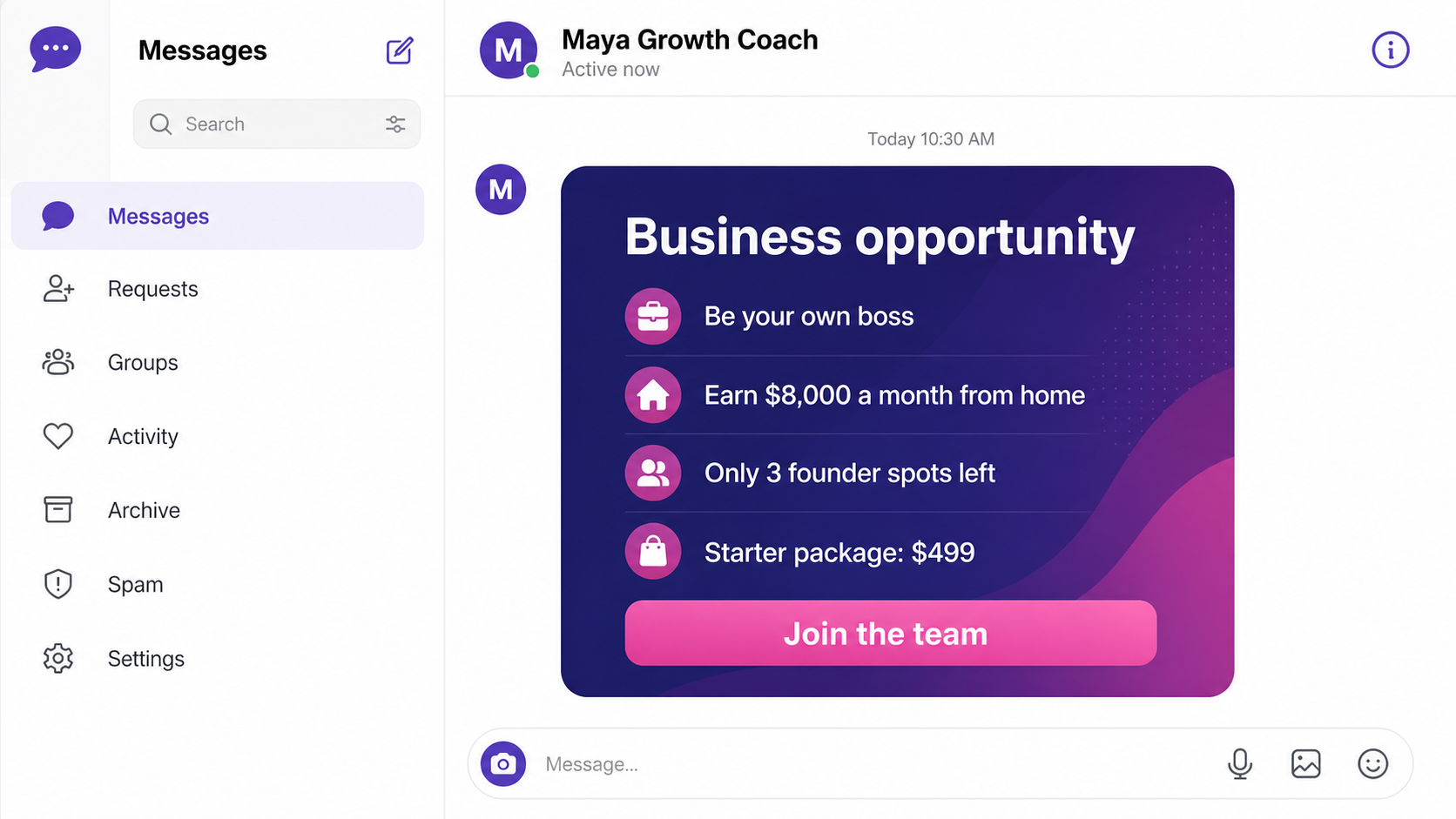
The invitation rarely begins with a business plan. It sounds more personal: a former coworker wants to catch up, a friend has found financial freedom, or a stranger thinks you would be “perfect” for a private opportunity.
An MLM scam hides the hardest questions behind optimism and belonging. The products, meetings, and success stories can look real while the money keeps moving upward through recruitment, required purchases, and recurring fees.
Overview
What an MLM scam promises
The pitch offers flexible income, independence, mentorship, and a ready-made business. You may be told that ordinary people are earning thousands each month by following a simple system and sharing products they already love.
Recruiters often avoid naming the company at first. They invite you to a call, webinar, coffee meeting, or private group where the opportunity can be explained without giving you time to research it beforehand.
When multi-level marketing becomes a scam
Not every company using person-to-person sales is automatically an illegal pyramid scheme. The critical issue is how the operation works in practice and what its compensation plan rewards.
The FTC explains that an MLM crosses into pyramid-scheme territory when recruitment rewards and participant payments overpower genuine sales to outside retail customers. Products can exist and still serve mainly as cover for money flowing from new recruits.
Why the opportunity can feel convincing
The person inviting you may sincerely believe in the program. They may have invested money, tied their identity to the group, and been trained to treat doubts as negativity rather than useful business questions.
Visible success is carefully curated. Social feeds show cars, trips, rank celebrations, and commission screenshots, while expenses, debt, unsold inventory, and the large number of quiet departures remain outside the frame.
- The company name or compensation plan is withheld until a presentation.
- Recruiting is described as the fastest or necessary route to meaningful income.
- A starter package, monthly order, training, or membership fee is required.
- Earnings claims emphasize lifestyle but omit typical net results after expenses.
- You are urged to approach friends and relatives before you understand the business.
- Questions about retail customers, refunds, or failure rates receive vague answers.
How the MLM Scam Works
Step 1: A relationship opens the door
The first contact often comes from someone you know or a friendly social media account. Instead of making a direct sales pitch, the recruiter asks about your goals, work frustrations, family needs, or desire for extra income.
This conversation gathers emotional leverage. A person worried about bills hears about fast income. Someone exhausted by a job hears about freedom. A parent seeking flexibility hears about working from home.
The recruiter may say the opportunity is selective and that a mentor must approve you. That framing makes a sales funnel feel like an exclusive interview.
Step 2: The presentation sells a future, not numbers
The webinar or meeting focuses on possibility. Speakers describe escaping employment, building generational wealth, and joining a supportive community. Specific market demand, customer acquisition costs, and typical profit may receive little attention.
Testimonials usually feature unusual winners. Their revenue may be presented without expenses, or their results may depend on entering early, holding a high rank, or operating a large recruitment network.
A legitimate business decision requires typical outcomes, not only the best examples. Ask how many participants earned a net profit after products, travel, tools, events, taxes, and unpaid time.
Step 3: An entry payment creates commitment
You are asked to buy a starter kit, enrollment package, product bundle, website, or training course. The amount may be described as a small investment in yourself rather than a cost owed to the company.
Paying changes the psychology of the decision. Once money is committed, walking away can feel like admitting failure, so participants may spend more in an attempt to make the first purchase worthwhile.
Pressure can include a deadline, a limited territory, a launch bonus, or a claim that your place will go to someone else. Honest opportunities allow time for independent review.
Step 4: Monthly purchases become the price of eligibility
After joining, participants may need recurring product volume to remain active, reach a rank, or qualify for commissions. What sounded optional during recruitment can become practically necessary inside the compensation plan.
Inventory begins accumulating when retail demand does not match the required order. The participant becomes the most reliable customer, even though the pitch described them as a business owner.
Additional expenses can include conventions, coaching, sample packs, subscription tools, branded materials, travel, and paid leads. Each fee is presented as the next step toward momentum.
Step 5: Recruiting becomes the real work
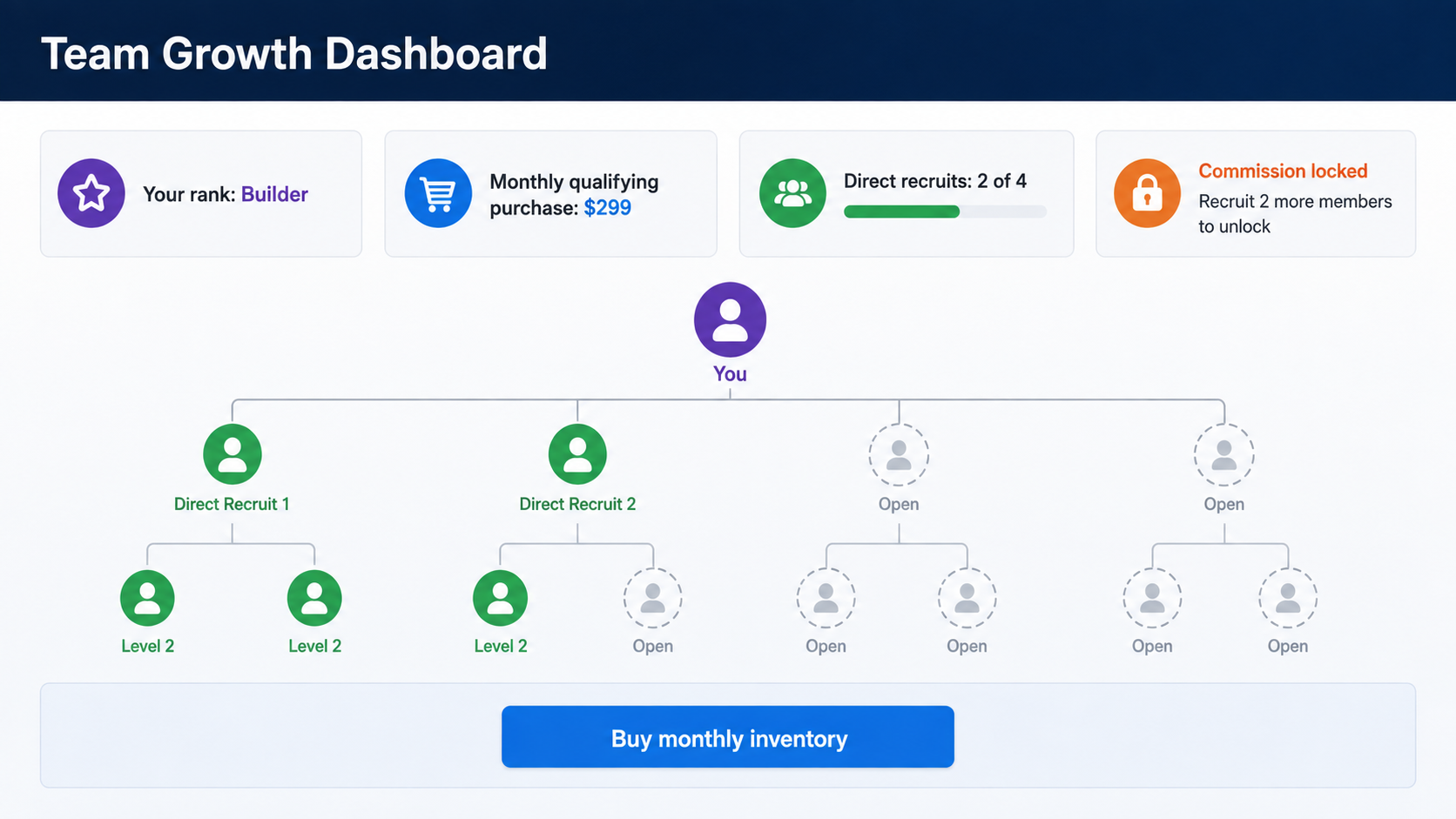
Retail sales may exist, but the strongest rewards often depend on building a downline. Participants are taught to make contact lists, message old friends, post lifestyle content, and invite prospects without revealing the company name.
The dashboard may show commissions locked until more people join or until the team reaches a volume target. That structure encourages every participant to reproduce the same recruitment funnel below them.
The mathematics become unforgiving. Each level needs a larger pool of new entrants, while the number of available friends, customers, and local prospects is finite.
Step 6: Losses are blamed on the participant
When sales remain weak, the program rarely says the model failed. Instead, leaders may claim the participant lacked belief, consistency, coaching, or commitment.
That blame can trigger more spending on training and inventory. It also discourages members from comparing results, asking for refunds, or warning new recruits.
People may stay because close relationships are tied to the group. Leaving can mean losing a community, disappointing the person who recruited them, or admitting the opportunity damaged household finances.
Step 7: The newest recruits carry the greatest risk
Money and bonuses move upward while later entrants face a saturated market. They compete with their own upline, teammates, and many identical sellers offering the same products and opportunity.
When recruitment slows, the structure can no longer support the earnings story. Most participants at the broad base may leave with fees, unused stock, strained relationships, and little recoverable income.
The FTC’s MLM guidance says most people who join legitimate MLMs make little or no money, and some lose money. That fact deserves more weight than a recruiter’s highlight reel.
Company, Address, and Fulfillment Checks
Identify the company before attending the pitch
Ask for the exact legal name, website, products, compensation plan, income disclosure, refund policy, and all required costs in writing. Refusal to provide them is information in itself.
Search regulator actions, state records, court filings, and consumer complaints. Similar names are common, so match the legal entity and address rather than assuming every result refers to the same organization.
Separate outside customers from participants
Ask what share of sales goes to people who are not distributors and have no financial reason to buy. A product moving mainly between the company and its recruits does not demonstrate healthy retail demand.
Compare the price and quality with ordinary alternatives. If customers would not buy the product without the attached income opportunity, recruitment may be supporting demand that the market itself would not create.
Calculate net income using typical results
Revenue is not profit. List enrollment, monthly orders, shipping, samples, software, events, travel, advertising, taxes, refunds, and the value of your time.
Ask current and former distributors what they earned after those expenses. A screenshot showing one commission payment cannot reveal the months of spending required to obtain it.
Read the refund and inventory-return rules
Get the policy before paying. Look for deadlines, restocking deductions, shipping costs, conditions on opened products, and clauses that make a refund depend on resigning from the program.
Save the version you relied on, along with receipts and recruiter claims. Verbal promises are difficult to prove when a support team later points only to the written contract.
Questions to Ask Before Joining
A recruiter may answer broad questions with motivation. Ask for numbers that can be checked and take the documents away from the meeting before deciding.
- How many participants earned a net profit last year after every expense?
- What is the median participant income, including people who earned nothing?
- Can meaningful commissions be earned without recruiting another distributor?
- How much product was sold to customers outside the participant network?
- Which monthly purchases are required to stay active or qualify for bonuses?
- How many recruits left during the last year, and why did they leave?
- Can unsold inventory be returned for a full refund, and within what period?
- Are earnings claims documented with a clear income disclosure statement?
Do not let the recruiter answer for the contract. Have an accountant, attorney, or financially experienced person with no connection to the program review the documents and assumptions.
Create a twelve-month cash-flow estimate before joining. Use the company’s required purchase schedule and conservative retail sales, not the recruiter’s projected rank. If the plan needs constant recruiting to cover ordinary costs, the risk is already visible.
Also consider the relationship cost. A model that turns every friendship into a prospect can damage trust even before financial losses appear, and that harm will not be shown in an income disclosure.
Give yourself a firm decision date after the presentation. Leaving the meeting without paying is normal due diligence, not a missed opportunity.
What to Do if You Have Fallen Victim to This Scam
- Stop new spending and recruitment. Cancel automatic orders, subscriptions, event registrations, and marketing tools. Do not bring another person into the program while you are evaluating losses.
- Collect the complete record. Save contracts, compensation plans, income disclosures, messages, webinar recordings, receipts, bank statements, product orders, and the exact earnings claims that influenced you.
- Request cancellation in writing. Follow the contract’s stated procedure and keep proof of delivery. Ask for confirmation that recurring charges and distributor access have ended.
- Return eligible inventory promptly. Photograph product condition, track the shipment, and document deductions. Deadlines can be short, so do not wait for an upline’s permission.
- Dispute unauthorized charges. Contact the card issuer or bank if billing continued after cancellation or differed from what you approved. Explain the timeline and provide written evidence.
- Protect submitted identity data. Change reused passwords, review credit reports, and watch for new accounts. Use IdentityTheft.gov if personal information was misused.
- Check devices used for the program. If you installed unknown sales software, browser extensions, or meeting files, remove them and run a full Malwarebytes scan.
- Limit malicious recruitment links. AdGuard can block many known phishing and tracking destinations, but it cannot cancel contracts or recover payments. Handle financial and legal steps directly.
- Report deceptive conduct. File details at ReportFraud.ftc.gov and with your state attorney general. Include earnings promises, required purchases, and refund problems.
- Get independent support. Speak with someone outside the organization. A consumer attorney, financial counselor, or trusted family member can help separate recoverable actions from pressure to keep investing.
Frequently Asked Questions
Is every MLM an illegal pyramid scheme?
No. MLM describes a distribution structure, and legality depends on the compensation incentives and real-world operation. A fact-specific review is needed.
The central warning is a system where meaningful rewards depend mainly on recruitment and participant purchases instead of sustainable sales to outside customers.
Does selling a real product prove the company is legitimate?
No. The FTC notes that an operation can sell real, even high-quality products and still have an unlawful pyramid structure. Products do not erase harmful incentives.
Examine who buys, why they buy, and what activities unlock compensation. The flow of money matters more than the presence of inventory.
Why do recruiters avoid saying the company name?
Withholding the name prevents prospects from researching complaints and compensation details before an emotional presentation. It also creates mystery and exclusivity.
A sound business opportunity should survive informed review. You do not owe anyone a meeting before receiving the basic identity of the company.
Can income screenshots be trusted?
A screenshot may show a payment without showing expenses, refunds, chargebacks, taxes, unpaid time, or how typical the result is. It can also be edited or taken from someone else.
Ask for the official income disclosure and typical net results. Extraordinary examples are not a reliable forecast for a new participant.
Should I borrow money to join or stay qualified?
Borrowing magnifies the risk because interest continues even if sales never appear. Required inventory and training can turn a small initial payment into persistent debt.
If the opportunity cannot tolerate a pause for financial review, the pressure is another warning. Do not risk rent, emergency savings, or essential household funds.
Can I recover money lost to an MLM scam?
Recovery depends on the contract, payment method, timing, and local law. Use written cancellation and inventory-return rights immediately, then ask the payment provider about valid disputes.
Be cautious of recovery agents demanding an upfront fee. Losing money can place your information on lists used for a second scam.
The Bottom Line
An MLM scam does not need fake products or fictional meetings. It can operate through a polished community while recruiting and participant spending carry more weight than genuine retail demand.
Slow the pitch down and replace lifestyle promises with verifiable numbers. Learn the total cost, typical net income, customer mix, refund rules, and exact activity that unlocks compensation.
If the MLM scam already cost you money, stop recurring losses first, preserve the claims that were made, and pursue refunds and reports promptly. Do not let sunk costs decide what happens next.

Join the discussion
0 commentsShare your experience or ask a question about this article.
Discussion
Start the conversation
Have a question or something useful to share? Add the first comment.