

A missing-pet post is meant for neighbors, shelters, and people willing to help. It also tells strangers exactly when a frightened owner is most likely to answer any promise that sounds hopeful.
The lost pet drone search scam arrives with modern language and immediate certainty. A recovery team has thermal equipment, trained pilots, and a crew ready to deploy as soon as an upfront fee is paid.
The map, license, and guarantee can look impressive. None of them puts a drone in the sky.
Overview
The scam finds owners through their own urgent posts
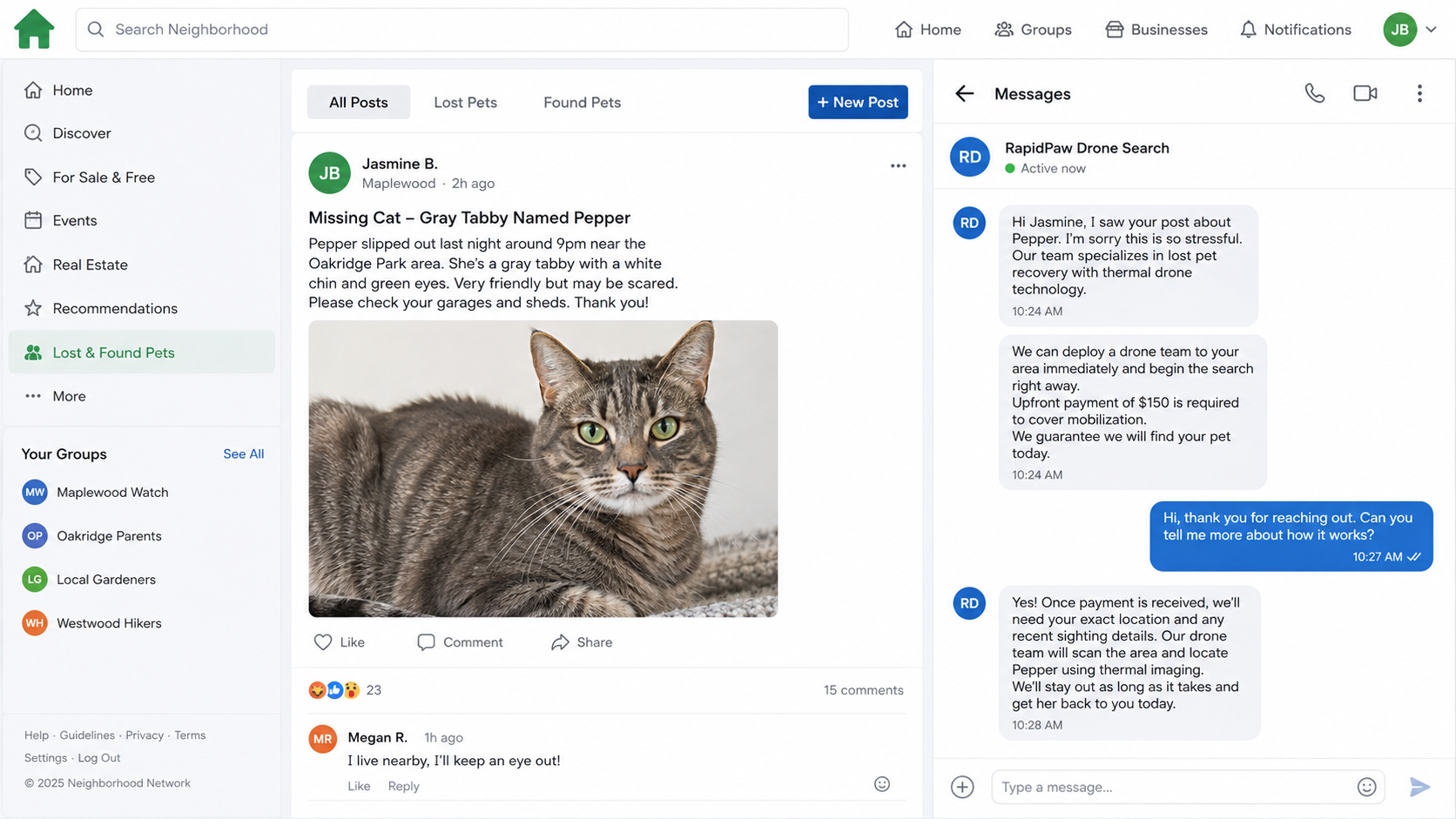
When a cat or dog disappears, owners publish photographs, names, locations, telephone numbers, and the time the animal was last seen. Those details help a real search. They also make it easy for a scammer to contact the family with a story tailored to the missing pet.
The message may appear below a Facebook or neighborhood post within minutes. Sometimes another account “recommends” the recovery service first, creating the illusion of a local referral. The service then moves the owner into private messages.
The FBI has warned about lost-pet scams and specifically advises people considering a pet detective, trained search dog, or other recovery service to check references and verify the provider’s training.
Drone language makes an old advance-fee scam feel technical
Thermal imaging, aerial grids, live tracking, AI recognition, and licensed pilots sound precise. The operator may display a certificate or map and claim the pet’s heat signature can be located within hours.
A real drone service cannot guarantee recovery before assessing weather, terrain, airspace rules, timing, animal behavior, and the limits of thermal imaging. A distant stranger who promises success from a social post is selling certainty, not evidence.
The Better Business Bureau documented reports in which supposed drone searchers requested $200 upfront to deploy people and equipment. The repeated script shows a mass scam pattern, not a dispute with one legitimate provider.
The first fee is often followed by an invented emergency
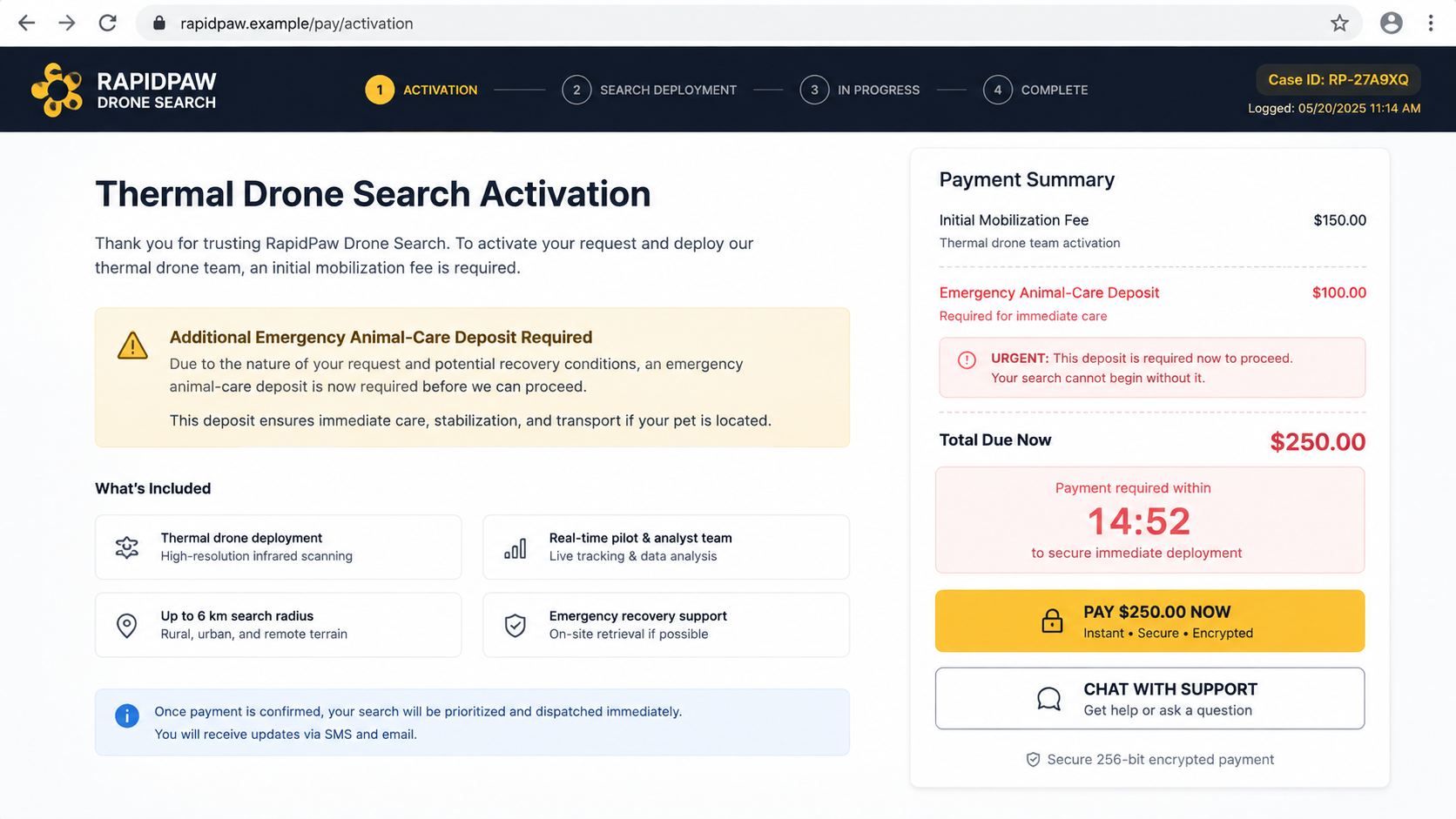
The service asks for $150 to activate the search. Once paid, a second message may claim the animal has been spotted, injured, picked up, or taken to a clinic. Another $100 is needed for medical care, transportation, a tracking collar, or extended flight time.
The new demand exploits the owner’s emotional investment. Refusing now can feel like abandoning the pet after the search supposedly found it. In reality, the operator can keep inventing progress because no independently verified search is happening.
Warning signs include:
- A recovery account appears immediately after a public missing-pet post.
- Another unfamiliar profile recommends the service in the comments.
- The provider claims a guaranteed same-day recovery.
- Payment is required before a telephone or video consultation.
- The service cannot provide local, independently reachable references.
- A drone license image is treated as proof of the entire business.
- The operator will not explain the pilot, aircraft, insurance, or flight plan.
- The payment recipient is a person rather than the verified company.
- A new medical or equipment fee appears after the first payment.
- Updates use vague maps or stock aerial photographs.
- The sender refuses to coordinate with animal control or local volunteers.
How the Lost Pet Drone Search Scam Works
Step 1: The criminal monitors missing-pet groups
Public groups, neighborhood networks, local pages, and lost-pet sites provide a steady stream of distressed owners. A post usually contains enough information to make an approach feel specific.
The scammer can mention the pet’s name, breed, color, neighborhood, and last-known location. Those facts came from the owner, but hearing them repeated by a stranger can feel like evidence that the service already investigated.
Step 2: A recommendation creates borrowed trust
One account may comment that a drone team recovered its pet last month. Another sends the service’s contact in a private message. Both accounts can belong to the same operation.
Testimonials, before-and-after photographs, pilot certificates, and recovery statistics can be copied or fabricated. A recommendation inside the same comment thread is not an independent reference.
Step 3: The service promises technology and speed
The operator says thermal drones can scan woods, roofs, fields, or alleys more effectively than volunteers. They may describe a grid search, real-time analyst, or AI system that distinguishes the missing animal.
Drones can be useful tools in some genuine searches. That truth makes the lie stronger. The question is not whether thermal cameras exist. It is whether this specific provider, pilot, location, plan, and payment can be independently verified.
Step 4: An upfront activation fee starts the loss
The owner is asked to pay for mobilization, fuel, pilot time, software access, or a refundable reservation. Payment may go to a personal payment-app account, cryptocurrency wallet, gift card, or unrelated recipient.
The deadline is short because the pet is supposedly moving. The scammer says every minute matters, turning basic business checks into something that feels cruel or irresponsible.
Step 5: Fabricated progress keeps the owner engaged
After payment, the service may send a generic aerial map, claim a thermal hit, or say the team is following tracks. The update contains enough technical language to make waiting feel productive.
Ask for verifiable operational evidence. Who is the local pilot? Where did they launch? What airspace authorization applies? Can animal control or a trusted volunteer meet the team? Vague answers do not become proof because a map is attached.
Step 6: A second emergency fee appears
The pet was allegedly injured, entered a restricted property, moved beyond the original radius, or now needs transport. The operator demands another payment before revealing the location or continuing the search.
This is the cruelest part of the script. The scammer converts hope into guilt. Paying again does not bring the animal closer; it confirms that the owner can be pressured with escalating stories.
Step 7: The service disappears or becomes threatening
When the owner asks for proof, the account may stop answering, blame the delay on nonpayment, or threaten a cancellation charge. The profile can be renamed and used in another local group.
Recovery scammers may later claim they can trace the first service, retrieve the money, or locate the pet through hacking. That is a separate advance-fee scheme targeting the same distress.
What a Real Pet Recovery Service Should Be Able to Prove
A genuine provider can identify the legal business, responsible operator, service area, pricing, insurance, and relevant training. They can explain what the search can realistically accomplish and what happens if conditions prevent a flight.
References should be independently reachable. Do not accept accounts or telephone numbers supplied only in the same social thread. Search the business name, contact local shelters, and ask established rescue groups whether they know the provider.
Drone work may be regulated by aviation authorities and local rules. Ask for the pilot’s name and credentials, then verify them through the appropriate official system where available. A photograph of a certificate is not verification.
A responsible operator does not guarantee that a drone will recover an animal. Vegetation, buildings, weather, battery limits, heat sources, time of day, and a frightened pet’s movement all affect the search.
Get the price and scope in writing. Understand deposits, cancellation terms, travel charges, and whether a refund is possible. A new medical fee should never be paid without speaking directly to the independently verified clinic that has the animal.
Keep the Real Search Moving While You Verify
Do not let a scammer’s claim pull volunteers away from reliable work. Contact animal control, shelters, veterinary clinics, microchip registries, and established local rescue groups. Give each one a clear photograph and accurate contact information.
Use social posts carefully. Consider a separate contact number or privacy controls, and avoid publishing the detail you will use to verify possession. A collar mark, unusual behavior, private photograph, or another nonpublic fact can help test a stranger’s claim.
Ask anyone who says they found the pet for live, specific proof. A current video with a requested action and visible surroundings is stronger than a copied photograph, but the safest exchange still involves a shelter, veterinarian, animal control officer, or police location.
Never share a code sent to your telephone. Some lost-pet scammers claim the code proves ownership, but it may be used to create an account, reset a password, or take over a telephone-linked service.
If a service seems plausible, ask a trusted person to review it while you continue other search channels. Urgency is real when a pet is missing, but that does not make the first stranger in the comments the right provider.
Keep a simple search log with the time, place, source, and result of each sighting. That makes genuine leads easier to compare and exposes a paid service that keeps recycling vague updates without producing a location anyone else can confirm.
Be careful when correcting a stranger’s guess. If someone asks whether Pepper has a white chin, answering yes gives them another fact to repeat later as supposed proof. Ask open questions and make the claimant supply details first.
A useful helper will tolerate verification and coordinate with people already searching. A scammer treats every pause as a crisis, every question as distrust, and every request for proof as a reason the pet may be lost forever. That emotional punishment is part of the payment pressure.
Company, Location, and Service Checks
The company must exist beyond social media
Find a legal business name, established website, working contact details, and an independent history. A page created recently with copied success stories is not enough.
The operator must be local and verifiable
Ask who will physically conduct the search and where they are based. Confirm training and aviation credentials through official records when relevant. Do not accept a license screenshot as the only evidence.
The search plan must fit the actual location
A provider should discuss terrain, airspace, weather, permissions, timing, and realistic limitations. Guaranteed recovery without an assessment is marketing pressure, not a professional plan.
The payment recipient must match the service
Review the written agreement and payment destination. Personal handles, gift cards, crypto wallets, and unrelated recipients remove accountability. Never pay a surprise clinic bill until the clinic confirms possession through a number you found yourself.
What to Do if You Have Fallen Victim to This Scam
- Stop all further payments. Do not send money for medical care, extended range, restricted access, transport, or a refund release unless the underlying event is independently verified.
- Keep the legitimate pet search active. Contact shelters, animal control, veterinarians, the microchip registry, neighbors, and established rescue groups. The scammer’s updates may be entirely fictional.
- Call the payment provider immediately. Report an advance-fee impersonation scam and ask about a reversal, card replacement, transfer recall, or freeze.
- Preserve the evidence. Save the missing-pet post, recommendations, profiles, messages, payment receipts, maps, certificates, telephone numbers, and claimed sightings.
- Report the accounts. Notify the social platform, payment service, website host, and domain registrar. Tell local group administrators so they can remove coordinated recommendation accounts.
- Protect the missing-pet post. Remove unnecessary home details, keep the verification fact private, and warn contacts not to trust new recovery messages automatically.
- Secure exposed accounts. If you shared a verification code, password, or login, change the affected credentials, sign out unknown sessions, and enable strong multifactor authentication.
- Check files and applications. If the service sent software, a tracking app, or an unusual attachment, run a full Malwarebytes scan and remove unfamiliar permissions.
- Use blocking as an extra layer. AdGuard can block many known phishing and malicious advertising destinations, but it cannot identify a real pilot or confirm that someone has your pet.
- Report the fraud. File with local police and ReportFraud.ftc.gov. Significant internet-enabled theft can also be reported through IC3.gov.
- Reject recovery offers. Anyone promising to recover the fee or locate the scammer for another advance payment may be exploiting the original report.
Frequently Asked Questions
Are all drone pet searches scams?
No. Legitimate operators exist, but they should have verifiable people, credentials, references, terms, and a realistic plan. An unsolicited guarantee with urgent payment is different.
Can thermal drones really find missing pets?
They can help in suitable conditions, but vegetation, buildings, weather, heat sources, timing, and animal movement create serious limits. No honest provider can guarantee recovery from a social post.
Does a drone license photo prove the service is genuine?
No. Images can be copied, altered, or belong to someone else. Verify the named operator through the relevant official system and confirm who will conduct the local flight.
Should I pay if the service says it found my pet injured?
Not before independent confirmation. Ask for live proof and contact the named veterinarian, shelter, or animal-control office through a number you locate yourself.
Why do fake services use recommendation accounts?
A recommendation makes the approach feel local and tested. The recommending profile may be controlled by the same scammer or part of a coordinated account network.
Can I recover an upfront search payment?
Contact the payment provider immediately and report fraud. Recovery depends on method and timing, but quick action is more useful than paying anyone who promises a guaranteed refund.
The Bottom Line
The lost pet drone search scam turns a public plea for help into a private payment funnel. Technical language, a license image, and a same-day guarantee are used to make a stranger look like an emergency service.
Keep searching through verified local channels and make any paid provider prove its people, credentials, plan, and payment identity. Hope is necessary when a pet is missing. It should never be accepted as proof.

Join the discussion
0 commentsShare your experience or ask a question about this article.
Discussion
Start the conversation
Have a question or something useful to share? Add the first comment.