


An email says you’ve been selected for a €7.5 million grant. You haven’t applied for one, and the message doesn’t explain how the sender found you.
There’s no application to fill out. The sender, who signs as Elon Corporation, asks for something that sounds much simpler: a reply.
Overview
Elon Corporation promises money before identifying a program
The Elon Corporation grant scam is an unsolicited email offering €7,500,000. It says the money can go toward personal needs, a business, projects, or investments.
There’s no named grant program, application number, selection criteria, or explanation of why the recipient qualifies. The sender presents selection as something that already happened.
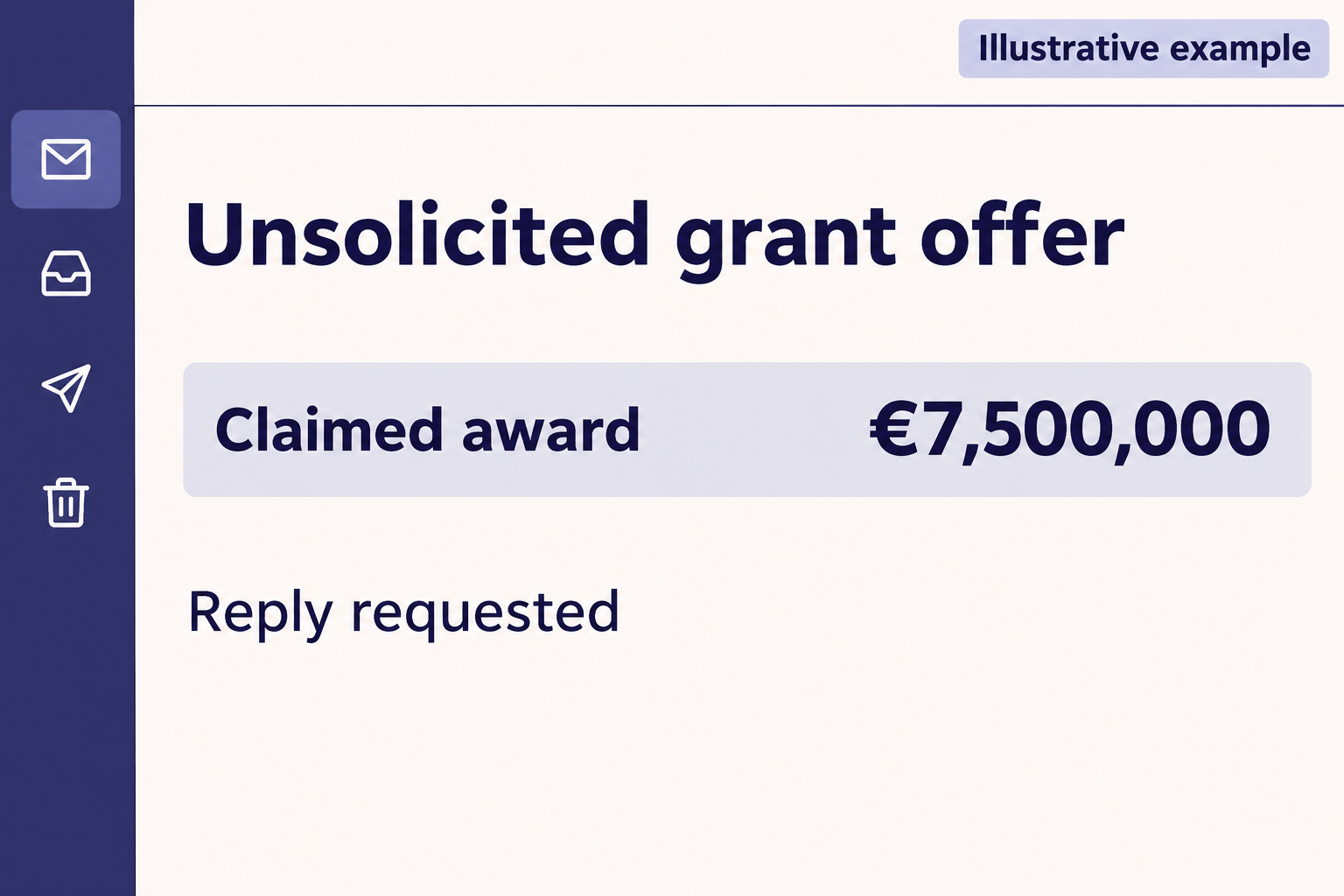
The wording is brief. The only action in the reported email is to reply. The illustration shows that premise, not an original inbox capture.
- A general greeting rather than an explanation of your connection to the funder.
- A precise award amount with no independently identified program attached to it.
- Unusually broad uses, from personal spending to investments.
- A request to reply for details instead of a public application or verification route.
A familiar name isn’t the same thing as a real sponsor
The email is signed Elon Corporation. It doesn’t identify Elon Musk as the author or establish a connection to him. Those are distinctions worth keeping.
The Musk Foundation’s own site lists specific grant areas, including pediatric research and engineering education. That’s not the open-ended personal or investment grant this message describes.
A real foundation can exist alongside a false promise that borrows a familiar name. Finding the former doesn’t validate the latter, or turn a reply into an application.
You don’t have to decide whether every business with similar wording is genuine. You need to decide whether this email establishes a grant you can verify independently.
The opening doesn’t ask for a fee, and that matters
The sample doesn’t contain a demand for payment, a request for a passport, or a link to a bank portal. It’s a reply-first approach.
The risk is what a reply can start. In advance-fee fraud, the cost typically appears after the recipient is invested in the idea that the money is theirs.
That distinction keeps the warning useful. You can reject the invitation without claiming that everyone who saw the message paid money or handed over documents.
If all you’ve done is read it, leave the conversation there. The promised award isn’t a reason to negotiate with a sender you can’t identify.
How the Elon Corporation Grant Scam Works
Step 1: An award appears without a recognizable application
The email asks you to start from a conclusion: someone has selected you. It never gives you a real application to connect to that decision.
If you run a small business, you may recall filling out applications for financing or local aid. The email leaves enough room for you to supply that association.
Someone receiving the offer at home can do the same thing. The promise fits personal circumstances without the sender having to know what those circumstances are.
Before you decide whether the opportunity sounds appealing, ask what process actually produced it. Look through records you already have, rather than asking the stranger to explain.
Step 2: A single amount is made to fit almost any need
For someone struggling with rent, the number might mean a way out. For a business owner, it might mean funding a project that’s been stalled for months.
The message doesn’t make you choose which kind of applicant you are. It folds several very different uses into the same promise.
Useful grant terms say more than what money could do. They identify the funder, who may apply, what’s permitted, and any responsibilities attached to the award.
An unexpected number written to the cent can feel like an account entry. It is still only a number in the message until the award is independently established.
Step 3: The sender asks for a reply instead of a payment
Replying can feel low risk. You aren’t paying anything or entering a password. You’re only asking a question that might clarify how the sender knows you.
That question gives the sender a private conversation. It also tells them that someone read the email and was interested enough to respond.
Your email signature can disclose more than you intended: your employer, a direct phone number, or the name you use in business.
Don’t send a test reply. A second message from the same person can expand the story, but it can’t independently verify the first one.
Step 4: Follow-ups can introduce a fee or an identity request
The original email doesn’t show a follow-up. If one arrives, judge the new request for what it would give the sender, not for the label attached to it.
A request for an ID image exposes a document that can be reused. An upfront payment takes real money away now in exchange for an unverified promise.
The FTC’s grant scam warning covers government impersonators. This email doesn’t claim to be from a government, but the pay-to-release-money warning is useful if demands begin.
A supposed bank or lawyer introduced by the sender isn’t independent confirmation. If you want to verify a named institution, find its genuine contact details yourself.
Step 5: An earlier reply can make another demand feel harder to refuse
Once you’ve shared information, you may feel that stopping means the whole effort was wasted. That feeling isn’t a reason to send anything else.
If a fee has already been paid, an additional charge can be presented as the final obstacle. Treat the demand as a new request, not a commitment.
Someone may also offer to recover a payment. A new contact who wants money or sensitive data first presents another risk, even if they know the original amount.
From that point, a real payment provider is more useful than a person promising to release or recover a grant. Put the evidence in the provider’s hands.
What a Real Funding Offer Lets You Check
Look for a program you can find without the email
Start with a funder you can identify and a published program that fits the amount and purpose. Look at who qualifies before you think about sending documents.
Some legitimate awards are invitation-only. That doesn’t require you to accept an unexplained email, and it doesn’t stop you from asking the verified organization to confirm it.
A legitimate organization should be able to explain which program is involved without first collecting your banking password or asking you to pay a stranger.
Look back through previous conversations with genuine grant officers or advisers. If there’s no connection to the message, don’t try to create one by replying.
Watch out for pages that simply reproduce the same offer. Several copies of an assertion still don’t show who approved the award or holds the funds.
Check the claim, not just the name
Finding a person or an organization with a similar name answers only whether that identity exists. It doesn’t prove the email came from them.
If a public institution is named later, locate its website yourself. Verify the exact program and the relevant contact, not just the appearance of a logo.
Bring a trusted adviser the message without sending them on to a suspicious address. Ask them what information is missing, not whether the amount would solve a problem.
A real award document should still match the process you can verify. Treat a PDF sent after a reply as another claim until you confirm its origin.
Don’t search the grant amount alone. The combination of the claimed sponsor, program name, and application history is more useful than the amount shared by copied posts.
Know which records to preserve without sending more
Save the original message and dates. If you’ve already replied, keep the thread so you can identify when the sender asked for something sensitive.
Separate what you told the sender from what they already appeared to know. That distinction helps if you need to explain a disclosure to a bank or employer.
Keep payment confirmations from the payment provider, not just a receipt the sender emailed back. The actual funding route determines whom you should call first.
If you received documents, don’t reopen attachments just to gather proof. Save them as part of the message and ask the appropriate reporting channel what it needs.
On a shared work account, let colleagues know the notice isn’t a payment instruction. Don’t circulate the sender’s reply address as though it were a useful funding contact.
If the Email Arrives at a Small Business
Keep an unsolicited award out of the books
A promise from a stranger isn’t a receivable. Don’t include the amount in a budget, make a purchase against it, or tell suppliers that the funding is secured.
If someone else handles your accounts, tell them why the email is suspicious. That matters if a follow-up invoice arrives addressed to the business rather than you.
Keep control of payment decisions with the people who normally approve them. An unexpected message doesn’t justify making an exception for a supposedly small charge.
Separate public business details from private records
A sender may know the company name or business address from a public listing. That doesn’t show they received an application or looked at your accounts.
Don’t supply invoices, tax filings, or customer records to prove that the business exists. A real funding process has a documented way to establish that relationship.
If a message claims to involve a director, check with that person through your usual channel. An email signature or a copied logo doesn’t speak for them.
What to Do if You Have Fallen Victim to This Scam
-
Stop responding and save the thread. If you replied with a question, that isn’t the same as sending a document or a payment. Don’t continue to clarify.
Keep a copy of the messages and note what you included in any signature. Be prepared for follow-up contact, including from people claiming a different role.
-
Contact the payment provider if you sent money. Use the contact details in your own account. Explain how the payment was induced and ask about recovery options.
Give the provider the amount, time and genuine transaction reference. Don’t tell the sender you need a new invoice or pay them to authorize a reversal.
-
Tell the bank exactly what details you gave out. An account number, card number, password, and authorization code present different risks. Don’t lump them together.
Ask the bank what it can secure or monitor. If you approved an action in its app, describe the action shown there, not the sender’s explanation.
-
Respond to any identity document exposure. If you sent an ID copy, note the issuing country and which pages or sides you sent. Contact the issuer for guidance.
In the U.S., the FTC’s fraud response guide explains what to do if you disclosed a Social Security number or other sensitive information.
-
Protect any accounts you actually exposed. If you entered a password on a follow-up page, change it from a device you trust. Address reused passwords too.
Start with the email account if you gave away its login. Check recovery contacts and active sessions so you don’t leave another route into it.
-
Report the approach without handing out more data. Use your mail provider’s phishing control and an appropriate fraud-reporting service. In the U.S., ReportFraud.ftc.gov is one option.
Keep any case number for your records. If someone contacts you claiming to be able to recover the grant or your money, verify them independently before engaging.
Frequently Asked Questions
Is the €7.5 million grant from Elon Corporation real?
Don’t treat the email as an award. It names no independently verifiable program or selection process and routes the entire inquiry back to the sender.
Does the email come from Elon Musk or his foundation?
There’s nothing in the reported text that establishes either connection. The Musk Foundation publicly lists specific grant areas, not this broad offer for personal or investment use.
Can I reply without giving them any documents?
Don’t reply. It starts a conversation with the party making the unverified promise and can disclose information in your signature or invite more targeted messages.
Why doesn’t the first message ask for money?
The first message only seeks a reply. A demand for a fee or personal information can follow later, but neither demand is in the reported opening email.
What if I really applied for a grant recently?
Contact the funder using the application records you already have. Compare the real program, applicant name, and reference before connecting any unexpected offer to it.
Will I get back money I sent for a release fee?
Recovery depends on the payment route and circumstances. Contact the provider promptly. A new fee to retrieve the first payment does not make recovery more likely.
The Bottom Line
Don’t reply to the Elon Corporation grant scam. The €7.5 million figure doesn’t identify a grant program, and the message gives you no independent way to verify an award.
If you sent money or identification, stop contact and protect what you exposed through the payment provider or relevant authority. Don’t pay a second fee to fix the first.

Join the discussion
0 commentsShare your experience or ask a question about this article.
Discussion
Start the conversation
Have a question or something useful to share? Add the first comment.