

A caller says you have been selected for a complimentary cruise from Orlando, even though you do not remember entering a contest. The trip sounds generous, the deadline sounds urgent, and the first charge seems small enough to risk.
The Orlando Promotion Center free cruise scam becomes expensive in the details that follow. Before you hand over a card number, it is worth slowing down and seeing what the word “free” is being used to hide.
Overview
What the Orlando Promotion Center offer promises
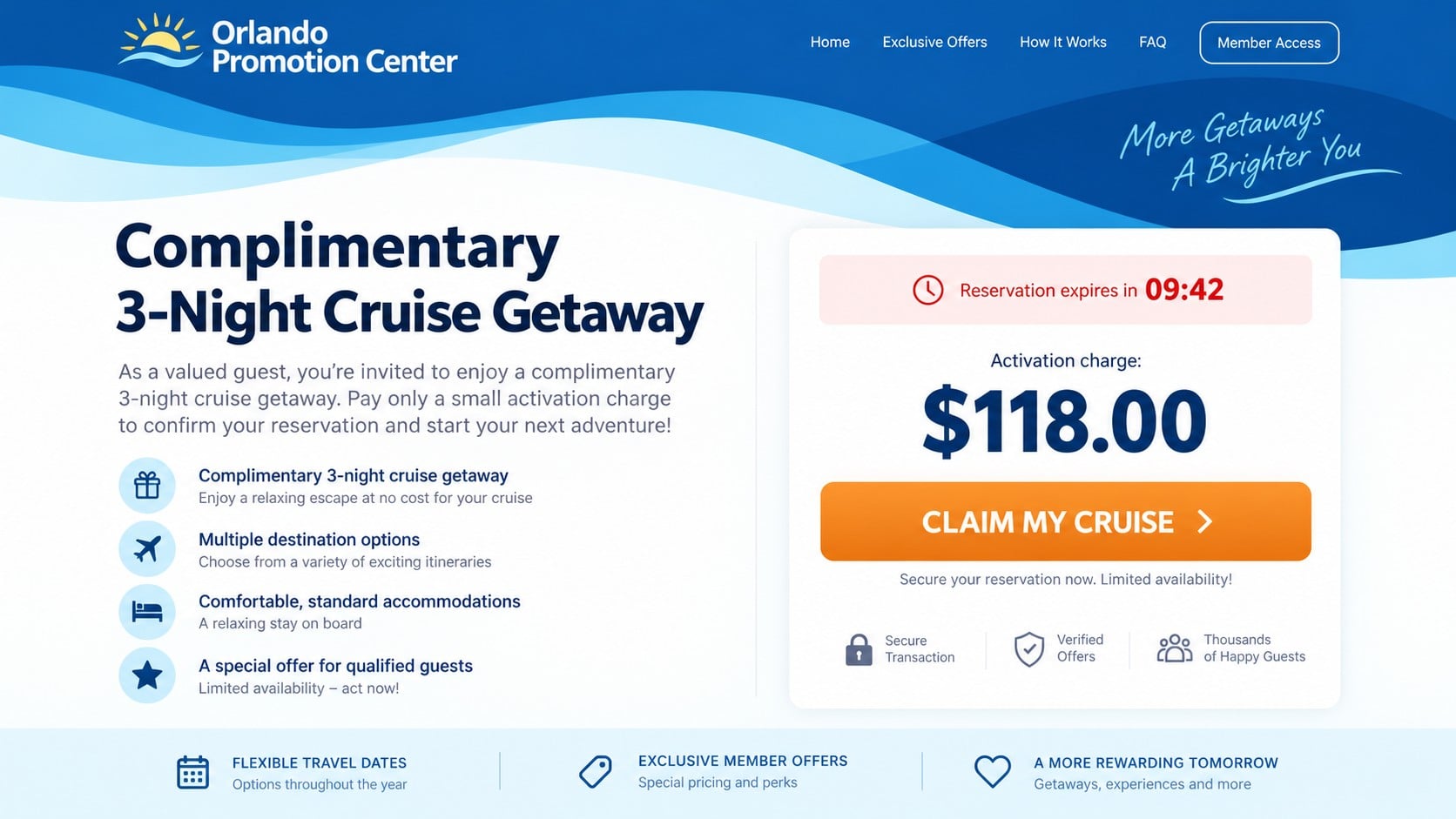
The pitch says the recipient qualifies for a short cruise, resort stay, or Florida vacation package. It may arrive through a robocall, a live telemarketer, a postcard, an online form, or a follow-up call after a travel survey.
The caller usually avoids calling the trip a purchase. Instead, a modest “activation,” “reservation,” “processing,” or “port” charge is presented as the only thing standing between the customer and a valuable vacation.
- A complimentary cruise or hotel stay for two
- A claim that the recipient was selected or specially qualified
- A short deadline to reserve the package
- An upfront fee that makes the free trip cost money
- Additional taxes, port charges, booking restrictions, or upgrades
- A possible vacation-club or timeshare presentation
Why the small first charge is not the full price
The quoted amount may only activate a certificate. It may not include transportation to the port, government taxes, port fees, hotel nights, meals, transfers, gratuities, resort charges, required upgrades, or travel on dates a customer can actually use.
Some offers also connect the reservation to a travel-club trial or a sales presentation. A trial can turn into recurring billing, while a presentation can consume hours and apply intense pressure to buy a membership or vacation product.
The result can be a certificate that is technically redeemable but difficult, inconvenient, or costly to use. In other cases, the promoter takes payment and never provides a usable reservation at all.
What makes this a scam warning rather than a bargain
An unexpected prize that requires payment deserves immediate suspicion. The Federal Trade Commission warns about free-vacation pitches that reveal fees only after a consumer responds or collect money for travel that does not materialize.
The name Orlando Promotion Center does not identify a cruise line, hotel, or government tourism office. A polished name and Florida theme can make a call feel local and established without showing who will receive the payment or fulfill the trip.
The safest conclusion comes from the contract, not the script. If the seller will not provide the legal company, complete price, specific sailing, cancellation policy, and all conditions in writing before payment, do not authorize the charge.
Why the Free Cruise Pitch Feels So Convincing
The caller turns an ordinary survey into a prize
A person may remember completing a travel questionnaire, entering a mall drawing, or clicking an online vacation ad. The caller uses that small memory to make an unexpected award seem connected to something real.
Other recipients are simply told that their phone number was selected. The explanation stays vague because the emotional effect matters more than the supposed selection process.
The first fee is framed as routine paperwork
A $118 charge feels minor beside a cruise advertised as worth hundreds or thousands. Calling it an activation fee makes it sound administrative, even though payment is the point at which the consumer accepts financial risk.
The representative may say the card is needed only to “hold” the package. Unless the written terms limit the authorization, a hold can become an immediate purchase, a trial enrollment, or permission for later charges.
The deadline prevents comparison shopping
Countdowns and same-call deadlines discourage the customer from contacting the cruise line, reading reviews, or asking a family member. The caller may warn that hanging up permanently forfeits the offer.
A legitimate travel seller can explain its identity, dates, inventory, and refund terms without punishing you for verifying them. An expiring verbal promise is not a substitute for a reservation.
How the Orlando Promotion Center Free Cruise Scam Works
Step 1: An unsolicited call announces a travel reward
The contact begins with a congratulatory recording or an upbeat agent. The person is told that a cruise, resort stay, or vacation certificate has been awarded because of a survey, promotion, prior purchase, or random selection.
Caller ID may display a local Florida number or a travel-related name. Phone numbers and display names can be spoofed, so neither one proves where the call originated.
The representative quickly asks qualifying questions about age, marital status, income, credit cards, or preferred travel dates. Those questions can be used to identify consumers who are more likely to buy a vacation membership.
Step 2: The word free is separated from the unavoidable fees
The caller describes accommodations and destinations before discussing cost. Once the listener is imagining the trip, the agent introduces an activation or reservation charge as a normal formality.
Taxes and port fees may be mentioned only after the customer agrees in principle. Airfare, ground transportation, hotel nights around the sailing, meals, gratuities, and upgrades can remain outside the quoted amount.
The FTC’s guidance is direct: a legitimate company does not make a consumer pay to receive a free prize. A package can contain a discounted component, but that is different from winning a no-cost vacation.
Step 3: The agent collects personal and payment details
The recipient is asked for a full name, address, email, birth date, card number, expiration date, and security code. The representative may say these details are required to confirm eligibility or reserve the cabin.
Some callers ask the consumer to speak clearly during a recorded verification. Listen to every question. A fast series of “yes” answers can be used to document acceptance of terms that were not explained during the sales pitch.
Never assume that a recording protects only the buyer. Ask for the complete agreement first, then read it away from the pressure of the call.
Step 4: A certificate replaces the promised reservation
After payment, the buyer may receive an email, login, or paper certificate instead of a cruise confirmation. The document can require a second booking company, a narrow travel window, advance notice, or several alternative dates.
Popular weekends and school holidays may be unavailable. The customer may also learn that the departure port, ship, cabin type, or hotel was never guaranteed.
A certificate is not the same as a reservation. A real booking should identify the travel provider, dates, traveler names, itinerary, cabin or room category, total paid, and balance due.
Step 5: Extra charges appear during redemption
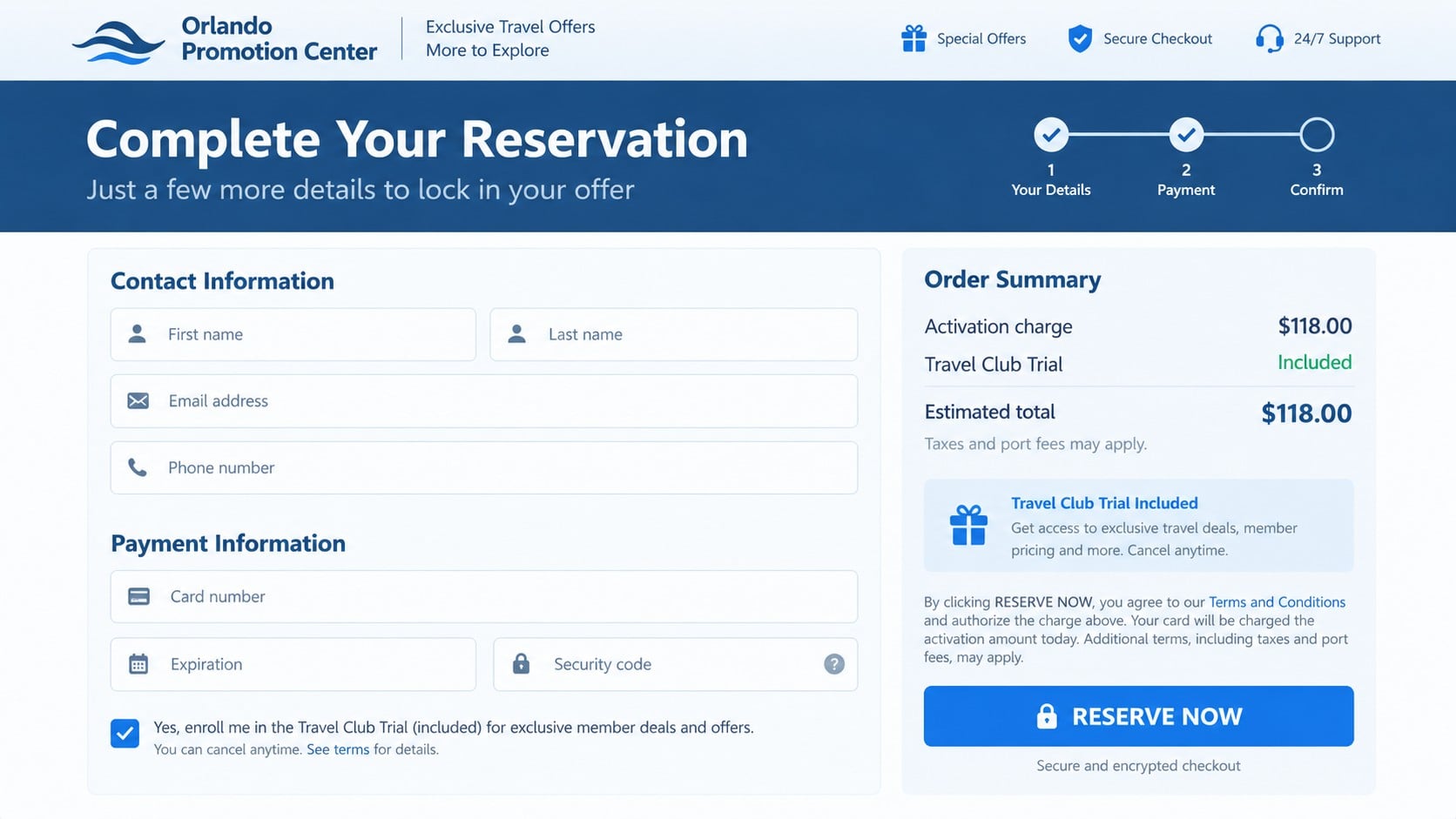
The booking process may add port taxes, resort charges, service fees, reservation fees, deposits, or mandatory upgrades. Each amount can be described as separate from the original promotion, making the final cost hard to compare with an ordinary trip.
A preselected travel-club trial can create another billing path. If the customer does not cancel through the exact procedure and within the stated period, a monthly or annual membership charge may follow.
The right comparison is not “$118 versus a free cruise.” It is the total required cost, restrictions included, versus a directly booked trip on the same dates.
Step 6: A presentation applies a second layer of pressure
Some vacation offers require attendance at a resort, timeshare, or vacation-club presentation. The customer may be told the meeting is brief, then face hours of sales pressure and multiple representatives.
The FTC’s timeshare and vacation-club advice recommends getting every promise in writing, understanding cancellation rights, and calculating the full long-term cost before signing.
Do not sign because you feel trapped, tired, or embarrassed. Take the contract away when local law and the seller allow it, and do not rely on a salesperson’s oral promise to cancel a clause later.
Step 7: Refund requests meet delay, conditions, or silence
When the buyer asks to cancel, support may say the activation payment was nonrefundable, the request missed a narrow deadline, or another company controls the booking. Repeated transfers can run out the card dispute window.
A representative may offer credits, extensions, or a different destination instead of returning money. Accepting a substitute can complicate a later dispute if it appears that the buyer agreed to revised terms.
Record each contact, but do not keep negotiating indefinitely. Written cancellation and a prompt card dispute create a clearer paper trail than repeated calls.
Company, Address, and Fulfillment Checks
The promotion name is not the legal seller
“Orlando Promotion Center” sounds like a place, not a complete company identity. Ask for the exact legal entity charging the card, its state of registration, contract name, and the descriptor that will appear on the statement.
Also identify the cruise line, hotel, certificate issuer, booking agent, travel club, and payment processor. Several companies may be involved, and one name should not be used to answer questions about another.
A Florida address may be a sales or mail location
An Orlando mailing address does not prove that a cruise line, resort, or booking operation works there. It could be a shared office, call center, mailbox, registered-agent address, or unrelated suite.
Check the address independently and compare it with the contract and card statement. A return address on a postcard is not enough to establish who owes the traveler a refund.
Support must work before payment, not only during the sale
Call the public customer-service number before buying and ask for dates, cancellation rules, and a sample agreement. If only the sales line answers, the operation has not demonstrated reliable support.
Use contact details found independently. A number supplied by the telemarketer may route back to the same sales floor under a different greeting.
Travel fulfillment must be specific and traceable
A usable package should name the provider, departure port, eligible dates, cabin or room level, maximum occupancy, required presentation, every fee, and the process for securing inventory.
Ask whether the quoted dates are available before paying. If the seller provides only a certificate and promises that another company will explain everything later, the most important part of the transaction remains unverified.
Questions to Ask Before Paying Any Travel Promotion
- What is the legal name of the company taking my payment?
- Which cruise line, ship, hotel, and booking company will fulfill the trip?
- What exact dates can I reserve today?
- What is the complete cost for both travelers?
- Are taxes, port fees, gratuities, meals, transfers, and upgrades included?
- Is a timeshare or vacation-club presentation required?
- Does payment enroll me in a trial or recurring membership?
- How do I cancel, and which charges are refundable?
- Will I receive a confirmed reservation or only a certificate?
Do not let the agent answer several questions with “everything is included.” Ask for amounts and conditions in writing. Vague reassurance is easy to give and difficult to enforce.
If the representative refuses to send terms before taking the card, end the call. A vacation worth taking will still make sense after you understand the price.
What to Do if You Have Fallen Victim to This Scam
- Stop new payments. Do not pay another booking fee, upgrade, tax, release charge, or refund fee. Tell travel companions not to provide their cards or identity documents.
- Send a written cancellation. Use every address listed in the agreement and keep proof of delivery. State the purchase date, amount, card used, reason for cancellation, and the resolution you want.
- Call the card issuer promptly. Use the number on the back of the card. Explain whether the service was misrepresented, never delivered, or followed by unauthorized recurring charges, then ask about dispute deadlines and card replacement.
- Identify every merchant involved. Save the statement descriptor, phone numbers, contract, certificate, confirmation email, booking portal, and any travel-club name. A dispute is stronger when it identifies the actual charge.
- Cancel recurring billing separately. Ending a cruise reservation may not cancel a club membership. Revoke authorization in writing and ask the card issuer how to block future charges from the merchant.
- Protect exposed identity information. If you shared a birth date, government ID, or Social Security number, follow the recovery plan at IdentityTheft.gov and consider placing credit freezes.
- Scan with Malwarebytes if you opened files or installed software. A full scan can detect malicious downloads linked to a fake booking portal. Complete the scan before using that device for banking or password changes.
- Use AdGuard to reduce malicious follow-up pages. It can block many known scam domains, deceptive ads, and tracking requests. It does not cancel a membership or guarantee that a travel seller is legitimate.
- Report the promotion. File details with the FTC, your state attorney general, the card issuer, and the platform or carrier that delivered the ad or call. Include dates and exact claims rather than conclusions alone.
- Beware of recovery agents. Someone who promises a guaranteed refund for an upfront fee may be targeting the same victim list. Work through the card issuer, regulator, or a qualified attorney you selected independently.
Frequently Asked Questions
Is Orlando Promotion Center a real cruise line?
The name does not itself identify a cruise line. Ask which licensed travel seller, cruise company, certificate issuer, and legal merchant are responsible. Verify each one using contact information you find independently.
Can a free cruise legally have taxes and port fees?
A promotion can exclude stated charges, but the seller must explain material costs and conditions clearly. If unavoidable payments are hidden until after the consumer accepts, the word free becomes misleading.
Why does the caller need my credit card to hold the prize?
The card allows an immediate charge and may authorize later billing. Do not provide it until you have the complete written price, cancellation policy, merchant identity, and confirmed inventory.
Does caller ID prove the call came from Orlando?
No. Scammers and telemarketers can spoof a local number or business name. Verify the company through an official registry, independent website, and a number you located yourself.
What if I received a certificate but cannot book dates?
Document every attempted date, fee, response, and restriction. Send a written demand for the promised service or refund, then ask the card issuer about a dispute before its deadline expires.
Should I attend the presentation to recover what I paid?
Read the agreement first. Attending may satisfy one condition, but it can expose you to more pressure and expense. Do not sign a membership merely to rescue the original payment.
The Bottom Line
The Orlando Promotion Center free cruise scam uses the excitement of a prize to make an upfront fee feel harmless. The true cost can include restrictions, extra charges, a travel-club trial, or a high-pressure sales presentation.
Do not pay for an unexpected vacation promise until the legal seller, provider, dates, complete price, and cancellation rights are in writing. If your card has already been charged, document the offer and contact the issuer without delay.

Join the discussion
0 commentsShare your experience or ask a question about this article.
Discussion
Start the conversation
Have a question or something useful to share? Add the first comment.