

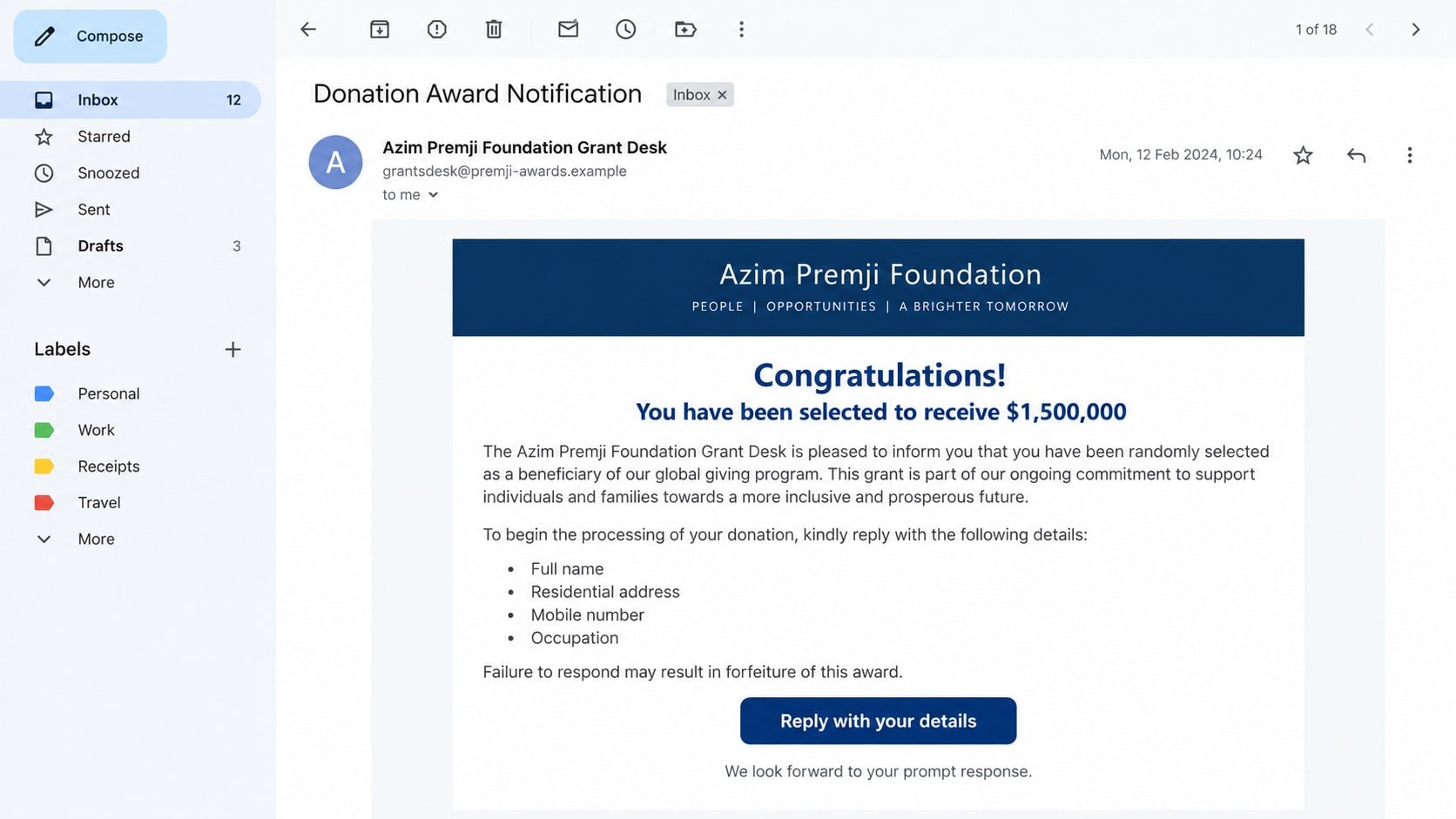
An email says a respected philanthropist has chosen you to receive $1,500,000. You did not apply, but the message describes a global giving programme and asks only for a few personal details to begin.
The Azim Premji Foundation donation scam borrows a real name to sell an imaginary windfall. The first reply feels harmless, yet it opens a carefully staged path toward fees, identity theft, and repeated pressure.
Overview
What the fake donation email promises
The message claims the recipient was randomly selected for a donation, grant, award, or online winner programme connected to Azim Premji or the Azim Premji Foundation. Amounts can reach $1,500,000 or more.
The recipient may be told to use the money for family needs, community projects, or helping less fortunate people. That charitable framing makes the offer feel meaningful rather than merely greedy.
- A large personal grant that required no application
- A claim that the email address was randomly selected
- Names and titles copied from a legitimate foundation
- A request for identity, address, occupation, and phone details
- A supposed bank, attorney, or release agent introduced later
- Processing, transfer, tax, account-opening, or courier fees
The real Foundation has issued a direct warning
The legitimate Azim Premji Foundation warns on its official notices page about fraudulent correspondence sent through email, websites, post, fax, and telephone. These messages may copy logos, photographs, links, and officials’ names.
The Foundation says it does not approach individuals with grant opportunities, charge administrative or handling fees when awarding grants, offer prizes through unsolicited contact, solicit investments, or request bank details outside official processes.
That warning matches the core of the donation email. An unexpected individual award followed by a fee or request for sensitive information is not the Foundation’s grant process.
The promised fortune is used to make smaller losses feel reasonable
Once the victim believes $1,500,000 is waiting, a $480 processing charge can look insignificant. The scammer frames each payment as the final obstacle between the recipient and life-changing funds.
There is no grant. Paying the first fee usually leads to another demand for tax clearance, insurance, anti-money-laundering certification, currency conversion, account activation, or courier delivery.
The personal information collected during the process can also be reused for identity fraud or sold to other criminals, even if the victim refuses to pay.
Why the Philanthropy Story Is So Persuasive
A real public figure lends borrowed credibility
Azim Premji is widely known for business and philanthropy. A recipient who recognizes the name may search it, find genuine charitable work, and assume the email is another part of that work.
The search verifies the person, not the sender. Impostors depend on that confusion and may even include links to authentic biographies or the official Foundation website.
The message appeals to generosity and personal need
Recipients are encouraged to imagine paying debts, supporting family, starting a project, or helping their community. The story gives the money a moral purpose and makes doubt feel like turning away an opportunity to do good.
Some emails ask the recipient to promise charitable use. That request costs the scammer nothing, but it creates emotional commitment to the fake award.
Formal roles create the appearance of an institution
The first sender may introduce a finance officer, bank manager, attorney, courier, or verification committee. Separate email addresses and titles make one criminal operation look like a chain of independent professionals.
Each role confirms the others, but none is independently verified. A conversation between several invented departments is still one closed system.
How the Azim Premji Foundation Donation Scam Works
Step 1: An unsolicited award email finds the recipient
The opening message announces that an email screening, online ballot, verification exercise, or philanthropic programme selected the recipient. No application, prior contact, or credible selection criteria are required.
The sender address often uses a free mailbox or an unrelated domain. The display name may show a senior official, grant desk, or Foundation department even though the address belongs to neither.
Bulk email allows the same promise to reach thousands of people. The absence of the recipient’s name may be explained as privacy, random selection, or an automated international programme.
Step 2: Public information is copied into the story
The message uses the Foundation’s real name, charitable language, or names of people associated with it. It may link to a real article about philanthropy to encourage the recipient to research.
This is an important distinction: a genuine website can be cited by a fraudulent sender. The question is not whether Azim Premji exists, but whether the Foundation sent this exact message.
Only the Foundation’s official contact channels can answer that. Do not use the reply address or telephone number in the award email for verification.
Step 3: A simple reply begins identity collection
The recipient is asked to provide a full name, residential address, country, occupation, mobile number, age, marital status, or scanned identification. The request is described as beneficiary registration.
Because no payment has been requested yet, the step can seem low risk. In reality, it confirms an active target and supplies details for more convincing follow-up messages.
A passport, driver’s licence, tax number, or bank statement can support identity theft. Never send these documents to an unsolicited grant contact.
Step 4: A second official-sounding contact takes over
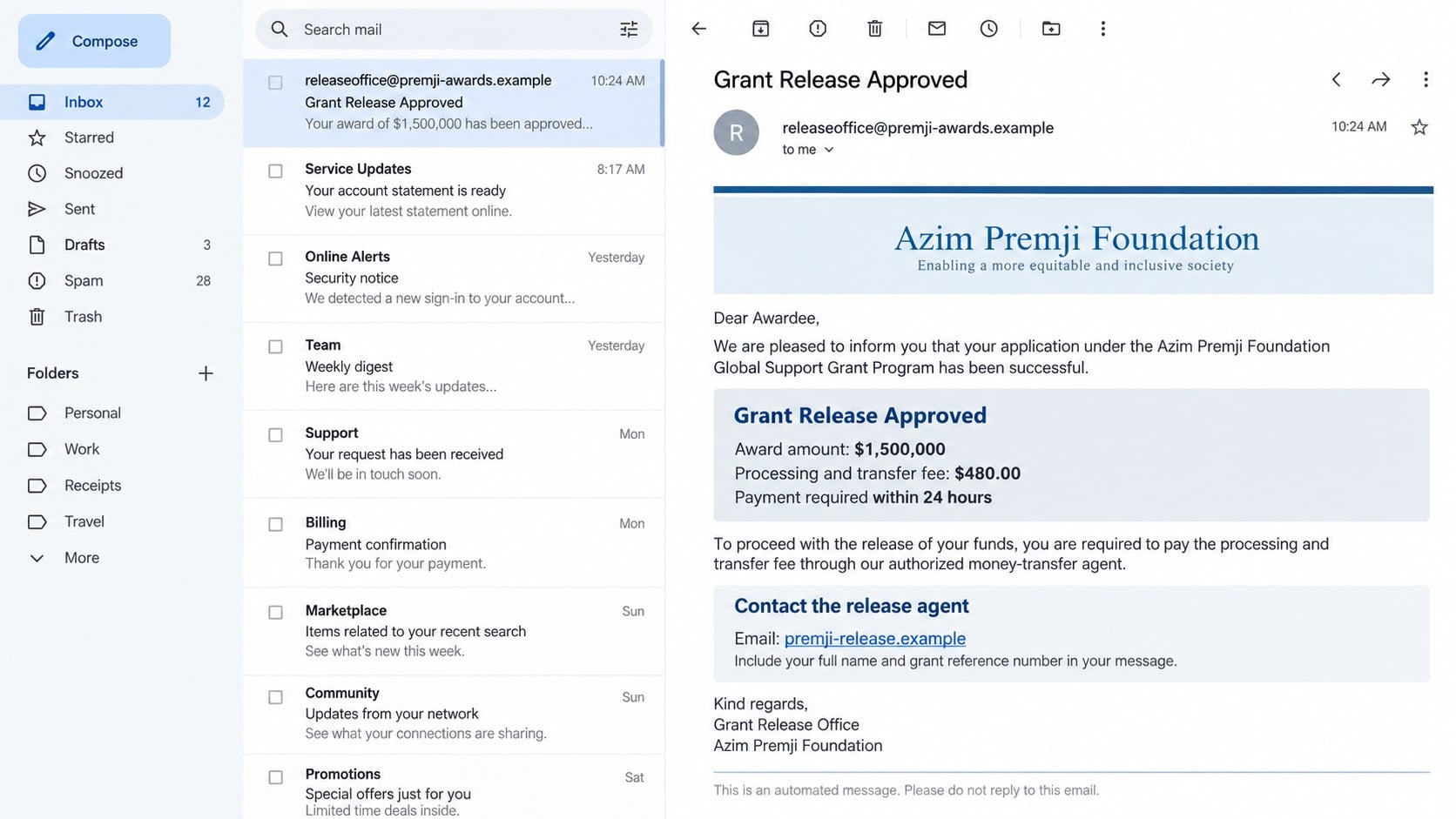
The supposed Foundation representative introduces a bank, payment office, attorney, or release agent. The victim receives a reference number and is told the grant has already been deposited or approved.
New paperwork can include certificates, account statements, letters of authority, or stamps. These files are easy to create and may contain copied names, signatures, and logos.
The extra role is meant to show progress. It also gives the scammer a reason to move the conversation to another address if the first account is reported.
Step 5: A fee appears before the award can be released
The victim is told to pay for processing, a transfer certificate, tax clearance, an account, insurance, anti-terrorism verification, currency conversion, or courier delivery. The amount may begin at $480.
Payment is often requested through a wire, money-transfer service, prepaid card, cryptocurrency, or a personal bank account. Those methods are difficult to reverse and do not resemble a controlled charitable disbursement.
The Foundation explicitly says it does not charge administrative, membership, handling, or other fees when awarding a grant. Any such demand contradicts the organisation’s own warning.
The FTC’s guide to fake prizes and grants gives the same practical test: if someone asks for payment or account information to release an unexpected award, the offer is a scam.
Step 6: One paid fee produces another obstacle
After the first payment, the release agent discovers another requirement. The story may blame a bank, regulator, customs office, tax authority, or international-transfer rule.
Receipts and progress updates keep hope alive. The victim is reminded that abandoning a $1,500,000 award over a smaller charge would be foolish.
This is the sunk-cost trap. Each payment makes the next one emotionally harder to refuse, while the promised grant remains unavailable.
Step 7: The operation shifts to threats or recovery
If the victim stops paying, the criminals may threaten forfeiture, legal action, tax penalties, or blacklisting. None of those threats creates a real obligation because the award never existed.
Later, another person may claim to be police, a bank investigator, or a fund-recovery specialist. They say the stolen money has been located but require a release fee.
A victim list is valuable. Treat every unexpected follow-up about the grant as connected until independently proven otherwise.
Company, Address, and Fulfillment Checks
The Foundation name belongs to a real organisation, not the sender
Impersonation works because the genuine Azim Premji Foundation exists. The fraudulent email does not become authentic by spelling the name correctly or linking to the official site.
Compare the complete sender domain with contact details published by the Foundation. Free mailboxes and lookalike grant domains should not receive personal documents or payments.
An office or bank address can be copied
A message may list a real Foundation office, Reserve Bank address, law office, or courier location. Public addresses can be copied into documents without the occupant’s knowledge.
Call the institution through a number found on its official website. Do not ask the supposed release agent to transfer you to another member of the same scheme.
Support responses are part of the performance
Fast, polite replies can make the award feel professionally managed. Scammers often respond more quickly before payment because keeping the target engaged is their main job.
Genuine support should confirm the programme through an established domain and public process. A chain of personal email accounts is not institutional verification.
A legitimate grant has a traceable application and disbursement
The Foundation’s real grant information is directed toward eligible organisations through its official registration and grant-management process. It is not a random personal award selected from email addresses.
A legitimate disbursement does not require the beneficiary to send money to unlock a larger payment. Fees deducted by a real institution would be documented, not routed to a stranger through irreversible methods.
Warning Signs in a Fake Foundation Grant
- You never applied and cannot identify a real selection process.
- The award is unusually large and available to an individual.
- The sender uses a free or unrelated email domain.
- The message asks for identity documents in the first reply.
- A bank or attorney appears only after you respond.
- You must pay before the grant can be released.
- The payment goes to a person, prepaid card, wire, or crypto wallet.
- Each completed requirement reveals another fee.
- The sender discourages contact with the real Foundation.
Grammar mistakes can be a warning, but polished writing is not proof of safety. Modern scam messages can be professionally written and visually convincing.
The strongest test is the mismatch between the offer and the official process. Random personal awards and release fees are exactly what the Foundation tells the public to distrust.
What to Do if You Have Fallen Victim to This Scam
- End the invented award process. Send no further fee, document, code, or explanation. Preserve the conversation before blocking the accounts.
- Contact the payment provider now. Report a wire, card payment, money transfer, prepaid card, or crypto transaction as fraud. Ask about recall, reversal, recipient-account review, and the evidence required.
- Notify the bank. If you shared account details or statements, ask the fraud team to monitor or replace affected accounts. Change telephone-banking codes and online credentials through official channels.
- Protect identity documents. Report a compromised passport, licence, tax number, or national identifier to the appropriate issuing authority. Consider fraud alerts or credit freezes where available.
- Secure email and cloud storage. Change reused passwords, enable multi-factor authentication, review forwarding rules, and remove unfamiliar sessions. Scammers may use mailbox access to intercept recovery messages.
- Report the impersonation to the real Foundation. Use the contact route on its official notices page and include the sender addresses, domains, documents, and payment instructions without sending additional sensitive data.
- Run Malwarebytes on devices used with attachments. A full scan can detect malicious files or remote-access tools delivered as grant forms. Remove confirmed threats before using the device for banking.
- Use AdGuard to reduce malicious follow-up traffic. It can block many known scam sites, harmful advertising requests, and trackers. It cannot retrieve money sent to a release agent.
- File formal reports. Report to local police, the relevant national fraud service, the bank, and any email or social platform involved. For US-based losses, use the FTC and FBI Internet Crime Complaint Center.
- Refuse recovery-fee offers. No honest investigator needs gift cards, crypto, or a personal transfer to release recovered funds. Select legal or financial help independently.
Frequently Asked Questions
Is Azim Premji Foundation really giving $1,500,000 to individuals?
No random email programme matching this pitch is part of the Foundation’s stated process. Its official warning says it does not offer unsolicited prizes or approach individuals with grant opportunities.
Why does the email link to the real Foundation website?
Scammers use genuine links to borrow credibility. A real link proves the organisation exists, not that the sender works for it or controls the award.
Can a grant require a processing fee?
The Foundation says it does not charge administrative, membership, handling, or other fees when awarding grants. A payment demand in this story is a decisive warning.
What if I replied but did not send money?
Stop contact, secure the mailbox, and prepare for more targeted messages. If you shared identity information, begin the appropriate identity-protection steps even without a financial loss.
Is the bank manager or attorney in the email real?
Do not assume so because the name or institution exists. Contact the bank or law office through its official website and ask whether the person and reference number are genuine.
Will paying one fee release the grant?
No. The grant is invented. Paying confirms that the target is responsive and usually leads to additional fees rather than a transfer.
The Bottom Line
The Azim Premji Foundation donation scam combines a respected name, a $1,500,000 promise, and a staged release process. Its goal is to collect personal data and a succession of smaller payments.
The real Foundation warns that it does not send random personal grants or charge release fees. Do not reply, verify through the official site, and report any information or money already exposed.

Join the discussion
0 commentsShare your experience or ask a question about this article.
Discussion
Start the conversation
Have a question or something useful to share? Add the first comment.