

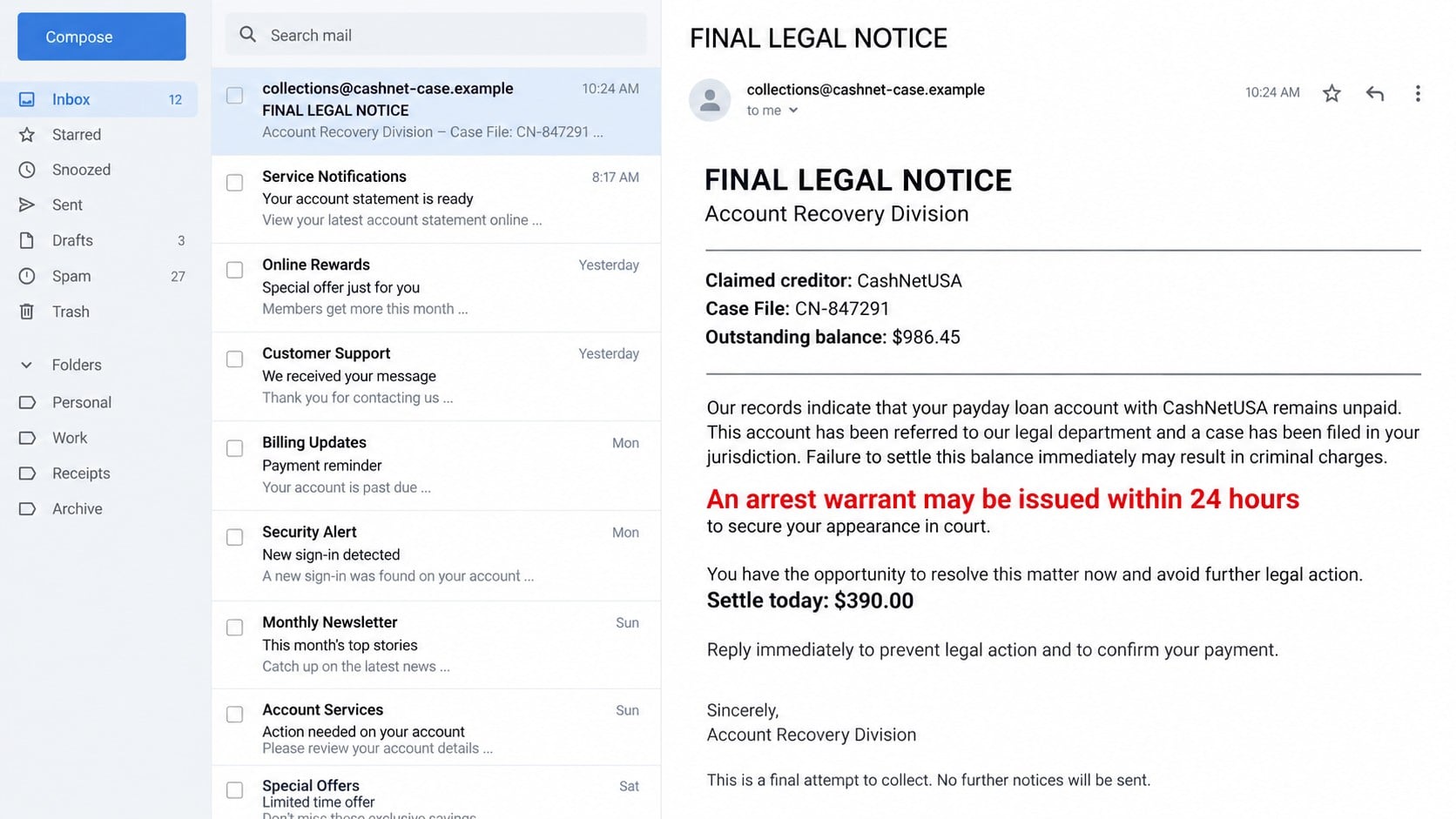
An email marked “FINAL LEGAL NOTICE” claims an unpaid CashNetUSA loan has become a criminal case. Pay a reduced settlement today, it says, or an arrest warrant may be issued within 24 hours.
The CashNetUSA arrest warrant scam is designed to make fear arrive before verification. Whether you once applied for a loan or have never heard of the account, the threat itself tells you where to look next.
Overview
What the fake debt notice claims
The message says a payday loan remains unpaid and that the account has been transferred to a legal, collection, or account-recovery department. It may accuse the recipient of check fraud or violating banking regulations.
A supposed case number, balance, courthouse deadline, or attorney name is added to make the threat feel active. The recipient is offered a lower amount, such as $390, if payment arrives immediately.
- A CashNetUSA loan or payday debt you may not recognise
- A warning about arrest, criminal charges, court, or wage garnishment
- A settlement much lower than the claimed balance
- A deadline measured in hours rather than a normal validation period
- Payment through gift cards, prepaid cards, wire, crypto, or transfer apps
- Refusal to provide a verifiable debt agreement and collector address
CashNetUSA says impostors use exactly these threats
CashNetUSA is a real lender, but its name is widely impersonated. The company’s official online security center warns about callers who fraudulently collect real or phantom debts.
Its warning lists threats of violence, arrest, or wage garnishment, refusal to provide loan history, and demands for amounts that do not match the account. The company says these contacts are not made by CashNetUSA or an affiliate.
A familiar creditor name does not prove the collector has authority. A scammer may know about an old application, a paid loan, or personal data from another source.
A debt question and a scam threat must be handled separately
You should not pay the person who threatens you, but you also should not assume every possible debt disappears. Contact CashNetUSA through its official website and check credit reports or prior records independently.
A legitimate collector must provide validation information about the company, current creditor, amount, and dispute rights. Criminal accusations and instant payment demands are not substitutes for that process.
The FTC says a collector who threatens arrest, refuses a mailing address, or pressures payment on an unrecognised debt may be a fake debt collector. Hang up or stop replying and verify elsewhere.
Why the Threat Can Frighten Even Someone Who Owes Nothing
Payday loan histories are difficult to remember
People may have compared lenders, started applications, borrowed years ago, or used a similar company. A broad accusation can feel plausible when the recipient cannot immediately recall every detail.
The scammer benefits from uncertainty. The notice may list several lender names so at least one seems familiar.
Personal information can make a fake collector sound informed
A caller may know a full name, former address, employer, relative, bank name, or partial Social Security number. That information can come from data breaches, old applications, public records, or purchased lists.
Knowing private facts does not establish ownership of a debt. Validation must connect the collector, creditor, agreement, balance, and consumer through records that can be checked.
Arrest language overrides ordinary judgment
Most people are unfamiliar with debt-collection law, so a message about a warrant or criminal charge sounds urgent. The deadline prevents the recipient from contacting the real lender or asking for written proof.
You cannot be jailed merely for failing to pay ordinary consumer bills. A collector also cannot create an arrest warrant through an email reply or prepaid-card payment.
How the CashNetUSA Arrest Warrant Scam Works
Step 1: An email or call announces a serious legal problem
The contact claims to come from CashNetUSA, a law office, a mediation department, a courthouse processor, or an account-recovery division. The subject may include “lawsuit,” “arrest warrant,” “legal notice,” or “final settlement.”
The sender often uses a free mailbox or a domain unrelated to CashNetUSA. A caller may spoof a local number, government office, or business name.
The message can be sent in bulk, but personal data helps tailor it. Do not confirm addresses, birth dates, bank names, or Social Security digits during the first contact.
Step 2: The scammer invents a debt and criminal explanation
The recipient is told that a payday loan, cash advance, or electronic check was never repaid. The notice may describe the balance as check fraud, theft by deception, banking fraud, or a violation of federal law.
Ordinary unpaid debt is a civil matter. Criminal-sounding labels are used to transform a questionable account into an emergency.
Some victims previously borrowed from a lender with a similar name. The scammer may be exploiting real application data while demanding payment for a debt it does not own.
Step 3: A case file and deadline create false authority
The email supplies a reference number, claimed balance, settlement amount, court date, or attorney signature. These details are typed into a template and do not prove that a case was filed.
The victim may be told that papers will be served at home or work within hours. Another variation threatens to contact the employer, suspend a licence, freeze an account, or damage the recipient’s Social Security record.
The FTC’s fake debt collector guidance says consumers should request validation information and report collectors who use arrest threats or refuse identifying details.
Step 4: A discounted settlement becomes the escape route
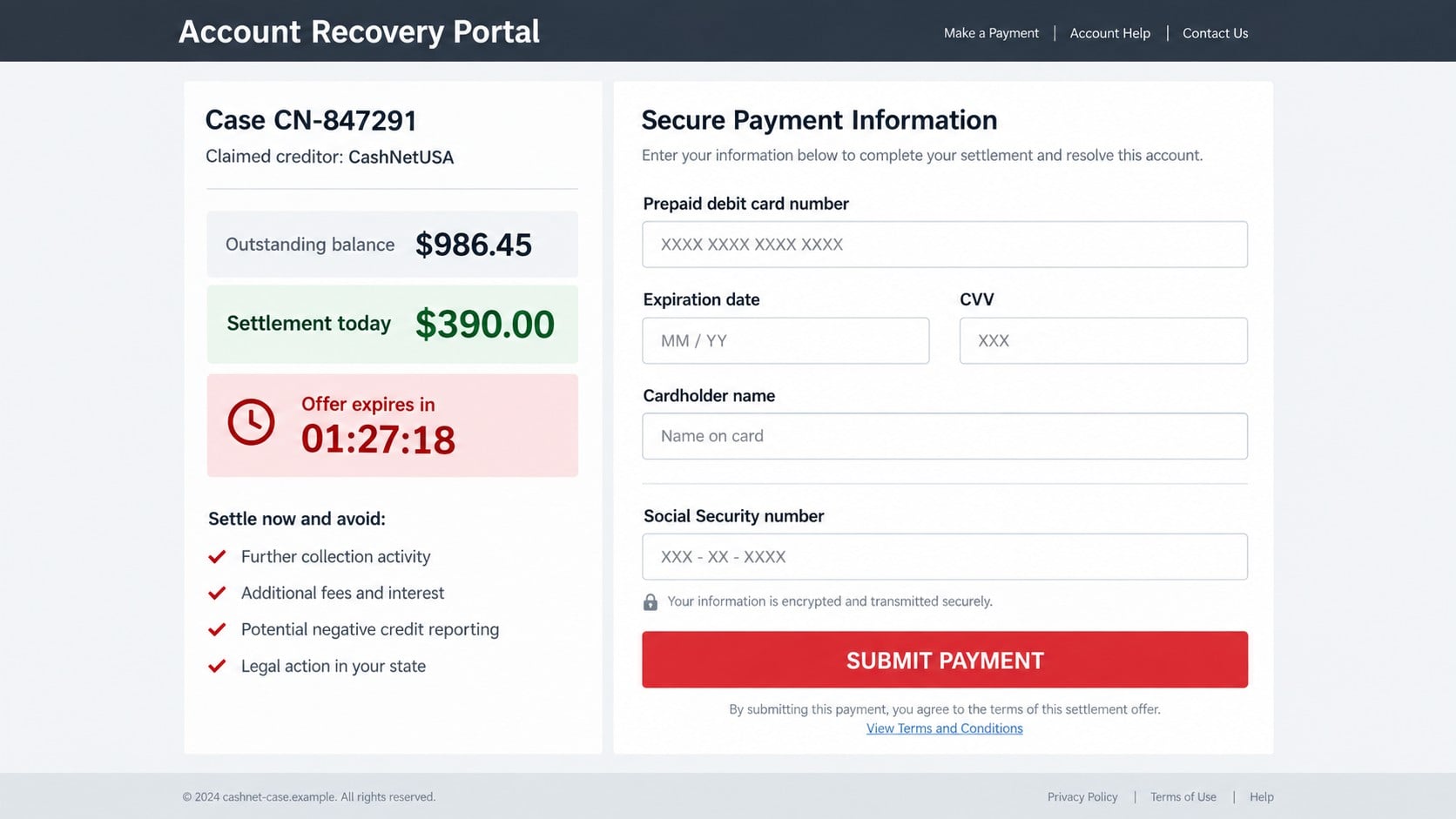
After creating fear, the sender offers relief. A claimed $986.45 balance can supposedly be closed for $390 if the recipient pays before the deadline.
The discount makes immediate compliance feel financially sensible. It also discourages a dispute because the recipient worries that asking questions will cancel the offer.
A legitimate debt remains subject to validation and dispute rights. A lower price does not establish that the debt exists or that the person collecting it has authority.
Step 5: Payment is routed through a hard-to-reverse method
The scammer may request a prepaid debit card, gift card code, wire transfer, crypto payment, cash app transfer, or deposit to a personal account. These methods avoid the controls used by established collection businesses.
A fake portal can collect card details and the settlement amount at the same time. It may also request a Social Security number or banking credentials under the label of identity verification.
CashNetUSA says it does not require upfront payment for its online loans and warns about impostors demanding money transfers or prepaid cards.
Step 6: A payment receipt does not close anything
After payment, the victim may receive a release letter, zero-balance certificate, or promise that the case was dismissed. Because there was no authorised collection, the document has no value.
The criminal may discover another fee for court filing, tax, legal clearance, account closure, or deletion of the warrant. Each demand is presented as the last one.
Stopping after the first payment can trigger harsher threats. That escalation is meant to protect the scammer’s revenue, not enforce a lawful debt.
Step 7: Stolen information supports future impersonation
Identity and financial details entered into the portal can be used for account takeover, fraudulent credit applications, or targeted calls. A later caller may pose as a bank investigator who already knows the case number.
The victim may also receive recovery offers. Someone claims the collector was arrested and promises reimbursement after a processing payment.
Do not trust a new contact because it criticises the first scammer. Verify every institution independently and never pay to release recovered funds.
Company, Address, and Fulfillment Checks
The CashNetUSA name does not identify the collector
CashNetUSA is a legitimate brand, but an email can type that name without permission. Ask the real lender whether it recognises the account, balance, and collection company.
Use the official site and contact information you found yourself. Do not call a “verification department” listed in the threatening notice.
A collector must provide a real mailing address
Fake collectors often refuse an address or provide one copied from a lender, courthouse, shared office, or unrelated law firm. Search the collector’s legal name and licensing information independently.
Request written validation. An address that cannot receive a dispute or has no connection with the named collector is a major warning.
Support should answer account questions without threats
A legitimate collector should explain the creditor, account, amount, payment history, and dispute process. It should not demand secrecy, insult the consumer, or say questions will trigger arrest.
If the agent refuses written proof and insists on payment during the call, end the conversation. Record the time, number, and exact language where local law permits.
The payment route must match the authorised company
A collection agency’s legal name should appear in the notice, payment page, receipt, and bank descriptor. Money should not be sent to an individual, unrelated business, crypto wallet, gift card, or personal transfer account.
Ask the original creditor whether it placed or sold the debt and to whom. If the payment destination cannot be connected to that chain, do not pay.
How to Verify a CashNetUSA Debt Without Trusting the Caller
- End the unexpected call or stop replying to the email.
- Find CashNetUSA’s website independently and contact official support.
- Ask whether the company recognises the loan and collector.
- Request written validation from the supposed collection agency.
- Compare the creditor, original account, balance, fees, and payment history.
- Check credit reports and your own bank records for the account.
- Verify any court case through the court’s official public system.
- Dispute an unrecognised or incorrect debt in writing.
Do not send a copy of your Social Security card or bank login to “help” the collector find the file. A legitimate validation process should not require surrendering new identity credentials to an unverified person.
If you confirm that a real debt exists, communicate with the authorised creditor or collector through documented channels. Verification protects you without avoiding a genuine obligation.
What to Do if You Have Fallen Victim to This Scam
- Stop payments and contact. Do not send another settlement, court fee, gift card, or verification code. Preserve the notice and payment instructions before blocking the sender.
- Call the bank or payment service immediately. Describe the threat and ask whether a transfer can be recalled, a card replaced, or a recipient account flagged. Supply transaction identifiers and recipient details.
- Contact CashNetUSA through its official site. Ask whether any account exists in your name and whether the company authorised the collector. Report the impersonation without using information from the threatening message.
- Secure exposed accounts. Change passwords for email, banking, and lender accounts if they were shared or reused. Enable multi-factor authentication and remove unknown sessions or forwarding rules.
- Protect your identity. If you disclosed a Social Security number, birth date, licence, or bank details, create a recovery plan at IdentityTheft.gov and consider freezes with the three credit bureaus.
- Check for a real debt separately. Review credit reports and request validation from any authorised collector. Paying a scammer does not satisfy a legitimate balance that may exist elsewhere.
- Run Malwarebytes if you opened an attachment or installed a tool. A full scan can find malicious files, remote-access software, or browser changes delivered by the notice. Clean the device before further financial activity.
- Use AdGuard to reduce malicious redirects. Its filters can block many known phishing sites, deceptive ads, and tracking connections. It cannot reverse a settlement already sent.
- Report the fake collector. File reports with the FTC, Consumer Financial Protection Bureau, state attorney general, email provider, and FBI Internet Crime Complaint Center when appropriate.
- Reject recovery and police impersonators. Real agencies do not demand prepaid cards or crypto to pursue a case. Call any officer, court, or regulator back through a verified public number.
Frequently Asked Questions
Can I be arrested for not paying a CashNetUSA loan?
You cannot be arrested simply for failing to pay ordinary consumer debt. Fraud involving separate conduct is different, but a collector cannot create criminal charges by threatening you in an email.
Is CashNetUSA itself a scam?
CashNetUSA is a real lender. This scam involves criminals impersonating it or falsely attaching its name to a phantom debt. Verify the exact account through official support.
What if the caller knows my Social Security number?
Private information can come from old applications or breaches. It does not prove the debt. Stop confirming details, request validation, and take identity-protection steps.
Does a case number prove a lawsuit was filed?
No. Anyone can invent a reference number. Check the named court through its official website or clerk using contact information you found independently.
Should I pay the discounted settlement to make the calls stop?
Not before verification. Payment to a fake collector will not resolve a real account and can lead to more demands. Ask for validation and confirm authority with the creditor.
What if I really had a CashNetUSA loan years ago?
That history can make the message convincing, but the collector still must be verified. Contact CashNetUSA and compare records, dates, balance, ownership, and any prior payoff.
The Bottom Line
The CashNetUSA arrest warrant scam turns a disputed or invented payday debt into a false criminal emergency. The case number, personal details, and discounted settlement are tools for pressure, not proof.
Stop the conversation, verify the account with CashNetUSA, and demand proper validation from any collector. If money or identity data was already sent, contact the bank and begin recovery immediately.

Join the discussion
0 commentsShare your experience or ask a question about this article.
Discussion
Start the conversation
Have a question or something useful to share? Add the first comment.