

A text saying your loan application was accepted can be hard to ignore, especially if you have recently compared rates or need money quickly. The message skips the sales pitch and makes approval sound almost complete.
That unfinished-business feeling is the hook. Before following the Bravaro link, ask a simple question: did you knowingly apply with a lender by that name, and can you verify who is actually requesting your financial details?
Overview
What is the Bravaro loan text scam?
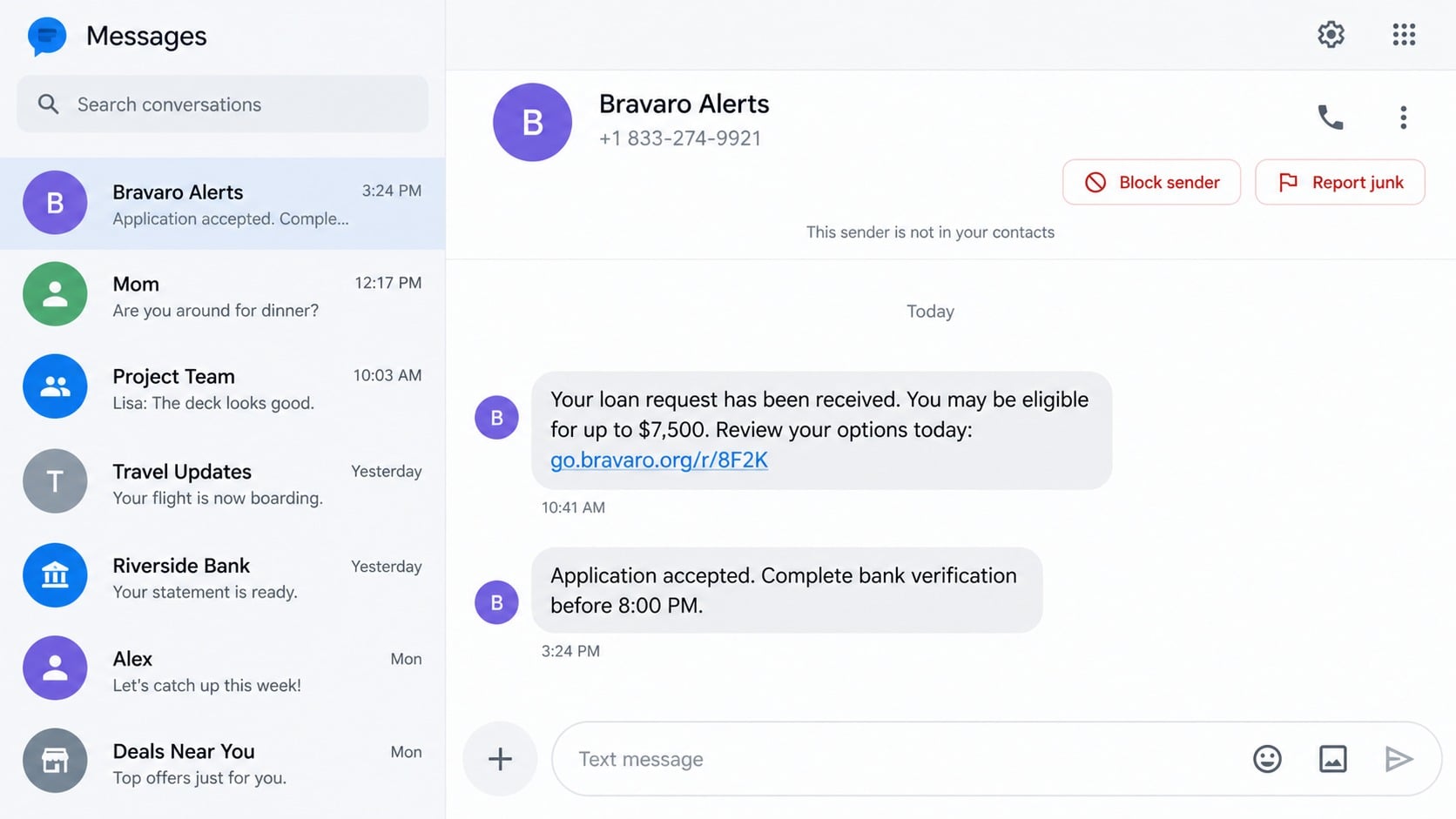
The Bravaro loan text scam is a campaign of unsolicited messages claiming a loan request was received, accepted, or ready for review. Reported texts have included links using Bravaro-branded subdomains and prompts to finish an application online.
The name in this article identifies the wording and web addresses shown in the messages. It does not establish the legal identity of the sender, because short codes, telephone numbers, display names, and redirects can be rented, spoofed, or changed.
The central risk is that recipients are pushed into a financial form they never intentionally began. The form may collect identity and bank information, route a person among lead buyers, or develop into an advance-fee loan demand.
Why the message can feel connected to a real search
People often submit one comparison form and then hear from several lenders or marketing partners. A Bravaro message arriving afterward may feel like the expected result of that activity, even if the recipient never saw the name before.
Loan language is intentionally broad. Phrases such as request received or application accepted avoid naming an amount, date, lender, or credit product until the recipient clicks.
The message may also reach someone who never applied anywhere. Sending large volumes is inexpensive, and a small number of timely matches can make the campaign profitable.
Red flags in Bravaro loan messages and pages
An unsolicited financial text deserves verification before any reply. Leave the conversation when the message or landing page shows several of these warning signs:
- You did not submit a loan application under the stated company name.
- The text announces acceptance without identifying the lender, APR, or repayment period.
- A shortened or tracking link hides the final destination.
- The page requests a Social Security number and bank credentials before giving legal disclosures.
- The lender’s state licence cannot be matched to the exact company and domain.
- Approval is described as guaranteed despite no meaningful underwriting.
- A fee, deposit, insurance payment, or gift card is required before funds arrive.
- The sender urges a reply such as YES or STOP even though you never opted in.
The FTC’s January 2026 alert, Can you spot a fake loan text scam?, describes unexpected preapproval and application messages as phishing. Its advice is direct: do not reply, do not click, and report the text through your messaging service.
How the Bravaro Loan Text Scam Works
Step 1: A bulk message creates a false application history
The first text does not ask whether the recipient wants to borrow. It says a request already exists, turning a cold solicitation into something that feels like account activity.
Different versions may say received, pending, preapproved, accepted, or action required. The wording invites the reader to correct, inspect, or complete the supposed record.
Even someone who knows they did not apply may click from concern that their identity was used. The same link therefore attracts both hopeful borrowers and worried fraud victims.
Step 2: A branded redirect separates the text from the final page
Reported Bravaro texts have used addresses such as go.bravaro.org and start.bravaro.org. A short path can record the recipient, campaign, and click before forwarding the browser somewhere else.
Redirects are common in legitimate marketing, but they also make inspection harder. The landing page may change by location, device, time, or advertising partner while the original message remains the same.
Do not judge the destination by the visible words alone. A subdomain belongs to the registered domain after it, but the page can still be operated for lead collection rather than direct lending.
Step 3: A simple eligibility quiz lowers resistance
The page may begin with harmless questions about desired amount, income range, employment, and credit condition. Progress bars and large buttons make the process feel quick and low commitment.
Each answer builds a valuable borrower profile. The operator can use it to choose later questions, sell the lead, or target the person with a more convincing offer.
A statement that checking rates will not affect credit can encourage completion. It should not replace a clear explanation of who receives the data and whether a hard inquiry may occur later.
Step 4: The form requests identity and banking data
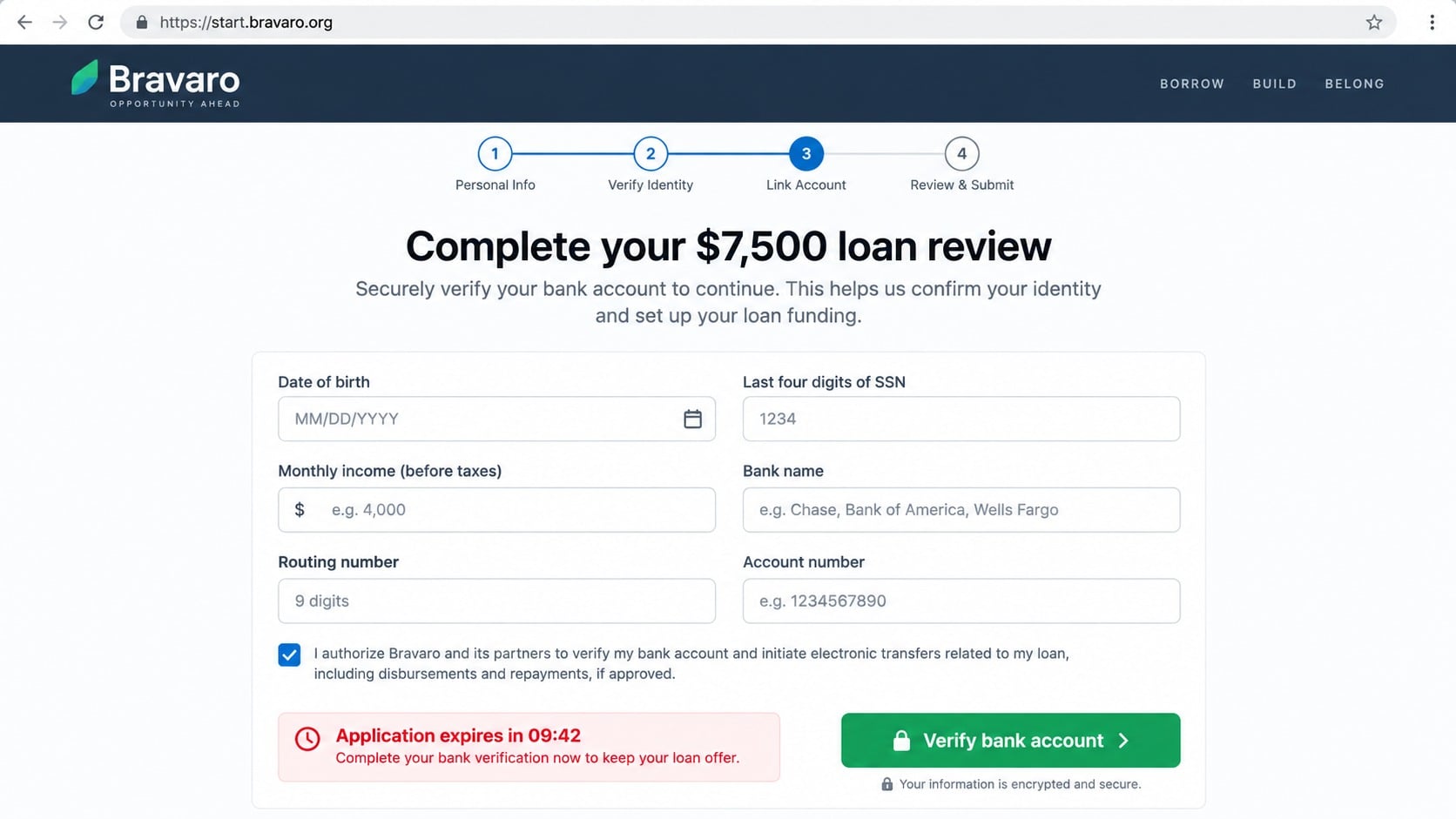
After several easy screens, the application asks for a full address, date of birth, Social Security number, driver’s licence, employer, monthly income, and banking details. Abandoning the process now feels like wasting earlier effort.
The last four digits of a Social Security number may seem safer than the complete number. Combined with other fields, however, they can help a criminal pass identity checks or craft highly personalized follow-up contact.
A bank-linking screen can request online banking credentials or routing and account numbers. Never sign in through an unfamiliar loan page until the legal lender and its service provider are independently verified.
Step 5: The information is routed, sold, or used for impersonation
Some loan pages are lead generators rather than lenders. A disclosure may permit data to be shared with a large network of finance, insurance, marketing, or debt-related businesses.
That can produce a flood of calls and texts even when no loan is issued. The new callers may know the requested amount and income, making them appear to have reviewed a genuine application.
In a malicious operation, the details can support identity theft, account takeover, or new credit attempts. The victim may not connect those events to a short form completed weeks earlier.
Step 6: A supposed approval introduces an advance fee
The next contact may congratulate the applicant and promise fast funding. Before releasing the loan, however, the representative claims a processing fee, insurance premium, tax, deposit, or credit repair payment is required.
The FTC’s advance-fee loan guidance warns that legitimate lenders do not guarantee credit in exchange for an upfront payment. The label on the fee does not change the risk.
Gift cards, cryptocurrency, wire transfers, and person-to-person payments are common demands because they are difficult to reverse. A promise that the amount will be refunded with the loan is part of the pressure.
Step 7: One response leads to more targeted contact
Clicking or replying confirms that a real person monitors the number. The recipient may then receive offers from different company names that reference the same loan amount.
If money was lost, another caller may claim to be a regulator, investigator, or recovery specialist. They can use information from the first interaction to sound credible and request a second fee.
Recovery does not require paying an unknown caller. Contact the payment provider, credit bureaus, and government reporting services through independently located channels.
Is Bravaro a Lender or a Marketing Funnel?
The most important distinction is whether the site itself makes credit decisions or merely sends applications to third parties. A lead generator can look like a lender while having no ability to approve or fund a loan.
Read the disclosures around the submit button. Look for phrases such as marketing partners, service providers, matching network, consent to calls, or not a lender.
Consent language may authorize automated calls and texts from many businesses. That does not make every resulting offer fraudulent, but it can explain why contact multiplies after one form.
A lender should provide its full legal name, licensing information, contact details, interest rate, fees, payment schedule, and required federal or state disclosures. An approval banner without those facts has little value.
Do not assume a domain registration or attractive logo supplies regulatory standing. Verify the exact lender through the financial regulator for your state, then make sure its listed website and telephone number match.
Company, Address, and Fulfillment Checks
Identify the legal company behind the form
Find the entity named in the privacy policy and loan disclosures, not only the Bravaro brand at the top. Record the legal name, registration state, address, and customer-service details.
If several entities appear, determine which one collects the application and which one would fund a loan. Vague references to partners do not tell you who is accountable for sensitive data.
Do not enter more information merely to reach the disclosures. A trustworthy service should make essential company and privacy terms available before submission.
Verify licences with the appropriate regulator
Search the lender in your state banking or financial-services registry. For mortgage-related claims, the Nationwide Multistate Licensing System may also provide useful licensing records.
Match the company name, licence number, address, domain, and telephone. Scammers sometimes copy the licence of a real business while changing the contact route.
A lead-matching site may not hold the same licence as a direct lender. It should state that role clearly instead of letting the consumer believe approval has already occurred.
Inspect the address and support route
Search the stated office independently and compare it with corporate filings. A mailbox is not proof of wrongdoing, but it offers less accountability than a verifiable operating location.
Call a public number from the regulator’s listing, not the one in the text. Ask whether the business sent the message and whether an application exists in your name.
Generic email addresses, broken contact pages, and support that refuses to answer licensing questions are reasons to stop. A real lender should not hide its identity while requesting yours.
Demand complete loan terms before any payment
Review the APR, finance charge, amount financed, total payments, payment dates, late fees, and security requirements. A monthly payment alone does not reveal the true cost.
No fee should be paid by an irreversible method to unlock funds. Origination costs on legitimate loans are disclosed in writing and handled through documented lending channels.
Never accept a check and send part of it elsewhere. A deposited check can appear available before the bank discovers it is fraudulent, leaving the customer responsible for the amount sent.
How to Respond Without Confirming Your Number
Do not reply to argue, ask who applied, or request removal. A reply can confirm that the number is active, and the sender can ignore opt-out language.
Use the built-in Report Junk control or forward the message to 7726 if your carrier supports it. Then block the sender and delete the conversation after preserving evidence you may need.
- Take a screenshot showing the sender, date, full wording, and destination address.
- Do not open the link simply to see where it goes.
- Check credit reports if the message claims an application you did not make.
- Contact a named lender through its regulator-listed number.
- Remove personal details from data-broker profiles where practical.
- Use unique passwords and strong multifactor authentication on email and banking.
If you really need credit, begin with a bank, credit union, or lender you select independently. Comparing written offers from verified institutions is safer than continuing a process started by an unexplained text.
What to Do if You Have Fallen Victim to This Scam
- Stop the application and preserve evidence. Save the text, final URL, screenshots, disclosures, emails, caller numbers, and every amount requested. Do not keep interacting to gather more proof.
- Contact your bank through its official channel. If routing details, account numbers, or login credentials were exposed, change online banking access, ask about replacing the account, and review pending transfers. Never approve a verification deposit for an unknown lender.
- Protect your Social Security number. Visit IdentityTheft.gov for a recovery plan, place fraud alerts or credit freezes with all three bureaus, and examine reports for unfamiliar inquiries.
- Dispute any money sent. Call the card issuer, transfer service, wire company, or cryptocurrency platform immediately. Explain that the payment resulted from a fake loan promise and ask whether it can be stopped or recalled.
- Secure email and telephone accounts. Replace reused passwords, enable app-based multifactor authentication, review mailbox forwarding, and add a carrier PIN. These accounts can be used to reset financial access.
- Report the message. Use Report Junk, forward it to 7726 where available, and submit the campaign to ReportFraud.ftc.gov. Include the Bravaro wording and domain as evidence, not as a verified sender identity.
- Check for unwanted software. If the site or caller persuaded you to install an application, run a full scan with Malwarebytes. Remove unfamiliar remote-control tools and browser extensions before accessing financial services again.
- Limit repeat phishing. Block the sending number and consider AdGuard for added protection against malicious advertising and known phishing addresses. Continue checking financial domains manually because filters cannot catch every new page.
- Expect secondary approaches. Treat new lenders and recovery services that quote your data with suspicion. Stolen application details make a stranger sound informed, but they do not make the offer legitimate.
Frequently Asked Questions
Did Bravaro really receive a loan application in my name?
The text alone cannot prove an application exists. Do not use its link to investigate. Check credit reports and contact any named lender through a number found in an official registry.
Is it safe to reply STOP to the message?
For an unsolicited suspicious text, use the messaging app’s spam-report control instead. Replying can confirm your number, while a malicious sender is not obligated to honor the request.
Why does the link use go.bravaro.org or start.bravaro.org?
Those are subdomains used in reported messages and application paths. A branded address does not show whether the page is a lender, lead generator, or safe recipient of financial data.
Can a lender approve me without checking my credit?
Some products use alternative underwriting, but responsible providers still verify identity and ability to repay. Guaranteed approval before meaningful review is a classic warning sign.
Should I pay a processing fee before the loan is deposited?
Do not pay an upfront fee to secure guaranteed credit, especially through gift cards, cryptocurrency, or wire transfer. Verify every charge in the lender’s written disclosures and regulatory listing.
What if I entered only the last four digits of my SSN?
Those digits can still help impersonation when combined with your name, address, birthday, bank, and income. Monitor credit, secure accounts, and be alert for highly personalized calls.
The Bottom Line
The Bravaro loan text creates momentum by treating a cold recipient like an approved applicant. The click can lead from a harmless-looking quiz to identity data, bank details, persistent marketing, or a demand for money before funding.
A trustworthy loan begins with a lender you can identify and verify, not an unexplained acceptance message. Ignore the link, investigate through public records, and never trade an upfront payment or security code for a promise of fast cash.








