

An EBT alert can create immediate fear because the balance may be needed for groceries that day. A message saying the card is suspended or requires review gives the recipient little emotional room to question the telephone number.
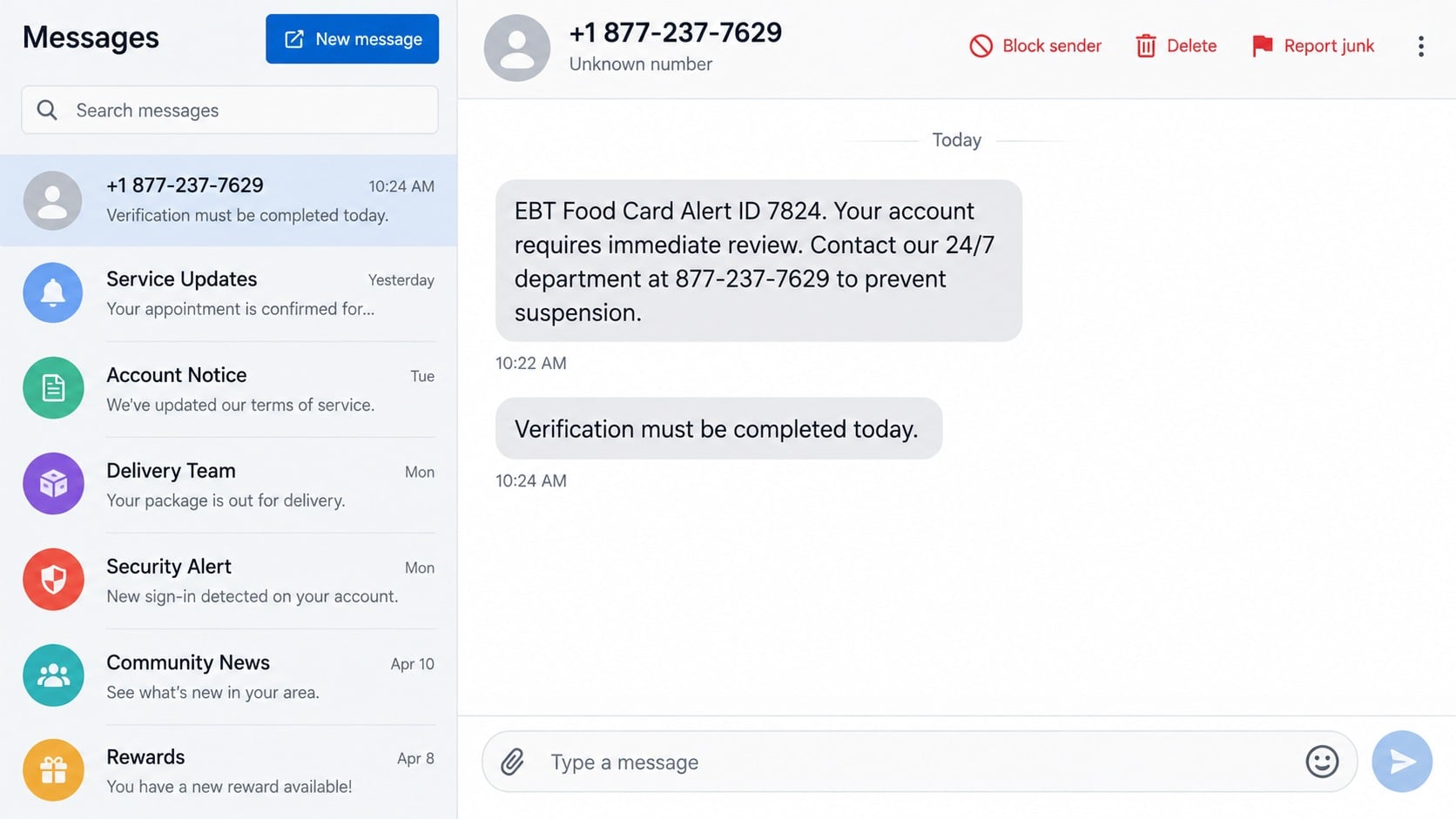
The number 877-237-7629 has appeared in texts directing people to a supposed 24/7 EBT department. Calling it can expose the card number, PIN, and identity details needed to empty a benefits account.
Overview
What is the 877-237-7629 EBT text scam?
The 877-237-7629 EBT text scam is a phishing message that claims an Electronic Benefit Transfer card needs urgent attention. Reported versions use phrases such as EBT Food Card Alert, include a random alert ID, and direct the recipient to a 24/7 department.
The text is not proof that a benefits agency detected a real problem. Some recipients report receiving it despite having no EBT card, showing that the campaign can be sent broadly rather than drawn from an actual account record.
The goal is to make people call before checking the number on the back of their card. A fake automated menu or representative can then request the card number, PIN, Social Security number, and other details.
Why an 877 number can seem official
Toll-free numbers are common for government contractors and customer-service lines. Seeing an 877 area code can therefore feel more credible than an ordinary mobile number.
There is no single official meaning attached to 877. Any eligible business or individual can obtain a toll-free line, and caller ID can display a different number from the true source.
A real EBT support number also varies by state. The correct route is printed on the back of the card and published by the state agency, not established by the area code in an unexpected message.
Signs that an EBT alert is phishing
Government benefit agencies publish consistent warnings about requests for secret card data. Treat the alert as fraudulent when it includes one or more of these features:
- The text tells you to call 877-237-7629 or another number not printed on the card.
- It claims benefits will be suspended, canceled, or lost unless you act today.
- An automated menu asks for the complete EBT card number and PIN.
- A link opens a generic benefits portal without your state’s official domain.
- The sender requests a Social Security number, birthday, or security code.
- The message reaches someone who has never had an EBT account.
- The text uses a random alert ID but gives no state agency or case information.
- The caller offers to protect the balance by moving benefits or changing payment details.
The California Department of Social Services’ EBT safety guidance states that state and county agencies will not text or call to request a card number or PIN. Only provide those details when you place the call using an independently verified customer-service number.
How the 877-237-7629 EBT Text Scam Works
Step 1: A bulk text imitates an automated benefits notice
The campaign begins with a short message designed to look machine-generated. A phrase such as Alert ID 7824 adds a reference number without providing any information that only the real agency would know.
Recipients may be selected randomly or from general contact lists. The operation does not need to know who receives SNAP because the cost of sending texts is low and millions of people use EBT cards.
A message that reaches a non-cardholder is clearly misplaced. A message that happens to reach a participant can feel personal even when the wording is identical.
Step 2: The threat focuses attention on losing food benefits
The text may say access is locked, a review is incomplete, or the card will be suspended. This creates urgency around money a household cannot easily replace.
Scammers know that a frightened recipient may not search for the state agency or check the card. The 24/7 label makes the provided number seem like the fastest solution.
A genuine administrative issue should still be verified independently. Do not let a same-day deadline decide where you disclose a PIN.
Step 3: The toll-free line copies a customer-service menu
Calling the number may reach a recording that welcomes the user to EBT support. Menu prompts, hold music, and account language can be copied from legitimate systems or created cheaply.
The recording asks the caller to enter a 16-digit card number, expiration information, or PIN. Keypad entries can be captured even if the call disconnects before any representative speaks.
A live operator may claim the data is needed to unlock the account. The person can sound patient and professional while recording every answer.
Step 4: A follow-up page collects a complete identity
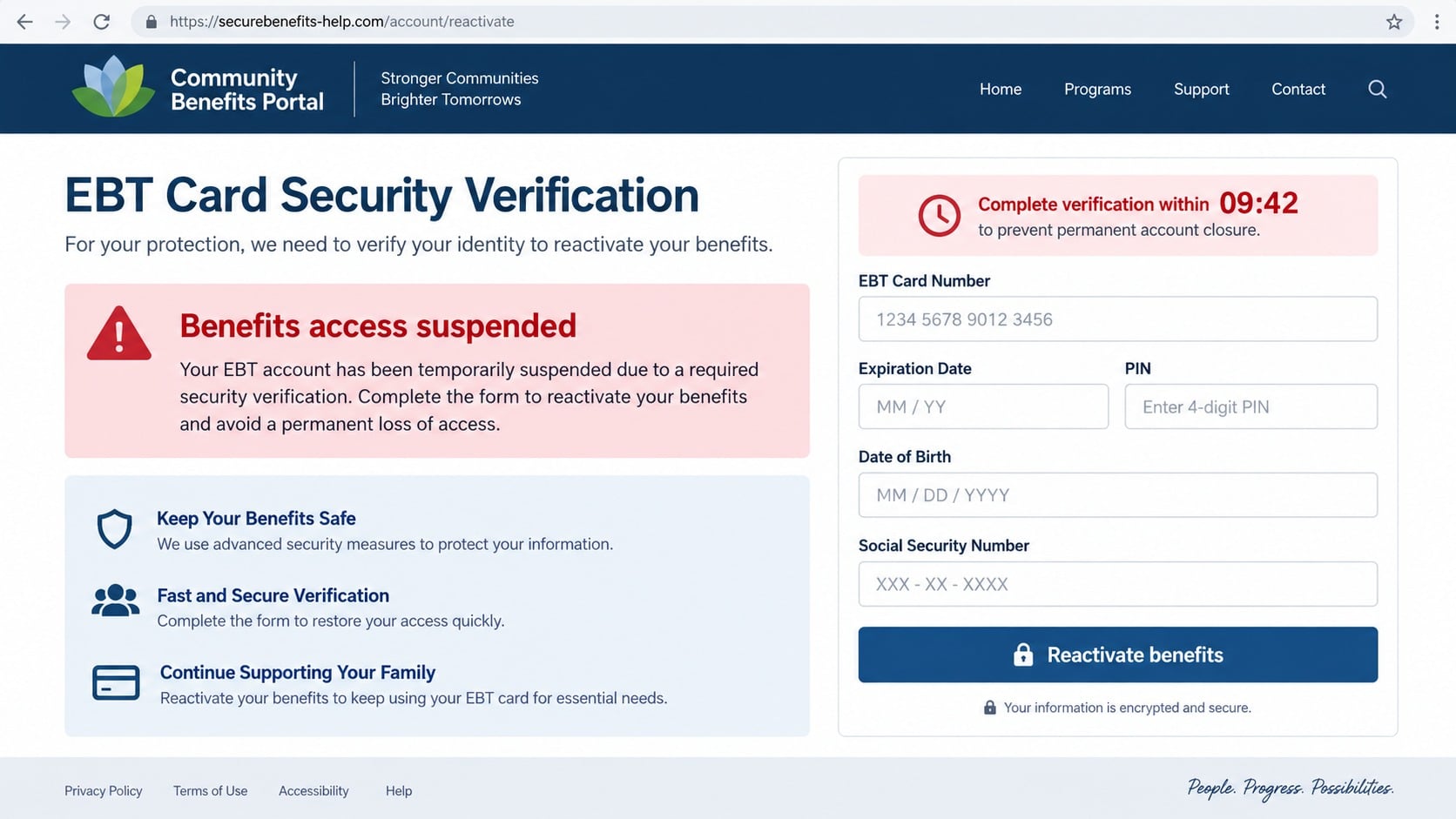
The caller may send a link and say online verification is safer. The page can use generic public-benefits colors, security icons, and accessibility links to resemble a state portal.
Fields may request the EBT card number, PIN, date of birth, address, and Social Security number. Together, those details support both benefit theft and broader identity fraud.
The domain may include words such as benefits, EBT, secure, help, or reactivate. Those words are not evidence of government ownership; official state pages should be reached through the agency’s known website.
Step 5: Criminals test the stolen card information
Once the card number and PIN are captured, the operator can check the balance or attempt account access. The information may be used to create a cloned card or make unauthorized transactions.
Thieves often wait until benefits are deposited, then spend them quickly. A victim can check the account in the morning and find the balance gone before reaching a store.
The USDA’s guidance on stolen SNAP benefits says state agencies and EBT processors do not call or text to ask for a PIN or card number. Keeping both secret is central to preventing theft.
Step 6: The account may be changed to delay discovery
If the system allows online account management, criminals may change contact information, security questions, or alert settings. That can prevent the real cardholder from receiving warnings.
A fraudster may also persuade the victim to read a one-time code or approve a change presented as reactivation. The code completes the criminal’s action rather than protecting the card.
Any unexpected confirmation message should be read carefully. Call the number on the physical card and ask what event generated it.
Step 7: Follow-up messages target the same household
A recipient who replied or called may receive more notices under different agency names. The operation now knows the number reaches someone concerned about benefits.
Later messages can mention recertification, a replacement card, benefit increases, fraud reimbursement, or a free government telephone. Each story seeks another piece of information.
Criminals may also offer to recover stolen benefits for a fee. Official replacement procedures vary by state, but they do not begin with gift cards or cryptocurrency sent to an unknown caller.
Why EBT Card Numbers and PINs Are So Valuable
An EBT card functions differently from a conventional credit card, but the card number and PIN can still authorize spending. Once both are exposed, the account may be emptied rapidly.
Benefit theft creates immediate hardship because the funds were budgeted for essential food. Reimbursement rules and deadlines vary, and not every loss is automatically replaced.
A Social Security number expands the damage beyond the EBT account. It can support credit fraud, tax identity theft, employment fraud, or convincing calls that pretend to investigate the original incident.
Date of birth and address details can help answer identity questions. Criminals combine information from the phishing call with material found in public records and earlier breaches.
Never use the same PIN for another card or account. Changing the EBT PIN after exposure is necessary, but every reused secret should also be replaced.
Company, Address, and Fulfillment Checks
Identify the state agency responsible for your benefits
SNAP is federal, but state agencies administer benefits and publish local support routes. Locate your agency through an official state website or the documents that came with the card.
Do not let the caller tell you which agency to contact. A generic title such as EBT Department or Food Card Security has no useful legal identity.
Ask the verified agency whether any notice, recertification, or hold exists. If the account is normal, report the wording and number from the text.
Use only the number on the back of the card
Turn the physical card over and call the printed customer-service number. If the card is unavailable, navigate from the state’s official benefits website.
Do not compare only the area code. Fraud lines can differ from a legitimate helpline by one digit, a technique designed to survive a quick glance.
When you place the verified call yourself, the automated system may legitimately ask for card information. The safety difference is that you chose a number obtained from a trusted source.
Check the web address before entering account data
State websites usually use a clearly documented government domain or link to an identified EBT processor. Reach that page through the agency rather than a text.
A lock icon means the connection is encrypted. It does not show that a generic benefits portal belongs to the government.
Close pages that demand immediate reactivation, display countdowns, or request both the complete card and Social Security number without a verified reason.
Confirm any replacement or reimbursement process
Report a compromised card promptly and ask the agency whether it must be canceled, frozen, or replaced. Record the case number and the time of the report.
If benefits were stolen, request the official claim form and deadline. Do not pay an outside service to submit it or share the new card details with someone offering faster reimbursement.
Delivery of a replacement card should follow the state program’s normal procedure. A stranger should never ask you to mail the old card or photograph both sides.
How to Protect an EBT Account From Text and Card Theft
Phishing is one path to benefit theft, while skimming at a payment terminal is another. Good protection addresses both without making normal grocery shopping unnecessarily difficult.
- Keep the card number and PIN secret outside your household.
- Change the PIN regularly and avoid sequences such as 1111 or 1234.
- Lock the card between purchases if your state’s official app supports that feature.
- Block out-of-state and online transactions when those controls are available.
- Inspect card readers for loose or mismatched parts before swiping.
- Cover the keypad while entering the PIN.
- Review the balance and recent transactions frequently around deposit dates.
- Ignore links and callback numbers in unexpected benefit messages.
South Carolina’s official texting-scam alert describes messages that claim a card is locked and direct recipients to a toll-free number. Its guidance is to avoid responding and protect the card information.
Use alerts offered inside the authentic EBT system. Legitimate balance notifications can exist, but they should never send you to an unfamiliar number for urgent identity verification.
What to Do if You Have Fallen Victim to This Scam
- Call the verified EBT customer-service line immediately. Use the number printed on the card or your state’s official site. Ask to freeze or cancel the card, change the PIN, review transactions, and issue a replacement.
- Report stolen benefits to the state agency. Request the official electronic-theft or fraud form, ask about filing deadlines, and keep the case number. Replacement eligibility differs by location and date, so act without delay.
- Change compromised account access. Replace passwords, security questions, email addresses, and PINs that the caller learned. Review whether online purchases, out-of-state transactions, or card unlock settings were changed.
- Protect your identity. If you disclosed a Social Security number or date of birth, create a recovery plan at IdentityTheft.gov, freeze credit reports, and monitor for unfamiliar accounts or inquiries.
- Preserve the message and call evidence. Save screenshots, voicemail, the 877-237-7629 number, timestamps, website addresses, transaction history, and names used by the caller. Hide card and case numbers before sharing copies.
- Report the phishing attempt. Use the messaging app’s spam option, forward the text to 7726 where supported, and submit a report at ReportFraud.ftc.gov. Notify the state benefits agency as well.
- Contact banks if other financial data was exposed. A caller who obtained debit-card or bank credentials can cause losses outside the EBT balance. Ask the institution to secure access and review pending transfers.
- Check devices only when software was involved. If the page demanded an application, extension, or remote-support program, run a full scan with Malwarebytes. An ordinary text without a download does not mean malware is installed.
- Reduce future malicious links. Block the sender and use AdGuard as an added filter for phishing and deceptive advertising. Continue using the number on the card because no filter can verify every new campaign.
Frequently Asked Questions
Is 877-237-7629 an official EBT customer-service number?
Do not treat it as official because it appeared in an alert. Use the number printed on your EBT card or published by your state agency and report the suspicious message.
Will an EBT agency ever text me?
Some programs offer legitimate alerts, but government agencies consistently warn that they will not text to request a card number or PIN. Verify notices through the authenticated account.
What if the text includes my real name?
A name can come from public records or a breached contact list. It does not prove the sender can see your benefits account or represents the state.
Can someone steal benefits with only my card number?
The PIN usually provides critical additional access, but the card number is still sensitive. Report exposure so the program can advise whether replacement is necessary.
Should I call back to tell them they have the wrong person?
No. Calling confirms an active number and puts you inside the fake verification system. Block and report the text without engaging.
Can stolen SNAP benefits be replaced?
Rules, available funding, and deadlines change. Contact the administering state agency immediately and request its current stolen-benefit claim procedure rather than relying on a stranger’s promise.
The Bottom Line
The 877-237-7629 EBT message uses a toll-free number and urgent account language to imitate official support. The decisive warning is a request to disclose card data, a PIN, or identity information through a route supplied by the text.
Do not call the number in the alert. Use the telephone line on the back of the EBT card, secure the account immediately after any disclosure, and report stolen benefits before the applicable deadline passes.








