

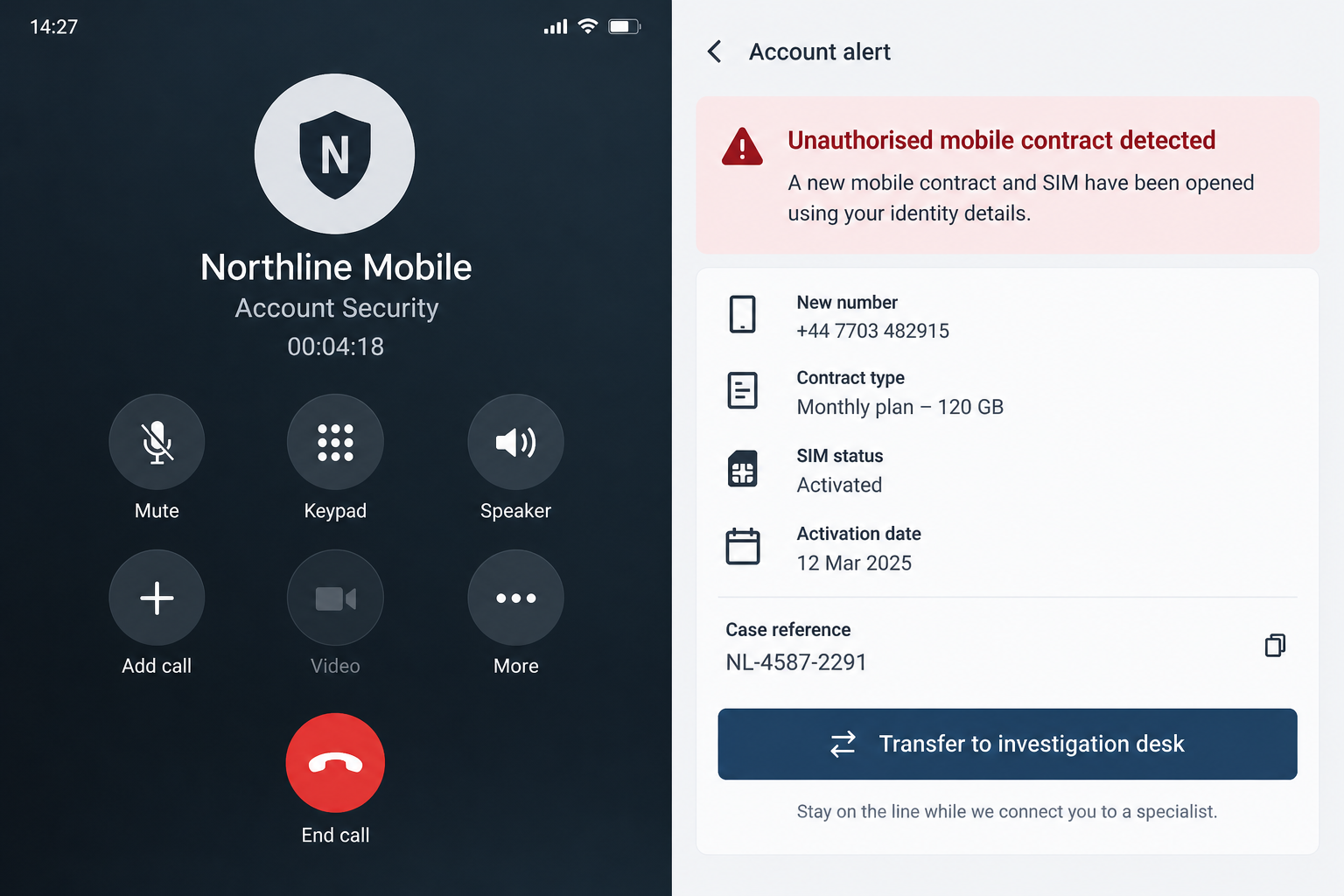
A phone contract call scam can begin when a supposed telecom employee reports an account opened with your identity. You do not recognize the number, handset, or monthly charge.
Then the explanation changes. The account is supposedly linked to money laundering, so the call must be transferred to an investigator who can clear your name.
Overview
The unknown phone contract is an emotional opening
A phone contract call scam begins with a problem that is easy to imagine. Someone may have used the victim’s identity to register a SIM card, buy a handset, create an insurance policy, or open an account.
The caller poses as a telecom provider, bank, or financial institution and already knows enough personal information to sound credible. They offer to cancel the account while quietly increasing the stakes.
The purpose is not to resolve a contract. It is to make the victim afraid that their identity is connected to a serious crime.
A staged transfer creates a fake chain of authority
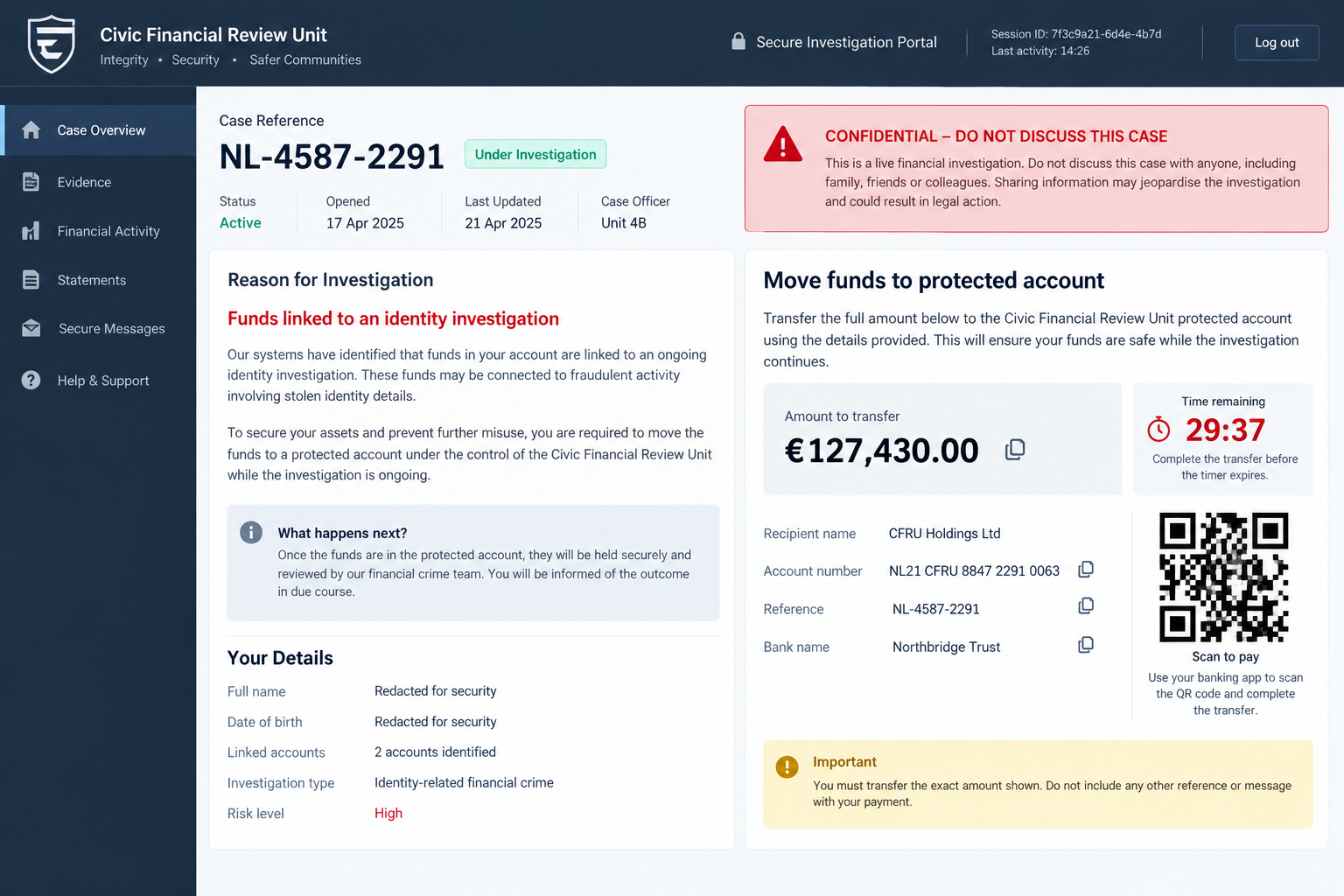
The first caller transfers the conversation to another scammer posing as police, a regulator, or a government official. The handoff feels convincing because two apparent organizations now confirm the same story.
The fake investigator accuses the victim of money laundering and demands secrecy. Bank balances, valuables, identity documents, and login information are described as evidence needed for the case.
To prove innocence, the victim is told to move money into a safe account, withdraw cash, buy cryptocurrency, or hand valuables to a representative.
Police confirmed a surge with substantial losses
The Singapore Police Force warned about this call-transfer campaign in July 2026. At least 12 cases reported since May had caused approximately $274,000 in losses.
Police described initial calls from supposed banks, financial institutions, and telecom providers, followed by transfers to impostors claiming to represent law enforcement or regulatory agencies.
Warning signs include:
- an unsolicited call about a phone contract, SIM card, policy, or card transaction;
- a caller who knows personal details and treats them as proof of identity;
- a company employee transferring the call directly to police or a regulator;
- accusations of money laundering or identity crime before written notice;
- instructions to keep the investigation secret from family and bank staff;
- a safe account, verification transfer, cash deposit, or cryptocurrency payment;
- requests to install an app or reveal banking credentials;
- demands to hand over cards, cash, gold, or luxury items to a courier.
The Call Transfer Is Theater, Not Verification
People often become less suspicious when a call passes between departments. In a genuine organization, a transfer suggests that another employee with separate responsibilities has joined.
Scammers recreate that experience with accomplices. The first person introduces the investigator, repeats a reference number, and leaves the call. Nothing independent has happened.
Even a different caller ID does not establish a second organization. Internet calling services and spoofing can make each stage display a chosen number or location.
The fake investigator may provide a name, badge number, case file, or video call. Those details can be invented, copied from real officials, or supported by forged documents.
Personal information is another prop. Data from breaches, public profiles, marketing lists, and earlier phishing can tell the caller an address, identity number, provider, or partial bank details.
The accusation is designed to overwhelm. Once the victim believes an arrest or frozen account is possible, moving money can feel like cooperation rather than payment.
Real police do not need a caller to transfer you to them. End the conversation and contact the agency through its public number. A genuine case will still exist after you verify it independently.
How the Phone Contract Call Scam Works
Step 1: A service provider reports identity misuse
The scammer calls as a telecom company, bank, insurer, or merchant. They claim a new phone, SIM, policy, or card transaction was registered in the victim’s name.
The victim naturally denies it. That denial gives the caller permission to escalate the incident as identity theft.
Step 2: The caller collects and confirms personal details
Under the pretext of canceling the account, the scammer asks for identity information. They may read back stolen details to make the verification feel mutual.
Every answer fills gaps that can later support account takeover or a more convincing investigator role.
Step 3: The problem becomes a criminal investigation
The caller says the disputed contract or account was used for illegal activity. Money laundering is common because it sounds serious and involves financial records.
The victim is warned that failure to cooperate may lead to arrest, account suspension, or an official summons.
Step 4: The call is transferred to fake authorities
An accomplice answers as police, a regulator, or a government department. They already know the first conversation’s details because the scammers share a script.
A case number and official terminology make the transfer appear documented. The victim is discouraged from ending the call.
Step 5: Secrecy isolates the victim
The investigator says disclosure could compromise the case. Family, bank employees, and local police are portrayed as possible suspects or sources of interference.
Isolation prevents a trusted person from pointing out that government officials do not investigate through secret transfers and private payments.
Step 6: Money is moved for supposed verification
The victim is told to transfer funds to a safe account, withdraw cash, deposit money at an ATM, buy cryptocurrency, or declare valuable property.
Some variants ask for loans, bank cards, PINs, or a meeting with a courier. Each method puts assets under criminal control.
Step 7: The investigation keeps demanding more
After one transfer, another account or asset becomes suspicious. The scammers may keep the victim on calls for hours while money moves.
Contact ends when funds are exhausted, the bank intervenes, or the victim verifies the story through a real agency.
What Real Telecom Providers and Police Will Do
A telecom provider can investigate an unauthorized contract through its fraud department. It can give a written reference and let the customer call back using the number on the official website or bill.
The provider does not need the customer to move savings, buy crypto, disclose a bank PIN, or hand valuables to an employee.
Police may contact a person about a genuine matter, but they will not require secret transfers to protect money or prove innocence. Funds do not become evidence by entering a stranger’s account.
A government investigator will not object to independent verification through the agency’s main switchboard. End the call before looking up the number, because scammers can keep a landline connection open in some environments.
If a caller gives a case number, write it down without supplying more information. Contact the named agency using its public site and ask whether the officer and case exist.
Call the telecom provider separately and ask whether an account was actually opened. Place a fraud flag through the provider’s official process if identity misuse is confirmed.
Do not trust a search advertisement for the contact number. Fraudulent support ads can insert another scammer into the verification attempt.
Why the Safe Account Story Never Makes Sense
A bank account does not become safe because an unknown caller gives it that label. The recipient controls the money once the transfer clears.
Legitimate investigators can seek records through legal processes. They do not need a suspect or witness to empty personal accounts into an operational holding account.
Cash, gold, luxury watches, and cryptocurrency are requested because they can move outside normal reversal procedures. The unusual payment method is evidence against the story.
Borrowing is even more destructive. A victim can lose the loan proceeds and remain responsible for the legitimate debt, turning one phone call into years of repayment.
Scammers may tell bank staff a cover story to avoid fraud controls. Any instruction to lie about the purpose of a withdrawal or transfer should end the process immediately.
A small verification payment is not safer. It confirms that the victim follows instructions and may lead to a much larger demand.
How Secrecy Keeps the Fraud Alive
The order not to tell anybody is one of the operation’s most important controls. A family member, bank employee, or local officer can break the story with a single independent question.
Scammers therefore claim the investigation is confidential, monitored, or connected to insiders at the victim’s bank. Ordinary caution is reframed as interference with law enforcement.
Long calls also prevent outside contact. A victim may be told to keep the line open while traveling to a bank, ATM, crypto kiosk, or meeting point.
The caller may coach the victim to mislead staff about the reason for a withdrawal. That script exists because honest answers would trigger fraud protections.
End the call even if the investigator threatens immediate consequences. Use another device to contact a trusted person, the bank, and genuine police.
Do not feel obligated to prove innocence to an incoming caller. Real allegations follow verifiable procedures, and independent confirmation does not obstruct them.
If the scammer already isolated you for hours, say that clearly when reporting. It helps the bank and police understand that unusual transactions occurred under manipulation.
Ask the bank to note the social-engineering circumstances, not merely the transfer. That context can help its fraud team identify linked recipient accounts and protect other customers.
Company, Address, and Fulfillment Checks
The first caller must be verified through the provider
End the call and contact the telecom or bank through its official app, bill, card, or public website. Ask whether the account and fraud reference exist.
Do not call a number supplied during the suspicious conversation.
The authority’s address must come from a public record
Check the named police or government office independently. A badge image, video background, or copied building address does not authenticate the caller.
Visit a local station if the accusation is serious and safe to verify in person.
Support cannot transfer you into a criminal case
A private company does not prove police involvement by connecting another voice. Real agencies have their own public intake and verification routes.
Treat the transfer as part of the original unverified call.
Every requested movement of money must be traceable
Ask why funds must move, who legally owns the destination, and where the instruction exists in public policy. A safe account will not survive those questions.
Never test the claim with a small transfer.
What to Do if You Have Fallen Victim to This Scam
- End all contact. Hang up, block the numbers, and do not answer a promised investigator callback or video meeting.
- Call your bank immediately. Use its official fraud number, identify every transfer and recipient, and ask about recalls, freezes, and compromised digital tokens.
- Contact the real telecom provider. Check whether a contract or SIM exists and place a fraud alert on the account if needed.
- Report to genuine police. Use the agency’s official public channel and provide the caller IDs, names, case numbers, accounts, wallet addresses, and courier details.
- Preserve evidence. Save call logs, recordings where lawful, messages, fake documents, transaction receipts, app names, and instructions to keep the matter secret.
- Secure every exposed account. From a clean device, change passwords, revoke sessions, reset banking credentials, and enable multifactor authentication.
- Remove unwanted software. Disconnect any device used for remote access or unofficial apps, uninstall the tools, and run a full Malwarebytes scan for credential theft.
- Block malicious routes. AdGuard can help stop known scam pages and advertising redirects, but caller verification still requires an independent official channel.
- Protect your identity. Contact credit bureaus and document issuers if identity records were disclosed, and monitor for new accounts or SIM changes.
- Reject recovery calls. Criminals may return as police, bank investigators, or asset-recovery firms. Do not pay anybody who guarantees the money back.
Frequently Asked Questions
Can a telecom company transfer my call to police?
A transferred voice does not verify police involvement. End the call and contact the agency through its publicly listed number.
What if the caller knows my identity number?
Personal data can come from breaches or earlier phishing. Knowledge of private details is not proof that the caller represents an authority.
Do safe accounts exist for investigations?
Police do not ask the public to move personal funds into accounts supplied during unsolicited calls to prove innocence.
Should I cooperate to avoid arrest?
Do not follow financial instructions from the call. Verify the alleged case directly with local police through an official channel.
What if a real phone contract was opened in my name?
Report identity theft to the provider and police independently. A genuine unauthorized account does not make the original caller trustworthy.
Can the bank reverse my transfer?
It may be able to recall or freeze funds if notified quickly, but recovery is not guaranteed. Contact the fraud team immediately.
The Bottom Line
A phone contract call scam uses a believable identity problem to lead victims into a fake criminal investigation controlled from beginning to end.
No telecom employee can authenticate police by transferring a call, and no investigator needs your savings in a safe account. Hang up, verify both organizations independently, and never move money to clear your name.








