

A friendly investing group starts with useful market talk. A mentor shares a few winning ideas, members post screenshots of gains, and nobody asks you for crypto or a wire transfer. Then one “high-potential” overseas stock becomes urgent.
The WhatsApp stock tip scam can take your money through a real brokerage account. Police have confirmed a resurgence of groups that push thinly traded shares, watch victims buy, and leave them holding the collapse.
Overview
Police confirmed a new wave of overseas-stock manipulation
On September 5, 2026, the Singapore Police Force issued an advisory about a resurgence of pump-and-dump scams involving overseas-listed companies.
Police said at least 21 cases had been reported since July 1. Victims were mainly approached through social media or messaging platforms such as Facebook and WhatsApp.
In one reported case, five victims bought a combined 1,037,000 shares in a Hong Kong-listed company after an “expert” recommendation. Within a week, the price fell almost 75%, producing combined losses above HKD4.6 million.
The victim buys real shares through a real broker
This detail makes the scheme confusing. The criminal may never ask for your brokerage password or tell you to send money to a fake platform. You place the trade yourself in an account you trust.
The fraud lies in the coordinated promotion. Organizers build demand for a selected low-liquidity share, then sell their own holdings into the price rise. When their support disappears, the market can collapse.
A completed order and a real ticker prove only that shares were purchased. They do not prove the mentor’s claims, promised timing, or hidden financial interest.
Chat members and reimbursement promises reinforce the trap
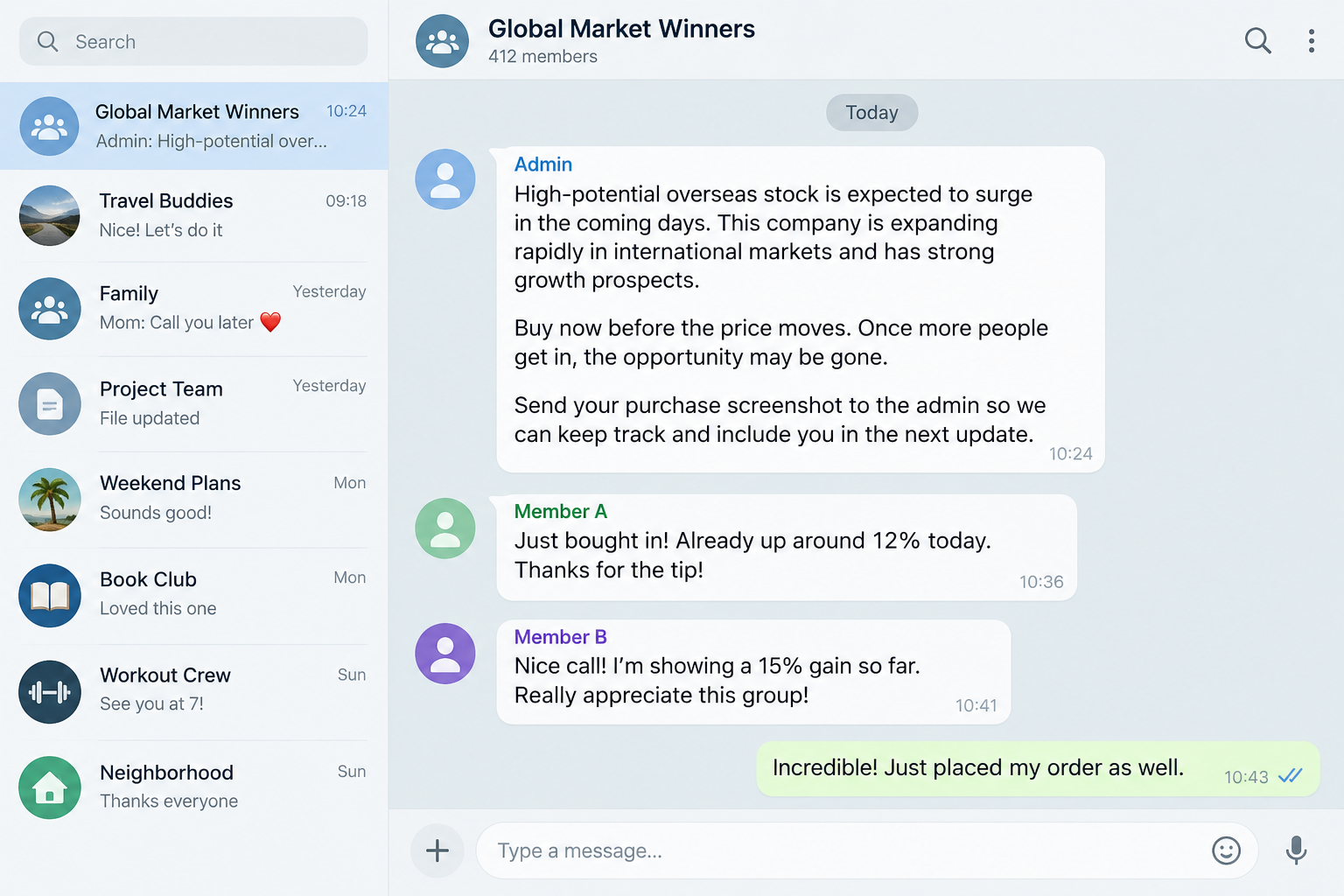
Police warned that accomplices may pose as group administrators or assistants, contact victims privately, and reinforce the investment story. Other apparent members can post gains or enthusiasm.
Victims may be asked to send screenshots proving their purchases. That lets promoters measure how much buying they generated and may determine rewards paid to recruiters.
Some scammers promise to reimburse losses. After the price falls, they disappear or make excuses.
- An unknown person adds you to an investing chat.
- A mentor claims privileged knowledge of an overseas stock.
- The group insists there is one narrow buying window.
- Members post unusually consistent praise and profit screenshots.
- An administrator asks for proof of your trade.
- The mentor guarantees reimbursement if the stock falls.
Why This Does Not Look Like a Typical Investment Scam
Fake investment platforms usually control the displayed balance. Here, your broker may show a genuine market price, real order status, and real ownership of the shares.
That legitimacy belongs to the broker and exchange, not to the person who recommended the trade. A real market can still be manipulated.
The group may spend days or weeks sharing general commentary before revealing the selected company. Early recommendations can even perform well, creating a record the mentor later uses as proof of skill.
Group dynamics add another layer. When hundreds of members appear to buy, waiting feels like missing out. Some accounts may be controlled by the same operation.
The final pressure arrives only after trust is built: buy a specific amount now, do not discuss it outside the group, and send a screenshot when finished.
How a Thinly Traded Share Can Be Moved
Low-liquidity shares have fewer buyers and sellers. A coordinated wave of purchasing can move the price more sharply than it would move a large, heavily traded company.
The promoters may already own shares bought at lower prices. New buying from the chat provides demand into which the organizers can sell.
Once they dump their holdings, the artificial support vanishes. Victims who try to exit together may find few buyers, wider spreads, or trading interruptions.
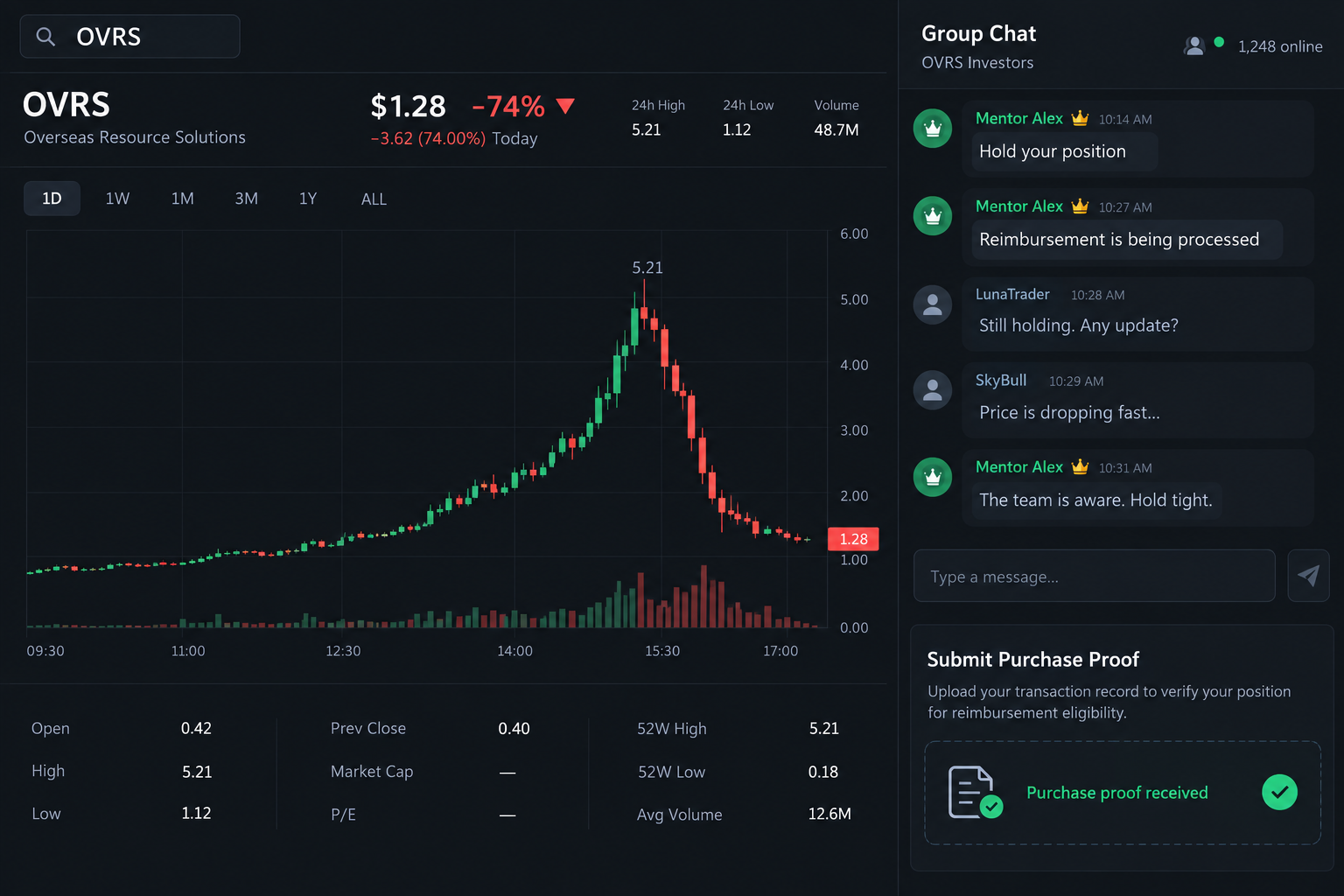
The fictional chart below shows the basic pattern and the excuses that can follow. It does not depict a real ticker or investment account.
How the WhatsApp Stock Tip Scam Works
Step 1: Recruiters build a large investing group
Victims may be added directly, invited through a social media advertisement, or approached by someone claiming to represent an investment educator.
The group uses a professional name and fills the chat with market news, charts, and supposed analysis. Administrators and assistants keep conversation active.
Do not interpret group size as regulation. Hundreds of unknown accounts can still belong to a coordinated operation.
Step 2: Early tips create a believable track record
The mentor may recommend liquid, well-known shares likely to move with the market. Successful calls are highlighted while poor calls disappear from the story.
Members post thanks and gains. Some may be genuine participants, while others may be planted accounts designed to establish consensus.
A handful of profitable ideas does not prove the person is licensed, independent, or acting in your interest.
Step 3: The group reveals a “high-potential” overseas company
After trust is established, administrators announce a lesser-known share listed in Hong Kong, the United States, or another market. The company is described as undervalued, connected to an upcoming deal, or ready for a breakout.
Claims may be presented as private research or insider access. The lack of public confirmation is reframed as the reason the opportunity is so valuable.
Unverifiable inside information is not a bonus. It is a warning about both fraud and possible securities-law risk.
Step 4: Urgency concentrates the buying
Members are told to buy immediately, sometimes at a specific time or within a narrow price range. The concentrated orders help push a low-liquidity share upward.
Recruiters may privately encourage larger positions and say that the mentor will announce the sell point later.
Never let a chat administrator decide position size. A loss can exceed what you expected when liquidity disappears.
Step 5: Purchase screenshots give promoters feedback
Police said accomplices may request proof of purchases. The screenshots show who followed instructions, how many shares were bought, and which victims might buy more.
The request may be described as access to a premium group or a requirement for reimbursement. Neither explanation makes it necessary.
Do not send brokerage screenshots. They can reveal account numbers, balances, holdings, and personal information beyond the targeted trade.
Step 6: Organizers sell while victims are told to hold
As demand lifts the price, earlier holders can sell. Victims may be told that a temporary dip is normal or that a larger rise is still coming.
By the time the group acknowledges the collapse, the promoters may have exited. The remaining holders compete to sell into weak demand.
A promise that the team will “support the price” is not protection. Markets do not owe victims the entry price.
Step 7: Reimbursement becomes the final excuse
After the fall, the mentor may claim compensation is being processed or ask victims to submit more documents. Police said promised reimbursements were not honored in reported cases.
A second payment may be requested for tax, legal, or release fees. Do not send more money to recover the first loss.
Save the group, usernames, messages, order history, and payment requests for your broker and authorities.
Company and Promoter Checks for an Overseas Stock Tip
Verify the person giving the advice
Search the relevant financial regulator’s register for the promoter, firm, and claimed license. Match the contact details, not just the name.
Impersonators may use the identity of a real professional while operating from a different WhatsApp number or social account.
Read the issuer’s official disclosures
Look at filings and announcements through the exchange or securities regulator. Compare the mentor’s claims about contracts, acquisitions, and earnings with documents the company is legally responsible for.
A screenshot of a press release can be edited. Open the filing at its official source.
Check liquidity, market size, and recent price action
Thin volume, a small market value, abrupt price rises, and heavy promotion increase manipulation risk. They do not automatically prove fraud, but they demand greater caution.
Consider whether your order could be exited without moving the price. The displayed last trade does not guarantee a buyer for your full position.
Ask why the group needs proof of your purchase
A legitimate analyst does not need your brokerage screenshot to make a public recommendation. The request benefits the promoter by measuring compliance and exposure.
Do not reveal account identifiers, balances, or other holdings to a chat administrator. Refusal should not affect any genuine brokerage service.
How to Research the Tip Before Placing an Order
Write down the exact factual claims and verify them outside the group. “Strong growth” is marketing language; a signed contract or audited result is a testable claim.
Search for disciplinary history, regulatory warnings, and prior ticker promotions associated with the same accounts. Be cautious when the group changes names after each call.
Discuss the trade with a licensed adviser who is not connected to the promoter. Independent advice is especially useful when the position would be large relative to your savings.
If the opportunity cannot survive a day of checking, it is not suitable for money you cannot afford to lose. Urgency is part of the mechanism, not evidence of value.
Read the order book and recent volume rather than relying on a screenshot from the group. A price can rise while available liquidity remains too shallow for members to exit together.
Search the exact phrases used by the mentor. Recycled promotional copy can connect a new group to earlier ticker campaigns that ended in the same pattern.
Ask who benefits if you buy at the requested time. If the promoter will not disclose compensation, holdings, or conflicts, you do not know whether the “mentor” is selling into your order.
Never borrow to follow a chat tip. Leverage adds interest and margin risk to a position whose promotion may already be manipulated.
A sound investment case should remain understandable when the chat room is removed from the decision.
What to Do if You Have Fallen Victim to This Scam
-
Stop following the group’s instructions. Do not average down, buy a second ticker, or send a fee for reimbursement. Mute the group while preserving the evidence.
Take screenshots or export messages according to platform rules. Record administrator accounts, numbers, links, and the time of each instruction.
-
Contact your broker’s fraud or compliance team. Explain that you may have traded during a coordinated pump-and-dump campaign. Provide the ticker, order times, quantities, and chat evidence.
Do not make a rushed trade solely because the group or an online commenter tells you to sell. Ask the broker about current restrictions, liquidity, and reporting options.
-
Preserve financial records. Download official trade confirmations, account statements, deposit records, and price data. Keep the originals rather than only screenshots.
Document any loss promise or request for purchase proof. That material may help investigators connect the promoter to the trading activity.
-
Protect the information shown in screenshots. If you sent an account number, balance, email, or identity detail, tell the broker and secure the affected accounts.
Change reused passwords and enable multi-factor protection. A stock manipulation scheme can become account phishing when criminals already know your holdings.
-
Report the scheme. Notify the securities regulator and police in your jurisdiction. Singapore victims can use the channels listed in the police advisory and contact ScamShield for guidance.
Report the group and advertisements to WhatsApp, Facebook, or the platform involved. Do not publicly post other victims’ account details.
-
Be ready for recovery scams. Anyone promising guaranteed reimbursement for an advance fee may be targeting you again. Verify lawyers, investigators, and regulators independently.
Malwarebytes is relevant only if the group persuaded you to install software or open a malicious file. AdGuard can block some dangerous ads and domains, but neither product can reverse a market trade or identify a fair exit price.
Frequently Asked Questions
Did police confirm WhatsApp pump-and-dump scams?
Yes. Singapore Police described victims approached through Facebook and WhatsApp groups and reported at least 21 cases since July 1, 2026.
How can it be a scam if I bought real shares?
The shares and broker can be real while the promotion is manipulative. Organizers create demand, sell their earlier holdings, and leave victims with the collapse.
Why do administrators ask for purchase screenshots?
The proof shows who followed the call and how much buying occurred. Police said accomplices may also use it to claim rewards for recruited victims.
Can a mentor guarantee my losses will be reimbursed?
No credible guarantee exists merely because it appears in chat. Police reported that promised compensation was followed by excuses or disappearance.
Are all WhatsApp investing groups fraudulent?
No, but an unknown group pushing one low-liquidity stock with urgency, planted praise, and purchase-proof requests matches the confirmed danger pattern.
Is the ticker shown in the image real?
No. The article uses a fictional ticker and reconstructed interfaces so it can explain the scheme without naming an unproven company or exposing a real account.
The Bottom Line
The WhatsApp stock tip scam hides inside a real market transaction. The broker can be genuine, the shares can exist, and the recommendation can still be part of a coordinated pump-and-dump.
Do not buy because a chat room appears unanimous. Verify the promoter and issuer independently, refuse purchase-proof requests, and report coordinated pressure before another “high-potential” stock becomes someone else’s exit.








