

The hottest afternoon of the year is a perfect time to sell relief. An advert promises that a tiny box will cool an entire room in seconds, and the price looks easier than waiting for a real air conditioner.
That promise can lead to a weak fan, a missing parcel, or a seller that disappears when the refund request arrives. The details behind the UK air conditioner scam matter more than the frosty video in the advert.
Overview
The advert sells an effect the small device cannot deliver
The UK air conditioner scam is a group of misleading heatwave promotions for miniature “AC” units, evaporative coolers, plug-in fans, and supposedly revolutionary personal cooling devices. Ads claim that a compact product can chill any room in seconds while using almost no electricity.
Small desktop coolers and fans are real product categories. The scam lies in fake stores, copied reviews, invented technical claims, unrealistic demonstrations, and refund obstacles used to sell an ordinary low-cost device as a substitute for room air conditioning.
The seller may be harder to identify than the product
A landing page often presents a memorable product brand but says little about the legal business taking payment. The checkout name, terms, card descriptor, support domain, and return warehouse can all belong to different entities.
Possible outcomes include a cheap fan arriving weeks later, no delivery at all, a tracking number for an unrelated parcel, or a request to return the item overseas at the buyer’s expense.
Heat and urgency make careful checks feel optional
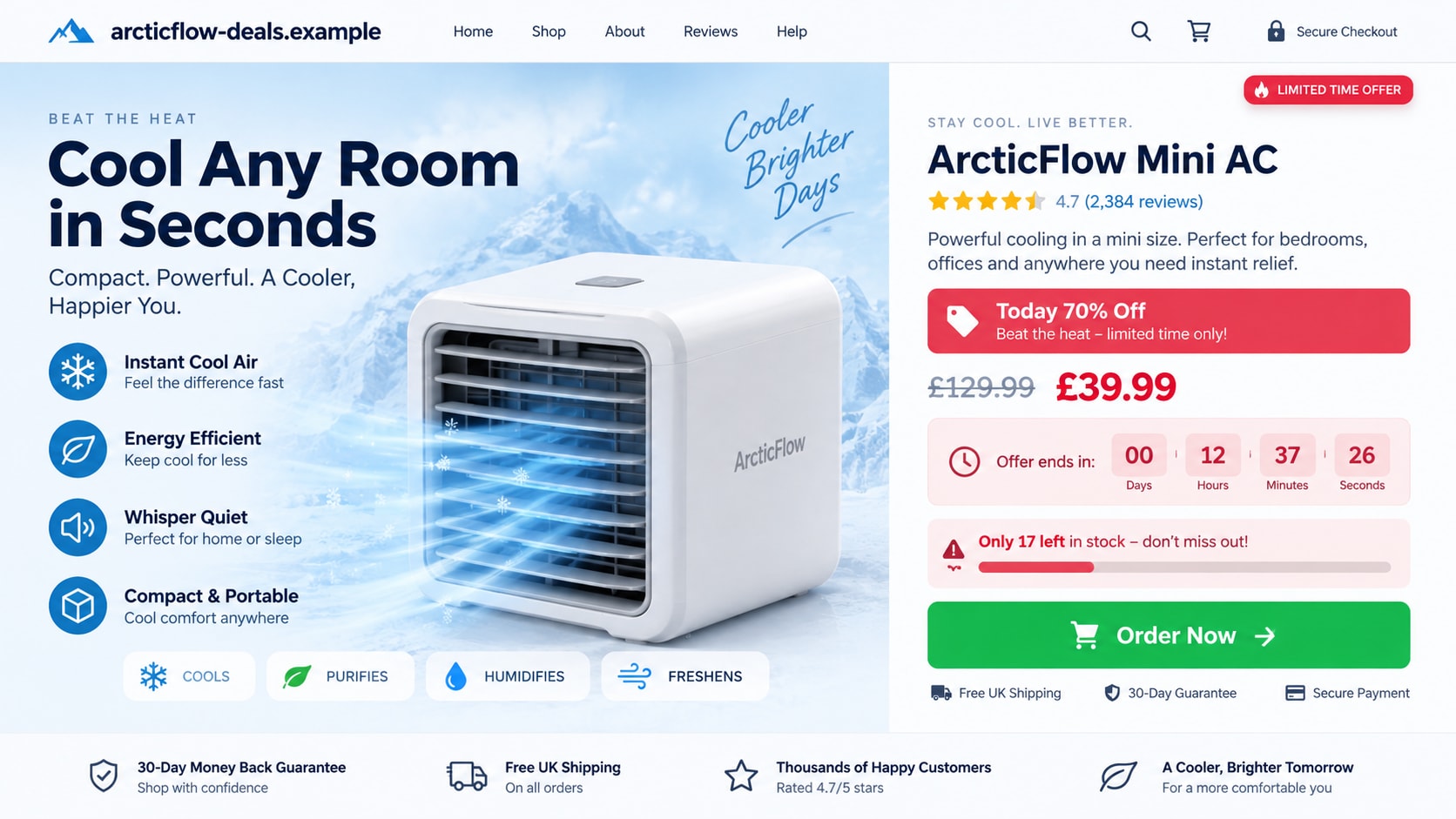
The campaign appears during warm weather, when established air conditioners are expensive or sold out. A countdown, “70% off” banner, and low-stock notice turn physical discomfort into a reason to order before comparing specifications.
Common warning signs include:
- A pocket-size device is shown cooling a whole lounge or bedroom.
- The demonstration uses ice effects, fog, or digital temperature graphics.
- No British thermal unit rating, room size, or measured test is provided.
- A permanent countdown claims the sale ends in minutes.
- The product is sold under many unrelated names with identical photographs.
- The company address and returns location are hidden before payment.
- Every review is perfect and appears only on the seller’s own page.
- The guarantee sounds generous but makes the customer pay costly overseas postage.
A Mini Cooler Is Not the Same as an Air Conditioner
A real room air conditioner moves heat from inside a space to the outside. Refrigerant, a compressor, heat exchangers, and a way to exhaust heat are central to that process. That equipment needs meaningful power and cannot be reduced to a tiny USB cube without changing what the product actually does.
A basic fan moves air across the skin. It can make a person feel more comfortable by helping sweat evaporate, but it does not reduce the room’s heat. Once the fan stops or the person moves away, the sensation changes.
A small evaporative cooler passes air through damp material. It may lower the temperature of a narrow stream of air in dry conditions, especially when used close to one person. In humid weather, evaporation is less effective, and the unit can add moisture to the room.
Calling either device “air conditioning” creates expectations that the hardware cannot meet. In a published mini-cooler advertising ruling, the Advertising Standards Authority found that claims about cooling any room in seconds were not supported by evidence and were misleading.
The question is not whether a small fan produces any cool air. It is whether the exact product can achieve the room-wide temperature change, speed, coverage, and energy savings stated in the ad.
How the UK Air Conditioner Scam Works
Step 1: A heatwave advert finds people who want immediate relief
The promotion appears on social media, a news-style page, a video platform, or a sponsored search result. It often begins with a sweltering room and an explanation that conventional air conditioning is too expensive.
The supposed solution is small, silent, portable, and cheap. A presenter or animation claims it was designed by an engineer after an energy company rejected the invention.
Step 2: A dramatic demonstration replaces measurable evidence
Cold mist, snowflakes, blue lighting, and rapidly falling thermometer graphics create the impression of powerful refrigeration. The video may never show an independent temperature measurement, room dimensions, starting conditions, or continuous unedited test.
Technical phrases such as “hydro-chill,” “rapid cooling core,” or “aerospace airflow” sound specific while providing no recognised performance value. A product name can be trademark-like without identifying a manufacturer.
Step 3: A steep discount prevents comparison shopping
The landing page crosses out £129.99 or more and presents a price near £39.99. A timer, visitor counter, and low-stock message suggest that leaving the page means losing the opportunity.
Those elements may reset when the page is reopened. The “original” price can be a marketing anchor rather than a price at which the item was genuinely sold for a meaningful period.
Step 4: Reviews and media logos manufacture confidence
The store displays thousands of high ratings, smiling testimonials, or logos from broadcasters and newspapers. Clicking the logos may lead nowhere, and the review photographs may appear on other sites under different names.
Statements such as “UK’s number one cooler” or “voted best of 2026” need a named survey and verifiable publisher. A badge designed by the seller is not an independent award.
Step 5: Checkout hides add-ons, subscriptions, or the real merchant
The first price may apply only to a small quantity or exclude postage. Buttons for extra filters, warranties, or additional units can be preselected, and a trial membership may sit in fine print near the payment button.
The name on the bank statement may not match the product or website. That mismatch makes it harder to recognise the charge and identify the company responsible for the order.
Step 6: Fulfilment creates a second layer of delay
An order confirmation arrives quickly, but dispatch may take weeks. Tracking can remain at “label created,” move between unfamiliar carriers, or show delivery without identifying the exact address.
Some buyers receive a generic fan worth far less than the advertised price. Others report an empty accessory, a differently branded unit, or nothing at all.
Step 7: Support uses delay and partial refunds to protect the sale
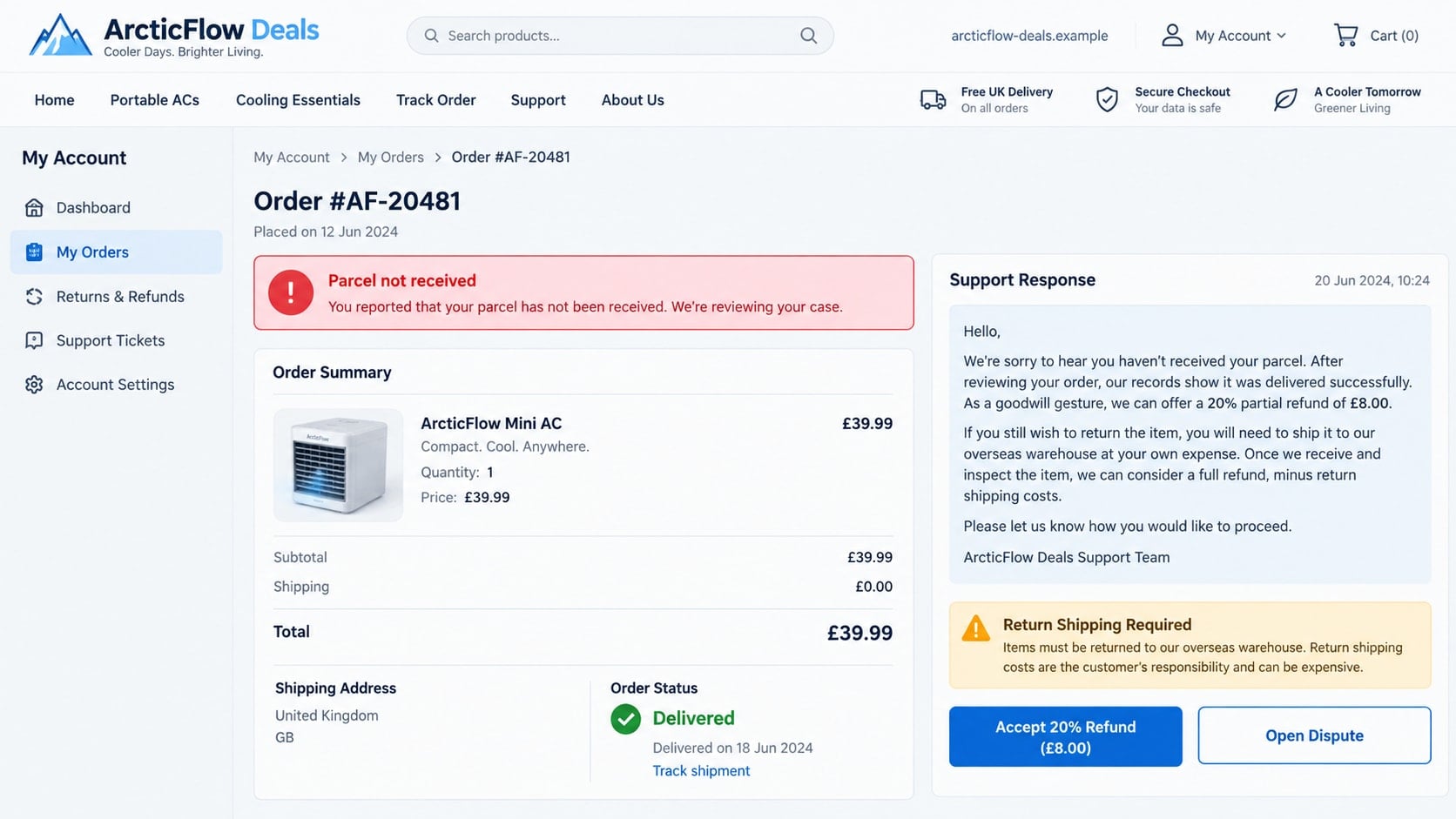
When the customer complains, support asks for more patience, blames customs, or repeats the carrier’s delivered status. A partial refund of 10%, 20%, or 30% may be offered instead of the promised money-back guarantee.
A full refund can require tracked return shipping to an overseas warehouse. The postage may approach the purchase price, and the dispute deadline can expire while the customer negotiates.
Misleading Cooling Claims to Watch For
Words such as portable, personal, evaporative, and air cooler can describe real products. Problems begin when the page quietly turns those limited devices into claims about whole-room refrigeration.
“Cools any room in seconds”
A claim this broad should be supported by a controlled test covering room volume, starting temperature, humidity, power use, distance, and elapsed time. A stream of cool air directly in front of the outlet does not demonstrate room cooling.
“Works without a hose or outdoor unit”
If a device truly removes heat from a room, that heat must go somewhere. A conventional portable air conditioner normally exhausts hot air outside. A tiny fan that stays entirely inside is not performing the same heat-transfer process.
“Uses less power than a light bulb”
Low power consumption is plausible for a fan or water pump, but it also signals limited cooling capacity. The ad cannot reasonably promise both negligible energy use and whole-room performance comparable with refrigerant equipment without strong evidence.
“No maintenance and completely silent”
Fans make sound, water tanks require cleaning, damp media can develop odours, and filters eventually need attention. Absolute claims should be treated cautiously when the manual and maintenance schedule are unavailable.
How to Compare a Cooler Before You Buy
Start with the exact product type. If the listing says evaporative cooler, understand that humidity affects performance. If it is a fan, judge airflow and noise rather than expecting a lower room temperature.
Look for real specifications: power draw, tank size, airflow, noise level, dimensions, weight, plug type, safety certification, warranty provider, and operating instructions. A page full of benefits but no measurable data is selling emotion.
Reverse-search product photographs and copy a distinctive sentence from the description into a search engine. Identical hardware sold at a fraction of the price can reveal a rebranded dropshipping item.
Search for independent demonstrations that show the device, thermometer, room, and elapsed time continuously. A cut between a hot room and a frosty result proves only that video editing exists.
Calculate the complete price before entering card details. Include postage, filters, warranties, return costs, and any recurring plan. A low headline price can become ordinary after add-ons.
Company, Address, and Fulfillment Checks
Identify the legal seller behind the product brand
Find the company name, registration, physical address, email domain, and telephone number in the terms and checkout. A memorable cooler name is not necessarily the business responsible for refunds.
Compare those details across the privacy policy, returns page, confirmation email, and card descriptor. Several unrelated names can indicate a disposable sales funnel or poorly disclosed intermediary.
Verify where returns actually go
“UK customer service” does not mean returns are accepted in the UK. Read the policy for the destination, authorization process, restocking charge, tracking requirement, and condition rules before ordering.
Be cautious when the address is disclosed only after support approves a request. A guarantee is far less valuable if exercising it costs almost as much as the device.
Check the delivery promise and tracking evidence
Record processing time, carrier, dispatch origin, delivery estimate, and procedure for a missing parcel. Save the page because these terms may change after a campaign attracts complaints.
If tracking says delivered, ask the carrier whether the destination, weight, and service match your order. A public tracking page may confirm a postcode without proving that the parcel reached your address.
Choose a payment route that preserves a dispute
A credit card or reputable payment service generally provides more recourse than a bank transfer, gift card, or cryptocurrency payment. Read the issuer’s limits and act before the dispute window closes.
Do not close an active dispute because the merchant promises a refund later. Ask the payment provider how withdrawal affects your right to reopen the case.
What to Do if You Have Fallen Victim to This Scam
- Save the offer exactly as it appeared. Capture the advertisement, video claims, product page, specifications, timer, checkout total, guarantee, returns policy, receipt, tracking history, and all support messages.
- Write down the promised and actual result. Note whether nothing arrived, tracking is unrelated, the item is different, or the cooler cannot perform a stated function. Photograph packaging, labels, plug, manual, damage, and the complete product.
- Ask the seller for a specific remedy in writing. State the order number, problem, and whether you want delivery, replacement, cancellation, or a full refund. Avoid endless negotiation over tiny partial offers.
- Contact the carrier about questionable tracking. Request confirmation that the parcel’s destination and weight correspond to your shipment. A written carrier response can be valuable dispute evidence.
- Open a payment dispute promptly. Tell the card issuer or payment service whether the case is non-delivery, unauthorized billing, or item not as described. Supply the ad and policy that influenced the purchase.
- Review the statement for added charges. Check for warranties, memberships, duplicate transactions, and unfamiliar merchant names. Ask the issuer to block further billing or replace the card when appropriate.
- Inspect the device before connecting it. Do not use a damaged plug, leaking tank, overheated cable, or unit without credible electrical markings. Seek qualified safety advice rather than testing questionable hardware unattended.
- Scan after a suspicious download. If the store made you install tracking software, a coupon extension, or a support tool, remove it and run Malwarebytes to check for malware and unwanted applications.
- Block repeat advertising routes. AdGuard can reduce exposure to known malicious ads, redirects, and tracking domains. It will not create a refund, so keep the financial dispute moving separately.
- Report the store and advert. Notify the advertising platform, payment processor, relevant UK consumer authority, and domain or hosting abuse contact. Use factual evidence and keep the report confirmation.
Frequently Asked Questions
Are all mini air coolers scams?
No. Fans and evaporative coolers are real, modest products. The scam concern applies when a seller makes unsupported room-cooling claims, hides the business, or takes payment without providing the advertised item and refund route.
Can a USB cooler lower the temperature of an entire room?
A small unit may make nearby airflow feel cooler, especially in dry conditions, but that is not equivalent to refrigerant air conditioning. Whole-room claims require credible product-specific testing.
Why do the videos show frost and very cold air?
Promotional footage may use digital effects, staged ice, unrelated hardware, or close measurements at the outlet. Ask whether an unedited test demonstrates the advertised result under stated conditions.
What if a cheap fan arrived and it works?
Compare it with the exact description that influenced your purchase. A functioning fan can still be materially different from a product advertised as a rapid room air conditioner.
Should I accept a 20% refund to avoid return postage?
That is your decision, but first ask the payment provider how acceptance affects a dispute. Do not let the merchant’s deadline replace the protections and time limits attached to your payment method.
Can I trust a 30-day money-back guarantee?
Only after reading how it works. Check the return country, authorization requirement, shipping responsibility, exclusions, inspection rules, and the identity of the company that actually issues refunds.
The Bottom Line
The UK air conditioner scam sells an urgent feeling of relief through impossible cooling claims, artificial discounts, and stores that are much harder to locate once the order goes wrong. A small fan may exist, but the advertisement must describe what it can genuinely do.
Judge the hardware, seller, delivery path, and return cost separately. If the page cannot explain how the device cools a room, who takes responsibility, and where a refund goes, leave the countdown running without you.








