

A blackout survival guide sounds sensible when storms, cyberattacks, and grid failures dominate the news.
Fatal Blackout turns that reasonable concern into a dramatic offer. The details behind the purchase deserve a much closer look.
Overview
What Fatal Blackout is
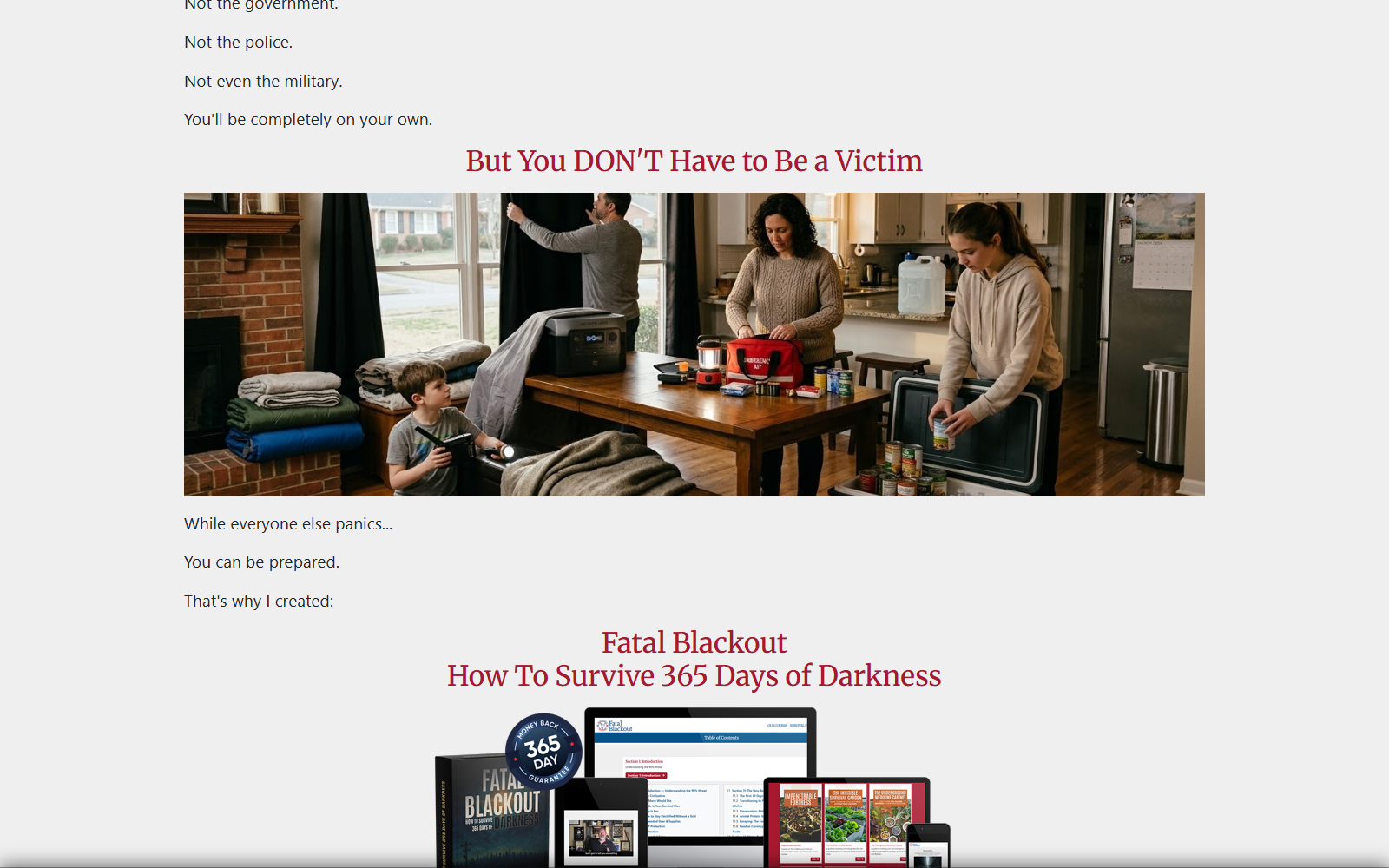
Fatal Blackout is a physical book with digital access and several downloadable preparedness guides.
The package promises advice about food, power, medicine, home security, and surviving an extended electrical outage.
The main sales presentation attributes the system to Teddy Daniels and emphasizes his military and emergency-response background.
Buyers may receive a genuine book. That does not make every sales claim, price presentation, or billing condition acceptable.
The billing problem hidden behind the book
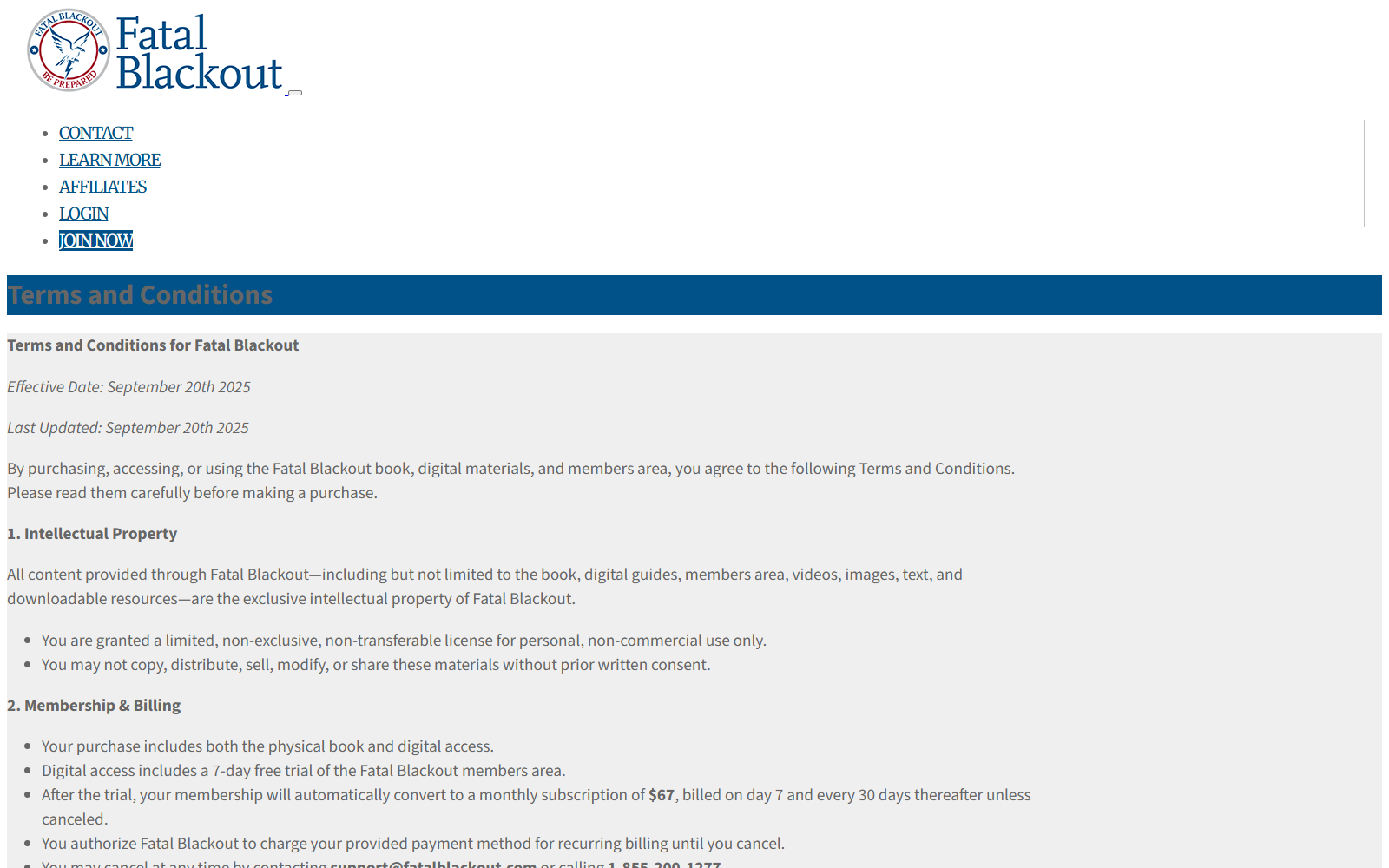
The official terms say digital access includes a seven-day trial of the Fatal Blackout members area.
After that trial, the membership automatically converts into a $67 monthly subscription, charged on day seven and every 30 days.
This recurring agreement is the central problem. Promotional pages elsewhere describe Fatal Blackout as a one-time $67 purchase with no subscription.
A shopper can reasonably believe they are buying a book once, while the formal terms authorize continuing charges.
Key warning signs found during our investigation
- Fear-heavy advertising predicts social collapse, violence, empty stores, and a year without electricity.
- Multiple pages use urgent language, dramatic countdowns, reserved-copy messages, and family-protection pressure.
- The official terms authorize a $67 monthly subscription after a seven-day trial.
- Affiliate pages describe the same offer as a one-time purchase without monthly fees.
- Observed prices varied between $67 and $74.50, depending on the checkout path.
- The sales network includes numerous Facebook pages, groups, advertorials, and parasite SEO posts.
- Company ownership is less visible than the author story, guarantee, and emergency claims.
Is Fatal Blackout a Real Book or a Scam?
Fatal Blackout appears to be a real commercial offer for a physical book, digital materials, and online membership access.
The deception is not that nothing exists. It is the mismatch between what shoppers are encouraged to expect and what the billing terms authorize.
A recurring subscription can be legitimate when it is displayed clearly, accepted knowingly, and easy to cancel.
Here, the recurring charge sits behind a strongly promoted book purchase and a vaguely described free bonus.
The checkout calls the Survival Intelligence Report free for seven days. It mentions cancellation, but does not display the later $67 monthly price nearby.
The exact price appears in the terms and privacy policy. Many shoppers will never open either page during an urgent checkout.
That presentation creates a subscription trap. The book becomes the front door for a much more expensive continuing service.
One year of $67 monthly charges would total $804, before counting the original order.
That amount is dramatically different from the one-time price highlighted across affiliate promotions.
What Buyers Are Actually Offered
The core package includes the Fatal Blackout book and immediate digital access.
Its sales page promises a plan for enduring up to 365 days without the power grid.
Additional guides cover an “Invisible Survival Garden,” an “Impenetrable Fortress,” and an “Underground Medicine Cabinet.”
Those names are designed to make ordinary preparedness topics sound secret, specialized, and unavailable elsewhere.
The presentation repeatedly suggests that institutions will fail and that conventional advice will leave families defenseless.
Real emergency planning matters. Reliable preparedness usually combines local alerts, water, food, medication, lighting, communication, and an evacuation plan.
No single book can predict every disaster, household need, medical risk, regional hazard, or year-long infrastructure failure.
Consumers should judge the materials as educational content, not as a guarantee that one purchase can secure a family against every crisis.
The Sales Story Uses Fear Before It Introduces the Price
The presentation begins by describing an extreme electromagnetic pulse and a nationwide grid failure.
It invokes a supposedly leaked report, government secrecy, war, civil disorder, food shortages, and violent looters.
The story then narrows toward the reader’s home. Parents are asked to imagine hungry children and a family with nowhere safe to go.
This progression is deliberate. Anxiety rises before the buyer sees the offer.
By the time the book appears, purchasing it feels less like shopping and more like protecting loved ones.
That emotional shift can suppress ordinary questions about authorship, evidence, billing, company identity, and refund conditions.
The page also says a copy has been reserved in the visitor’s name and may soon be released.
Such scarcity language encourages immediate action, even though the offer is digital and the urgency is not independently demonstrated.
The Checkout Reveals Only Part of the Continuing Offer
During our review, one official checkout displayed $74.50 due immediately.
Other paths showed the familiar $67 amount. That difference suggests affiliate parameters or campaign routing can change the upfront price.
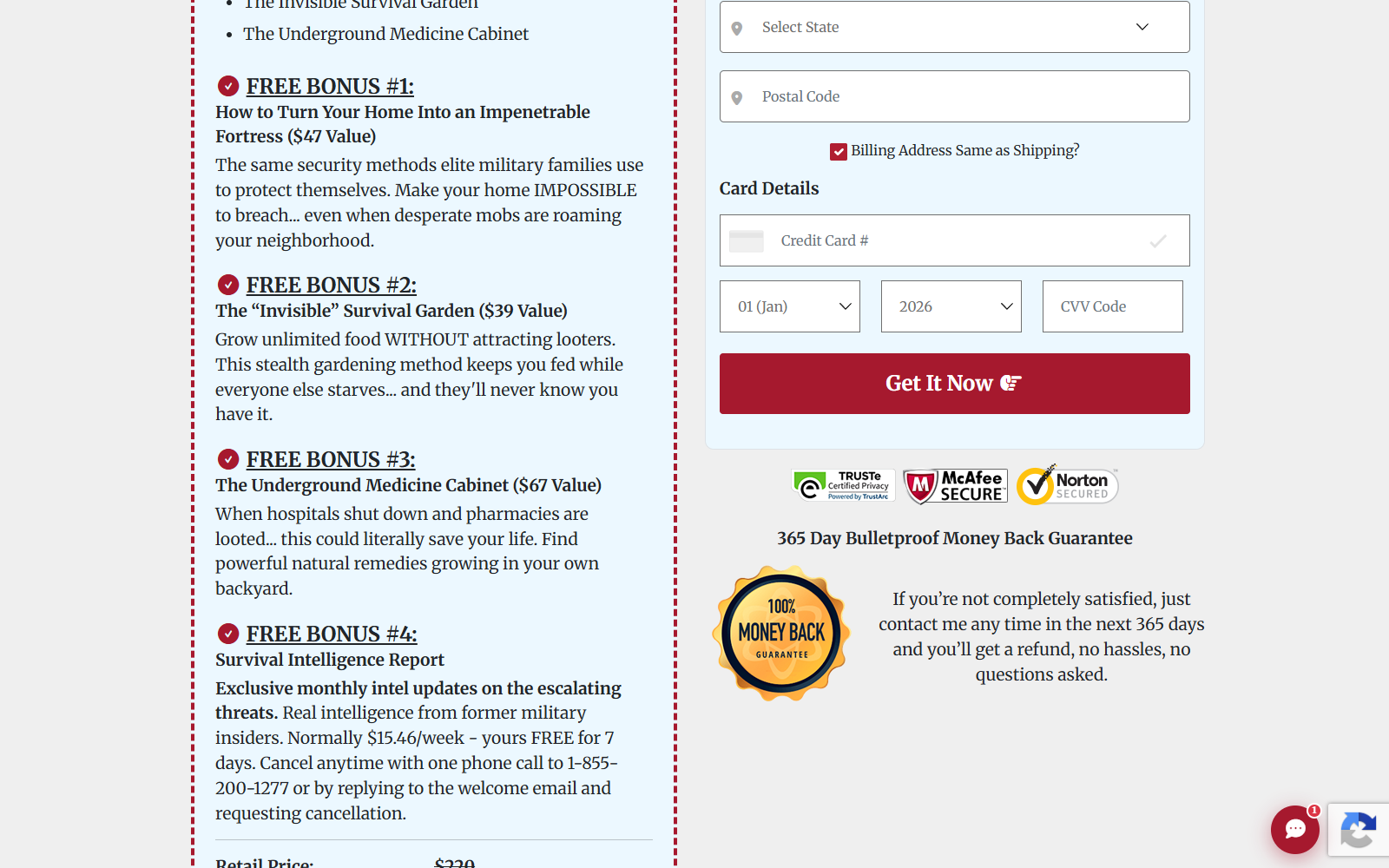
The checkout lists a fourth bonus called the Survival Intelligence Report.
It describes monthly intelligence updates, says the service normally costs $15.46 each week, and offers it free for seven days.
The text says customers can cancel by phone or by replying to the welcome email.
However, the nearby checkout copy does not clearly state that the trial becomes a $67 monthly charge.
A buyer must reach the terms or privacy policy to discover that crucial amount and billing schedule.
How the Fatal Blackout Scam Works
Step 1: Promotional pages flood search results and social media
The campaign does not depend on one stable website.
Facebook pages, Facebook groups, blogs, podcast pages, form builders, and community sites repeat near-identical Fatal Blackout reviews.
Many posts use phrases such as “official site,” “hidden truth,” “current savings,” or “what buyers should know.”
This creates the appearance of broad independent interest when much of the content functions as promotion.
If one page disappears, another can continue ranking, redirecting traffic, and presenting itself as the trustworthy starting point.
Step 2: A frightening scenario captures attention
The visitor encounters a story about a catastrophic blackout, an electromagnetic attack, or the collapse of essential services.
The scenario mixes real vulnerabilities with extreme predictions that are difficult for an ordinary reader to verify.
Images of empty stores, dark cities, frightened families, and armed disorder intensify the message.
The goal is not calm risk assessment. It is to make delay feel dangerous.
Step 3: Authority claims make the warning feel credible
The sales page emphasizes military experience, intelligence knowledge, emergency response, and a Purple Heart.
It also references officials, congressional material, and national-security threats.
These details encourage the reader to trust the narrator before examining the commercial terms.
Claims about the author’s background do not independently prove the sales forecast or the effectiveness of every recommendation.
Step 4: The book becomes the apparent solution
After describing a crisis, the presentation introduces Fatal Blackout as a complete survival system.
Bonuses expand the offer into food, medicine, energy, and home defense.
Large stated values make the current price appear unusually generous.
The shopper is encouraged to compare the offer against catastrophe, not against other preparedness books or free public guidance.
Step 5: The payment looks like a single book purchase
Affiliate pages repeatedly advertise $67 as a one-time payment.
Some even answer the subscription question with a direct “no.”
The official sales path emphasizes the book, instant digital delivery, bonuses, and a long money-back guarantee.
Those signals can make the transaction feel complete and nonrecurring.
Step 6: A trial is attached as a free bonus
The Survival Intelligence Report appears among free bonuses rather than as the main purchase.
It promises ongoing updates and offers seven days without an immediate additional fee.
“Free for seven days” sounds harmless unless the later price and automatic renewal are equally visible.
Here, the $67 monthly conversion is disclosed in policy text, not prominently beside the bonus.
Step 7: The trial converts into recurring $67 charges
The official terms say billing begins on day seven.
The same payment method is then charged every 30 days until the customer cancels.
A shopper focused on receiving the book may overlook the trial entirely.
The first recurring charge can therefore arrive before the physical package has been fully evaluated.
Step 8: Cancellation depends on the customer noticing quickly
The terms require cancellation at least 48 hours before the next billing date.
Customers are directed to email, call, reply to a welcome message, or use a separate support portal.
Each additional path creates another detail the buyer must preserve and follow correctly.
If the customer assumes the purchase was one-time, they may not look for cancellation instructions until another charge appears.
The Official Terms Confirm Automatic Monthly Billing
The strongest evidence comes from Fatal Blackout’s own legal pages.
The terms say the purchase includes a physical book, digital access, and a seven-day free trial of the members area.
They state that membership automatically becomes a $67 monthly subscription after the trial.
Billing occurs on day seven and every 30 days afterward unless canceled.
The terms also authorize recurring charges to the payment method provided during checkout.
Fatal Blackout’s privacy policy repeats the same $67 monthly billing information.
This is not a rumor, isolated complaint, or inference from a bank statement.
It is a recurring-payment condition published by the seller itself.
The problem is how little prominence that condition receives compared with the book, bonuses, urgency, and one-time pricing language elsewhere.
Company, Address, and Fulfillment Checks
The accountable company is not prominent
The main Fatal Blackout presentation spends far more space on danger, the author, testimonials, and bonuses than on the legal seller.
Its terms describe obligations between the customer and Fatal Blackout, but the visible policy text does not clearly introduce a corporate entity.
A related Survival Intelligence Report page names Visionarydata Inc. and describes the report as an add-on for Fatal Blackout or Lost Liberty.
That connection is relevant, but it does not prove that Visionarydata owns every affiliate page using the Fatal Blackout name.
The listed locations look operational, not transparent
A related page lists Visionarydata Inc. at 440 W Colfax Street, PO Box 1094, Palatine, Illinois.
A separate Fatal Blackout storefront publishes a returns address at 19655 East 35th Drive, unit 25, Aurora, Colorado.
A PO box or returns facility can receive mail without being the headquarters, publisher, or company controlling the advertising.
Buyers should not mistake a shipping address for proof of manufacturing, editorial oversight, or accountable management.
Phone numbers and email routes are fragmented
The official Fatal Blackout terms list support@fatalblackout.com and 1-855-200-1277 for cancellation.
The related Visionarydata pages use different numbers for connected preparedness offers.
Fatal Blackout’s contact page also directs subscription customers to a separate generic cancellation portal.
Before buying, call the displayed number and ask for the monthly price, cancellation deadline, refund procedure, and card-statement descriptor.
The guarantee language is inconsistent
The checkout promotes a 365-day money-back guarantee.
At the same time, one guarantee image is labeled as a 180-day guarantee.
Related storefronts advertise 60-day or 365-day periods, depending on the route.
A book refund and a subscription refund may also follow different rules.
Customers should obtain written confirmation covering the original product, trial, recurring membership, shipping, and any already-posted charge.
Why the “One-Time Payment” Claims Matter
A recurring service is not automatically fraudulent merely because it costs $67 each month.
The problem arises when marketing creates a materially different expectation.
Several Fatal Blackout promotions state that $67 is a one-time purchase and that no hidden monthly fees exist.
Those claims cannot be reconciled with official terms authorizing a $67 monthly membership after seven days.
An affiliate might describe only the book while ignoring the attached members-area trial.
That distinction is unlikely to help a customer who used one card and understood the entire checkout as one transaction.
Clear consent requires the recurring amount, frequency, trial deadline, and cancellation method to appear where the customer makes the decision.
Burying those details in policies while affiliates promise the opposite is a serious warning sign.
How to Evaluate Blackout Preparedness Claims Safely
Start with hazards that actually affect your region, such as hurricanes, winter storms, wildfires, floods, heat, or planned outages.
Use official local alerts and emergency-management guidance to build a household plan.
Account for water, medications, mobility needs, pets, backup power, carbon-monoxide safety, transportation, and family communication.
Be skeptical of any seller claiming one secret system covers every disaster for every household.
Search distinctive sentences from the advertisement. Repeated promotional articles on unrelated platforms may reveal an affiliate campaign.
Read the terms before entering card details. Search the page for “subscription,” “trial,” “monthly,” “renew,” “cancel,” and “refund.”
Take screenshots of the offer, checkout, selected bonuses, total price, guarantee, and cancellation language.
If the sales page and legal terms disagree, trust neither until support explains the conflict in writing.
What to Do if You Bought Fatal Blackout
- Find the order confirmation. Save the receipt, welcome email, checkout screenshots, terms, shipping notice, and every message about the members area.
- Cancel the trial immediately. Email support@fatalblackout.com and call 1-855-200-1277. The terms require action at least 48 hours before renewal.
- Use the subscription portal carefully. The contact page points customers to onlinesupport.org. Save screenshots of every submission and confirmation number.
- Demand written confirmation. Ask support to confirm that the trial, membership, and future recurring charges are canceled, not merely the physical shipment.
- Request the applicable refund. Identify the guarantee shown during your purchase. Ask whether it covers shipping, the book, digital access, and membership charges.
- Check your card statement. Review transactions from the purchase date onward. Look for unfamiliar descriptors and another $67 charge near day seven.
- Contact your card issuer. Dispute charges you did not knowingly authorize. Explain the one-time advertising, trial presentation, renewal amount, and cancellation attempts.
- Do not rely only on a replacement card. Ask the issuer to block future recurring transactions from the merchant and confirm how account-updater services are handled.
- Report deceptive marketing. Submit the advertisement, URL, receipt, and billing evidence to the FTC and your state consumer-protection office.
- Secure the device if needed. If you installed software or entered credentials on an unexpected page, scan with Malwarebytes and change exposed passwords.
- Reduce repeat targeting. AdGuard can block many malicious advertisements and tracking requests, but it cannot cancel an existing subscription.
Frequently Asked Questions
Is Fatal Blackout a real book?
Yes, the offer appears to include a physical book and digital materials. The central concern is the attached trial and recurring billing, not an imaginary product.
Does Fatal Blackout include a monthly subscription?
Yes. The official terms say the seven-day members-area trial automatically becomes a $67 monthly subscription, billed every 30 days until canceled.
Why do some pages say it is a one-time payment?
Affiliate pages may describe only the book price or omit the attached trial. Their claims conflict with the recurring billing published in the official terms.
How do I cancel Fatal Blackout?
The terms list support@fatalblackout.com and 1-855-200-1277. The contact page also links to onlinesupport.org. Request written confirmation covering every recurring service.
Can I get a refund for Fatal Blackout?
The checkout advertises a long guarantee, but displayed periods vary across pages. Contact support promptly and specify every book, digital, trial, and membership charge.
Is the 365-day blackout prediction proven?
No specific prediction can guarantee that a nationwide blackout will last 365 days. Treat the claim as sales framing, not a confirmed timetable.
The Bottom Line
Fatal Blackout may deliver a real book, but the transaction is not presented with the clarity buyers deserve.
The official terms authorize a $67 monthly subscription after seven days, while promotional pages repeatedly describe a one-time purchase.
That contradiction, combined with extreme fear, urgency, fragmented support, and inconsistent guarantee language, makes this a high-risk offer.
Consumers seeking emergency guidance should choose transparent resources without surprise continuity billing, document every checkout term, and never let panic make the purchase decision.








