

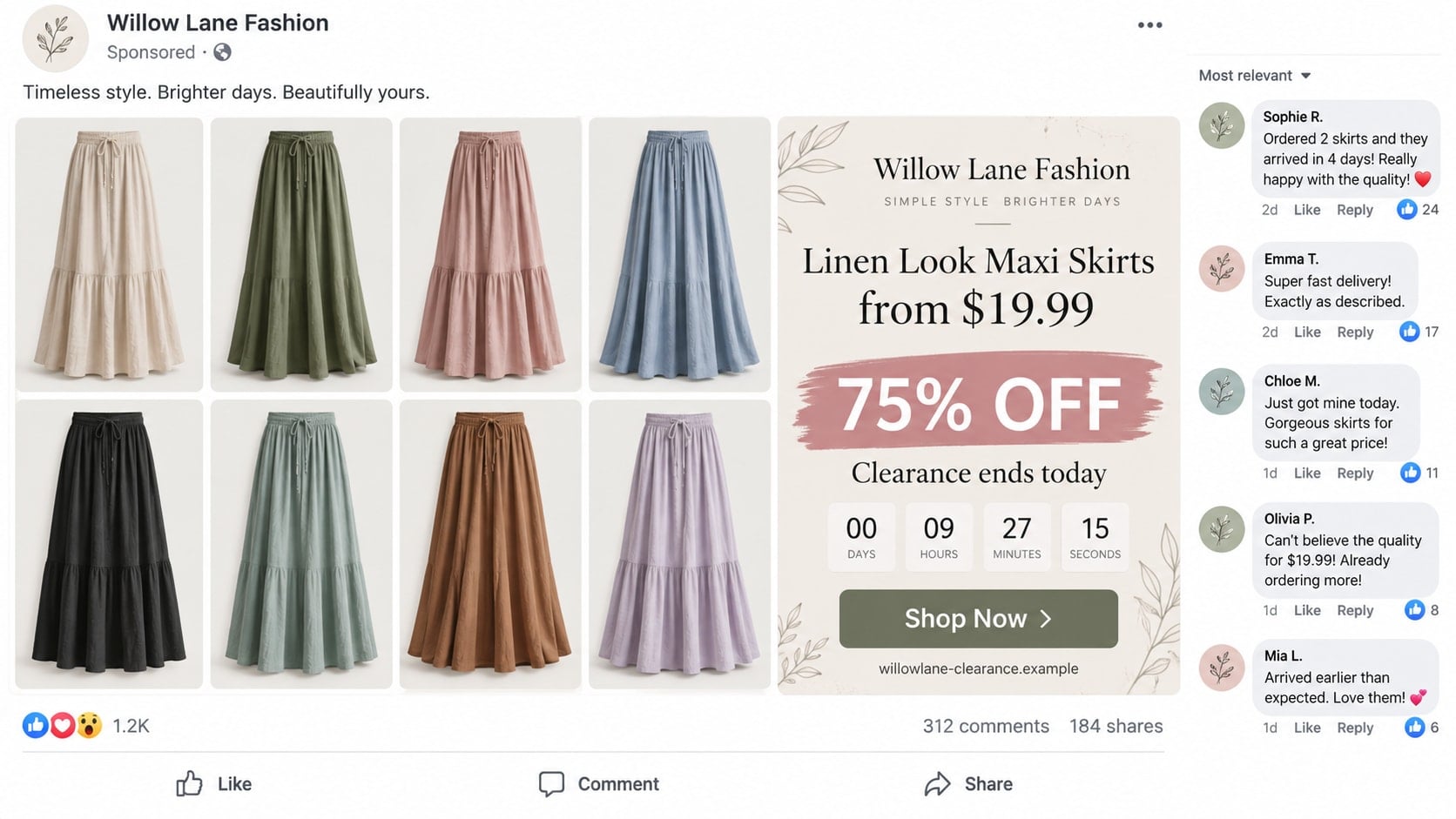
A social ad shows a flowing linen-look skirt with layered fabric, neat embroidery, and the kind of movement that makes it feel handmade. The price is only $19.99, the comments are glowing, and a countdown says the clearance ends tonight.
What arrives, if anything arrives, may bear little resemblance to that image. The long skirts scam turns beautiful product photography and social proof into a fast checkout, then leaves the buyer dealing with thin fabric, misleading sizing, costly returns, or silence.
Overview
The advertisement sells a feeling before it sells a garment
The long skirts scam commonly begins with an eye-catching ad for bohemian, tiered, embroidered, cotton, or linen maxi skirts. The visuals suggest artisan workmanship and premium fabric, while the price suggests a rare closing sale or direct-from-maker bargain.
Some ads use images copied from designers or legitimate shops. Others appear generated or heavily altered. Either approach can show texture, drape, pockets, seams, and details that the seller’s actual product cannot match.
The transaction can end in non-delivery or a bait-and-switch
Not every questionable store behaves identically. Some take payment and provide no usable tracking. Others ship a cheap polyester item that looks different from the linen, cotton, or embroidered skirt pictured in the ad.
A delivered package does not make the advertisement honest. Material, color, construction, size, print quality, and return terms are all part of what the shopper agreed to buy.
Temporary storefronts make accountability difficult
The shop may use a generic name, recently created domain, copied policies, and support address that serves several unrelated stores. When complaints accumulate, the same product images can reappear under another domain and brand name.
- Social ads promise handmade-looking skirts at unusually low prices.
- Product photos may be copied, edited, or generated.
- Countdowns and low-stock notices pressure immediate checkout.
- The legal seller may be hidden until the receipt or card statement arrives.
- Returns may require expensive international shipping or prior authorization.
- The customer may receive a poor substitute or nothing at all.
Why the Product Images Can Be So Convincing
Fashion purchases depend heavily on visual details. Buyers judge fabric weight, movement, length, stitching, and fit from a small set of pictures. A deceptive seller only needs to create confidence long enough to secure payment.
Copied images inherit the reputation of the original creator. The setting, styling, and garment can look authentic because they were authentic somewhere else. The problem is that the site using the image may have no relationship with the item shown.
Generated images can create designs that do not exist as physical garments. Repeated folds may merge, embroidery can change between views, waistbands may be inconsistent, and patterns may ignore seams. These clues help, but a clean image is not proof of legitimacy.
Reverse-image search is useful because it can reveal the same photo on an established designer’s site, an older marketplace listing, or many unrelated storefronts. Compare publication dates, brand names, product descriptions, and prices instead of assuming the cheapest page is the original.
How the Long Skirts Scam Works
Step 1: A social ad targets a specific fashion preference
The campaign is often built around a clear aesthetic: cottagecore, bohemian, modest, vintage, festival, or natural linen. Advertising systems place the offer in front of people who have viewed similar clothing, making the product feel unusually well matched.
The ad may describe a warehouse closure, anniversary sale, final collection, or family business retiring after many years. That story explains the low price and makes the shopper feel they have found a limited opportunity.
Step 2: Images and comments manufacture trust
The product grid shows multiple colors and perfect details. Comments may claim that orders arrived quickly or that the quality exceeded expectations. These reactions can be fabricated, recycled, or displayed inside the ad creative rather than posted by real customers.
Look for repetitive phrasing, recent accounts, comments that never mention sizing or fabric, and praise that continues even when independent buyers report problems.
Step 3: The landing page turns doubt into urgency
The site repeats the discount, adds a countdown, claims that only a few sizes remain, and may offer extra savings for buying two or three skirts. Trust badges and payment logos create a familiar checkout environment without proving who operates the store.
Product descriptions can be inconsistent. The title may say linen while the specifications mention a blend or avoid material percentages entirely. Size charts may use generic measurements that do not match the garment.
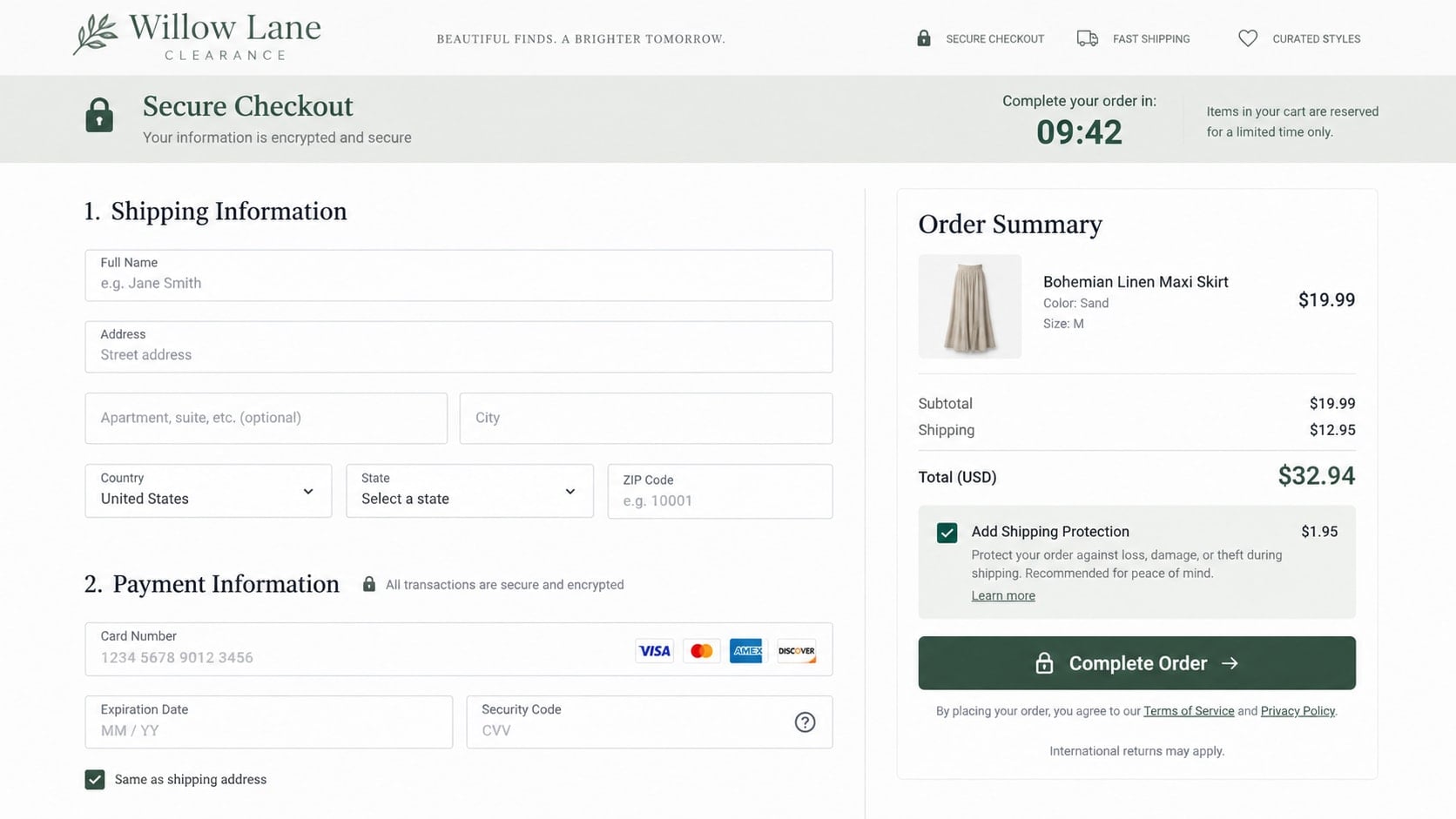
Step 4: Checkout hides the true seller and return burden
The checkout collects name, address, phone number, email, and card data. Shipping protection or other fees may be preselected, increasing the total after the low advertised price has done its work.
The site may not clearly identify the legal merchant. A different name can later appear on the receipt or card statement. Return language may mention international shipping, short deadlines, restocking fees, or an authorization that support must provide.
Step 5: Tracking delays the buyer until dispute time is shorter
After payment, the shopper may receive a tracking number that remains in pre-shipment, travels through unclear locations, or shows delivery somewhere else. Support replies may blame customs, demand more patience, or offer a small refund to close the complaint.
Delay matters because card disputes and marketplace claims have deadlines. A seller that repeatedly promises an imminent delivery can keep a buyer waiting past the easiest recovery window.
Step 6: A cheap substitute makes the dispute less obvious
Sending any item can give the merchant proof of delivery. The customer then has to show that the product was materially different from the advertisement, not merely unwanted.
Common complaints include thin synthetic fabric, printed patterns replacing embroidery, poor seams, incorrect colors, distorted proportions, and sizing that does not match the chart. Photograph the package and garment before wearing, washing, or altering it.
Identity, Contact, and Payment Checks
Identify the legal seller, not just the store name
Read the terms, privacy policy, receipt, checkout, and card descriptor. A decorative brand name is not enough. Look for a consistent company name, registration jurisdiction, and contact information.
Verify the address and return destination
A return warehouse, mailbox, or unrelated residence is not proof of a clothing company. Ask where returns must be sent and who pays shipping before ordering. Save the answer in writing.
Test support before payment
Send a specific question about material percentages, garment measurements, and returns. Generic replies that avoid the question suggest support may be designed to close sales rather than resolve problems.
Use a payment method with dispute rights
A credit card generally offers stronger options when goods never arrive or are materially misrepresented. Avoid sellers that require bank transfers, gift cards, cryptocurrency, or person-to-person payments.
How to Check a Long Skirt Store Before Buying
- Reverse-search several product images, not only the main picture.
- Compare fabric claims across the title, description, and care instructions.
- Search the exact domain with terms such as scam, review, complaint, and return.
- Check whether the store’s social account existed before the current sale.
- Read independent reviews outside the storefront and ad comments.
- Look for a real legal seller, address, email, and working phone number.
- Read return costs, deadlines, exclusions, and authorization requirements.
- Take screenshots of the item, size chart, price, and delivery promise.
The FTC warns that unusually low social-media offers can lead to fake stores that take payment, deliver a cheap substitute, or send nothing. Its social-media shopping scam guidance recommends researching the seller, comparing prices, and paying by credit card.
Sizing, Fabric, and Return Details Worth Saving
A deceptive clothing offer often relies on claims that are difficult to prove after the page disappears. Before buying, save the product title, material percentages, care instructions, size chart, promised length, color name, photographs, price, and estimated delivery date.
Material language deserves close attention. Linen look, linen style, cotton feel, and natural texture do not necessarily mean the garment contains linen or cotton. Check the specifications for an exact fiber composition instead of relying on the marketing headline.
Compare the measurements with a skirt you already own. Generic small, medium, and large labels are less useful than waist, hip, and total-length measurements. A chart copied from another product may conflict with the dimensions shown elsewhere on the page.
Return terms can determine whether a low-cost order becomes an expensive mistake. Look for the destination country, authorization requirements, return deadline, restocking fee, original-shipping deductions, and whether sale items are excluded. Save the policy as it appeared on the purchase date.
If the seller provides only a return email and no address, ask for the likely destination before paying. International tracked shipping can cost more than the garment, and some merchants reveal that burden only after a complaint.
How Deceptive Fashion Stores Keep Reappearing
One operator can run several storefronts using the same product catalog, policies, checkout system, and customer-service scripts. When complaints accumulate around one domain, the advertising budget and product images move to another name.
This rotation makes a simple search for the current store less effective. The new domain may have no reviews because it is only days old, while complaints remain attached to an older brand that used the same photographs and legal text.
Search distinctive phrases from the product description and return policy inside quotation marks. Repeated wording across unrelated stores can reveal a shared template. Also compare contact addresses, company names, checkout descriptors, and image filenames.
A young website is not automatically fraudulent, and a long registration period does not guarantee honest fulfillment. Domain history is one piece of evidence that should be combined with seller transparency, independent reviews, payment options, and realistic product claims.
Social platforms can remove an advertisement while the linked shop remains online. Report both the ad account and the destination when possible, and include screenshots so the platform can review the exact creative that made the misleading promise.
What to Do if You Have Fallen Victim to This Scam
- Save the complete offer. Capture the advertisement, product page, size chart, material claims, checkout total, return policy, domain, order confirmation, and every support message. Evidence is especially important in a bait-and-switch dispute.
- Contact the seller in writing. Clearly state whether the order never arrived, arrived damaged, or was materially different from the description. Request the remedy promised by the policy and set a reasonable response deadline.
- Open a payment dispute promptly. Contact the card issuer or payment service if the seller does not resolve the problem. Explain the exact issue and provide screenshots, photographs, tracking records, and correspondence. Do not let repeated delay messages push you beyond a dispute deadline.
- Document the item and packaging. Photograph labels, fabric composition, dimensions, seams, printed details, shipping label, and outer package. Keep the item until the payment provider explains whether it must be returned.
- Watch the card for additional charges. If the checkout seemed suspicious or the descriptor is unfamiliar, ask the issuer whether the card should be replaced. Monitor statements for small tests, duplicate charges, or subscriptions you did not accept.
- Change any reused password. If you created an account using a password found elsewhere, replace it on every affected service. Begin with email and financial accounts, and enable multi-factor authentication.
- Scan the device if you downloaded anything. Run Malwarebytes if the store prompted you to install an app, browser extension, invoice viewer, or tracking program. It can help find malicious files and unwanted software.
- Block the advertising path. Report the ad to the social platform. AdGuard can help block known malicious domains and deceptive advertising networks, reducing the chance of revisiting the same rotating storefront.
- Report the seller. Submit the domain and evidence to the FTC at ReportFraud.ftc.gov and to your state attorney general or local consumer-protection office when appropriate.
Frequently Asked Questions
Are all inexpensive long skirts sold online scams?
No. Price alone is not proof. The risk rises when a deep discount is combined with copied images, hidden ownership, vague materials, artificial urgency, and weak return information.
How can I tell whether a product photo was stolen?
Run a reverse-image search and compare the earliest appearances, store names, descriptions, and prices. Finding the image on an older designer page is a strong reason to question a new discount store.
What if I received a skirt but it looks nothing like the ad?
Photograph it beside the saved listing and identify objective differences in material, construction, measurements, color, and design. Use that evidence when requesting a refund or disputing the charge.
Should I pay international return shipping?
Review the saved policy and ask the payment provider before spending more money. A return cost that was hidden before purchase can be relevant to a misrepresentation dispute.
Do social-media comments prove that a shop is legitimate?
No. Comments can be fabricated, curated, copied into the image, or posted by coordinated accounts. Look for independent reviews and verifiable seller information outside the ad.
Can a padlock in the browser prove the store is safe?
No. HTTPS encrypts the connection, but a scam site can also obtain a certificate. It does not prove honest advertising, reliable delivery, or a real return process.
The Bottom Line
The long skirts scam uses attractive imagery, low prices, social proof, and urgency to make an unfamiliar seller feel like a trusted boutique. The risk is not only non-delivery. A cheap substitute and an impractical return process can produce the same financial loss.
Pause before leaving the social platform, identify the actual merchant, reverse-search the images, read the return terms, and pay by credit card. A beautiful skirt photo should begin your research, not end it.








