

Someone says a little-known tax form can produce a refund you never knew you could claim. The explanation sounds technical, and the promised amount gets your attention.
Before handing over your records, ask where that money supposedly comes from. The Form 2439 refund scam depends on an answer that deserves careful checking.
Overview
A genuine investment form is used to support a false claim
Form 2439 is real. It relates to undistributed long-term capital gains reported to shareholders by a regulated investment company or real estate investment trust.
The scam is fabricating or overstating information associated with that form to claim money the taxpayer is not entitled to receive.
The IRS added this abuse to its 2026 Dirty Dozen warning, describing increased improper refund claims.
This is not a warning that ordinary investment funds or genuine Form 2439 recipients are fraudulent. The false claim is the issue, not the form’s existence.
The investment behind the document must actually exist
A professional-looking tax document cannot create a shareholder relationship or a tax payment that never happened. Its figures need a legitimate underlying basis.
The IRS warning includes fabricated entities and misuse of real organizations’ names. Seeing a familiar financial company on a document is therefore not enough.
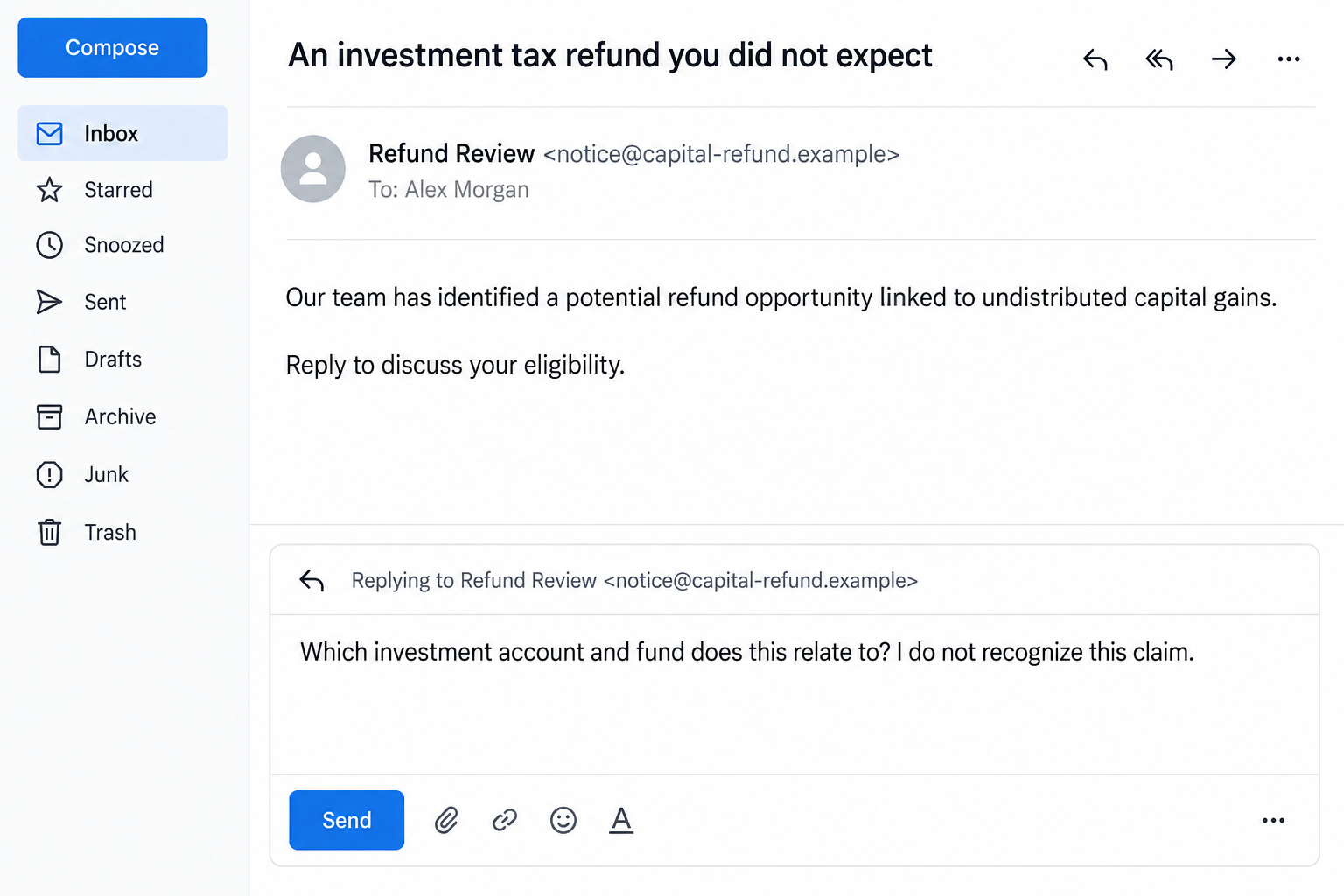
Ask which investment account and issuer support the information. Confirm that through records and contacts independent of the person promoting the refund.
If you do hold investments, do not guess that an unfamiliar claim must relate to one of them. Get the specific connection explained.
What to check before approving anything
- Which actual investment and tax year does the claim concern?
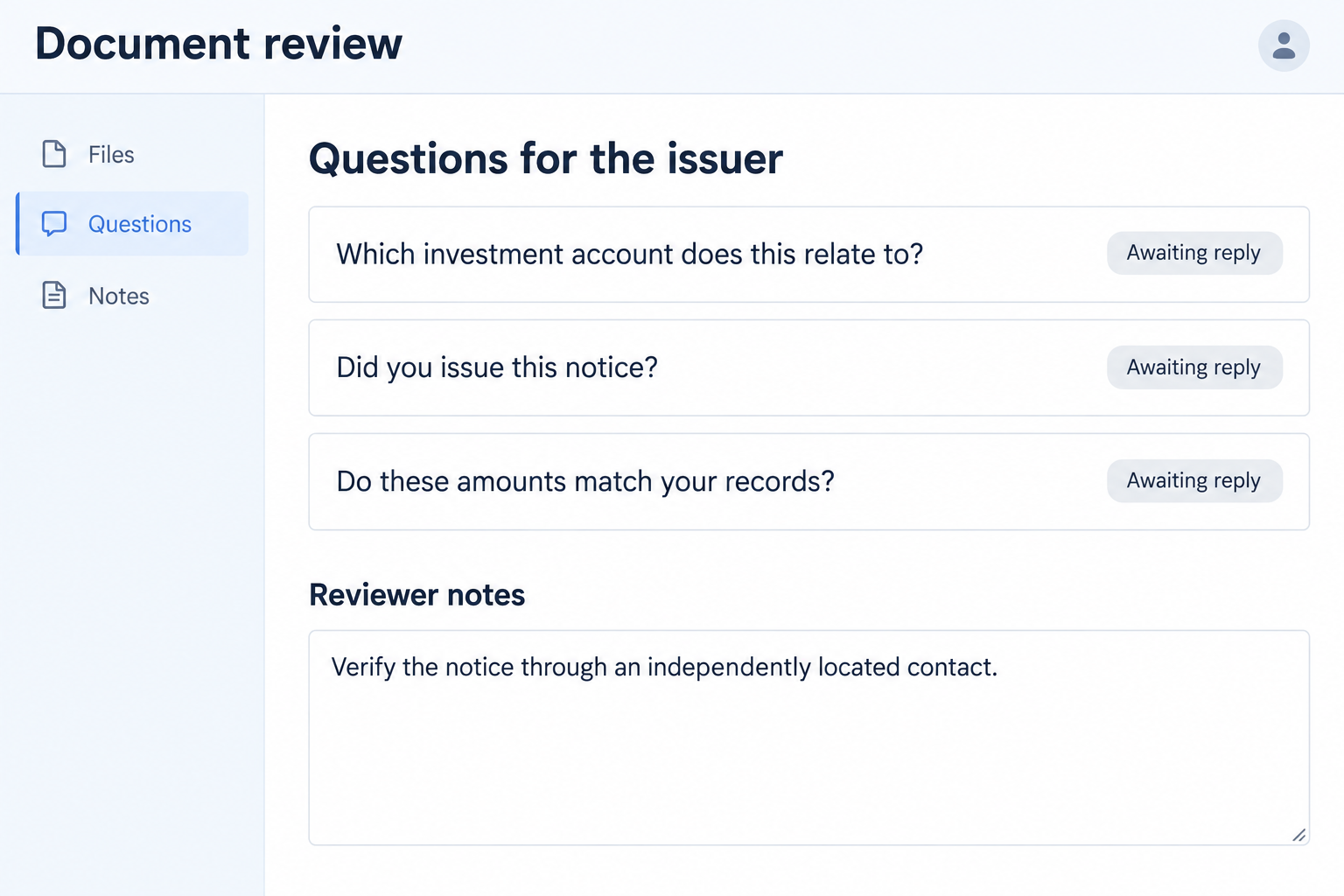
- Who issued the shareholder notice, and can that issuer confirm it?
- Do your account records support the claimed relationship?
- Are the amounts consistent with the issuer’s documentation?
- Will you receive the complete return before authorizing filing?
- Can an independent tax professional explain why the claim applies?
A promoter’s assurance is not independent confirmation. Neither is a screenshot showing that someone else received a payment.
The fictional interfaces shown here illustrate verification questions. They are not IRS screens, genuine tax documents, or evidence of a particular person’s filing.
What Form 2439 Actually Does
The IRS description of Form 2439 identifies its specific purpose: notifying qualifying shareholders about undistributed long-term capital gains.
In plain language, it concerns investment gains retained by a qualifying fund or trust rather than paid out in the ordinary way.
There can also be tax paid by the issuer that affects the shareholder’s reporting. The details belong to a real investment relationship and documented amounts.
IRS Publication 550 explains the genuine treatment. It is not a general refund application available to anyone who discovers the form online.
That difference matters because unfamiliar forms can sound like hidden opportunities. Most people have no reason to recognize every specialized tax document.
Not knowing a form does not mean you overlooked money. It means you should establish whether the form has anything to do with your circumstances.
If your fund legitimately issued one, discuss it with your tax professional. Do not discard a genuine document merely because scammers abuse the same form number.
If someone created it without a supporting investment, the official form number does not make the invented information valid.
How the Form 2439 Refund Scam Works
Step 1: A specialized tax rule is presented as an easy refund
The person promoting the claim emphasizes the result before establishing eligibility. Technical language can make ordinary verification questions feel like a lack of tax knowledge.
You do not need expertise to ask which investment generated the figures. That is a basic factual question, not a challenge to tax law.
Be especially careful when the promised outcome remains the same regardless of your records. A genuine calculation depends on facts, not enthusiasm.
The IRS warning confirms the false-claim mechanism. It does not establish one universal advertisement, fee amount, or contact method used by every promoter.
Step 2: A document appears to supply the missing authority
A form bearing your name and a financial organization’s details can look persuasive. Those details still need to be checked against the actual issuer.
The document might name an entity that cannot issue the relevant notice. It might also misuse a genuine company’s identity.
Do not contact the issuer using only a phone number printed on the questionable document. Find the organization’s established contact route separately.
Ask whether it issued that notice for your account and tax year. Do not send a stranger additional identity documents just to make the claim fit.
Step 3: Unsupported figures become part of a tax return
The danger is not limited to losing a preparation fee. A false refund claim can become part of the tax records filed under your identity.
Request the complete proposed return and supporting paperwork before authorizing submission. A summary showing only the expected payment hides the basis for the calculation.
If the numbers do not connect to your records, stop the process. Ask a qualified person outside the promoter’s arrangement to review them.
Do not let someone answer a missing-evidence question with a promise that the software will accept it. Data entry is not proof of entitlement.
Step 4: A filing response is treated as proof the claim was valid
A confirmation that a return was received does not independently establish the truth of every entry. Keep the underlying records, not just the filing message.
If a promoter points to another person’s refund, remember that you cannot see their circumstances or any later review.
The IRS warns that abusive claims can lead to delayed refunds, audits, penalties, and other consequences. The outcome depends on the particular facts.
Do not spend disputed money on the assumption that a deposit permanently settles eligibility. Seek advice if you have reason to believe the claim was false.
Step 5: The taxpayer must deal with questions the promoter avoided
When supporting information is requested, the original promise is not enough. The taxpayer needs records explaining why the reported amounts belong on their return.
A promoter may be unavailable or keep insisting everything is fine. Neither response replaces a proper review of the filing.
Take official correspondence seriously, but verify it through the IRS. Do not assume a later caller demanding payment is genuine simply because you are worried.
Respond to the actual issue with qualified assistance. An inaccurate return, unauthorized filing, and identity theft are related concerns but not automatically the same situation.
Follow the Evidence Back to Your Investment Account
Start with records you already control. Identify the relevant account and the fund or trust, rather than searching for a company name supplied by the promoter.
Check the tax year carefully. Even a genuine document can be irrelevant to the return someone is proposing to file.
Use your established account portal or verified financial institution contact. Ask how shareholder tax documents are delivered and whether the notice matches its records.
If the account is held through an intermediary, ask that institution how to obtain confirmation. Do not assume a missing document proves fraud without checking.
Compare the information with the copy supplied by the promoter. Keep both copies if names, amounts, dates, or account details differ.
A discrepancy could be an error, an outdated version, or fabrication. Have it explained before deciding which, rather than jumping to an accusation.
A prospectus or general brochure proves that an investment product exists. It does not establish that you owned it or received the particular tax notice.
Similarly, finding a real company in a business register does not verify a document using its name. The issuer must confirm the relevant relationship and information.
Pressure Tactics That Should Not Decide a Tax Filing
When seeking a second opinion, bring the original proposal as well as the tax document. The promised outcome may explain why questionable entries appeared.
Ask the reviewer to distinguish factual uncertainty from a technical tax question. Missing proof that you held an investment cannot be solved by interpreting a rule differently.
If a genuine issuer needs time to respond, document your request. A delay is not permission to substitute figures provided by an unrelated promoter.
Also keep track of who supplied each version of the notice. That makes it easier to identify whether an error originated with an issuer or elsewhere.
You do not have to conduct a forensic investigation yourself. Your task is to avoid approving unsupported information and give the right professional a clear record.
If the figures turn out to be legitimate, that review can confirm them. Careful verification protects genuine claims as well as exposing fabricated ones.
A promoter may present hesitation as a lost opportunity. But an approaching deadline does not supply missing investment records.
Ask for the proposal in writing, including the factual basis and any fees. Someone who changes the explanation when you ask for records deserves closer scrutiny.
Do not agree to keep the arrangement secret from your regular tax professional. Independent review is especially useful when a claim seems unusually generous.
Be wary of explanations built around what the IRS supposedly cannot check. The relevant question is whether the information is true, not whether it might pass unnoticed.
You also do not need to prove malicious intent before declining. An unsupported claim is enough reason not to authorize your return.
If a family member is excited about the offer, ask to review the supporting documents together. Avoid making the conversation a contest over who understands taxes.
Keep the discussion concrete: the issuer, the account, the tax year, and the amounts. Those questions are harder to dismiss than a general warning about scams.
If the person has already paid for preparation, that sunk cost should not decide whether to file. A questionable return can create a larger problem.
What to Do if You Have Fallen Victim to This Scam
- Stop approving unsupported claims.
If nothing has been filed, tell the preparer in writing that you do not authorize submission until the disputed information is resolved.
Ask for copies of all documents already prepared. Do not supply invented investment details to complete a form the promoter has started.
- Establish what was submitted and under whose authority.
Save the return you received, any authorization, and filing confirmations. Check your IRS records through official channels if the preparer’s account is unclear.
Do not rely on a cropped screenshot or verbal assurance. An independent reviewer needs the complete paperwork to understand the issue.
- Ask a qualified tax professional about correction.
Show them the alleged Form 2439, actual investment records, and any correspondence. Explain which information you supplied and which appeared without your knowledge.
The appropriate response depends on whether the filing was authorized and what was wrong. Avoid submitting multiple returns or amendments without understanding the correct process.
- Verify the issuer and protect any affected account.
Contact the genuine financial institution separately if its name or your account details were used. Ask it to confirm the document and note suspected misuse.
If you disclosed account credentials rather than just records, secure that account with the provider. Use a trusted contact route, not the promoter’s help link.
- Report facts, not assumptions.
The IRS tax-scam reporting resources explain where to report suspected fraud. Include the proposal, documents, payment records, and dates you can substantiate.
If a paid preparer was involved, consult the IRS preparer-misconduct process. Reporting the conduct does not by itself correct a filed return.
- Handle disputed money carefully.
Ask your adviser and the IRS how to address any improper refund. Do not send money to a caller or promoter offering an unofficial repayment route.
If you paid a preparation fee under false pretenses, discuss available options with the payment provider. Recovery depends on the payment method and circumstances.
- Keep track of notices and deadlines.
Record when each official letter arrived and what it requests. Verify questionable correspondence using contact information you obtain directly from the IRS.
Seek help early if you cannot understand or meet a response requirement. Ignoring the letter will not resolve the unsupported claim.
No security app can establish tax eligibility or repair a false filing. The useful response here is documentation, independent professional review, and the correct official process.
Do not let embarrassment delay those steps. Discovering a problem gives you a reason to act, not a reason to keep trusting the original promise.
Frequently Asked Questions
Is Form 2439 itself a scam?
No. It is a legitimate shareholder tax document. The fraud involves fabricated or overstated information used to claim a refund without the required factual basis.
Can anyone use the form to obtain an extra refund?
No. Its purpose is tied to qualifying investment circumstances. An online promotion cannot create eligibility or replace genuine records from the relevant issuer.
What if a well-known fund appears on the document?
Verify it directly. The IRS has warned that real organization names can be misused in abusive claims. A familiar name alone does not authenticate the notice.
Does a refund deposit prove the claim was approved permanently?
No. Keep the records supporting your return and obtain advice if you suspect false information. A payment is not a substitute for a valid underlying claim.
Should I accuse my preparer if I see Form 2439?
No. Ask which investment and issuer support it. A genuine form can belong on a legitimate return; unexplained or fabricated information needs investigation.
What should I bring to an independent reviewer?
Bring the full return, shareholder notice, investment statements, authorizations, messages, and any IRS letters. Include different document versions rather than replacing them.
The Bottom Line
The Form 2439 refund scam borrows a real tax document to make unsupported money claims look legitimate. The form number is not the evidence.
Follow the claim back to a genuine investment and confirmed issuer records. If that connection is missing, do not authorize the filing.








