

An editor emails about your book by name. They seem to understand its audience, mention a major publisher, and suggest a deal worth taking seriously.
Then comes a small requirement before the offer can move forward. The fake publisher email scam is built around making that requirement feel like progress.
Overview
The acquisition offer is invented, but the payment request is real
An impostor claims that a publisher wants your manuscript or rights. Before the promised agreement or advance, you must pay for an evaluation or another service.
The request can arrive from a supposed editor, literary agent, or intermediary. A separate provider may collect the fee, making it seem unrelated to the publisher.
What connects the demands is the false offer. The author is paying because someone has represented a publishing opportunity that the real company has not made.
This is impersonation and advance-fee fraud, not an ordinary disagreement over an editing bill.
Major publishers have issued direct warnings
Hachette Book Group’s fraud alert describes impostors using employee names, fake agreements, and promised advances to solicit fees from authors.
Macmillan warns about similar impersonation, including supposed agents and documents misrepresenting a connection to its publishing business.
Penguin Random House also warns about fraudulent approaches and demands involving outside services or certifications.
The publishers are being impersonated. Their names on an email, invoice, or agreement do not establish their involvement in the request.
The offer needs verification before money or manuscripts move
- Confirm the sender through the publisher’s independently located contact route.
- Check whether the claimed acquisition offer actually exists.
- Question any required payment before an advance or contract.
- Verify an outside provider’s claimed relationship with the publisher.
- Keep the original message and attachments as evidence.
- Do not let secrecy or urgency prevent an independent review.
A legitimate paid editor or self-publishing service is not automatically a scam. The issue here is a fabricated traditional publishing deal used to obtain payment.
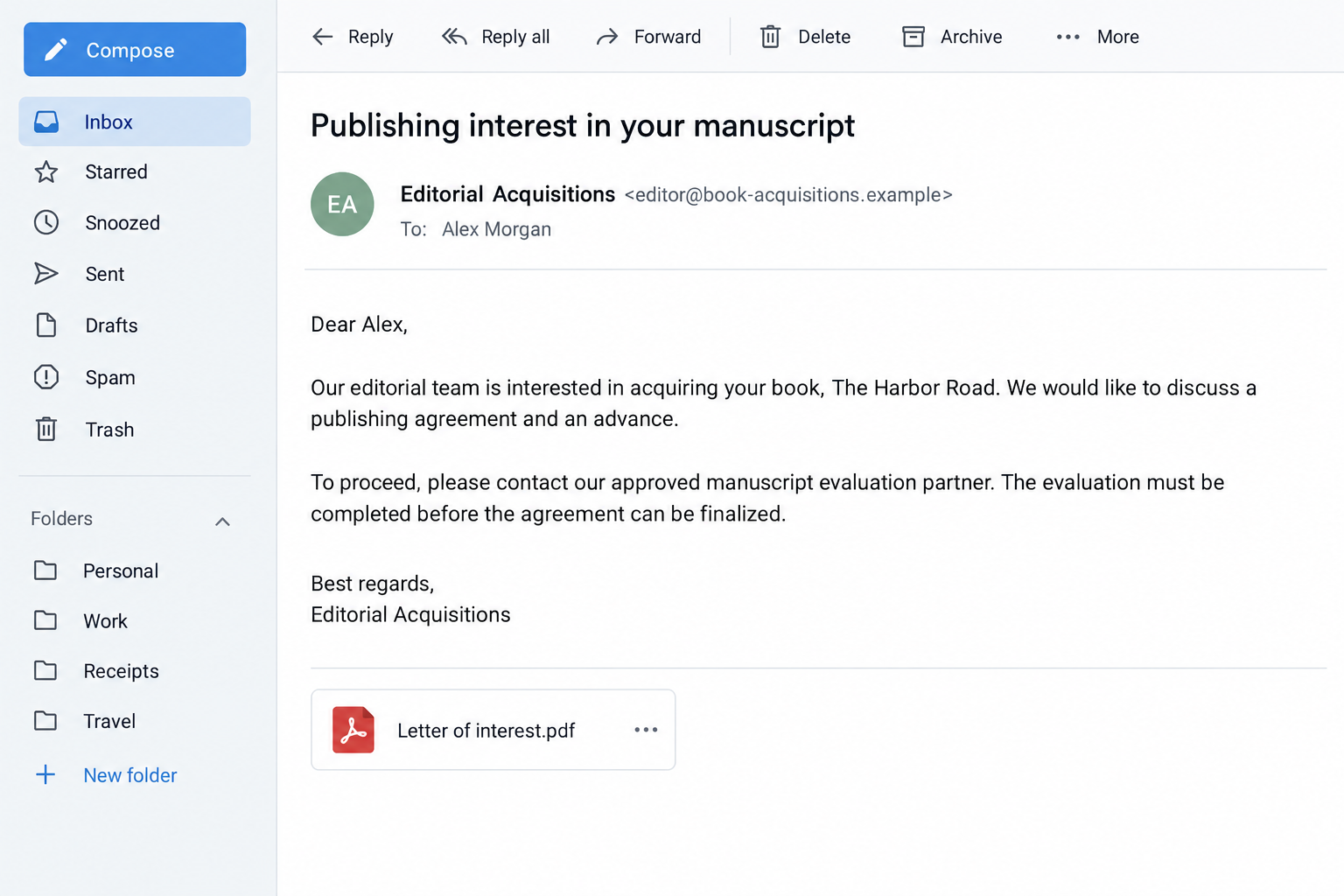
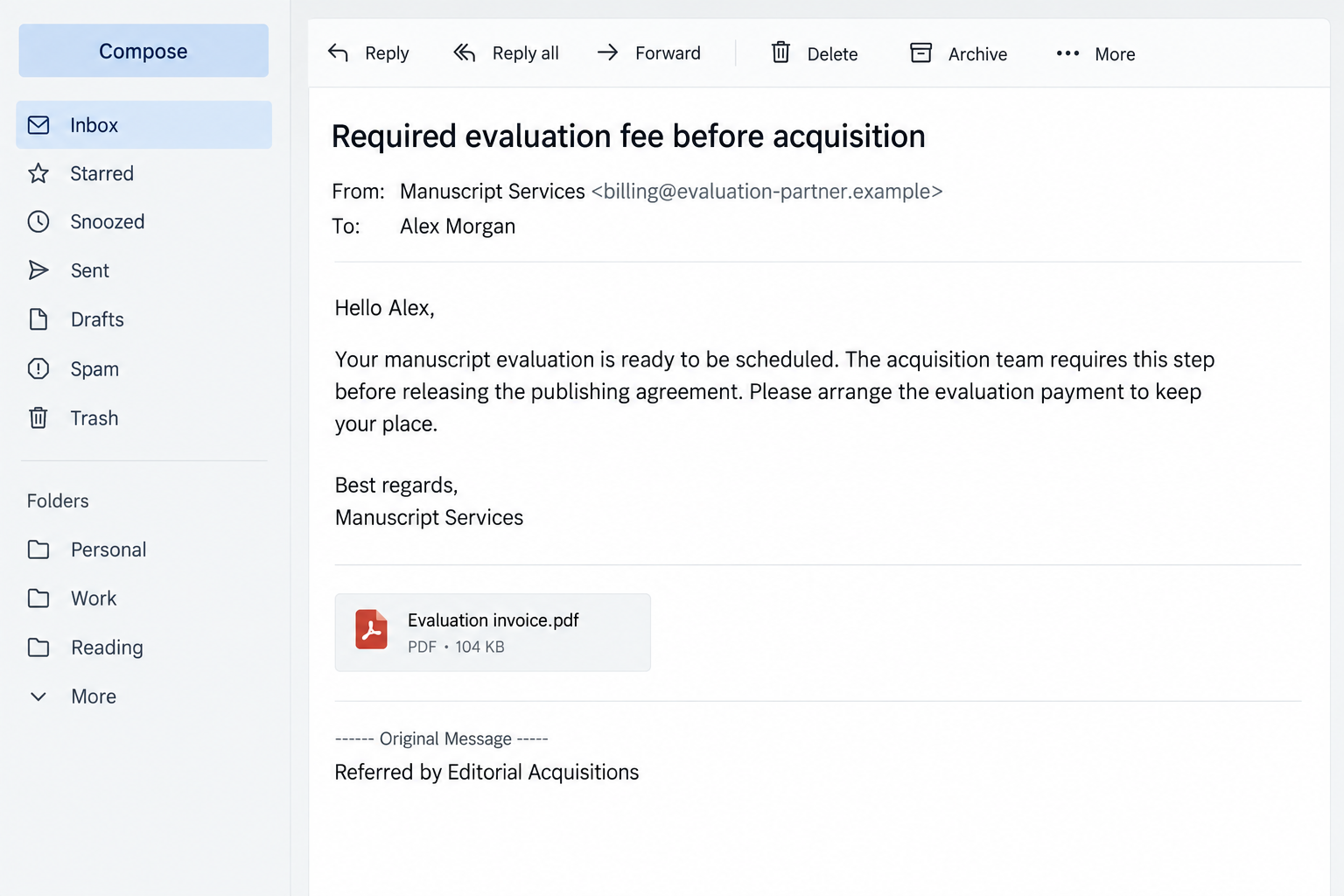
Both images are fictional interface illustrations. The book title, sender details, and domains are invented, not authentic correspondence from a named publishing company.
Personal Praise Is Easy to Make Convincing
After spending months or years on a manuscript, an interested editor can feel like the message you have been waiting for.
The sender may know the title, genre, summary, and author biography. Those details can be available through your website, retailer listing, or social profiles.
Knowing them does not prove that the sender read the manuscript. It certainly does not establish authority to offer a contract.
A carefully written paragraph about your book can still be part of an unsolicited pitch. Judge the sender’s identity and actual proposal, not just the flattering language.
The Authors Guild’s publishing alerts describe increasingly personalized approaches and impersonation. Polished writing is not a reliable authenticity test.
That does not mean every thoughtful email was generated by AI. There is usually no need to decide how the text was written to check the offer.
An authentic opportunity should survive a basic identity check. Taking time to verify does not make you unprofessional or ungrateful.
How the Fake Publisher Email Scam Works
Step 1: Someone important appears to have discovered your book
The email introduces a supposed publishing contact and expresses interest in a specific project. Familiar company names make the approach feel significant.
A signature can include a real employee’s name, a job title, and a copied logo. Searching the name may reveal a genuine person.
That only proves the person exists. It does not establish that they control the email account contacting you.
Keep that distinction in mind before responding with unpublished material or personal information. A biography and a message can belong to different people.
Step 2: Documents make the interest look official
A letter of interest or proposed agreement can arrive next. Formal formatting and legal language encourage the author to treat the opportunity as established.
The document may describe an advance, rights acquisition, or an upcoming decision. Those promises matter only if the actual publisher confirms them.
A logo is easy to reproduce. So is a signature image. Neither turns a file from an unknown sender into an authenticated contract.
Do not use a phone number inside the attachment as your only verification route. The person who supplied the document may also control that number.
Step 3: An outside service becomes the required next step
The supposed deal now depends on an evaluation, certificate, marketing package, or another paid item. A designated provider is presented as the approved choice.
This separates the exciting promise from the request for money. The editor appears to offer the advance while someone else issues the invoice.
Ask the real publisher whether it requires that service for the specific offer. Do not rely on the provider to confirm its own claimed appointment.
Macmillan’s warning specifically rejects certain supposed manuscript fees and mandatory promotional materials used in impersonation. The actual publisher’s policy outranks an impostor’s explanation.
Step 4: The promised advance makes the fee seem manageable
A fee can feel small beside an attractive contract. That comparison encourages you to think about what you might gain rather than whether the offer exists.
The money you are asked to send is real and immediate. The advance remains an unverified promise from the same people requesting payment.
Do not calculate the opportunity’s value until you have authenticated it. A larger fictional advance does not make a smaller real payment safer.
If the sender threatens to withdraw the offer because you asked the publisher directly, stop. Verification should not be treated as a breach of trust.
Step 5: More requirements replace the deal
After payment, another condition may appear or communication may stop. Not every version follows the same sequence, and there is no standard amount lost.
The Authors Guild’s avoidance guide explains why authors should question fee-based routes presented as access to major publishing opportunities.
Do not pay an additional charge to rescue the first payment. Ask for independent confirmation before doing anything else.
If the genuine publisher denies the offer, preserve that response with the messages and receipts. It helps establish what was falsely represented.
Verify the Offer Without Staying Inside the Sender’s Story
Find the publisher’s website separately. Look for its fraud alert or contact instructions rather than following a verification link supplied by the sender.
Explain that someone claims to represent the company and provide the relevant message details. Avoid sending your entire manuscript unless the verified contact requests it.
Check the full email address, including the domain after the @ symbol. The display name can say anything the sender chooses.
Lookalike domains may add acquisition-related words, swap letters, or use a different ending. Familiar branding does not make those addresses official.
Even an apparently correct address should not end verification when a payment request is unusual. Use a fresh, independently addressed message rather than replying in the same thread.
If a literary agent is involved, establish the agency’s identity and its actual relationship with the proposal. Ask for confirmation beyond the agent’s own assurances.
A video call is not a substitute for authority. Seeing a person discuss the book does not show that a publisher authorized them to acquire it.
Keep your usual representative involved if you have one. A request to bypass your agent or conceal the offer deserves a clear explanation.
Paid Publishing Services Are a Different Question
There is another practical reason to slow down: rights agreements can cover more than the manuscript currently being discussed. Read the complete document, not just the advance figure.
Ask an appropriate professional about unclear language, including the rights, duration, and parties named. This is useful even when the offer is genuine.
Check that the company named in the agreement matches the organization you verified. A familiar imprint in the email does not explain a different contracting party.
A mismatch may have a legitimate explanation, but the explanation should come from a verified representative. Do not let the sender decide that it is irrelevant.
Keep verification separate from enthusiasm. You can be pleased that someone noticed your work while still asking whether they have authority to make the proposal.
It also helps to let a trusted person read the exchange before you pay. Fresh eyes may notice that every promised benefit depends on another purchase.
That person should assess the evidence, not simply search whether the publisher is real. The existence of the publisher was never the disputed point.
Authors legitimately hire editors, designers, formatters, and marketing professionals. Self-publishing involves expenses, and some publishing models openly charge authors.
Those services should be evaluated on their actual terms, deliverables, qualifications, and representations. Charging a fee alone does not establish fraud.
The deceptive step here is claiming that an established publisher has offered a deal when it has not, then making payment a condition of receiving it.
For example, an independently hired manuscript assessment is different from an impostor claiming that a major publisher requires a particular paid assessment.
You may decide an openly described service is poor value without calling it a scam. Keep that judgment separate from provable impersonation.
Also distinguish a submission acknowledgment from an acquisition offer. Confirmation that a manuscript was received does not mean the publisher agreed to buy rights.
If an intermediary exaggerates a routine acknowledgment into a guaranteed deal, ask the publisher what was actually communicated.
The most useful question is not whether every fee is suspicious. It is whether the specific publishing promise used to sell the fee is true.
What to Do if You Have Fallen Victim to This Scam
- Pause payments and new submissions.
Do not pay for another required service or send additional personal documents. Keep the conversation long enough to save the relevant evidence safely.
You do not need to argue about whether the sender is a fraudster. A short refusal to proceed without publisher confirmation is sufficient.
- Contact the real publisher independently.
Use the company’s published fraud-reporting or customer contact instructions. Include the sender address, claimed employee name, proposed deal, and payment request.
Make clear that you are reporting possible impersonation. Do not accuse the publisher of operating the scam simply because its branding was copied.
- Ask your payment provider about the transaction.
Explain the false publishing representation and provide the invoice, receipt, and any denial from the genuine publisher. Ask what dispute or recall options remain available.
Be accurate about how you paid and what you authorized. No article or recovery service can guarantee a refund.
- Preserve the full message trail.
Save original emails where possible, not only cropped screenshots. Keep attachments without repeatedly opening them, and record the dates and payment destinations.
Retain the promised deliverables and contract versions. Store manuscript files separately so you can identify exactly what was shared.
- Get advice about any agreement you signed.
An author organization, your agent, or a qualified lawyer can review the specific document. Do not assume signing an impostor’s form automatically transferred enforceable rights.
Do not assume the opposite either. Preserve the agreement and seek advice before making legal claims or signing another document intended to cancel it.
- Secure accounts if the exchange involved a fake login or download.
Change any password entered through a suspicious link and review account sessions. If the password was reused for email, secure that account too.
If you installed software or opened an unexpected executable, a Malwarebytes scan can help investigate unwanted software. Merely receiving a PDF does not prove infection.
AdGuard can limit some malicious advertising exposure when researching offers. It cannot authenticate an editor or establish whether a rights agreement is genuine.
- Report the impersonation and refuse recovery fees.
Report the relevant email or social account through its platform. For US fraud reports, use official FTC or FBI IC3 channels as appropriate.
Anyone who later promises to recover your fee for another advance payment deserves caution. Work through your payment provider and verified professional contacts.
If you shared a manuscript but no money, keep a clear record of the version and recipient. Ask your representative about any specific rights concern.
Do not publicly upload contracts containing personal details. A concise warning can describe the method without exposing your address, signature, or unpublished work.
Frequently Asked Questions
Can a fake editor know the title and plot of my book?
Yes. Public descriptions, retailer pages, and author profiles can supply convincing details. Specific praise does not prove that the sender read the manuscript or represents a publisher.
Does a real employee name authenticate the email?
No. Impostors can copy employee identities. Confirm the contact and proposal through the publisher’s independently obtained channels.
Is paying for an editor always a scam?
No. Legitimate editing services charge for defined work. This scam uses a false acquisition offer or publisher impersonation to make a payment seem compulsory.
What if the invoice comes from a separate company?
Verify the alleged requirement with the actual publisher. A separate invoice does not establish that the provider is approved or that the publishing offer exists.
Should I open a letter of interest attachment?
Verify an unexpected sender before opening files. A letter’s appearance cannot authenticate the offer, and you should never install software just to review a supposed contract.
Will the publisher refund money paid to an impostor?
Do not assume that. Report the impersonation and contact your payment provider. The genuine publisher may have had no involvement in the transaction.
The Bottom Line
The fake publisher email scam turns an author’s hopes into an invoice. A personalized pitch and official-looking contract are not proof of a real deal.
Confirm the offer with the actual publisher before paying or signing. Genuine professional interest should withstand that check.








