

Your marketplace purchase is supposedly ready to ship, but a courier email demands one more payment. The FedEx gift card scam begins where you expect delivery.
The seller sounds reassuring. The shipping message sounds urgent. Both suggest the package is close, provided you take care of a small problem first.
Overview
A supposed courier turns a purchase into repeated payments
This scheme combines a marketplace purchase with a fake delivery representative. The buyer is told that a parcel needs an additional fee before it can move.
The decisive warning is the payment method: buy a retail or gaming gift card and send its redemption code to the supposed courier.
FedEx is being impersonated. The real delivery company, the gift card issuer, and the brand of the purchased item are not responsible for that demand.
The fraud warning is supported by primary sources
FedEx warns about fraudulent communications that misuse its identity and demand money in connection with supposed shipments.
The FTC’s gift card scam guidance explains why code-based payment demands are dangerous: the recipient can take the value without receiving the physical card.
Recent individual reports can illustrate this approach, but they do not independently establish every seller’s identity, shipment status, or claimed loss.
Real shipping charges do not justify a gift card demand
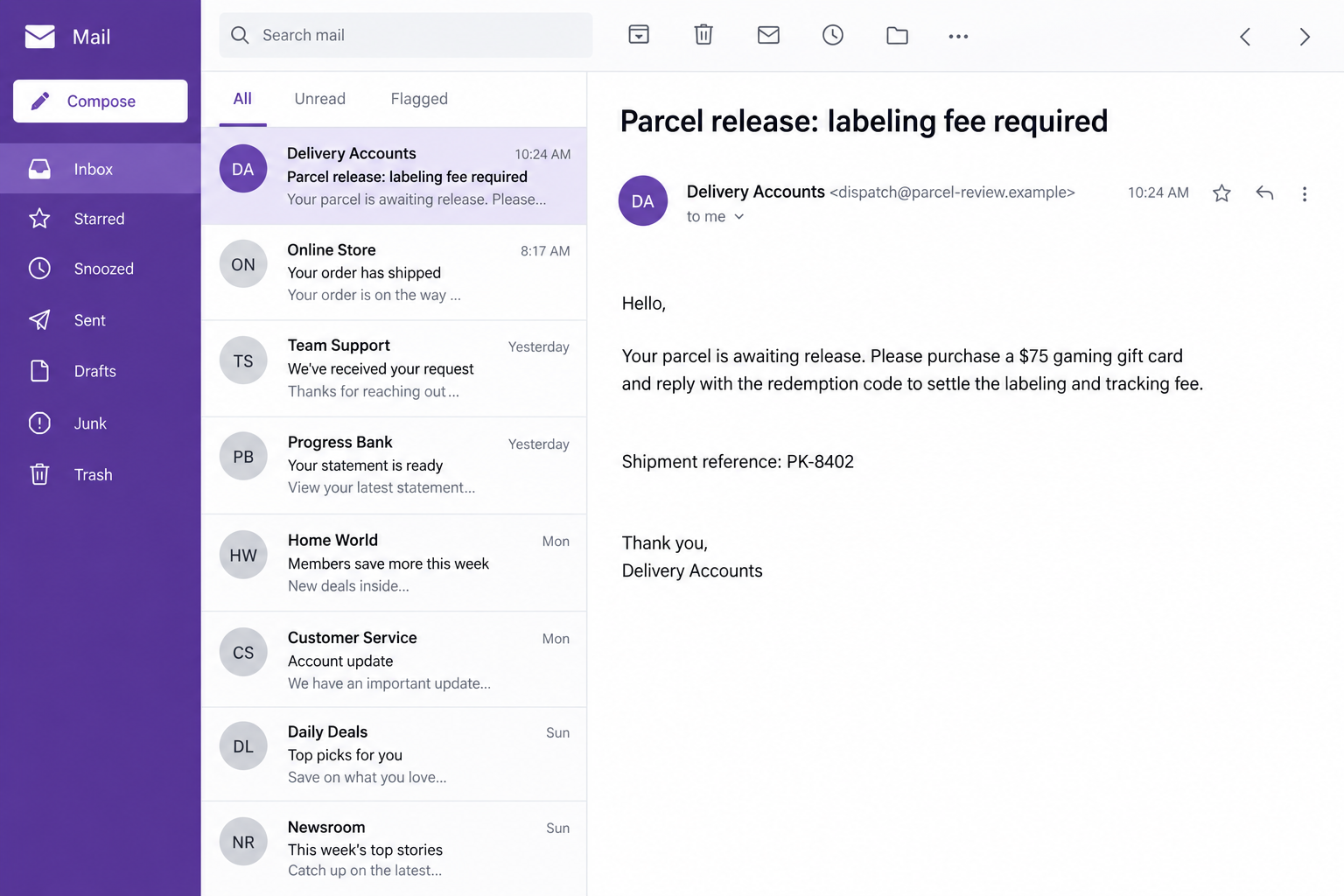
- A seller introduces an unfamiliar email contact as the person handling shipping.
- The contact demands a fee for labeling, tracking, clearance, insurance, or release.
- Payment must be made by sending gift card numbers or redemption codes.
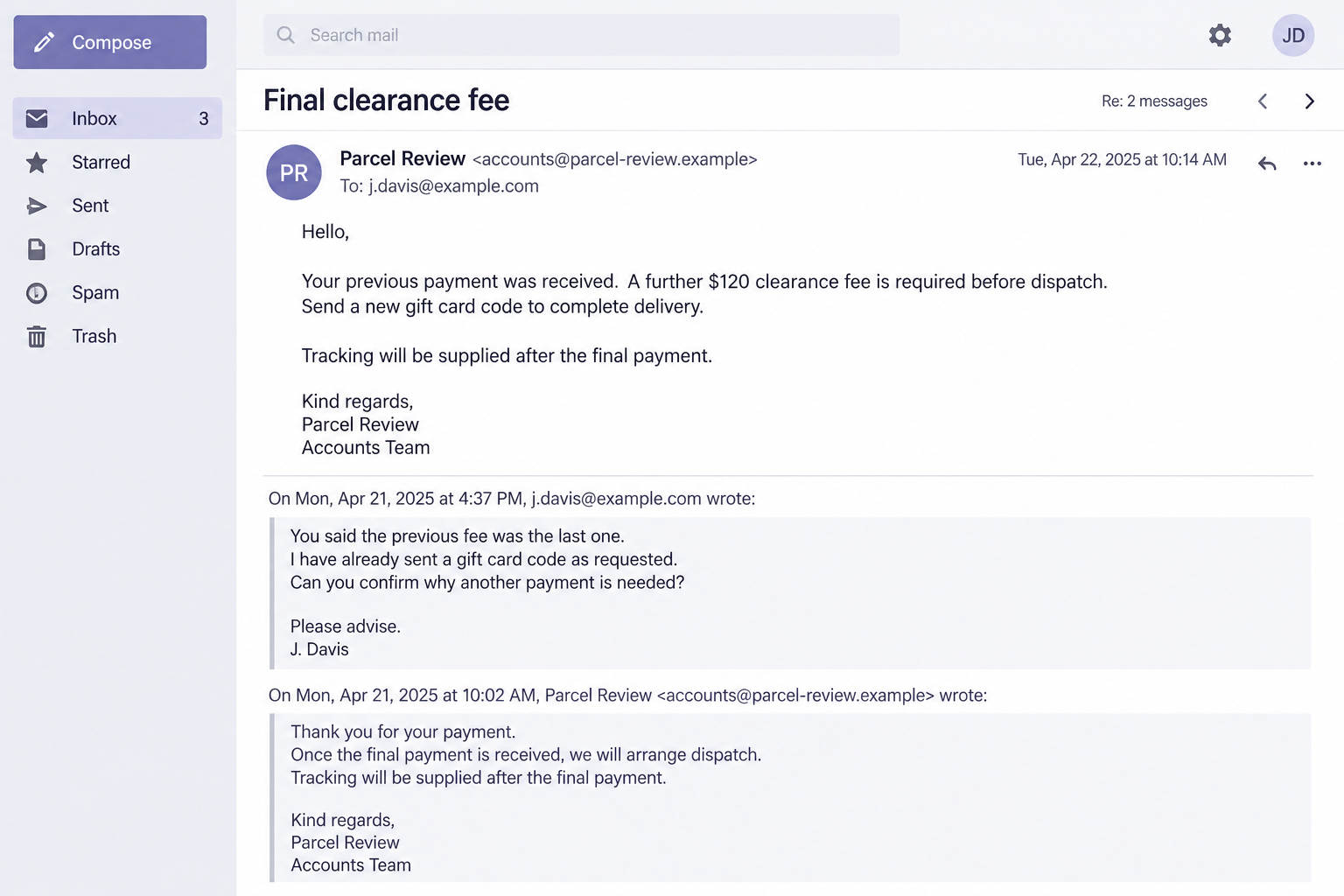
- Another supposedly final fee appears after the previous one is paid.
- Verifiable shipment information remains unavailable or does not match the order.
International shipments can genuinely involve duties or taxes. Verify those through FedEx’s official channels, not by accepting an email’s demand for gaming credit.
The email images are invented, nonfunctional reconstructions. They show the payment pattern without reproducing a real victim’s details or providing an active payment destination.
Why This Feels More Convincing After You Already Bought Something
A random delivery message can be easy to dismiss when you expect no package. An actual purchase changes that context.
You have already chosen the item, discussed it with a seller, and perhaps paid. A shipping update is exactly the next thing you anticipate.
The fake courier borrows that expectation. Instead of establishing a relationship from scratch, the message presents itself as the next administrative step.
The seller may reinforce the story by saying the courier always handles these charges. That reassurance is not independent verification of the courier’s identity.
Nor does knowing what you ordered prove the message came from a delivery company. The seller already has that information.
It is possible for a genuine merchant or account to be impersonated too. Do not assume who controls every stage without evidence.
What you can assess immediately is the demand itself. A stranger asking for a gift card code to release freight is not offering ordinary courier billing.
The safest pause happens before buying the card, not after sending its code. Once redeemed, the value may be difficult or impossible to recover.
How the FedEx Gift Card Scam Works
Step 1: A purchase creates a believable delivery story
The buyer finds an item through a marketplace, social group, or private listing. Communication may move from the listing to email or direct messages.
A collectible, used product, or discounted item can make the opportunity feel personal. The buyer wants this particular transaction to succeed.
Do not let that preference replace basic checks. Save the listing, seller account, agreed price, payment method, and shipping terms before sending funds.
If the seller later introduces a new fee, compare it with the original agreement. A changed explanation deserves verification, even if the amount seems manageable.
Step 2: An unfamiliar contact takes over as the courier
The seller supplies an address or forwards a message from a supposed shipping department. Familiar courier language makes the handoff sound routine.
An email display name can say FedEx while the underlying address belongs elsewhere. Open the sender details rather than relying on the inbox label.
A free email address claiming to be a major courier’s billing desk is a serious mismatch. However, a convincing-looking domain still needs independent checking.
Do not reply to ask whether they are genuine. The person making the claim cannot serve as their own independent verifier.
Step 3: Shipping requires a gift card instead of a normal payment route
The supposed courier asks for a retail or gaming gift card code to settle a parcel charge. The requested brand may change between attempts.
That brand is not the important part. The code gives the recipient access to stored value, while the buyer receives no ordinary shipping-payment protection.
A claim that the gift card is merely a temporary payment voucher does not change what it is. Read the card’s actual purpose before purchasing.
If a store employee questions the purchase, take the opportunity to stop. You do not need to defend the courier’s explanation to complete an online deal.
Step 4: The final fee is followed by another final fee
After one code is sent, another obstacle appears. A labeling charge can become clearance, insurance, storage, or another invented requirement.
The exact labels vary. The repeated structure is what matters: the shipment is always close, and another payment is always supposed to unlock it.
Having paid earlier can make refusing harder. You may feel that stopping now would waste everything already spent.
But another unverified payment does not protect the earlier ones. Evaluate the new demand as money you can still avoid losing.
Step 5: Missing delivery becomes another reason to wait or pay
If the parcel does not arrive, the supposed courier may blame processing, a payment mismatch, or a newly discovered hold.
The seller may continue reassuring you. That does not prove there is a shipment or that the courier contact is genuine.
Stop evaluating promises and check independently verifiable facts: a matching shipment, an official charge, and a payment channel controlled by the real company.
If those facts are absent, do not fund another explanation. Begin reporting the transaction and protecting any remaining card balance.
Check the Shipment, Not the Email’s Confidence
Enter tracking details on the real courier website
Type the courier’s official address or use its established app. Do not use a tracking link supplied by the suspicious sender.
A tracking number that returns information is not necessarily linked to your purchase. Compare the available dates, destination information, and shipment status.
If details do not make sense, ask the courier through independently obtained support. Do not let the seller explain away every mismatch.
A screenshot of tracking is weaker than a check you perform yourself. Images can be outdated, unrelated, or altered.
Separate a real import charge from the requested method
FedEx’s fraud guidance acknowledges legitimate import duties and taxes and points customers toward its official import-payment resources.
That exception matters. It would be inaccurate to tell readers that every delivery-related payment request is fraudulent.
However, the existence of real customs charges does not validate a gift card request. Verify both the charge and how the real courier collects it.
If the sender refuses any independent confirmation, do not pay. Urgency is not a substitute for a bill you can authenticate.
Keep the seller’s assurances separate from courier evidence
The person who introduced the shipping contact cannot independently establish that contact’s legitimacy. You need confirmation from outside that chain.
This does not automatically prove the seller’s legal identity or broader history. It establishes that their reassurance is insufficient to justify the payment.
Ask for ordinary order and shipment information, but do not send additional money while waiting. A legitimate explanation can be reviewed without exposing more gift codes.
Why a Gaming Card Cannot Prove a Parcel Was Released
A receipt from a store proves you bought the gift card. It does not prove the courier received a valid payment for your shipment.
A message saying the code was accepted proves even less. The same person requesting the code can claim success and invent the next obstacle.
Likewise, a balance of zero tells you value is no longer available. It does not establish that anything was paid toward delivery.
Do not confuse these separate records: the purchase price for the item, the gift card purchase, the code disclosure, and any real shipment record.
Keeping them separate helps when reporting. Your bank, marketplace, courier, and gift card issuer may each need different details.
If you paid the item seller through a protected checkout, review that transaction’s dispute process promptly. An off-platform courier payment may fall outside the same protection.
Do not assume a marketplace will cover every payment simply because the original conversation started there. Read the applicable rules for how you actually paid.
And do not send a second gift card to correct an alleged error in the first. Verify the first card’s status directly with its issuer.
What to Do if You Have Fallen Victim to This Scam
- Stop buying or sending additional codes.
Do not pay storage, clearance, refund, or release fees introduced by the same contact. Save the messages before ending the conversation.
If you purchased a card but have not disclosed it, keep its details private. Ask the retailer or issuer about your options without promising yourself a refund.
- Call the gift card issuer promptly.
Tell support the code was sent to a suspected courier impersonator. Ask whether any unspent value can be frozen or otherwise protected.
Keep the physical card, purchase receipt, and time of disclosure. The FTC’s guidance provides reporting advice and contact information for multiple card issuers.
Act quickly, but expect limits. A company may be unable to recover value after redemption, and no outside helper can guarantee otherwise.
- Report the original purchase through its payment channel.
Contact the marketplace and payment provider about the item transaction. Explain the separate shipping-fee demands and attach the relevant exchange.
Ask about the available dispute process and deadlines. Do not describe a gift card code as a conventional card payment to make the report sound simpler.
If your bank funded the gift card purchase, explain that distinction accurately. Buying a legitimate card and being tricked into sharing it are separate events.
- Notify the real courier about the impersonation.
Use the fraud-reporting instructions on FedEx’s genuine website. Include the suspicious sender and claimed tracking information while protecting unrelated personal details.
The courier can assess misuse of its identity. It may not control the gift card funds or be able to resolve the marketplace purchase.
- Preserve a clear timeline.
Save the listing, seller profile link, agreed shipping terms, emails, codes sent, receipts, and payment dates in a private evidence folder.
Keep gift card secrets out of public posts. A warning to other buyers should not expose whatever balance remains.
- Check any extra digital exposure.
If you entered a password on a fake tracking page, change it through the real service. Review connected sessions and account-recovery details.
If you installed a tracking attachment or app, use Malwarebytes or another reputable scanner and seek assistance when needed. Merely reading an email does not establish infection.
AdGuard can help limit deceptive advertising and web redirects. It cannot authenticate a courier email or reverse a redeemed code.
- Reject paid recovery promises.
A supposed shipping supervisor or recovery agent may offer a refund after one more fee. Do not continue the same payment pattern under a new label.
Work through institutions you contacted independently. Give yourself permission to stop chasing the parcel and focus on limiting the loss.
If You Have Not Paid Yet, You Can Stop Here
You do not need to prove whether the seller and courier are the same person. The gift card demand is enough reason to withhold payment.
Ask the real delivery company whether the shipment and charge exist. If the seller objects to that check, their objection does not make the fee legitimate.
Preserve the original order agreement before the listing changes or disappears. Then use the appropriate marketplace process for an undelivered item.
A disappointing purchase is frustrating, but it does not obligate you to finance repeated rescue attempts. Money not yet sent is still under your control.
Frequently Asked Questions
Does FedEx collect parcel fees through gaming gift cards?
A demand to send gaming or retail gift card codes to a supposed courier is a scam signal. Verify legitimate charges through FedEx’s official payment channels.
Can there be a real fee before an international delivery?
Yes. Duties or taxes can apply. Confirm the shipment and payment instructions directly with the courier rather than accepting an email’s gift card demand.
What if the seller says this courier always works that way?
The seller’s reassurance is not independent confirmation. Contact the real courier yourself and do not send more money while the charge remains unverified.
Does a working tracking number make the email safe?
No. Check that the shipment actually matches your order, then verify the charge separately. An unrelated or copied tracking record cannot authorize a gift card payment.
Can I get the gift card money back?
Contact its issuer immediately and retain the receipt. Some situations permit intervention, but recovery is not guaranteed, especially after the value has been redeemed.
Is the company that issued the gift card involved?
The card brand is the payment instrument being abused. Its presence does not establish involvement by the issuer, courier, or manufacturer of the item you ordered.
The Bottom Line
The FedEx gift card scam turns anticipation of a delivery into repeated demands for spendable codes. Another final fee does not bring an unverified package closer.
Check the shipment and charges with the real courier. Keep gift card details private, stop further payments, and report the transactions through their proper channels.








