

A name necklace feels personal before it even reaches the cart. That makes the promise beside its price especially reassuring.
But what happens if the lettering, color, or fit disappoints? Dorado’s written return rules deserve a close look before you choose a promotion.
Overview
Why shoppers are asking about Dorado
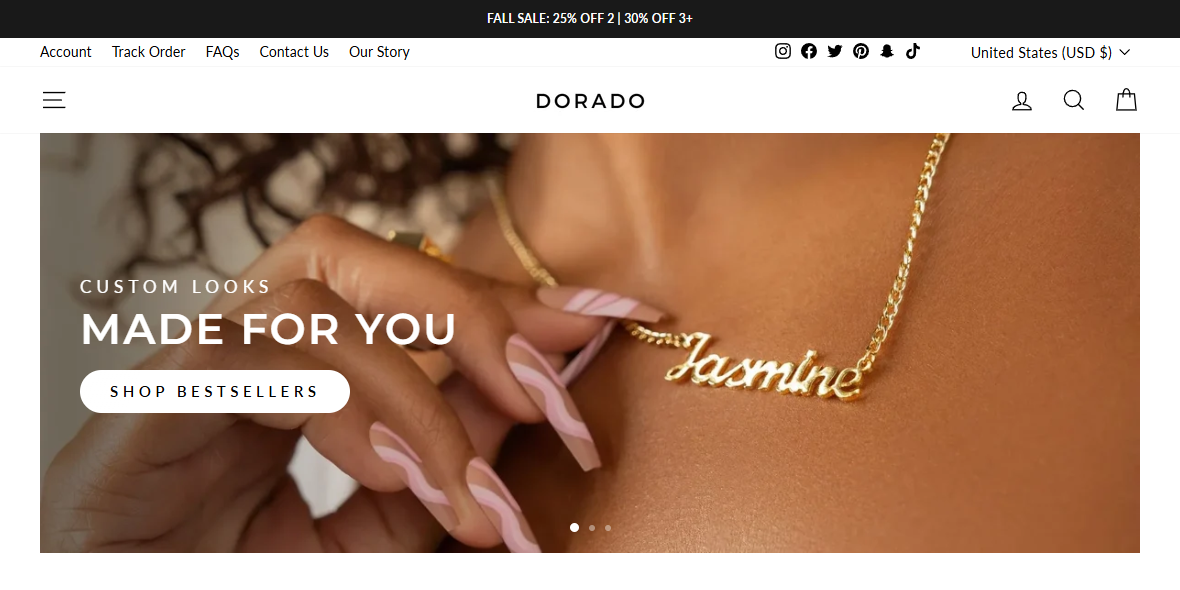
Dorado is an active jewelry retailer with custom pieces, ready-to-ship designs, and frequent discount offers. A promotion can make a personalized gift seem easy to try.
The problem is not an invisible merchant. It is the gap between an expansive “30-Day Money Back Guarantee” label and the narrower outcomes in the policy.
The decisive exclusions
The refund policy says personalized items generally cannot be returned or exchanged, though defects may qualify for replacement. Cancellation of a custom order must be requested within 12 hours.
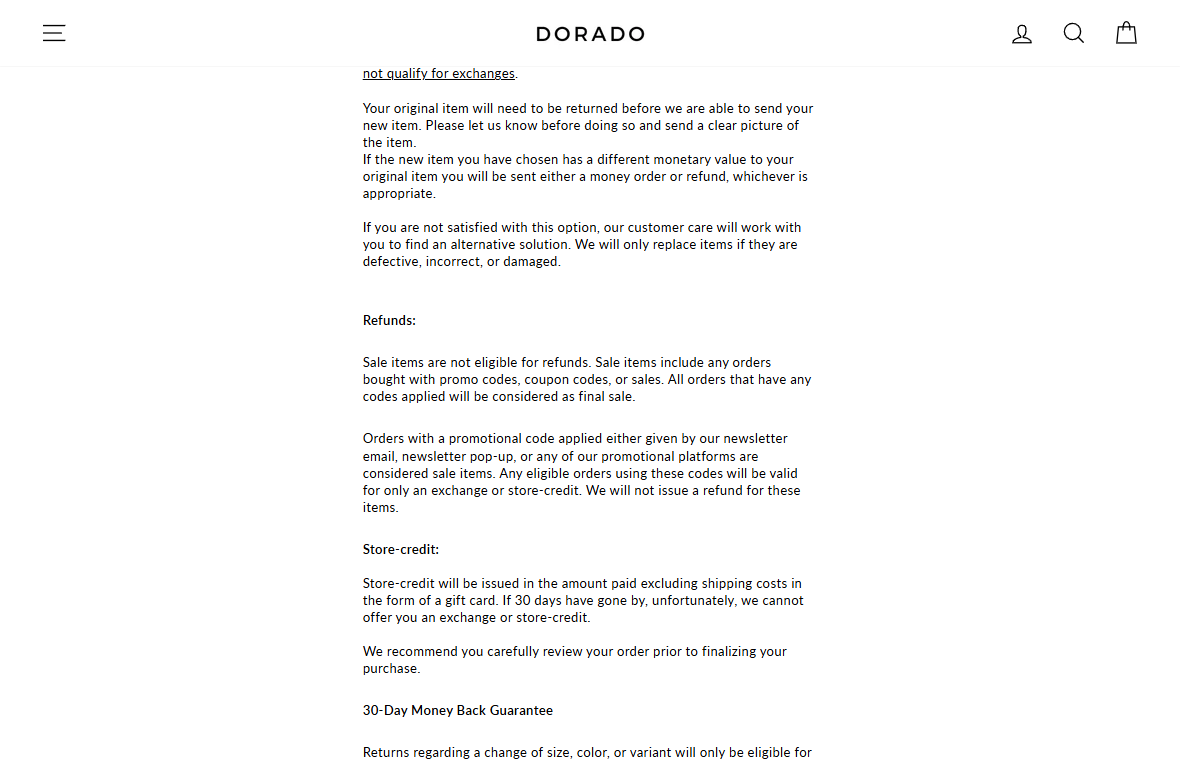
It also treats orders placed with a promo or coupon code as sale items. Those orders are not eligible for a cash refund under the stated rules.
What our review concludes
Dorado sells real jewelry. Its marketing and refund language, however, can create a much broader impression than the policy delivers for ordinary shoppers.
- Custom item: ordinarily no return or exchange for a change of mind.
- Promo-code order: generally exchange or store credit, not a refund to your card.
- International order: the published policy calls it final sale and does not support international returns.
- Uncustomized full-price item: possible return within 30 days of purchase if unused and packaged correctly.
That is a buyer-risk finding, not a claim that every dissatisfied Dorado customer was defrauded. The exact remedy depends on the item and transaction.
Read the Money-Back Promise Alongside the Fine Print
A shopper could reasonably understand “money back” as a return to the original card. Dorado’s policy describes several other remedies before a cash refund.
For an unwanted product, it first points toward exchanging it for another item or receiving store credit. It says a full refund may follow only if alternatives do not suffice.
A size, color, or variant change is specifically limited to exchange or store credit. That distinction matters with jewelry bought as a surprise gift.
For sale items, the policy goes further. It says any promotional code, including one from a newsletter popup, places an order in the sale category.
Such an eligible order can receive an exchange or gift-card credit, but the policy says the merchant will not issue a refund for it.
There is tension even inside that description: the page calls coded orders “final sale,” then describes exchange or credit for eligible coded orders.
Rather than guessing how support interprets it, ask a precise question before using a coupon. Preserve the answer with the cart showing the code.
Customized jewelry has another rule. A necklace made with a name, photograph, or chosen wording is ordinarily outside change-of-mind returns.
The seller says it can replace a custom item with a problem or defect. A replacement is not the same as a discretionary refund because the design disappointed you.
Timing also starts earlier than many buyers expect. For nonpersonalized products, the policy says 30 days from purchase, not 30 days from delivery.
If production and shipping consume part of that period, the decision window after arrival may be shorter than the headline suggests.
Return shipping is assigned to the customer and is nonrefundable. The policy warns that returning higher-value items without tracking creates a risk the store will not receive them.
These conditions do not make a sale illegitimate. They do mean the phrase “30-Day Money Back Guarantee” needs more explanation than its name provides.
How a Dorado Order Can Lose Its Cash-Refund Option
Step 1: A discount becomes part of the buying decision
A visitor sees a multi-item sale or newsletter coupon while choosing a necklace. The code feels like an uncomplicated saving on the advertised price.
At checkout, that small saving can change the policy category of the entire order. The written rules treat purchases with any applied code as sale items.
The buyer may never notice this consequence if the coupon box and refund promise appear on separate screens. Save both screens before committing.
If the possibility of cash back matters more than the discount, ask the store whether purchasing without a code changes eligibility for that specific piece.
Step 2: Personalization closes another door
A name, initials, birthstone selection, or photograph can make a piece special. It also moves the purchase into Dorado’s personalized-item rules.
The policy permits a cancellation request within 12 hours of ordering custom jewelry. After that, the seller says the production process prevents cancellation.
Double-check spelling, capitalization, chain length, plating, and the delivery address while the order is still open. A typo is painful when edits are not accepted.
If the finished product differs from the approved design, preserve the original customization details. That is different from simply changing your mind.
Step 3: Delivery starts a race against an earlier purchase date
The ordinary nonpersonalized return window is measured from purchase. Someone who bought a gift weeks ahead should not assume 30 fresh days after delivery.
Open the parcel promptly and inspect it in good light. Take photographs before removing protective packaging if a defect or wrong item is visible.
Keep the box and inserts for a possible return. The policy requires unused goods in the same condition and original packaging.
A piece that looks different under indoor light than it did in a heavily lit product photograph may be disappointing without necessarily being defective.
Step 4: Support proposes a different remedy
A customer requesting money back may be offered a replacement, exchange, complimentary item, or store credit. Those are listed in the satisfaction language.
Some buyers will happily accept a corrected necklace. Others need their payment reversed because the intended occasion has passed.
State the reason for the request and the remedy you want. Ask support to identify the clause governing your particular order and promotion.
The policy displays more than one support address across its sections. Use the current official contact page or return portal, and keep copies of every submission.
Step 5: An international customer finds the return unavailable
Dorado says it does not support international returns and considers all international orders final sale. That rule should be evaluated before paying overseas shipping.
Do not interpret an international shipping option as an international change-of-mind return option. Those are entirely separate services.
A damaged or incorrect delivery may still warrant contacting support, but do not assume the normal domestic return path is available abroad.
Ask in writing how a seller-caused mistake will be corrected for your country, including duties and return shipping, before buying an expensive item.
Step 6: The final amount shrinks through postage and credit
Even when a noncustomized return is approved, the buyer generally pays the shipment back. Original delivery charges are excluded from store credit.
A gift card for the purchase amount minus shipping may feel very different from a promised “money-back” outcome. Check the remedy before sending anything.
Never mail jewelry to a manufacturer or guessed address. The policy explicitly says not to do that and requires proof of purchase.
If a representative promises a refund, request confirmation that it will go to the original payment method, in what amount, and on what timeline.
Company, Address, and Fulfillment Checks
Know who takes the payment
Dorado has an operating storefront, help center, and order-tracking link. That is meaningful evidence of a retail operation, but it does not broaden the refund promise.
Before paying, record the merchant name shown on the order and bank transaction. If you later challenge a charge, the processor may show a different descriptor.
Do not confuse the brand’s customer-satisfaction language with the legal rules for a personalized or discounted item. Keep the order-specific documents together.
Ask where an approved return actually goes
A return address is not necessarily a corporate headquarters or the workshop that made a necklace. It can be a contracted processing facility.
Dorado’s policy specifically says not to mail purchases to the manufacturer. Wait for the return instructions associated with your order number.
Photograph the sealed parcel and save tracking. For a higher-value piece, consider a shipping method with a reliable delivery record.
Use the official help route, not an ad’s contact box
The policy lists customer-service instructions, while the site also links a return portal. Use contact details reached directly through the current Dorado domain.
Ask whether your exact order is custom, sale, or eligible full-price merchandise. Mention the code used, destination country, and purchase date.
An answer that simply says “covered by our guarantee” is incomplete. Request the expected remedy, whether cash is possible, and the return shipping responsibility.
Separate custom production from product quality
The seller’s inability to reuse a personalized necklace explains a restrictive return rule. It does not excuse a misspelling the company introduced or a broken clasp.
When a piece is wrong, compare it with the order proof. Photograph the engraving, stone, chain, and package label before requesting correction.
Likewise, a promotional discount does not make an unsafe or incorrect item acceptable. The remedy for a seller error may differ from a preference return.
Questions to Ask Before You Enter a Promo Code
Would you still buy this piece if you could only exchange it or receive a store gift card? If not, a modest discount may not be worth the trade.
Is the item personalized in the policy’s sense? A seemingly minor custom choice can move it out of standard return eligibility.
What date starts the 30-day period? The current policy says purchase date for nonpersonalized returns, so mark that date on a calendar.
Does the listing promise a particular metal or just a finish? Read the material description to avoid treating a color name as a precious-metal guarantee.
Does a warranty extension appear in the cart? The policy describes an optional 2-year extension, which is not identical to a general refund right.
How will a mistake be fixed if you live outside the United States? An international final-sale rule deserves a written exception process for incorrect goods.
Is this a time-sensitive gift? If the recipient cannot use the item, store credit may be much less helpful than a payment reversal.
Finally, preserve the current policy. A screenshot of the precise sale and refund language can settle confusion better than a remembered headline.
What to Do if Your Dorado Purchase Goes Wrong
- Collect the order facts. Save the item listing, customization details, coupon code, receipt, purchase date, delivery date, and policy shown at checkout.
- Act immediately on a custom-order error. If you need to cancel, contact the seller within its 12-hour request window. Keep proof of submission.
- Inspect the delivered jewelry. Photograph damage, incorrect text, wrong color, missing components, and packaging before using or modifying the piece.
- Classify the remedy. An incorrect or defective item is different from a preference return. Explain the specific mismatch and what correction you seek.
- Use an authorized contact route. Open the official return portal or contact support through the site. Ask for written instructions before mailing the item.
- Clarify cash versus credit. If support offers an exchange or gift card, ask whether a refund is available for your exact order and why.
- Escalate with documents if necessary. If the merchant fails to supply a promised, policy-compliant remedy, contact your payment provider within its deadline and provide the complete timeline.
A bank dispute is strongest when it describes a measurable problem or broken promise. A promotional code you knowingly used may limit an ordinary cash-return argument.
There is no need to accuse the merchant of fraud just to be heard. A precise account of what you ordered, received, and requested is more useful.
Frequently Asked Questions
Is Dorado jewelry a scam?
We found a functioning jewelry retailer. The issue documented here is the limited remedy behind a broad money-back phrase, especially for custom and discounted orders.
Does a coupon code cancel my cash-refund option?
The reviewed policy treats orders using promo or coupon codes as sale items. It says eligible coded orders can receive an exchange or credit, not a refund.
Can I cancel a custom name necklace?
The policy says personalized-order cancellation must be requested within 12 hours of placing the order. After that, production may prevent cancellation.
Can I return nonpersonalized jewelry?
An unused full-price piece may qualify within 30 days of purchase, subject to packaging and other conditions. Confirm whether a discount or international destination changes eligibility.
Does Dorado accept international returns?
Its published policy says international returns are not supported and international orders are final sale. Ask support separately about incorrect or damaged deliveries.
Who pays return shipping?
For an ordinary return, the policy assigns postage to the customer and excludes shipping charges from credit. Get seller-error instructions in writing before shipping.
The Bottom Line
Dorado’s “30-Day Money Back Guarantee” is not a universal 30-day cash-refund offer. Customization, coupon codes, and destination can substantially narrow the remedy.
Before ordering, decide whether exchange or store credit would genuinely work for you. If not, confirm cash eligibility for that exact item and cart in writing.








