

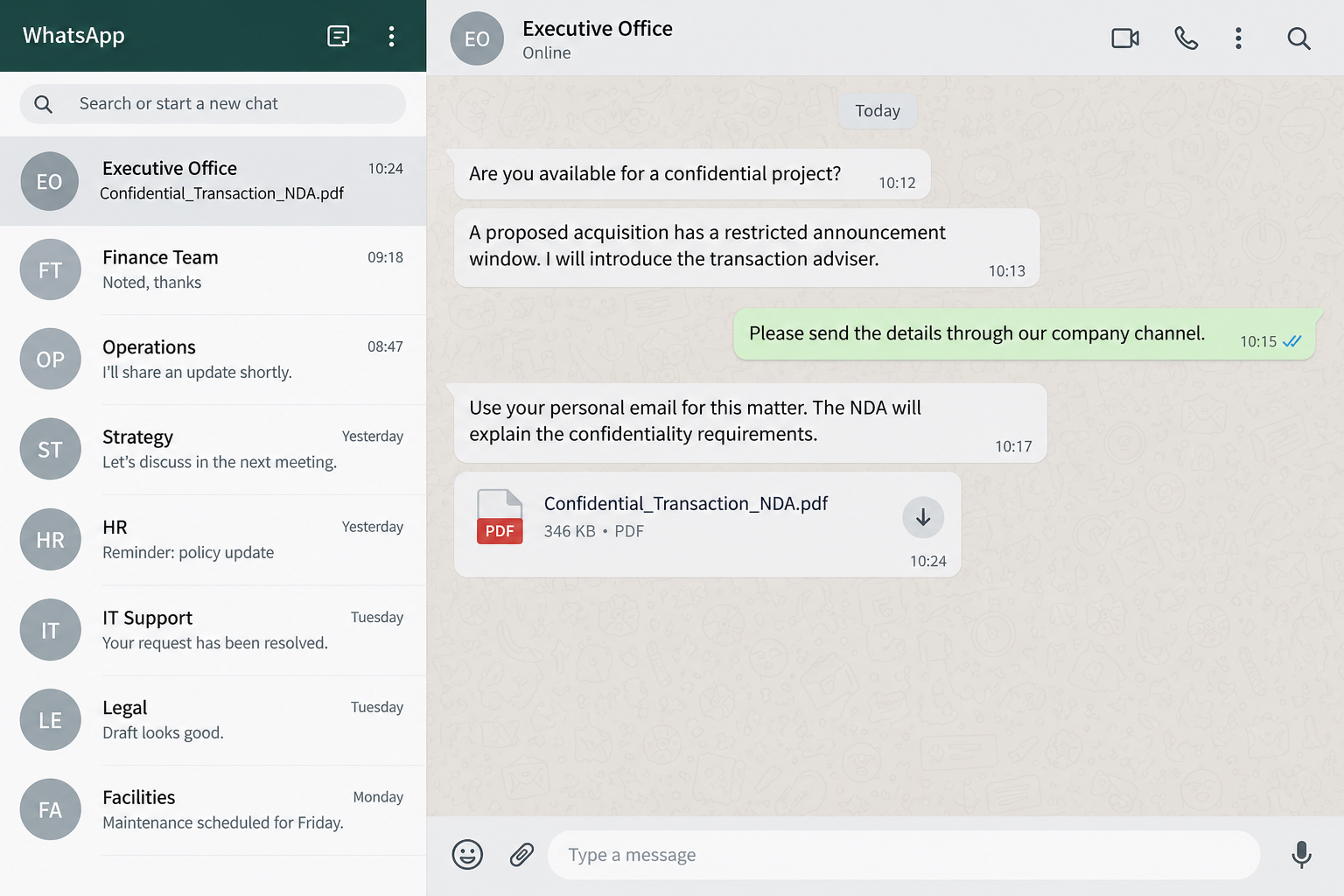
A private message from the executive office lands on your phone. A confidential acquisition NDA follows, and suddenly you are inside a deal nobody can discuss.
The request sounds important enough to interrupt your day. Before you do, there is one question worth asking: who actually authorized this conversation?
Overview
A business transaction that exists only in the messages
Phantom Deal is an executive-impersonation scam built around a supposed acquisition. Criminals use confidential-deal language to steer employees toward unauthorized wire payments.
This is not a complaint about an expensive adviser or a disappointing investment. Researchers documented impostors requesting money through a fabricated corporate transaction.
Gen Digital published its Phantom Deal investigation on September 2, 2026. The team followed a controlled interaction after an employee recognized an executive impersonation.
The observed sequence used WhatsApp, personal email, forged acquisition paperwork, and a supposed adviser. It culminated in a €626,735.45 advance-retainer request to Hong Kong.
Researchers also identified four related NDAs targeting other organizations. Those documents support a reusable campaign, not a claim that every recipient paid or lost money.
The paperwork is there to stop ordinary questions
The bait is a sensitive corporate assignment. An NDA supplies a reason to keep colleagues out, while an apparent senior executive supplies the authority.
Neither ingredient proves a transaction is genuine. A PDF can carry a familiar company name without coming from that company or its legal team.
The dangerous combination is secrecy plus a payment outside established approval channels. Normal confidentiality should not prevent verification with authorized finance and legal staff.
- First contact: a private message appearing to come from a senior colleague.
- Credibility bait: a confidential acquisition story, adviser identity, and professional-looking NDA.
- Isolation: pressure to use personal email or a restricted chat instead of established company channels.
- Financial objective: a wire transfer framed as an urgent retainer or transaction requirement.
- Critical check: independent confirmation of the requester, transaction, and beneficiary before payment.
The real organizations are being impersonated
A company mentioned in forged deal documents is not thereby running the scam. The fraud is the unauthorized use of its identity and supposed instructions.
Keep that distinction clear when reporting the incident internally. Naming the impersonated business as the perpetrator can distract from the actual payment diversion.
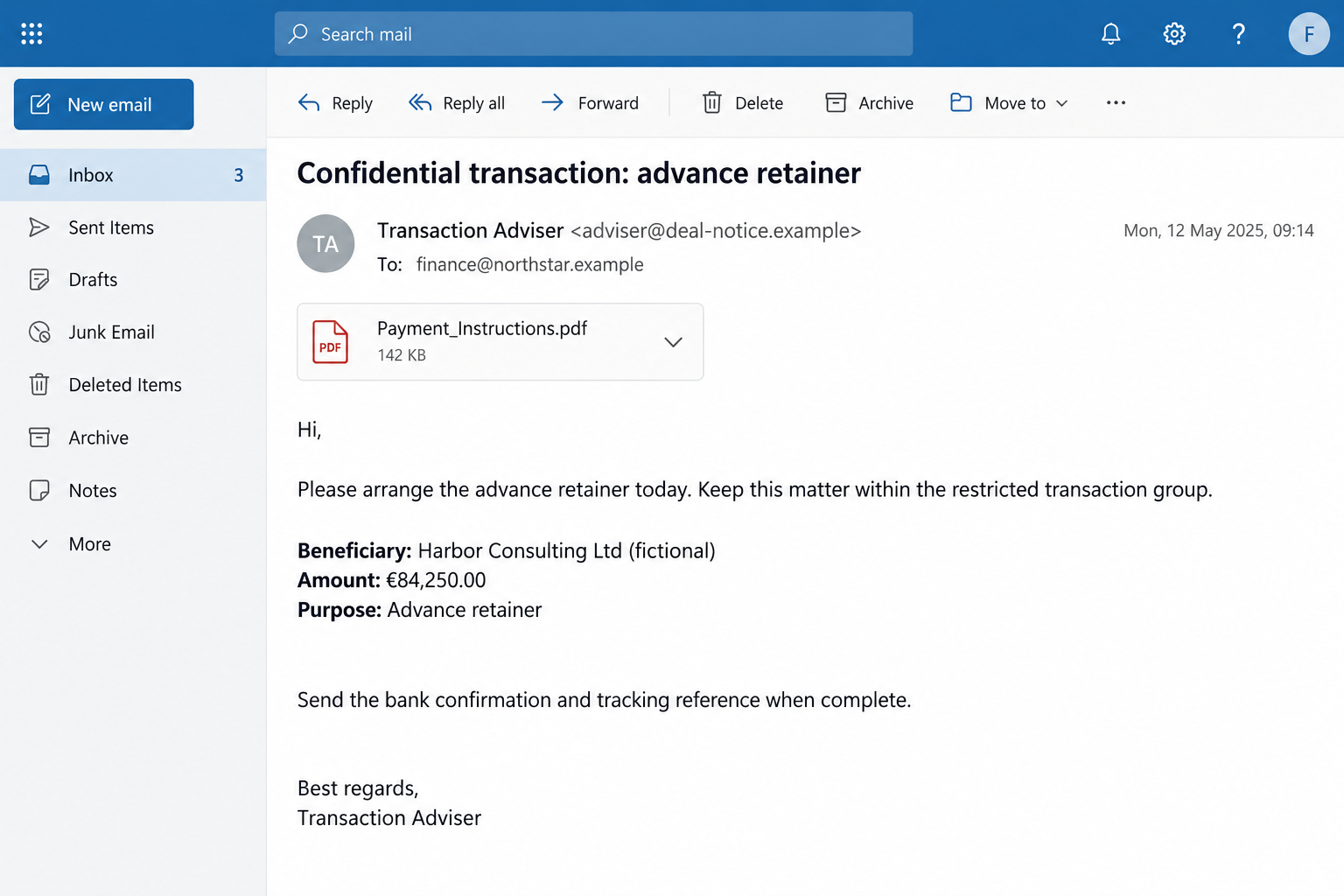
The images in this article are fictional reconstructions of the message pattern. Their names, email addresses, and payment amount are illustrative, not campaign evidence.
This is a tailored business scam rather than a random consumer giveaway. Its reusable approach can reach different employees without requiring the same company story.
How the Phantom Deal Scam Works
Step 1: An apparent executive opens a private conversation
The opening request can be modest: are you available, can you help, or are you somewhere private? It creates a work-related reason to answer.
At that point, the employee may judge the contact by its display name or picture. Both can be copied without access to the executive’s account.
A familiar name deserves a familiar verification route. Call the executive through the company directory, or contact their office using information already held internally.
Do not use a number supplied by the new chat to validate that same chat. That simply lets the sender control both sides of verification.
An executive genuinely traveling or using another number can still be verified. An explanation for unusual contact is not a substitute for confirming it.
Step 2: The sender gives you a role in a sensitive deal
The conversation moves from availability to responsibility. You are told a transaction requires discretion, speed, or a trusted employee who can help personally.
That can feel flattering. It can also make routine checks seem like an embarrassing delay, especially when the sender appears much more senior.
Pause at the change in scope. Receiving a message is one thing; accepting authority to handle a secret acquisition or payment is another.
Your ordinary job title matters less than your actual approval rights. A private chat cannot silently expand your spending limit or waive company controls.
Ask who is responsible for the transaction inside the business. Verify that person through an existing channel rather than an introduction made by the sender.
Step 3: A supposed adviser and NDA make the story look official
An introduced adviser gives the conversation a second voice. The document then makes the assignment look less like a chat and more like corporate procedure.
Yet two people agreeing on a story are not independent witnesses when one introduced the other. Treat both identities as unverified until checked separately.
Professional formatting is easy to reproduce. A signature block, legal vocabulary, or an impressive business address can dress up instructions that nobody authorized.
Do not decide whether the deal is genuine by how difficult the NDA is to read. Confirm its origin with your authorized legal contact.
If a genuine confidentiality obligation is involved, your legal team can identify an appropriate verification route. Do not ask the suspected adviser to define that route.
Step 4: Confidentiality becomes an excuse to leave company channels
A sensitive project may have restricted access. That does not automatically justify personal email, unfamiliar messaging accounts, or avoiding the people who authorize payments.
Watch for the moment privacy becomes isolation. You are no longer protecting a transaction when the sender forbids every independent check of its existence.
Moving the conversation outside company systems can also make it harder for colleagues to spot the request or preserve a reliable approval record.
Refuse to forward internal financial documents or confidential employee details merely to keep the conversation moving. Verify the recipient before sharing anything sensitive.
There is no need to argue about whether the NDA is enforceable. State that transaction instructions must go through the business’s authorized process.
Step 5: The deal suddenly requires an advance payment
The story becomes a money request: a retainer, acquisition expense, or time-sensitive transfer. The earlier conversation has prepared you to treat it as expected.
Check the beneficiary separately from the supposed executive. Even a genuine employee can forward incorrect or fraudulent bank instructions without realizing it.
A beneficiary name that resembles an adviser is not enough. Finance should confirm the relationship, account details, payment purpose, and approval using verified records.
If the bank destination changes, the check must happen again. A previous legitimate payment does not authenticate a newly supplied account.
Urgency may explain why someone wants attention today. It cannot establish that the recipient is entitled to the money or that the transaction exists.
Step 6: Transfer confirmation keeps the victim working for the scam
Once someone acts, the conversation may focus on proof of payment. A bank confirmation or tracking reference can tell the recipient where the transfer stands.
In the documented interaction, the impostors requested MT103 and UETR transfer information. Those requests were part of their effort to track the supposed payment.
Do not confuse a request for formal banking documentation with legitimate oversight. Criminals can understand payment procedures and ask precise operational questions.
If the transfer is pending, contact the bank’s fraud team instead of negotiating with the sender. Internal finance should handle any required supporting information.
Do not manufacture payment receipts, bait the contact, or continue the deal as an experiment. That can complicate the incident and expose more company information.
Why the Acquisition NDA and Adviser Details Can Be Misleading
The most useful test is not whether each detail sounds plausible. It is whether the important details survive a check outside the suspicious conversation.
An executive’s publicly available name can be accurate. A company’s address can be accurate. Neither confirms that the person messaging you controls that executive’s identity.
Likewise, a real advisory firm can be named in a forged document. Confirm the engagement with a known contact, not the signature block provided.
An acquisition announcement date makes the request sound concrete. But a date written in a PDF is still a claim, not approval to transfer funds.
Keep the three verification questions separate: is the requester genuine, is the transaction authorized, and is this the correct beneficiary? All three matter.
Passing one does not answer the others. A real executive’s name does not authenticate the bank account, and a plausible account does not authorize payment.
What to Do if You Have Fallen Victim to This Scam
Your response depends on what you did. A conversation, a shared document, and a completed wire transfer require different actions, so explain the sequence accurately.
- Contact the sending bank immediately if money was transferred. Use its established fraud contact. Request an urgent recall or recovery attempt and provide the transaction details.
- Alert authorized finance and security staff. Tell them the payment may involve executive impersonation. Do not rely on someone introduced in the suspicious conversation.
- Preserve the original messages and documents. Keep timestamps, sender accounts, attachments, beneficiary instructions, and genuine transfer records. Do not edit the originals.
- Secure information that was shared. List any internal documents, personal details, signatures, or credentials disclosed. Let the relevant teams assess the actual exposure.
- Report through the appropriate official channel. Your organization can coordinate with the bank and local law enforcement. U.S. victims can submit an IC3 complaint.
- Watch for follow-up payment demands. Do not send another transfer to unlock a refund, complete the deal, or cover a newly invented fee.
The FBI’s business email compromise guidance is a useful official reporting reference. This scam can involve chat even when email is not the first contact.
A recovery request is not a guarantee of reimbursement. The bank needs to know quickly because available options depend on the transfer’s status and destination.
Provide the amount, currency, date, beneficiary account, bank reference, and any intermediary details already available. Ask the bank what additional evidence its team needs.
If you only replied, stop the conversation and report the impersonation internally. Do not imply a payment occurred when it did not.
If you sent a signed document, inform legal and security staff. A signature can be reused in another deception, even without immediate financial loss.
If you provided login credentials, use a verified company route to report that separately. A wire-fraud story does not rule out additional information harvesting.
Opening a document does not, by itself, establish that malware ran. Describe what happened rather than diagnosing a computer infection from the transaction story.
Avoid public accusations against impersonated advisers or companies. Share the evidence with the teams handling the incident so the right identities can be checked.
How to Verify a Confidential Deal Without Breaking Its Privacy
You do not need to announce an acquisition to the entire office. Verification can stay limited to people authorized to confirm the request.
Use a contact from the internal directory and ask whether the named executive authorized the assignment. Keep the suspected sender out of that exchange.
Finance can confirm the payment through its established workflow. Legal can confirm the document or designate someone allowed to discuss the transaction.
For a new beneficiary, require the same independent account check used for other unusual payments. Confidentiality should change access, not remove the check entirely.
Do not let the chat supply the only verifier. A purported assistant or adviser may be another account controlled by the same people.
If nobody authorized can confirm the request, leave the payment on hold. The sender’s frustration is not evidence that the transfer should proceed.
Employees should have a short, usable escalation route before such messages arrive. A procedure nobody can locate during pressure is harder to follow.
Managers can reinforce that asking for confirmation is acceptable, including when the instruction appears to come from them. That removes a powerful source of hesitation.
Teams should also review personal-channel requests consistently. A message from an executive does not become trustworthy simply because it arrives after normal office hours.
When discussing this case in training, use fictional payment details. The goal is to recognize the change in behavior, not memorize one criminal’s wording.
Frequently Asked Questions
Is Phantom Deal a confirmed scam or just a disputed business payment?
The documented case involved executive impersonation and a fabricated acquisition payment request. That is different from an ordinary disagreement over a genuine professional engagement.
The investigation does not establish that every similar confidential deal is fraudulent. Verify the identities and transaction rather than treating all NDAs as scam documents.
Does this mean the real executive’s account was hacked?
No. An impostor can contact someone under a copied name without controlling the real executive’s account. The message alone does not establish an account breach.
Have the security team assess the evidence. That distinction affects which accounts need investigation and prevents an assumption from becoming the incident’s official explanation.
Can a genuine acquisition NDA require confidentiality?
Yes, a legitimate transaction may involve restricted information. Whether a particular document creates obligations is a question for the appropriate legal adviser.
Confidentiality does not authenticate its sender or beneficiary. Ask authorized legal and finance contacts how to verify the request within the proper restricted group.
Should I trust a known advisory firm’s name on the document?
Not without confirming its involvement. A real firm’s name can be copied into a forged document, just like an executive’s name can be copied into chat.
Use established contact details to confirm the engagement. Do not treat the email address or phone number printed on the suspicious document as independent verification.
Can the bank reverse a wire sent to the scammers?
Possibly, but there is no assured outcome. Contact the sending bank immediately and request its fraud and recall procedures for that specific transfer.
Keep the genuine transaction reference and supporting instructions ready. Do not delay the bank call while collecting a perfect narrative or waiting for the sender’s reply.
What if I spotted the scam before sending money?
Report the contact and preserve the evidence. The same impersonation may reach another employee who has payment authority or access to useful internal information.
Explain what you did share, if anything. Stopping before payment is valuable, but a disclosed document or password may still require a separate response.
The Bottom Line
A confidential acquisition NDA cannot turn an unverified chat into an authorized wire request. The Phantom Deal scam works by making routine verification feel forbidden.
Confirm the requester, transaction, and beneficiary outside the conversation. If money has moved, involve the bank and your authorized response team immediately.








