

After another restless night, a soft neck collar can look more appealing than another struggle with a CPAP mask. Vitavix NeckSupport is sold around that hope.
The page promises an easier bedtime. Before buying, look closely at the difference between feeling comfortable and knowing your breathing is being treated.
Overview
The collar is promoted as an answer to sleep apnea
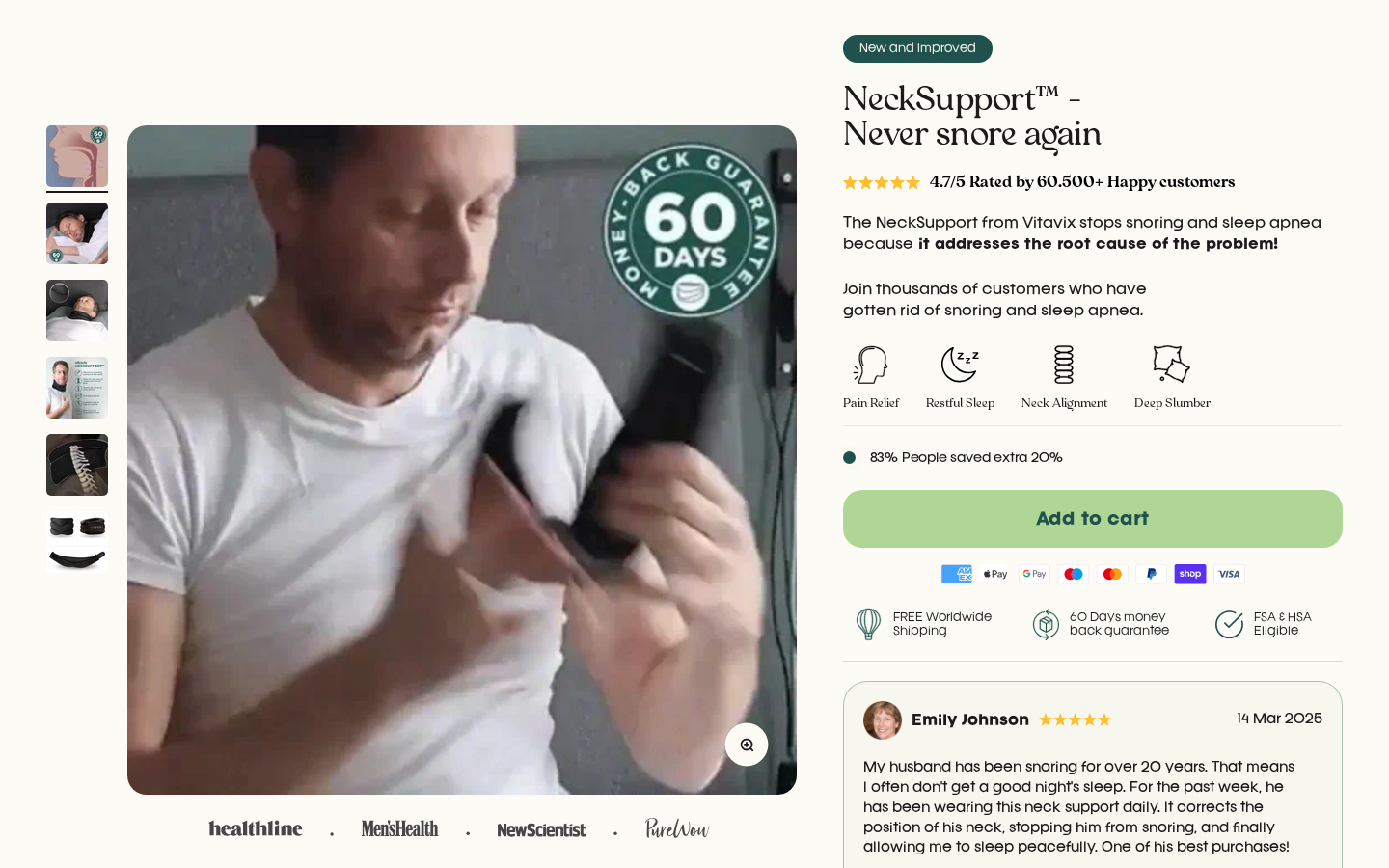
Vitavix sells a neck support for snoring, posture, and sleep apnea. Its product page says the collar stops snoring and sleep apnea by addressing the root cause.
A related advertorial criticizes CPAP and presents the collar as an immediate alternative. That is a much bigger promise than helping your neck feel supported.
The pages do not provide a usable clinical study showing that this particular collar can replace prescribed treatment. Do not make that switch on the advertisement’s advice.
The percentages sound reassuring, but the study details are missing
One claim says 92% of participants noticed reduced sleep apnea after two nights. Another page refers to effectiveness for 94% of users.
Neither figure comes with enough published detail to check how breathing was measured, who took part, or what counted as improvement.
Sleeping more comfortably or snoring less can feel encouraging. Those impressions do not tell you whether breathing interruptions are adequately controlled.
- The product page promises to stop sleep apnea.
- The advertorial encourages readers to favor the collar over CPAP.
- Clinical-sounding percentages lack a usable study report.
- The 60-day satisfaction promise sits beside an unused-item return requirement.
- No automatic refill plan is established for the device offer.
Keep your sleep-care team involved
If you have prescribed treatment, speak with the clinician managing it before trying a replacement. Explain what is making the current setup difficult.
Also ask the seller whether you can return NeckSupport after wearing it. A sleep trial is hard to evaluate if the return policy requires an unused product.
The two questions belong with different people: your clinician can assess treatment, while the seller needs to explain the purchase and guarantee.
A Quiet Bedroom Does Not Answer Every Breathing Question
When snoring keeps someone awake, silence can feel like a breakthrough. It is easy to focus on the sound because that is the problem everyone notices.
Sleep apnea involves interruptions in breathing during sleep. A partner hearing less noise cannot measure all those interruptions or tell whether treatment is working.
The National Heart, Lung, and Blood Institute explains sleep-apnea treatment options, including positive-airway-pressure devices and other approaches chosen for the patient’s needs.
Its CPAP guidance explains how air pressure helps keep the airway open. Prescribed equipment and settings are part of that treatment.
A neck collar changes support or position. That is not enough, by itself, to show the same breathing benefit for a particular patient.
It is entirely reasonable to want something easier to wear. A mask that leaks, dries your mouth, or feels awkward can make bedtime frustrating.
Tell your clinician about those problems. They are useful details for improving the setup or considering another suitable option.
You should not have to choose between tolerating discomfort silently and abandoning treatment. The advertising makes that choice look narrower than it needs to be.
If another option is considered, ask how its effectiveness will be checked. Feeling better on the first morning is encouraging information, but not a complete assessment.
How the Vitavix Pitch Moves From Comfort to a Purchase
Step 1: The page starts with the part of treatment you dislike
The advertorial talks about masks, marks, dryness, noise, cleaning, and travel. Readers who have struggled with equipment may recognize several of those complaints.
Then it offers a quiet, soft collar without the same setup. The relief is easy to imagine, especially when you are tired of trying to get comfortable.
Keep that comfort question separate from the breathing question. A product can be easier to wear without being an adequate treatment for your condition.
Step 2: Neck alignment is presented as the missing answer
The page describes poor neck position as the explanation behind the problem. It says the support keeps the airway open naturally.
That neat explanation leaves little room for differences between patients. The seller has not assessed your diagnosis, anatomy, symptoms, or current treatment.
Take the actual claim to your clinician. Ask whether it applies to you and whether this particular device has a useful role alongside your care.
Do not assume a generic drawing of an airway answers those questions. A diagram explains a proposed idea; it does not measure what happens while you sleep.
Step 3: Large percentages make the result feel predictable
The product page refers to observational studies, participant numbers, and rapid improvement. Those details make the promise sound more settled than the available explanation allows.
Ask for the named study and the full report. You should be able to see what device was used and how the researchers assessed breathing.
A percentage loses meaning when the outcome is vague. Did people report better sleep, did partners hear less snoring, or did a test measure fewer apnea events?
Those are different results. A study needs to say which one it measured before the number can guide a medical decision.
The same goes for references to doctors or researchers. Names, methods, and results are more useful than a general appeal to expert approval.
Step 4: The money-back promise makes trying it feel easy
The sales page advertises a 60-day risk-free experience. That can make ordering feel like a low-pressure way to find out whether the collar helps.
But the linked return policy says items must be unused, in their original packaging, with the accessories included.
Someone buying a sleep product naturally expects to sleep in it. The seller needs to explain whether that use still qualifies for the promised satisfaction return.
Get the answer before paying. If the trial has special rules for NeckSupport, ask for those rules rather than relying on a general returns sentence.
Step 5: Your first impression may be mistaken for a treatment result
A softer bedtime or a quieter room can feel like confirmation that the purchase was worthwhile. The page encourages that hopeful interpretation.
Share the experience with your sleep-care team instead of changing treatment alone. They can explain what further assessment, if any, is appropriate.
If the collar causes discomfort or breathing concerns, stop using it and seek advice. Do not make it tighter or improvise a modification to chase the advertised effect.
Can You Try It and Still Get Your Money Back?
The product page says its guarantee begins when the item is received. It invites buyers to contact the seller if they do not have a positive experience.
The return policy also describes 60 days after receipt, while noting that the period can vary by product.
The unused-item condition is the sticking point. Ask whether wearing the support for a night, or opening its packaging, changes your eligibility.
You also need to know what would be refunded. The policy assigns return postage to the buyer and describes approval after inspection.
If you need to ship it overseas, postage could affect whether a return feels worthwhile. Get the destination and costs while you are still deciding.
A one-year warranty for a product defect is another matter. It should not be assumed to cover disappointment with sleep results.
Keep any reply explaining an exception to the general policy. Ask support to connect the answer to NeckSupport and, after purchase, to your order number.
Seller, Address, and Device Information
The terms identify TVT Trading B.V.
The store’s terms name TVT Trading B.V. and Chamber of Commerce number 83778144 as the operator.
That gives you a company name to compare with the invoice. A name in the terms is not a clinical credential or an endorsement of the device.
Check that your payment confirmation identifies the transaction clearly. If a different business appears, ask how it relates to the store.
The Tilburg address needs the right context
The terms and footer list Kraaivenstraat 23-21, 5048AB, Tilburg, Netherlands. They do not establish that the collar is manufactured at that address.
A business address and a returns depot may serve different purposes. Ask support where your particular order should go if a return is approved.
Do not send the collar to the footer address automatically. The return instructions may name another location or require a form inside the package.
Support should answer the trial question clearly
The published email is info@tryvitavix.com. The site also gives support hours, but no call or message was tested for this article.
When contacting support, ask about worn-item eligibility, the deadline, postage, and the refund amount. A useful reply should answer each point.
Keep the response with the order confirmation. If you later need help from a payment provider, that record shows exactly what you were told.
The device needs more than a comfortable-looking photograph
Request the manufacturer, materials, sizing range, instructions, and warnings. For something worn during sleep, those details should be easy to obtain.
Check that the instructions belong to the exact device shipped. If they conflict with the page’s broad promises, get an explanation before wearing it.
No physical device test is included here. The concern is the leap from neck support to a confident promise about treating sleep apnea.
How to Bring This Up at Your Next Appointment
You do not need to feel awkward about wanting a more comfortable night. Bring a screenshot of the offer and explain what attracted you to it.
Be specific about what is difficult with your current treatment. That gives your clinician something they can actually help with.
- My mask is uncomfortable. What can we adjust?
- Does neck position matter for my particular diagnosis?
- Could this collar help alongside treatment, or would it be unsuitable?
- If we change something, how will we check that breathing is still controlled?
- What should I do if nighttime symptoms continue?
If you have not been assessed but are worried about nighttime breathing, arrange an appointment first. A retail page cannot tell you what treatment you need.
What the FSA and HSA Badge Means for Your Purchase
The product panel advertises FSA and HSA eligibility. That may interest someone hoping to use a health-related spending account.
Ask your plan administrator about the exact item and any documentation needed. Keep the answer and receipt if you use those funds.
A payment-eligibility badge does not demonstrate that the collar treats sleep apnea. It answers a different question about paying for the item.
Also ask how a return would be handled through that account. It is easier to sort out the paperwork before a refund is already in dispute.
What to Do If You Bought Vitavix NeckSupport
-
Talk to your sleep clinician before changing treatment. Show the advertisement and explain whether you have already tried the collar.
If CPAP is uncomfortable, describe the problem instead of simply stopping. Your clinician can help assess adjustments or alternatives appropriate to your needs.
-
Keep the order and packaging. Save the receipt, guarantee wording, device instructions, and delivery date. Photograph what arrived.
Check the quantity and any additional items too. If the confirmation includes a separate payment commitment, make sure you understand it.
-
Ask whether your use affects a satisfaction return. Tell support whether the collar is opened or worn and request an answer for your order.
Attach the guarantee shown at purchase. Do not wait until the end of the trial period to discover that the seller interprets the unused condition differently.
-
Get approval before posting it back. Confirm the address, required form, accessories, postage responsibility, and amount due back.
Keep tracking and photographs of the packed item. They can help if support later says the parcel or an included accessory is missing.
-
Describe the problem in ordinary words. Explain whether the support fits poorly, is damaged, feels uncomfortable, or fails the advertised benefit you expected.
Pictures can show a physical issue. Claims about breathing control should be discussed with your clinician rather than judged from one quiet night.
-
Ask your payment provider about an unresolved return. Send the receipt, guarantee, policy, correspondence, and tracking.
Explain what was promised and what happened. Ask about the time limit for a dispute while the seller’s reply is still pending.
-
Stop using the collar if it causes a concerning problem. Seek medical advice for discomfort or breathing concerns and bring the device information.
Do not alter or tighten it to force a result. A difficult night is a reason to get help, not to experiment with a more restrictive fit.
Frequently Asked Questions
Can Vitavix NeckSupport replace my CPAP machine?
The sales pages do not provide reliable evidence for that switch. Discuss it with your sleep clinician before replacing prescribed treatment.
If my snoring stops, does that mean my sleep apnea is treated?
Not necessarily. Less noise does not measure every breathing interruption. Your clinician can explain how treatment effectiveness should be checked.
Can the study percentages be checked?
The pages do not supply a usable full report. Ask for the named study, device tested, and method used to measure the advertised improvement.
Can I return NeckSupport after sleeping in it?
The satisfaction promise and unused-item rule leave that unclear. Get a written answer for the exact product and order before relying on the trial.
Who operates the Vitavix store?
Its terms name TVT Trading B.V., with Chamber of Commerce number 83778144 and a Tilburg address. Compare those details with your purchase paperwork.
Does buying the collar include automatic refills?
No refill arrangement is established for this offer. Read your own receipt for any extra subscription or continuing-payment agreement.
The Bottom Line
Do not buy Vitavix NeckSupport as a sleep-apnea treatment or CPAP replacement. Its sales pages do not provide reliable evidence for that medical promise.
Keep prescribed care in place and speak with your sleep clinician about discomfort or alternatives. If you already bought the collar, contact the seller promptly about returning it.








